
UPDATE — June 12, 2026
SpaceX IPO'd today. SPCX opened at $150, hit $176.52, closed at $160.95 (+19%). $75B raised at a $1.77T IPO valuation; the close valued SpaceX at roughly $2.1T, per CNBC. The largest IPO in stock market history is now real.
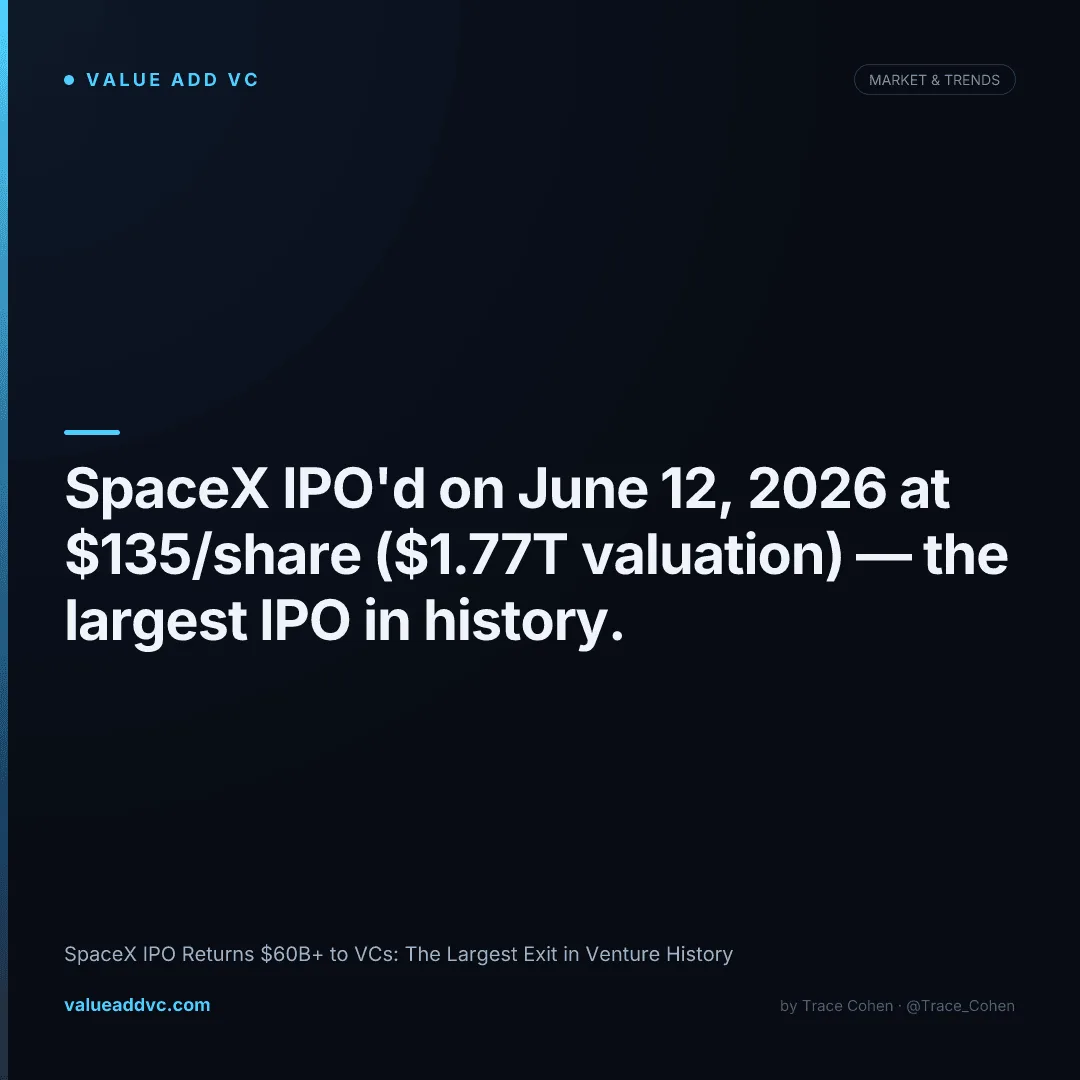
It happened. SpaceX went public on June 12, 2026 — and the numbers are staggering. $75 billion raised at $135/share, a $1.77 trillion valuation at pricing. Roughly $2.1 trillion of market cap at the close. Over $150 billion in venture value crystallized in a single day.
This isn't just the largest IPO in history. It's the largest venture-backed exit ever — by a factor of 10x. And the funds that held on are now minting returns that will define the asset class for a generation. For the full IPO breakdown, see the SpaceX IPO 2026 guide.
IPO Day: The Numbers
| IPO Date | June 12, 2026 |
| Exchange | Nasdaq — ticker SPCX |
| IPO Price | $135/share |
| Shares Offered | 555.6 million |
| Capital Raised | $75 billion |
| Opening Trade | $150 (11.1% above IPO price) |
| Day 1 High | $176.52 (+31% from IPO) |
| Day 1 Close | $160.95 (+19.2% from IPO) |
| Valuation at IPO Price | ~$1.77 trillion |
| Market Cap at Close | ~$2.1 trillion |
| Oversubscription | 400%+ |
| Retail Allocation | ~30% of shares (vs. typical 5-10%) |
| Musk Voting Control | 82%+ post-IPO |
| Lead Underwriter | Goldman Sachs (lead left); Morgan Stanley led stabilization |
The VC Returns: Who Got Paid and How Much
At the $1.77 trillion IPO valuation, the venture investors who backed SpaceX over the last 18 years are sitting on the largest realized gains the asset class has ever produced. Here's the breakdown.
~3-4% · Earliest VC backer (2008). Largest single venture return in history.
~3-4% · Early growth investor. $60B+ return.
~2%+ · Invested $800M+. At least 40x return on invested capital.
~1.5% · First backed SpaceX in 2019. ~$20B+ on a relatively late entry.
~0.5-1% · Largest single return in firm history.
~5-7% (diluted) · $1B invested at $12B valuation = ~30-40x
~42% equity · 82% voting control retained post-IPO
Total estimated VC/growth investor value at close: $150B+. Stakes from disclosed rounds and institutional filings. Track comparable exits on the Tech IPO dashboard.
The Valuation Climb: From $1B to $1.77 Trillion
| Year | Valuation | Multiple vs. seed | Key driver |
|---|---|---|---|
| 2008-09 | <$1B | 1x | First Falcon 1 to orbit; near-bankruptcy |
| 2015 | $12B | ~12x | Google + Fidelity invest $1B |
| 2019 | $33B | ~33x | Starlink launches begin |
| 2021 | $74B | ~74x | Crew Dragon, reusability scaled |
| 2023 | $137B | ~137x | Starlink hits 1M+ subscribers |
| 2024 | $210B | ~210x | Starlink profitable; booster catch achieved |
| Dec 2024 | $350B | ~350x | Insider share sale at $185/share (CNBC) |
| Dec 2025 | $800B | ~800x | Insider share sale at $421/share (Reuters via CNBC) |
| Feb 2026 | $1T | ~1,000x | xAI merger: SpaceX $1T + xAI $250B = $1.25T combined (CNBC) |
| Jun 2026 (IPO) | $1.77T | ~1,770x | IPO at $135/share; closed at $160.95 (~$2.1T market cap) |
From sub-$1B to $1.77T in 18 years. The 1,770x multiple on seed-era dollars is the largest in venture capital history.
Why This IPO Changes Everything for Venture
The DPI dam breaks
VCs have been sitting on paper gains for years. SpaceX's IPO unlocks $150B+ in distributions — the single largest liquidity event in VC history. LPs who've been demanding DPI just got it.
Deep tech is validated
SpaceX proves that hardware-heavy, capital-intensive companies can deliver venture-scale returns. Expect more LP appetite for space, defense, energy, and robotics funds.
30% retail allocation
Musk allocated 30% of shares to retail — 3-6x the typical 5-10%. This sets a precedent for founder-controlled IPOs giving retail access. Watch for OpenAI and Anthropic to follow.
The $28.5T TAM claim
SpaceX's S-1 claimed a $28.5 trillion total addressable market, mostly tied to AI enterprise applications. The market bought it — at $1.77T, SpaceX is priced as an AI infrastructure play, not just rockets.
The Fund-Returner Math
Venture is a power-law business: one or two investments drive nearly all the returns. SpaceX just produced the cleanest example anyone has ever seen.
Founders Fund's earliest SpaceX checks — roughly $20M at a sub-$1B valuation — are now worth over $60 billion. That single position returns the entire fund 300x+. Read the full Founders Fund SpaceX breakdown for the round-by-round math. The median VC fund returns 1.5-1.8x TVPI. Top-quartile funds target 3.0x+. SpaceX doesn't just clear those bars — it makes them irrelevant. See how managers stack up on the VC Performance dashboard.
The asymmetry, realized
Maximum downside on the seed check was $20M (a total loss). The realized upside is $60B+. A 3,000:1 payoff ratio. This is the entire reason the venture model tolerates a 60-70% loss rate on individual investments. SpaceX is no longer the theoretical proof — it's the actual, verified, publicly-traded proof.
Market Impact: Day One Ripple Effects
- • Satellite stocks dropped 10%+ — Planet Labs, AST SpaceMobile shed value as SpaceX's dominance was priced in
- • SpaceX closed day one at a roughly $2.1T market cap — well above Tesla (around $1.5T that day), per CNBC
- • VCs predict the IPO will lift the entire industry — LPs receiving SpaceX distributions will recycle capital into new fund commitments. See what happens to VC funds after a portfolio company IPOs
- • Starlink revenue at $22-24B projected for 2026 — the only profitable segment and the primary value driver; for the line-by-line 2025 numbers, see our breakdown of the S-1's revenue and margin disclosures
SpaceX returned $60B+ to venture — the largest exit in the history of the asset class.
The paper gains just became real.
SPCX closed at $160.95. +19% on day one. $1.77 trillion at pricing, ~$2.1 trillion at the close.
Explore Related Dashboards
Interactive tools with live data on this topic
Track the SpaceX IPO live on the SpaceX IPO Dashboard and the full Starship Story timeline. Compare VC fund performance by vintage year and explore the IPO tracker. Originally published in the Trace Cohen newsletter.
Latest from the Pulse
Get VC data most people never see
— free to subscribe
Trace's notes on venture, AI and startups, a few times a week. Join 5,000+ subscribers. No spam.
No spam, unsubscribe anytime. Sent via Substack · Privacy · or subscribe on Substack ↗