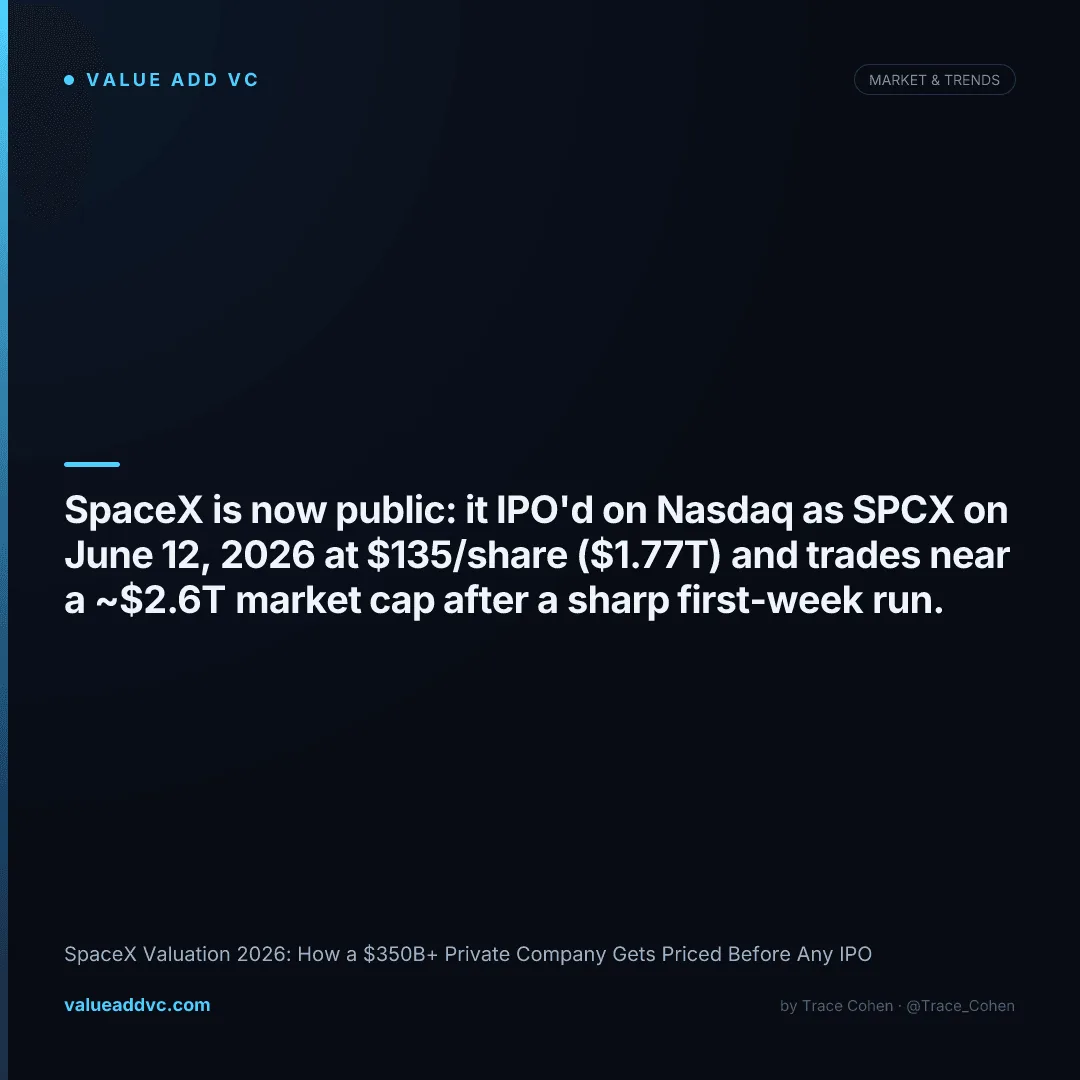
SpaceX is now public. It IPO'd on Nasdaq as SPCX on June 12, 2026 at $135/share — a $1.77T valuation and the largest IPO in history — and has since traded near a ~$2.6T market cap.
That's the short answer. The longer answer is more interesting, because for years SpaceX carried a price tag bigger than most of the S&P 500 without a stock ticker — last marked around $350B+ in late-2025 employee tender offers at roughly $212/share. The sections below trace that private valuation ladder and the Starlink revenue that justified it, then explain how the same fundamentals now anchor the public SPCX price.
SpaceX valuation 2026: the number and how it's set
The SpaceX valuation in 2026 stands at $350B+, established in late 2025 through an internal tender offer that priced shares at about $212 each. SpaceX is private, so there is no live market price. Instead its value is set two ways: primary funding rounds, where new money buys newly issued shares, and recurring secondary tender offers, where employees sell existing shares at a company-determined price roughly twice a year. Multiply that per-share price by total shares outstanding and you get the headline figure.
This is the core thing to understand: SpaceX's valuation is a negotiated number, not a discovered one. There is no order book of millions of traders pushing the price up and down by the second. There is a small set of late-stage investors and a periodic tender that establishes a clearing price. That makes the number more stable than a public stock — and slower to react to bad news.
How a $350B private company gets priced: the valuation ladder
SpaceX's valuation has roughly tripled in four years. Here is the round-by-round climb that produced the $350B+ figure, with the approximate per-share price and what drove each step.
| Date | Valuation | ~Share price | Driver |
|---|---|---|---|
| Feb 2021 | $74B | ~$420 (pre-split) | Crew Dragon, Starlink beta |
| Oct 2021 | $100B | ~$560 (pre-split) | Starlink subscriber growth |
| Dec 2022 | $137B | ~$77 | Falcon launch cadence ramps |
| Jun 2023 | $150B | ~$81 | Starlink approaching profitability |
| Dec 2023 | $180B | ~$97 | Record launch year |
| Jun 2024 | $210B | ~$112 | Starlink cash-flow positive |
| Dec 2024 | $350B | ~$185 | Tender; Starship progress |
| Late 2025 | $350B+ | ~$212 | Starlink ~$11.8B revenue |
Figures are approximate and based on reported tender and primary-round prices; SpaceX does not publish official financials. A 10-for-1 stock split in 2022 explains the per-share reset.
Why SpaceX gets priced this high before any IPO: Starlink
The single biggest reason SpaceX is worth $350B+ is Starlink. Rockets are a project business — lumpy, capital-intensive, and hard to assign a high multiple to. Starlink is a subscription business, and subscription revenue is what public markets pay 8–15x for. Starlink reached an estimated $11.8B in revenue in 2025, up from roughly $8.2B in 2024 — a 44% jump — with more than 6 million subscribers across 100+ countries.
The launch business funds the moat, but Starlink is the asset markets are actually valuing. If you strip Starlink out, SpaceX looks like an extraordinary launch monopoly worth maybe $80–120B. Add a fast-growing global broadband network with recurring revenue, and you get the $350B+ figure. This is why Starlink — not Starship, not Mars — is the line item that moves the valuation.
SpaceX vs other giant private companies
SpaceX has now graduated to the public markets, but its old peer group — the largest private tech companies — is still a useful frame. Here's how SpaceX's last private mark and its current public cap stack up against the other heavyweights as of mid-2026.
| Company | Valuation | Pricing method | Core business |
|---|---|---|---|
| SpaceX | ~$2.6T (public, SPCX) | Public market | Launch + Starlink broadband |
| Anthropic | ~$965B | Primary; S-1 filed | AI models / Claude |
| OpenAI | ~$852B | Primary; S-1 filed | AI models / ChatGPT |
| ByteDance | ~$300B | Buybacks | TikTok / Douyin |
| Stripe | ~$91B | Tender | Payments infrastructure |
| Databricks | ~$62B | Primary rounds | Data + AI platform |
The pattern: the largest private companies have all found a way to give shareholders liquidity without an IPO. Tender offers and buybacks have effectively replaced the public market as the exit valve for the biggest names. You can track the broader cohort on the unicorns dashboard and watch the IPO pipeline on the tech IPO tracker.
What a $350B valuation actually implies
At $350B+ with combined launch and Starlink revenue in the ballpark of $14–15B for 2025, SpaceX trades at roughly 23–25x revenue. That's a steep multiple for a hardware-heavy company — and it only makes sense if you believe Starlink keeps compounding and Starship unlocks an order-of-magnitude drop in launch cost. The bull and bear cases hinge on exactly that.
The bull case
- ✓ Starlink revenue compounding 40%+ annually
- ✓ Starship cuts cost-per-kg by ~10x if reusable
- ✓ Direct-to-cell expands the subscriber base
- ✓ Effective monopoly on heavy-lift launch
The bear case
- ✕ ~23–25x revenue is priced for perfection
- ✕ Starship is unproven at operational cadence
- ✕ Amazon Kuiper and others target broadband
- ✕ Heavy key-person and regulatory exposure
SpaceX went public after years of staying private
For most of its life SpaceX had no reason to IPO. The reason was the tender offer: most startups eventually go public because employees and early investors need liquidity, but SpaceX solved that internally — roughly twice a year it let people sell shares at the company-set price, near $212 in late 2025. That removed the single biggest force pushing companies onto the market. It finally listed on Nasdaq as SPCX on June 12, 2026 at $135/share — the largest IPO in history — giving public investors a direct way in for the first time. Starlink remains a possible separate spin-off listing; track the latest on the SpaceX IPO tracker.
SpaceX spent years as the world's most valuable private company — then ran the largest IPO in history.
From a $350B+ tender-offer mark to a ~$2.6T public market cap as SPCX — still built on Starlink's recurring revenue.
Explore Related Dashboards
Interactive tools with live data on this topic
Track private-company valuations and the IPO pipeline on the Tech IPO Tracker and Unicorns Dashboard at Value Add VC. Originally published in the Trace Cohen newsletter.
Get VC data most people never see — free.
Weekly benchmarks, valuations, and fund data. No spam, unsubscribe anytime.