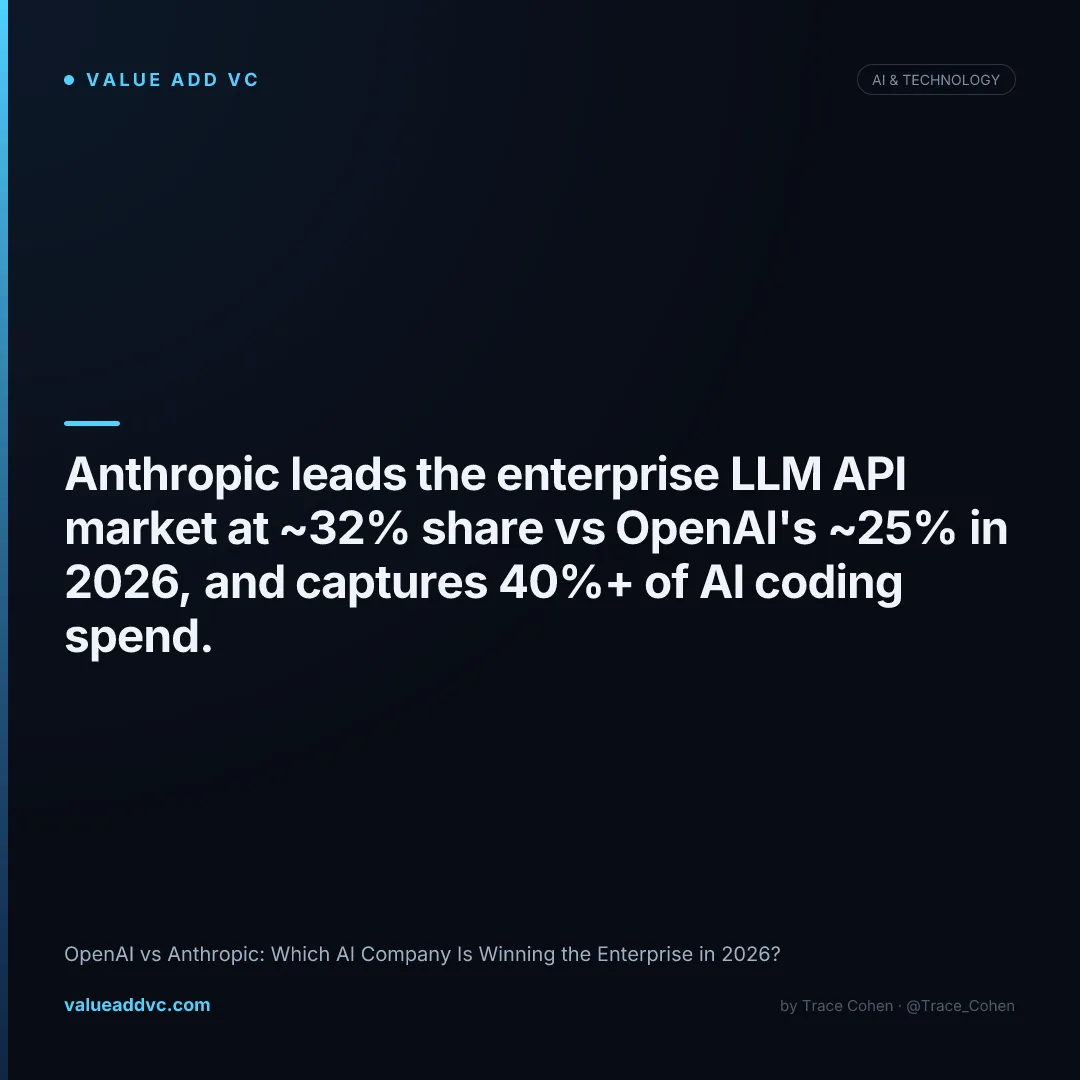
Anthropic now holds roughly 32% of the enterprise LLM API market versus OpenAI's ~25% in 2026 — but OpenAI still leads total revenue at ~$13B ARR against Anthropic's ~$5B. That's the short answer. The longer answer is more interesting.
"Winning" depends entirely on which scoreboard you read. If you measure the enterprise developer layer — the companies wiring models into products, agents, and internal tools — Anthropic has pulled ahead. If you measure raw revenue, users, and brand reach, OpenAI is still the giant. Both can be true at once, and in 2026 they are.
OpenAI vs Anthropic Enterprise 2026: Who Is Actually Winning?
In 2026 Anthropic leads the enterprise LLM API market with about 32% share to OpenAI's 25%, having reversed a gap that OpenAI dominated as recently as 2023. OpenAI still wins on total revenue (~$13B ARR vs ~$5B) and consumer reach (~800M weekly ChatGPT users vs ~30M for Claude). So Anthropic is winning enterprise developers while OpenAI is winning overall scale.
| Metric | OpenAI | Anthropic | Edge |
|---|---|---|---|
| Total Revenue (ARR) | ~$13B | ~$5B | OpenAI |
| Enterprise API Market Share | ~25% | ~32% | Anthropic |
| Weekly Active Users | ~800M (ChatGPT) | ~30M (Claude) | OpenAI |
| AI Coding API Share | ~25% | ~40%+ | Anthropic |
| SWE-bench Verified (flagship) | High 60s | Low-to-mid 70s | Anthropic |
| Valuation | ~$300B+ | ~$183B | OpenAI |
| Cloud Distribution | Azure (exclusive) | AWS + Google Cloud | Anthropic |
| Flagship Input Price (per 1M tokens) | $10–15 | ~$15 (Opus) | Comparable |
| Mid-tier Input Price (per 1M tokens) | $2–3 | ~$3 (Sonnet) | Comparable |
| Enterprise Customers Using 2+ Vendors | — | — | ~60% multi-vendor |
Figures are 2026 estimates blended from public reporting, Menlo Ventures enterprise surveys, and provider pricing pages. Private-company numbers are directional, not audited.
How Anthropic Took Enterprise API Market Share From OpenAI
The shift in enterprise market share is the single most important storyline in AI infrastructure. In 2023, OpenAI controlled more than 50% of enterprise LLM API spend and Anthropic sat around 12%. By 2026 those numbers crossed: Anthropic ~32%, OpenAI ~25%, with the rest split across Google's Gemini, Meta's Llama-based deployments, and a long tail of open models.
Three forces drove the crossover. First, coding: Anthropic's Claude models became the default for software engineering, and engineering is where the heaviest, stickiest API usage lives. Second, reliability and safety positioning that shortened enterprise procurement cycles. Third, a multi-cloud distribution strategy — Claude is available through both AWS Bedrock and Google Cloud — that avoided locking buyers into a single vendor relationship.
~12%
Anthropic enterprise share 2023
~32%
Anthropic enterprise share 2026
50%+
OpenAI enterprise share 2023
~25%
OpenAI enterprise share 2026
~40%+
Anthropic AI coding API share
~60%
Enterprises using 2+ model vendors
Where OpenAI Still Wins the Enterprise in 2026
Don't mistake API share for total dominance. OpenAI's ~$13B ARR is more than double Anthropic's ~$5B, and the gap is structural: ChatGPT's ~800M weekly active users feed a consumer and prosumer subscription business Anthropic simply doesn't have. On the enterprise side, OpenAI's deep integration with Microsoft — Azure OpenAI Service, Copilot across Office, and Microsoft's own ~$13B+ investment — puts GPT models inside thousands of companies by default.
OpenAI also leads on breadth of product surface: a mature Assistants and Responses API, the widest set of multimodal capabilities, voice, image generation, and a developer ecosystem that's years deep. For an enterprise that wants one vendor across consumer-grade chat, internal copilots, and API access, OpenAI remains the path of least resistance. That convenience is worth real market share.
OpenAI's Enterprise Strengths
- ✓ ~$13B ARR and ~800M weekly users
- ✓ Native Microsoft Azure + Copilot distribution
- ✓ Broadest multimodal + voice product surface
- ✓ Deepest developer ecosystem and tooling
Anthropic's Enterprise Strengths
- ✓ ~32% enterprise API share, 40%+ of coding spend
- ✓ Leading SWE-bench coding performance
- ✓ Multi-cloud (AWS + Google Cloud) distribution
- ✓ Safety brand that eases compliance review
Claude vs GPT Pricing and Performance for Enterprise Buyers
On pricing, the two are closer than the marketing suggests. Anthropic's flagship Claude Opus lists around $15 per million input tokens and $75 per million output, while its workhorse Sonnet runs ~$3 input and ~$15 output. OpenAI's flagship sits in a comparable $10-15 input band, with mid-tier models around $2-3 input and $10-15 output. For most production workloads, enterprises run the mid-tier models on both sides — which is where ~80% of token volume actually lands. Track the full spending breakdown on the AI Spending dashboard.
On performance, the split is workload-specific. Anthropic edges OpenAI on coding (SWE-bench Verified in the low-to-mid 70s vs high 60s) and on long-horizon agentic tasks. OpenAI tends to lead on multimodal reasoning, voice, and the broadest general-knowledge benchmarks. The honest takeaway for buyers: pick by workload, not by brand. Coding-heavy and agent-heavy shops lean Claude; multimodal and consumer-facing products lean GPT.
This is also why ~60% of enterprises now run two or more model vendors. Single-sourcing a foundation model is increasingly seen as a procurement risk — both for pricing leverage and for resilience if one provider has an outage or a capability regression. You can track how these valuations and funding rounds are moving on the AI Valuations dashboard and broader category context on the AI Landscape.
What This Means for Founders and Investors
For founders building on top of these models, the practical lesson is to architect for portability. Abstract your model layer so you can route between Claude and GPT by task and by price — the teams doing this are cutting inference costs 20-40% while improving reliability. For investors, the enterprise API share shift is the signal that matters more than headline ARR: the developer layer is where switching costs and durable revenue compound, and Anthropic is winning it.
The valuation gap — OpenAI at ~$300B+ versus Anthropic at ~$183B — reflects OpenAI's scale premium and consumer optionality. See the full private AI revenue rankings and enterprise adoption data. But if you believe enterprise API revenue is the higher-quality, stickier business, Anthropic's position looks underpriced relative to OpenAI on a per-dollar-of-enterprise-revenue basis. That's the bet a lot of late-stage capital is quietly making.
So who's winning the enterprise in 2026?
Anthropic wins the enterprise API and coding layer. OpenAI wins total revenue, users, and brand. The honest call: Anthropic is winning enterprise, OpenAI is winning everything else.
Track AI company valuations and funding on the AI Valuations dashboard at Value Add VC. Originally published in the Trace Cohen newsletter.
Get VC data most people never see — free.
Weekly benchmarks, valuations, and fund data. No spam, unsubscribe anytime.