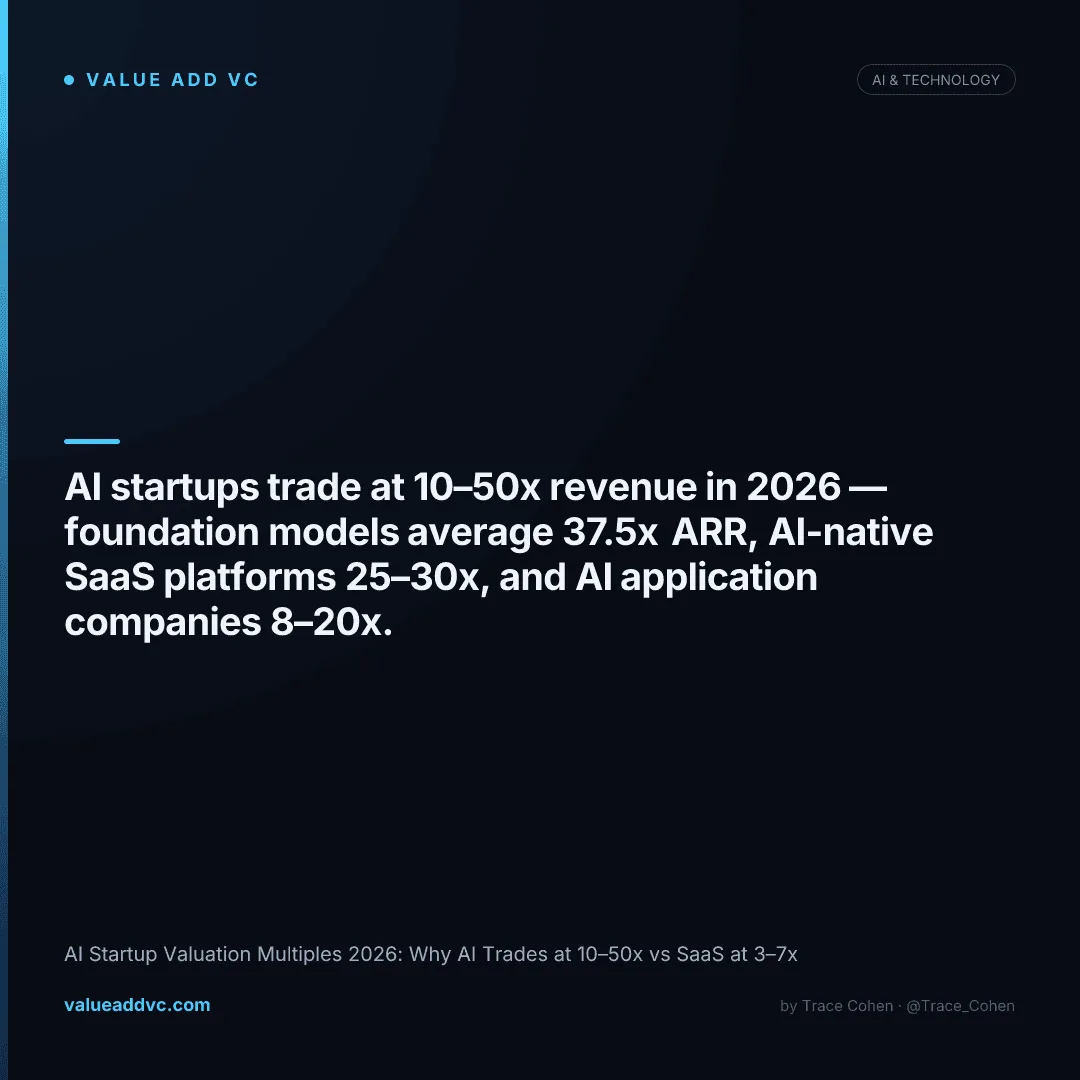
Private AI companies trade at a median of 27.1x annualized revenue across nine companies tracked by Value Add VC as of October 16, 2026, more than six times the 4.3x median EV/NTM revenue multiple for public SaaS that Clouded Judgement reported on October 9, 2026.
The spread inside AI is wider than the gap to SaaS. Anthropic and OpenAI, together worth $1.82 trillion at their last priced rounds, trade at roughly 15x to 17x revenue. Application companies such as Sierra and Decagon trade at 45x to 75x. Every multiple below is Value Add VC's arithmetic on a reported valuation and a reported revenue run rate, each linked to the outlet or company that published it.
AI startup valuation multiples in 2026: the tracked table
AI startup valuation multiples in 2026 run from about 10x to 75x annualized revenue across nine private companies with both figures on the record. The median is 27.1x, set by Databricks ($190 billion on a $7 billion run rate). Rows marked "talks" or "reported" use a valuation the company has not confirmed, and the multiple inherits that status.
| Company | Valuation | Annualized revenue | Multiple | Status / dates |
|---|---|---|---|---|
| Mercor | $20B (talks) | $2B+ gross | ~10.0x | Talks reported Jul 2026; gross revenue, Jun 2026 |
| Anthropic | $965B | $65B+ | 14.8x | Series H, May 2026; run rate end of Jul 2026 |
| OpenAI | $852B | ~$50B | 17.0x | Round closed Mar 2026; run rate late Sep 2026 |
| Lovable | $13.3B | $500M | 26.6x | Series C, Aug 2026; run rate Jun 2026 |
| Databricks | $190B | $7B | 27.1x | $5B round and run rate, both Aug 2026 |
| ElevenLabs | $22B (reported) | $600M ARR | 36.7x | Both Sep 2026 |
| Perplexity | $30B+ (talks) | $750M+ | ~40x | Both reported Aug 2026 |
| Decagon | $4.5B | $100M+ | ~45x | Series D, Jan 2026; revenue Aug 2026 |
| Sierra | $15B+ | $200M ARR | ~75x | $950M round, May 2026; ARR late May 2026 |
How we counted: latest reported post-money, tender or talks valuation divided by the latest reported annualized revenue (run rate or ARR); private AI companies with both figures published by a named outlet or the company; 9 companies; as of October 16, 2026. Multiples are Value Add VC arithmetic, rounded to one decimal; "~" marks a valuation or revenue reported as a floor ("more than") or an unconfirmed talks price. Decagon's revenue is from Newcomer (August 2026); Sierra's $200 million ARR is from TechCrunch's July 2026 roundup.
What revenue multiple are Anthropic and OpenAI valued at?
Anthropic raised $65 billion in its Series H at a $965 billion post-money valuation on May 28, 2026, and said in the Series H announcement that its run-rate revenue had crossed $47 billion earlier that month. That priced the company at about 20.5x revenue on the day of the round. By the end of July, Anthropic's run rate had passed $65 billion, Bloomberg reported (via TechCrunch), which cuts the same valuation to about 14.8x. TechCrunch also cited a Financial Times report that investors expect Anthropic to finish 2026 between $100 billion and $120 billion.
OpenAI's valuation stands at $852 billion after a $122 billion round that closed in March 2026. Its annualized revenue was about $50 billion as of late September, according to the Financial Times and CNBC, as reported by Quartz on Yahoo Finance (October 8, 2026). The widely cited $68 billion to $70 billion figure included gross revenue from partner companies. On the corrected $50 billion, OpenAI trades at about 17.0x, slightly above Anthropic. The full valuation history is in our OpenAI valuation breakdown and Anthropic valuation explainer.
Anthropic vs OpenAI: valuation and run rate
Anthropic Series H announcement; TechCrunch (Aug 17, 2026); Quartz via Yahoo Finance (Oct 8, 2026)
Anthropic reports a higher run rate on a higher valuation, so its multiple is the lower of the two.
How do AI multiples compare with public SaaS multiples?
Public cloud software traded at a 4.3x median enterprise value to next-twelve-months revenue as of October 9, 2026, per Clouded Judgement's weekly index. Its growth buckets show how much growth explains: high-growth SaaS (above 22% projected growth) at 19.3x, mid-growth (15% to 22%) at 7.0x and low-growth at 3.4x. The top five public SaaS names had a 37.3x median.
| Group | Median multiple | Basis | As of |
|---|---|---|---|
| Public SaaS, top 5 | 37.3x | EV / NTM revenue | Oct 9, 2026 |
| Private AI, tracked (9) | 27.1x | Valuation / annualized revenue | Oct 16, 2026 |
| Public SaaS, high growth (>22%) | 19.3x | EV / NTM revenue | Oct 9, 2026 |
| Private AI, Anthropic + OpenAI combined | 15.8x | $1,817B / $115B | Oct 16, 2026 |
| Public SaaS, mid growth (15–22%) | 7.0x | EV / NTM revenue | Oct 9, 2026 |
| Public SaaS, all | 4.3x | EV / NTM revenue | Oct 9, 2026 |
| Public SaaS, low growth | 3.4x | EV / NTM revenue | Oct 9, 2026 |
How we counted: public SaaS medians from Clouded Judgement's October 9, 2026 index (EV / NTM revenue); private AI rows from the table above; 7 groups; as of October 16, 2026. The combined Anthropic + OpenAI row is Value Add VC arithmetic ($965B + $852B over $65B + $50B).
The fairer comparison for most AI startups is the high-growth SaaS bucket, not the overall median. Tracked AI companies are growing far faster than any public SaaS bucket: Databricks said it is growing 80% a year, Lovable reached a $500 million run rate eight months after its December round, and Mercor doubled its gross run rate to $2 billion in four months, per the sources in the table. On that view, a 27.1x private median against 19.3x for the fastest public SaaS looks less like a different universe and more like a growth premium. For the public side in detail, see current SaaS revenue multiples and the SaaS valuations tracker.
Why do AI application startups get higher multiples than the labs?
The table splits cleanly into two groups. The two labs and Mercor sit between 10x and 17x; every application or tooling company sits at 26.6x or higher. Three factors explain most of it, and each is Value Add VC's reading of the data rather than a reported fact.
- Base size. Anthropic's $65 billion run rate is 325 times Sierra's $200 million. Investors pay more per dollar of revenue when that revenue can still multiply many times over.
- Compute cost. The labs carry the training and inference bill directly; application companies buy model access as a cost of goods. One read on this: lab revenue is valued closer to infrastructure revenue.
- Revenue definition. Mercor's $2 billion is gross revenue, and much of it passes through to the experts it pays, so a gross-revenue multiple understates what investors pay for net revenue. Perplexity's and ElevenLabs' figures are company-stated run rates, not audited revenue.
AI customer service is the clearest outlier. Sierra and Decagon, which compete for the same enterprise support budgets, carry the two highest multiples in the table. Newcomer reported in August 2026 that Sierra had "well-surpassed $200 million" in annualized revenue, so its true multiple may be below 75x. More on each: how Sierra makes money and Decagon's valuation.
How fast are AI multiples compressing as revenue grows?
Anthropic is the clearest case. Its multiple fell from about 20.5x at the May 2026 round to about 14.8x by the end of July with no change in valuation, because revenue rose from $47 billion to $65 billion in roughly two months. Any company growing that fast "grows into" its last round within a quarter, which is one reason AI companies raise again so often.
The same math runs in reverse for talks prices. Perplexity's last verifiable valuation, $20 billion in September 2025 per The Information (cited by Reuters), is only about 26.7x its current $750 million-plus run rate; the reported $30 billion-plus talks price lifts that to about 40x. Mercor's last priced round, $10 billion in October 2025, is about 5x its current gross run rate, half the 10x that a $20 billion round would imply. For how these companies rank on revenue alone, see private AI companies by revenue; on valuation alone, the highest-valued private AI companies.
What the headline misses
Nine companies is a small, skewed sample: it includes only AI companies that publish a run rate, and companies disclose revenue when it is growing fast. Run rate is a projection from a recent short period, not trailing revenue, and private valuations are post-money prices that often carry liquidation preferences, so they overstate what common equity is worth. The public SaaS figure is enterprise value on analysts' forward revenue; the private figures are equity value on current run rate. Mixing them is useful for scale, not for precision. A down quarter in AI spending would compress the right-hand side of this table first, and none of these multiples has yet been tested by a public listing.
Figures re-verified against each linked source on October 16, 2026. Company pages: Databricks, Lovable, Perplexity, Mercor; ElevenLabs is covered in how ElevenLabs makes money. Track the wider market on the AI valuations dashboard and the AI spending tracker. Published by Value Add VC · Editor-in-chief: Trace Cohen.
Latest from the Pulse
Get VC data most people never see
— free to subscribe
Trace's notes on venture, AI and startups, a few times a week. Join 5,000+ subscribers. No spam.
No spam, unsubscribe anytime. Sent via Substack · Privacy · or subscribe on Substack ↗