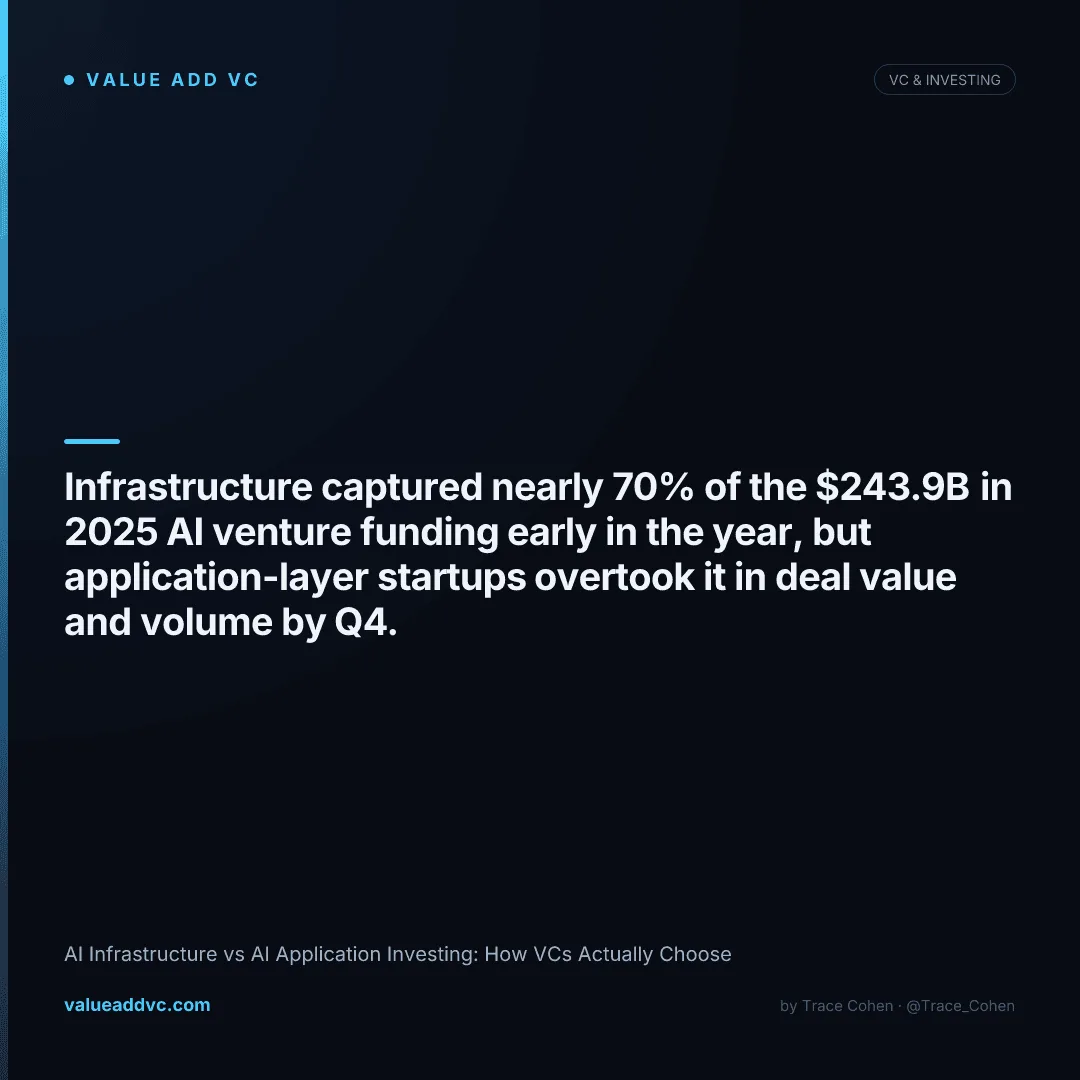
VCs poured a record $243.9B into AI in 2025, and the single biggest decision behind those checks was infrastructure vs application — nearly 70% of AI deal value went to infrastructure and foundation models in Q1, but by Q4 application-layer startups had overtaken them in both deal value and deal volume.
The two sides of the AI stack have almost opposite economics, and the funds winning right now are the ones that figured out which layer fits their fund size, ownership targets, and time horizon. I've made 65+ investments across both, and the framing below is how I actually think about it.
AI Infrastructure vs AI Application Investing: What VCs Are Actually Deciding
AI infrastructure investing backs the compute, chips, data centers, and foundation models everything runs on — CoreWeave, Nvidia, OpenAI, Anthropic. AI application investing backs the software built on top — coding agents, legal copilots, vertical workflows. Infrastructure is capital-intensive with 20–35% gross margins and hard capital moats; applications are capital-light with 70–85% margins and faster recurring revenue but weaker defensibility.
| Attribute | AI Infrastructure | AI Application |
|---|---|---|
| 2025 VC dollars | ~$50B in Q1 alone (~70% of AI deal value) | Overtook infra in value & volume by Q4 |
| Typical gross margin | 20–35% (compute resale) | 70–85% (software) |
| Capital intensity | Very high — GPUs, power, data centers | Low — headcount + compute spend |
| Primary moat | Scale, capital, supply deals, switching cost | Workflow, proprietary data, distribution |
| Valuation basis | EV/EBITDA, EV/revenue ~5–15x | EV/ARR ~20–50x+ on hypergrowth |
| Key risk | GPU depreciation, overbuild, rate moves | Model commoditization, churn, platform risk |
| Bellwether | CoreWeave (CRWV): ~$55B cap, $6.2B rev | Anysphere/Cursor: ~$50B, $2B ARR |
| Check size to lead | $50M–$1B+ (large/crossover funds) | $5M–$50M (seed to growth) |
| Exit profile | IPO-ready, asset-heavy, lumpy | Premium M&A + IPO multiples |
Figures are 2025–26 estimates blended from PitchBook AI & ML VC Trends (Q1–Q4 2025), CoreWeave public filings, and reported financing rounds for Anysphere. Margin and multiple ranges reflect public comparables and last private marks; ARR figures are company-reported.
Where the $243.9B Went in 2025
The headline number — $243.9B in AI venture deal value — hides a sharp rotation that played out over four quarters. In Q1 2025, horizontal AI platforms (foundation models and core infrastructure) captured roughly $50B across 426 deals, nearly 70% of all AI & ML deal value. The megarounds did the heavy lifting: OpenAI, Anthropic, and xAI absorbed tens of billions between them, and US venture funding as a whole hit a record ~$267B for the year on the back of those deals.
By mid-year, horizontal platforms tripled quarter-over-quarter to more than $33.5B in a single quarter, while vertical applications quietly led on deal volume with 663 transactions. Then the curve crossed: in Q4 2025, vertical applications overtook horizontal platforms in both deal value and volume. That is the clearest signal we have that capital is rotating up the stack as the underlying models commoditize.
You can watch this concentration in real time on our AI Valuations dashboard and trace the matching capex on the AI Spending tracker. The pattern matters because it tells you where the next markups — and the next down-rounds — are most likely to land.
The Case for AI Infrastructure Bets
Infrastructure is the "picks and shovels" trade, and the appeal is that demand is contracted and visible. CoreWeave (CRWV) is the cleanest public proxy: it IPO'd in March 2025 and now carries a market cap around $55B on roughly $6.23B in trailing revenue, with multi-year capacity contracts from the largest AI labs. Hyperscalers backed the thesis with their wallets — Microsoft, Google, Meta, and Amazon together committed over $300B in 2025 capex, and Nvidia's data-center business sits at the center of it. We break that down in Nvidia's share of AI capex.
The moat is capital itself. Securing power, land, GPUs, and supply contracts is something a $5M seed startup simply cannot replicate, which is why infrastructure consolidates around a handful of well-funded players. For a large or crossover fund that can write $100M+ checks, that's a feature: you underwrite a near-utility with real assets and a credible IPO path. That logic has started reaching upstream into raw materials, too — Khosla's bet on an autonomous copper mine built to feed AI data center demand is the same picks-and-shovels thesis pushed one layer further down the supply chain.
But the risks are just as concrete. GPUs depreciate over a roughly 3–5 year useful life, so a wave of overbuild can strand capital fast. CoreWeave's own stock swung from a 52-week high of $173.35 to a low of $63.80 while carrying $1.59B in trailing losses — that volatility is the tax you pay for an asset-heavy, rate-sensitive model.
The Case for AI Application Bets
The application layer is where software economics return. Anysphere, maker of the Cursor coding agent, is the defining example: ARR went from $100M in January 2025 to $500M by June, crossed $1B by late 2025, and passed $2B by February 2026 — roughly zero to $2B ARR in three years, the fastest B2B software ramp on record. Its valuation re-rated just as fast, from a $29.3B post-money in November 2025 to a reported ~$50B round in April 2026 co-led by a16z and Thrive Capital — making it one of the fastest-climbing AI unicorns on record. (See our full Cursor valuation breakdown.)
What makes applications attractive to smaller and mid-size funds is the math: 70–85% gross margins, recurring revenue, and capital efficiency. You can lead a seed or Series A with a $5M–$50M check and still own a meaningful stake, instead of being diluted to nothing in a $1B infrastructure mega-round. The app layer is also where the next wave of agent companies is forming — I covered the landscape in AI agent startups.
The catch is defensibility. When the underlying model is a commodity API, the moat has to come from proprietary data, workflow lock-in, and distribution — not the model. Churn and platform risk are real: a foundation lab can ship a feature that eats a thin wrapper overnight. The application winners are the ones embedded so deeply in a workflow that ripping them out costs more than keeping them.
How VCs Actually Choose Between Infrastructure and Application Investing
The choice between AI infrastructure and application investing is mostly a function of fund size, not conviction. A $2B+ growth or crossover fund needs to deploy in $100M+ increments, which pushes it toward infrastructure and late-stage foundation models where rounds are large enough to absorb the capital. A $50M–$300M seed fund can't lead those rounds without blowing its concentration limits, so it lives in the application layer where a $5M check still buys ownership.
Ownership and reserves drive it too. Infrastructure rounds dilute early backers brutally as capital needs compound, so funds underwrite them more like project finance than venture. Application bets follow a classic power-law model — you accept that most fail, and you reserve heavily for the few like Cursor that compound 20x ARR in a year. Returns also bifurcate by strategy, which you can compare on our VC Performance dashboard.
AI Infrastructure vs Application: The Margin and Moat Tradeoff
Strip it down and you're trading margin for durability. Infrastructure gives you a defensible, capital-protected position at 20–35% gross margins and modest multiples. Applications give you 70–85% margins and 20–50x ARR multiples, but the moat is behavioral, not physical. Most experienced funds don't pick one — they barbell: a few large infrastructure anchors for durability, and a wider spread of application bets for the asymmetric upside.
The Bottom Line
For most funds in 2026, the application layer is the better risk-adjusted bet — but infrastructure is the safer one.
The Q4 2025 rotation was the market telling you that foundation models have matured and the value is migrating up the stack. If you can write nine-figure checks and underwrite capital intensity, infrastructure offers durability and a clean IPO path. Everyone else should be in the application layer, where 70–85% margins and Cursor-style 20x ARR ramps create the asymmetry venture is built for. The single best portfolio owns a little of both — but if I had to put new dollars to work today, I'm leaning into applications with proprietary data and deep workflow lock-in.
Track AI valuations, capex, and fund performance on the AI Valuations, AI Spending, and VC Performance dashboards at Value Add VC. Originally published in the Trace Cohen newsletter.
Latest from the Pulse
Get VC data most people never see
— 100% free
Weekly benchmarks, valuations, and fund data. Join 5,000+ investors. No spam.