AI agent startups raised over $3B in 2024. The category that barely existed as a coherent market in 2022 is now one of the most actively funded segments in venture.
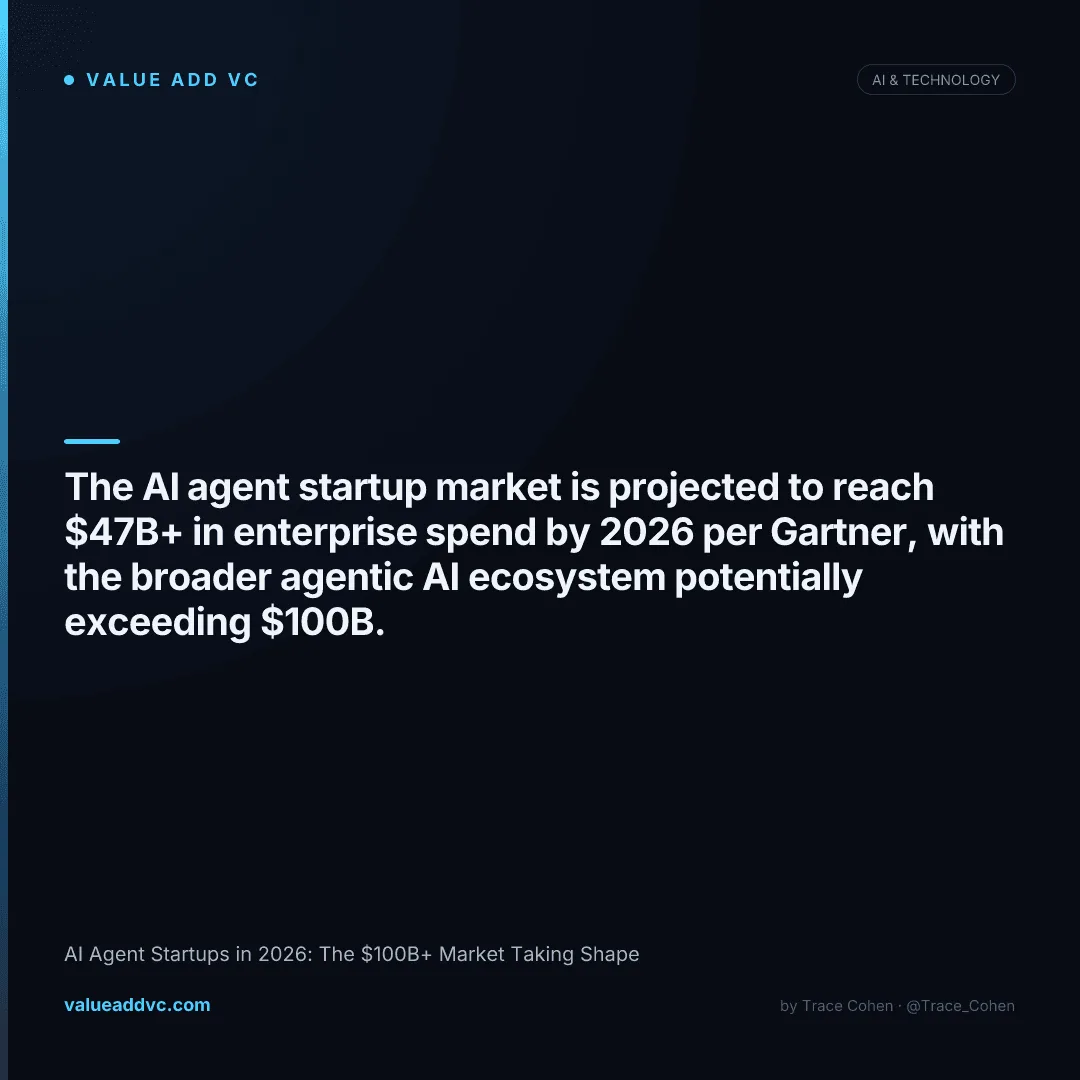
Gartner puts the AI agent software market at $47B by 2026. That number will prove conservative. When you fold in the enterprise workflows these systems are replacing — RPA, BPO, knowledge work outsourcing — the actual economic displacement is closer to $100B+. This is not a niche. It is the core of enterprise software's next decade.
The AI Agent Startup Landscape in 2026
The category has stratified quickly. There are infrastructure plays, vertical-specific agents, and horizontal platforms. Only the vertical-specific ones are commanding premium valuations.
| Company | Category | Last Round | Valuation |
|---|---|---|---|
| Glean | Enterprise Knowledge | $260M | $4.6B |
| Sierra AI | Customer-Facing Agents | $175M | $4.5B |
| Cognition (Devin) | Coding Agents | $175M | $2B |
| Writer | Enterprise Workflow | $200M | $1.9B |
| Harvey | Legal Agents | $100M | $1.5B |
| Hebbia | Research/Knowledge | $130M | $700M |
| Decagon | Customer Support | $65M | $650M |
| Lindy AI | Personal AI Agents | $10M | N/D |
Source: PitchBook, Crunchbase, public announcements. Valuations as of most recent disclosed round.
Add HappyRobot to that vertical-agent list — its $150M Series C at a $1.2B valuation in August 2026 is the clearest sign yet that voice-first, operations-focused agents are commanding the same premium as text-based ones. Decagon's $650M mark above is also stale: it closed a $250M Series D at a $4.5B valuation in January 2026, nearly 7x higher just two years later.
Why 2026 Is the Breakout Year for AI Agent Startups
Three things converged to make agentic AI viable at enterprise scale in 2025–2026:
The Real AI Agent Startups 2026 Investment Thesis
The mistake most people make when evaluating this market is conflating "AI agents" with "AI tools." A copilot assists a human. An agent replaces the task. That distinction drives everything about valuation.
High-Value Agent Characteristics
- ✓ Vertical-specific training data (legal, medical, finance)
- ✓ Workflow ownership, not just task completion
- ✓ Usage-based or outcome-based pricing
- ✓ NDR above 120% from natural task expansion
- ✓ Integration with enterprise systems of record
Low-Value Agent Plays
- ✕ Generic agents with no domain depth
- ✕ Wrappers on OpenAI with seat-based pricing
- ✕ No proprietary data or feedback loop
- ✕ Dependent on one foundation model provider
- ✕ Point solutions without workflow depth
Harvey is a perfect case study. It is not "AI for lawyers." It is an agent trained on decades of legal work product that can draft, review, and negotiate contracts autonomously. Its closest competitor is a junior associate billing $200/hour. Harvey charges a fraction of that and never sleeps. That is why it raised at $1.5B before reaching $10M ARR.
Who Is Funding AI Agent Startups in 2026
The investor base for agentic AI has concentrated. Sequoia led or co-led rounds in Sierra, Harvey, and Glean. a16z backed Cognition and Writer. NVIDIA Ventures has taken positions in agent infrastructure plays. Khosla Ventures backs both Cognition and Factory, two direct rivals in the coding-agent category — a cross-bet that became public news in October 2026. Beyond the headline names, rising AI valuations like Profound's $1.8B Series D show how investor appetite for deep-tech AI has broadened beyond the consumer-facing agent companies. Coatue, Tiger, and Lightspeed are active across the board.
Source: public disclosures, Crunchbase, PitchBook as of May 2026
What Comes Next for the AI Agent Market
The next 18 months will separate infrastructure from application. Foundation model providers — OpenAI, Anthropic, Google — are all building agent layers into their platforms. That compresses the moat for horizontal agent builders but actually accelerates vertical specialists who can layer proprietary data and workflow depth on top of better underlying models.
The companies that survive and scale will look like Harvey, Sierra, and Glean: deep vertical ownership, outcome-based pricing, and NDR above 130%. The companies that fail will look like generic "AI workflow builders" that commoditized the moment OpenAI shipped Agents SDK or Anthropic released Claude tool use.
Track current AI company valuations and agentic AI funding rounds on the AI Landscape Dashboard. For the full breakdown of how AI multiples compare to SaaS, see why AI trades at 10–50x vs SaaS at 3–7x.
The $100B+ AI agent market will not be won by the best model.
It will be won by the companies that own the workflow, the data, and the outcome — not just the inference layer.
Track AI startup valuations and funding rounds at the AI Valuations Dashboard on Value Add VC. Originally published in the Trace Cohen newsletter.
Latest from the Pulse
Get VC data most people never see
— free to subscribe
Trace's notes on venture, AI and startups, a few times a week. Join 5,000+ subscribers. No spam.
No spam, unsubscribe anytime. Sent via Substack · Privacy · or subscribe on Substack ↗