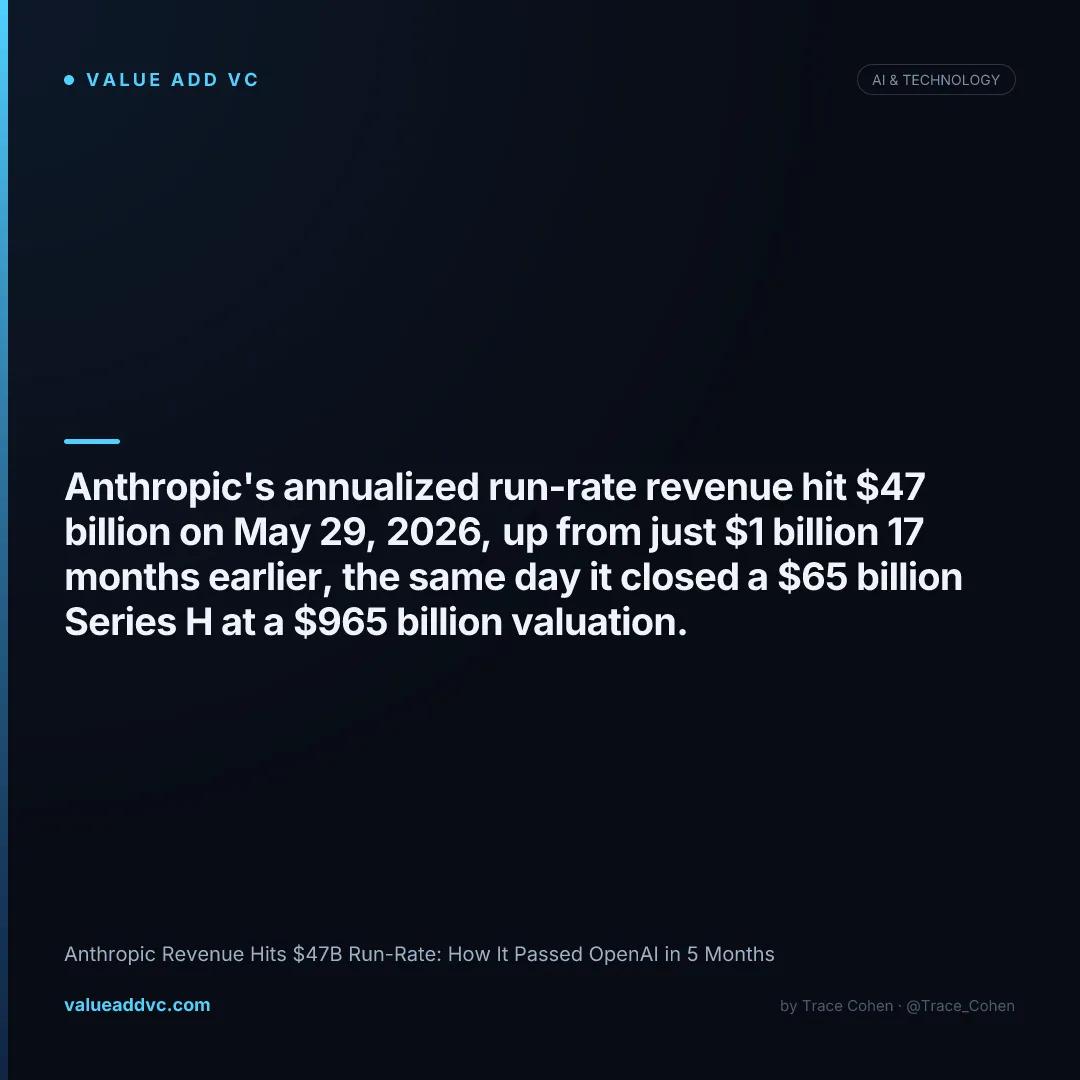
Anthropic's annualized run-rate revenue hit $65 billion at the end of July 2026 — up from $1 billion just 19 months earlier. Along the way, that ramp overtook OpenAI's run rate, and the company just posted its first quarter of positive operating income while lining up an October IPO.
Revenue run rates get thrown around loosely in AI coverage, so it's worth being precise about what actually happened here. Anthropic didn't gradually out-execute OpenAI over years — it went from $14 billion in annualized revenue in February 2026 to $65 billion by the end of July, more than quadrupling in about five months. That $65 billion figure comes from Bloomberg's August 17, 2026 reporting, corroborated the same week by TechCrunch. Having tracked both companies' funding rounds closely from the venture side, this is one of the fastest revenue ramps documented at this scale — and it's now happening alongside real quarterly earnings, not just a headline run-rate number.
Figures from Bloomberg (Aug 17, 2026), TechCrunch (Aug 17, 2026), CNBC's Q2 earnings report (Aug 15, 2026), and Bloomberg's OpenAI run-rate report (Aug 13, 2026).
What Is Anthropic's Revenue Run Rate in 2026?
Anthropic's annualized run-rate revenue reached $65 billion at the end of July 2026, as of this writing the most recent figure the company and its backers have confirmed to reporters. That figure was $9 billion at the end of 2025, $14 billion in February 2026, $30 billion in April, $47 billion on May 29 when its Series H closed, and $65 billion by late July — a growth curve steep enough that each monthly snapshot has been stale within weeks of publication.
Anthropic vs OpenAI: Revenue Run Rate, Side by Side
| Metric | Anthropic | OpenAI |
|---|---|---|
| Run rate, Jan 2025 | ~$1B | ~$13B (est.) |
| Run rate, end 2025 | $9B | $20B |
| Run rate, Feb 2026 | $14B | $25B |
| Run rate, Apr 2026 | $30B | ~$27B |
| Run rate, May 29 2026 | $47B | ~$27B |
| Run rate, end Jul 2026 | $65B | $40B |
| Q2 2026 actual revenue | $11.5B+ | not disclosed |
| Latest private valuation | $965B (Series H) | $852B (post $122B raise) |
| Revenue mix | ~80-85% enterprise/API | ~85% consumer (ChatGPT) |
Figures blended from Anthropic's Series H announcement (May 2026), Bloomberg's August 17, 2026 run-rate report, Bloomberg's August 13, 2026 OpenAI report, and CNBC's August 15, 2026 Q2 earnings report. OpenAI's Jan 2025 figure is a directional estimate; the company does not publish a monthly run-rate series.
How Did Anthropic's Run Rate Grow From $1B to $65B So Fast?
The growth wasn't linear — it compounded hardest in 2026 itself. Anthropic spent all of 2025 climbing from roughly $1 billion to $9 billion, a 9x increase over twelve months that was already unusual. Then across just seven months of 2026, the run rate went from $9 billion to $65 billion, more than a 7x jump, driven primarily by enterprise Claude adoption and API consumption rather than a comparable jump in user count.
Why Does Anthropic's Revenue Mix Look So Different From OpenAI's?
Roughly 80-85% of Anthropic's revenue comes from enterprise and developer customers buying Claude API access directly or through platforms like Amazon Bedrock, versus an estimated 85% of OpenAI's revenue tied to ChatGPT consumer subscriptions, where roughly 95% of users pay nothing at all. That structural gap explains why Anthropic can post a larger run rate than OpenAI despite having a fraction of ChatGPT's user base — a business-to-business dollar converts to revenue far more reliably than a consumer freemium funnel does. You can track how the broader AI valuation gap has moved on the AI Valuations Dashboard.
Anthropic's First Profitable Quarter, and the Road to an October IPO
The run-rate headline isn't the only new number worth tracking. Anthropic's actual Q2 2026 revenue came in above $11.5 billion, according to CNBC's August 15, 2026 report — more than 14 times the roughly $787 million Anthropic booked in Q2 2025, and more than double Q1 2026's $4.73 billion. That same quarter, Anthropic posted positive adjusted operating income for the first time, with Claude Code alone reportedly contributing close to $8 billion of the quarterly total. The figures are preliminary, per Bloomberg, and could shift once audited numbers appear in a public filing.
That earnings momentum is now feeding directly into IPO pricing talk. Anthropic filed a confidential S-1 with the SEC on June 1, 2026, and as of early September, backers were telling reporters they expect a public listing as soon as October 2026 at a valuation of $2 trillion or more — roughly double the $965 billion Series H mark from May — with Morgan Stanley, Goldman Sachs, and JPMorgan reportedly running the offering. A $2 trillion valuation on a $65 billion trailing run rate implies a forward multiple near 31x; against investors' own $100-120 billion full-year 2026 revenue projection, that compresses to roughly 18x. For the fuller valuation-side story, see our dedicated breakdown of Anthropic's $2 trillion IPO target.
Anthropic's $965B Series H vs OpenAI's $852B Valuation
Anthropic's $65 billion Series H, led by Altimeter Capital, Dragoneer, Greenoaks, and Sequoia Capital, closed on May 29, 2026 at a $965 billion post-money valuation — narrowly ahead of OpenAI's roughly $852 billion mark from its earlier $122 billion raise. Both are private-round valuations, not trading prices. OpenAI filed a confidential S-1 on June 8, 2026 with Goldman Sachs and Morgan Stanley reportedly leading the process, and both companies are now racing toward a fall 2026 listing.
Anthropic vs OpenAI: Valuation and Run Rate
Anthropic Series H announcement, May 2026; OpenAI $122B raise reporting; Bloomberg, August 2026.
Anthropic's valuation-to-run-rate ratio (~14.8x on its $965B Series H mark) is now tighter than OpenAI's (~21.3x), a gap that partly explains why some investors have started framing Anthropic as the more capital-efficient bet of the two.
Anthropic Revenue Run Rate by Milestone, 2025-2026
Is OpenAI Still Bigger Than Anthropic on a Trailing Basis?
Yes, on cumulative booked revenue, though the run-rate gap keeps growing in Anthropic's favor. OpenAI's full-year 2025 revenue came in around $12.7-13 billion versus Anthropic's roughly $9 billion for the same period, so on a trailing, already-booked basis OpenAI was still the larger company through year-end 2025. What changed in 2026 is the forward-looking run-rate metric — the number investors use to price the next round — where Anthropic's steeper trajectory pulled it ahead by April and pushed the gap to roughly $25 billion by the end of July. OpenAI's own run rate has since climbed too, topping $40 billion in July per Bloomberg, roughly doubling from the end of 2025 — but Anthropic more than quadrupled over the same window. The full OpenAI side of that story, including its own IPO prep, is in our OpenAI revenue deep dive.
None of this settles which company "wins" long term — profitability, burn rate, and model quality all matter as much as top-line run rate. But for LPs and operators trying to underwrite AI lab valuations in real time, the run-rate crossover plus Anthropic's first profitable quarter are the clearest data points available, and both moved faster than almost anyone modeling this space expected twelve months ago.
How Does a $65B Run Rate Compare to Other Fast-Scaling Companies?
Context helps here, because claims like "grew faster than any software company in history" get made constantly. Snowflake took roughly six years to cross $1 billion in annualized revenue and about nine to approach $3 billion. Databricks needed close to a decade to reach a comparable run rate to what Anthropic just posted in under two years. Even OpenAI's own climb — widely regarded as one of the fastest SaaS-style ramps in software history before 2025 — took roughly three years to go from its first meaningful ChatGPT revenue to $13 billion annualized. Anthropic covered a larger dollar distance, from $1 billion to $65 billion, in 19 months. The closest historical comparisons are chip and cloud infrastructure buildouts rather than software companies, which is itself a signal that AI-lab revenue behaves more like a capital-intensive infrastructure business than a traditional SaaS one.
What's Actually Driving Enterprise Demand for Claude?
Three things show up repeatedly in enterprise procurement conversations: coding-assistant deployments (Claude Code alone was reportedly close to an $8 billion revenue line in Q2 2026 on its own), customer-support automation at large call-center operators, and internal knowledge-retrieval systems built on the Claude API rather than a general chatbot interface. Anthropic has also leaned harder than OpenAI into distribution partnerships — Claude is natively available inside Amazon Bedrock and Google Cloud's Vertex AI, which lets enterprise buyers procure Claude access through cloud contracts they already have rather than signing a net-new vendor agreement. That distribution advantage is easy to undercount in headline revenue comparisons but shows up directly in how fast net-new enterprise accounts convert to paid usage — the same procurement dynamic we walk through in our head-to-head comparison of Claude, GPT-5, and Gemini for enterprise buyers.
What Are the Risks to Anthropic's Run-Rate Narrative?
A few things are worth flagging before treating $65 billion as a permanent state rather than a snapshot. First, run rate is inherently a forward projection built off the most recent month of usage — it is not the same as trailing twelve-month booked revenue, and Anthropic's own full-year 2025 revenue of roughly $9 billion was a fraction of the current run rate. Second, Anthropic reports revenue on a gross basis through cloud partners like AWS and Google Cloud, which OpenAI's own leadership has argued inflates the headline figure relative to OpenAI's net-basis reporting with Microsoft — see our full breakdown of the gross-vs-net accounting dispute for what that means for the comparability of these numbers. Third, both the Q2 2026 earnings figures and the run rate itself are described by Bloomberg as preliminary and subject to revision once audited numbers appear in Anthropic's IPO prospectus. None of that erases the $65 billion number, but it's the reason serious LPs model a range of scenarios rather than extrapolating the last seven months in a straight line to 2027.
What Does This Mean for AI Startup Valuations Broadly?
The Anthropic-OpenAI crossover matters beyond the two companies themselves because both are used as the reference comps for pricing every other frontier and near-frontier AI lab, from xAI's roughly $230 billion valuation to smaller model developers raising Series B and C rounds. When the market leader's valuation-to-run-rate multiple compresses from OpenAI's roughly 21.3x down to Anthropic's roughly 14.8x, that recalibrates the multiple investors are willing to underwrite across the whole category — which is exactly the kind of shift worth tracking on the AI Valuations Dashboard rather than assuming last year's multiples still hold.
Anthropic went from $1B to $65B in annualized run-rate revenue in 19 months and just posted its first profitable quarter.
The enterprise-first bet is now outgrowing the consumer-first one — and heading for an October IPO.
How Does Anthropic's Run Rate Compare to Google's and Meta's AI Businesses?
It's worth putting $65 billion next to the AI-specific revenue disclosed by the hyperscalers, even though the comparisons aren't apples-to-apples. Google's Cloud segment, which bundles Gemini API revenue with broader cloud infrastructure, crossed roughly $50 billion in annualized revenue in 2026, while Microsoft's Azure AI services revenue has been reported in a similar range once bundled with the broader Azure business. Meta doesn't break out standalone AI product revenue at all, folding it into advertising performance gains instead. What makes Anthropic's number distinct is that it's a much closer to pure-play figure — almost entirely model API and Claude subscription revenue, with no cloud infrastructure, advertising, or hardware revenue mixed in. That's part of why investors have started using Anthropic's multiple as the cleaner reference point for how the market is actually pricing frontier model capability on its own, separate from the infrastructure businesses wrapped around it.
The Bottom Line
Anthropic's $65 billion run rate, as of July 2026, is a real, reporter-confirmed number tied to actual Q2 revenue above $11.5 billion and the company's first quarter of positive operating income — not just a projection or a leak. It crossed OpenAI's run rate months earlier at $30 billion and has kept widening the gap since. The mechanism is straightforward: an 80-85% enterprise and API revenue mix converts more reliably than a consumer subscription base where the overwhelming majority of users pay nothing. Whether that trajectory holds through the October IPO and into 2027, especially once OpenAI's own enterprise mix approaches parity with consumer revenue as it has signaled, is the next number worth watching closely.
More Anthropic Coverage
- Anthropic's Business Model — how the "safety company" actually makes money (80% API/enterprise).
- Is Anthropic Profitable? — burn rate, cumulative losses, and the breakeven math.
- Anthropic's $2 Trillion IPO Target — the full valuation-side breakdown of the October listing.
Track frontier AI valuations and funding rounds on the AI Valuations Dashboard at Value Add VC. Reach out at t@nyvp.com or @Trace_Cohen.
Latest from the Pulse
Get VC data most people never see
— 100% free
Weekly benchmarks, valuations, and fund data. Join 5,000+ investors. No spam.