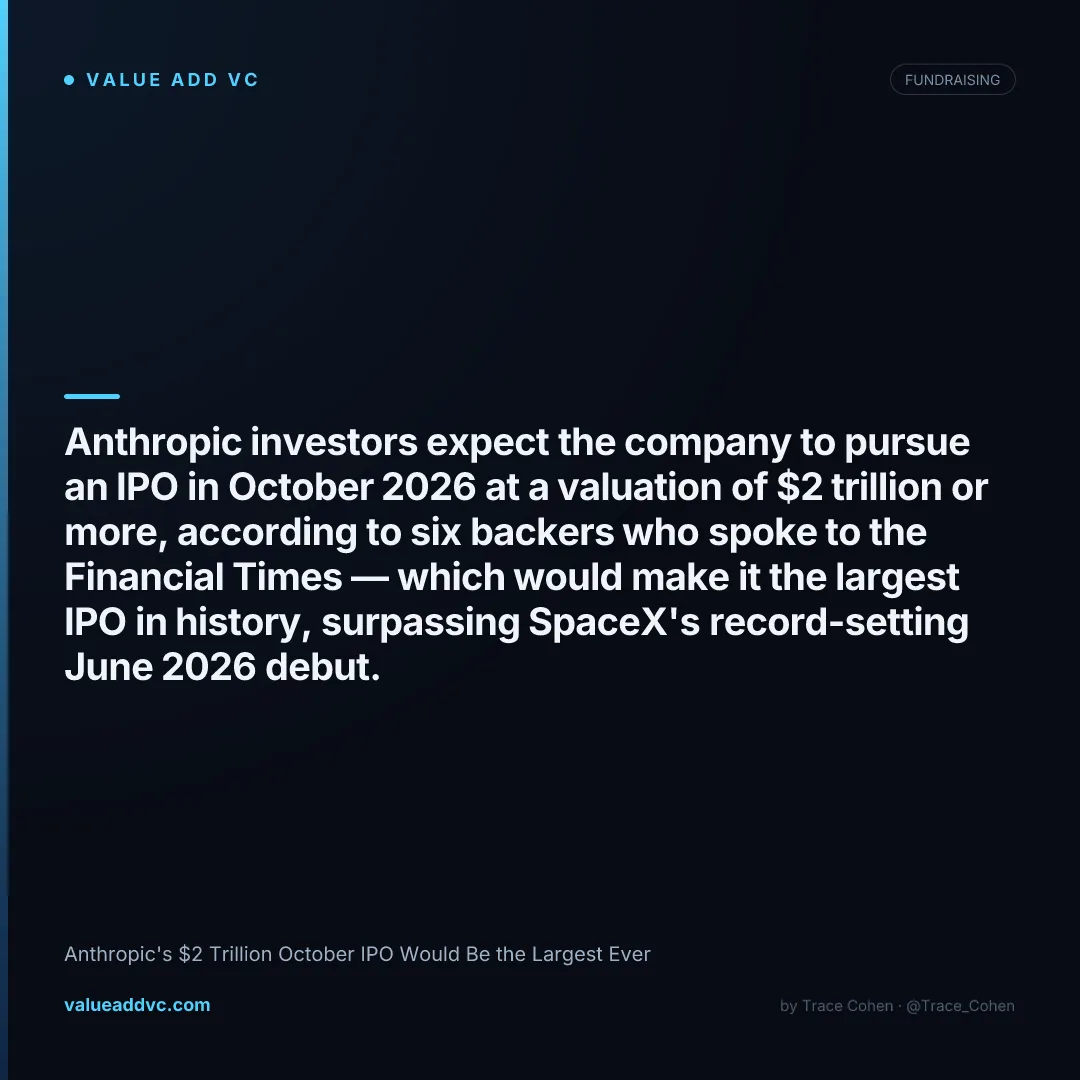
Anthropic investors are now telling reporters to expect a $2 trillion-plus IPO in October — double what the company was reportedly targeting earlier this year, and a number that would make it the largest public offering ever.
The report, from six Anthropic backers who spoke to the Financial Times this week, is the clearest signal yet that the Claude maker's public debut is close, big, and getting bigger by the month. It's also a reminder of how unusually the AI lab IPO cycle is playing out: valuation expectations are being set by the investor rumor mill weeks before a roadshow even starts, and they keep doubling — a pattern worth tracking against the broader tech IPO pipeline as more AI labs approach public markets.
What's actually being reported
Anthropic confidentially filed IPO paperwork on June 1, 2026. Since then, the expected pricing has moved fast: reporting earlier in the year pointed to a roughly $1 trillion target, in line with the trajectory from its $965 billion Series H that closed in July. This week's Financial Times report, citing six unnamed investors, pushes that number to $2 trillion or more for an offering targeted for October — which would put Anthropic public before rival OpenAI, whose own IPO timeline remains less defined.
Morgan Stanley, Goldman Sachs, and JPMorgan are reportedly running the book. Importantly, the $2 trillion figure is investor speculation, not a company-issued target — senior Anthropic executives reportedly haven't settled on a valuation range even in private conversations, which means the number could still move meaningfully in either direction before pricing.
Figures from Financial Times reporting (via Bloomberg, Fortune, TechCrunch, Forbes) on Anthropic's IPO plans, August 13-14, 2026.
The valuation trajectory: from $183B to $2T in a year
What makes this number so striking isn't just its size — it's the speed of the climb. Anthropic was worth $183 billion in September 2025. By February 2026 that had roughly doubled to $380 billion. Its Series H in July pushed it to $965 billion, more than 5x higher than where it stood eight months earlier. A $2 trillion IPO print in October would mean Anthropic's valuation increased roughly 11x in thirteen months.
Would it really be the largest IPO ever?
The current record holder is fresh: SpaceX, which priced its June 2026 IPO at $135 a share, raised $75 billion, and closed its first trading day near a $2.1 trillion market cap before settling back to roughly $1.5 trillion by late July. A $2 trillion Anthropic listing would sit right at or above that opening print — meaning the record for largest tech IPO could change hands twice in the same year.
That comparison also doubles as a caution. SpaceX's valuation came down about 30% from its first-day peak within six weeks of trading once the market had time to digest the number against actual financials. If Anthropic follows a similar pattern, the headline $2 trillion print and the valuation that actually holds a quarter later could be two different numbers.
The revenue math has to work
Anthropic reported a $47 billion annualized revenue run rate in May 2026. Investors cited in the FT report expect that figure to reach $100-120 billion by year-end — more than double in roughly seven months. At the low end of that range, a $2 trillion valuation implies a forward revenue multiple of about 20x, which is rich even against the AI lab comp set, where valuations have consistently priced years of expected growth rather than trailing performance.
The growth story isn't uninterrupted. Revenue growth slowed in June after the U.S. Commerce Department imposed a temporary export restriction on Anthropic's top models — the kind of regulatory risk that doesn't show up in a clean revenue chart but matters enormously to how public-market investors price a company they can no longer analyze through a private round's confidentiality. Investors told the FT that business rebounded after the restriction lifted, but the episode is a preview of the kind of headline risk Anthropic will trade on every quarter once its numbers are public.
Pricing power and competition are the real swing factors
Anthropic's flagship model reportedly carries a list price more than 2.5x higher than OpenAI's flagship offering, and it competes against a fast-improving field of lower-cost Chinese open-weight models that keep compressing what enterprises are willing to pay for frontier-model access. That combination — premium pricing, capable low-cost alternatives, and a customer base of technically sophisticated developers who switch providers easily — is exactly the setup that makes revenue durability, not revenue size, the question public investors will actually underwrite.
It's also why Anthropic beating OpenAI to market matters strategically beyond bragging rights. Whichever lab prices first sets the comp the other has to be measured against, and a clean $2 trillion print — even if it compresses afterward, the way SpaceX's did — becomes the reference point every subsequent AI lab IPO gets valued off of for the next several years.
The public S-1 is close, and it flags AI backlash as a risk
The timeline moved up since this post first published. CNBC reported on August 21, 2026 that Anthropic's forthcoming public S-1 will list AI backlash — public and regulatory pushback against the technology itself — as an explicit risk factor, alongside separate reporting that the public filing could land as soon as the end of August 2026, which would put a Nasdaq listing on track for September or October rather than a later date. Goldman Sachs, JPMorgan, and Morgan Stanley are reportedly leading the offering, which is expected to raise more than $60 billion — on top of, not instead of, the $65 billion already raised privately in the Series H.
One read on this: naming AI backlash as a formal risk factor is standard IPO lawyering — S-1s are written to disclose every plausible threat to the business, not just the likely ones — but it's also a tell that Anthropic's bankers expect public-market investors to ask about it directly, in a way private Series H backers didn't need to. The company got one piece of that backlash resolved after this post first published: a federal judge struck down the Pentagon's supply chain risk designation against Anthropic as unlawful on August 27, 2026, removing one governance overhang just as bankers finalize the risk-factor language.
Secondary marketplace pricing has moved in the meantime too: shares were trading at implied valuations of roughly $1.05-1.15 trillion in the weeks after the Series H closed — above the $965 billion round price, but still a third below the $2 trillion figure investors floated for the actual IPO print. That gap is the market's way of saying it believes the IPO could reprice sharply higher, but isn't willing to pay full freight for that outcome before the roadshow actually happens.
How to get exposure before the October listing
For investors who don't want to wait for the roadshow, Anthropic shares already change hands pre-IPO — with the usual caveats that secondaries are illiquid, carry transfer restrictions, and often price at a premium to the last institutional round. The main avenues:
Forge Global
The largest secondary marketplace for pre-IPO shares. Anthropic trades regularly on Forge with typical minimums of $50,000-$100,000; Forge handles transfer-agent coordination and compliance.
Hiive
A newer marketplace with competitive pricing and lower minimums (sometimes $25,000+). Hiive has seen significant Anthropic volume in 2026 as early employees and seed investors take partial liquidity ahead of the listing.
EquityZen
Pools smaller accredited investors into SPVs holding Anthropic shares, with minimums typically starting at $25,000-$50,000 and quarterly NAV updates.
DXYZ (Destiny Tech100)
A publicly traded closed-end fund on NYSE holding Anthropic alongside other pre-IPO names — no accreditation required, buyable through any brokerage. It routinely trades at a large premium or discount to NAV, so you're paying for wrapper convenience, not clean exposure.
Important Disclaimer
Pre-IPO investing carries significant risk including total loss of capital, and secondary pricing near a hyped listing can exceed what the stock trades at once public. This is not investment advice — consult a financial advisor before investing.
Bottom line: A $2 trillion IPO target is investor chatter, not a locked number — Anthropic's own leadership reportedly hasn't settled on one. But the fact that six backers are independently telling reporters to expect double the earlier target, just months after a $965 billion private round, tells you where the pressure in this market is pointing. If it holds, October 2026 would produce the largest IPO in history for the second time in five months, and it would do it on a revenue multiple that assumes Anthropic's growth rate, pricing power, and regulatory footing all hold steady in a market where none of the three are guaranteed.
Latest from the Pulse
Get VC data most people never see
— 100% free
Weekly benchmarks, valuations, and fund data. Join 5,000+ investors. No spam.