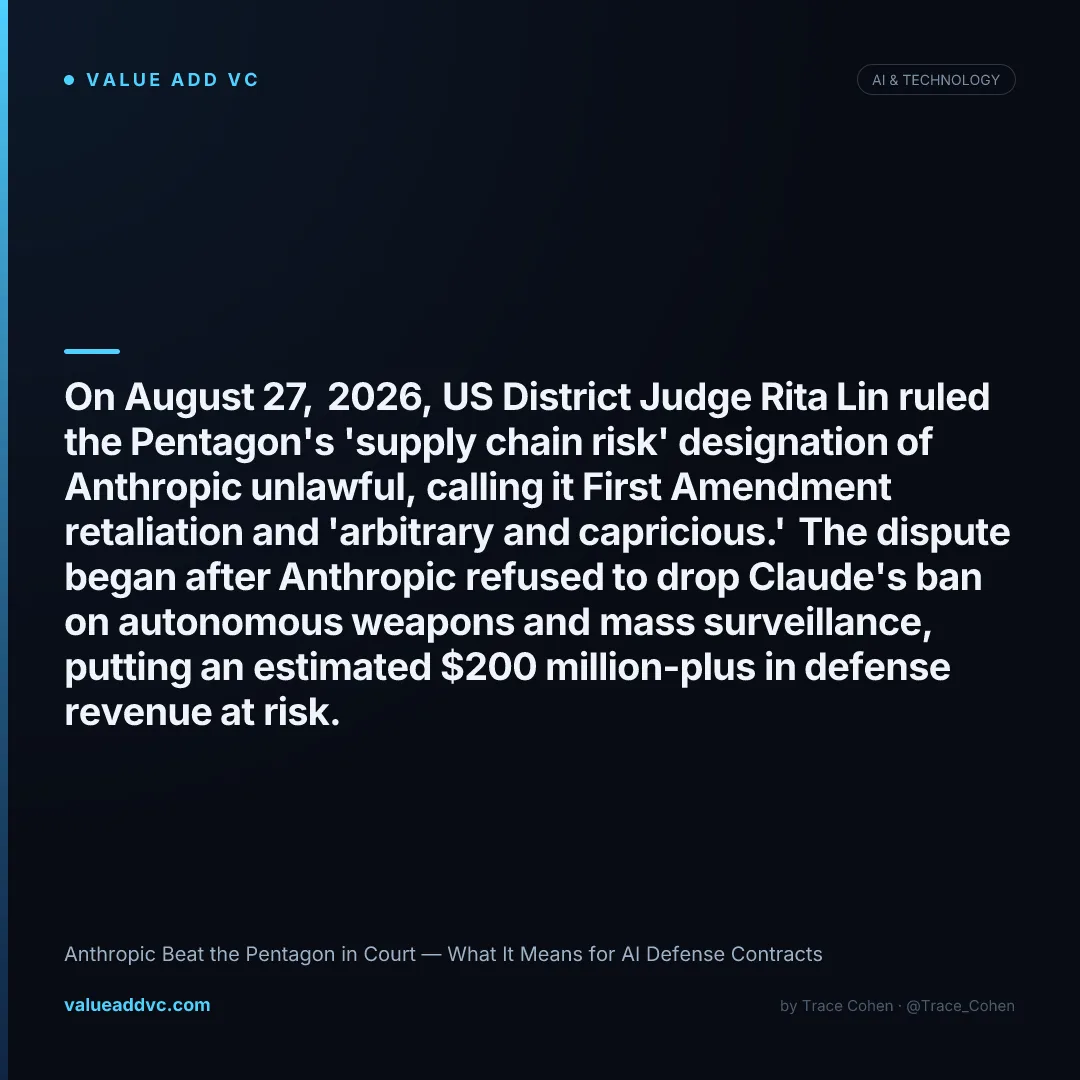
A federal judge ruled on August 27, 2026 that the Pentagon's "supply chain risk" blacklist of Anthropic was unlawful retaliation. That's the short answer. The longer answer is a six-month fight over whether an AI lab gets to say no to the US military.
US District Judge Rita Lin found that the Department of Defense's designation violated Anthropic's First Amendment rights, denied it Fifth Amendment due process, and was "arbitrary and capricious" as a matter of administrative law. The ruling is a genuine win for the $965 billion AI company heading toward a possible IPO within weeks — but it doesn't end the underlying standoff over whether frontier AI vendors can refuse to let the Pentagon build fully autonomous weapons on top of their models.
Figures from Anthropic public revenue disclosures, court filings reported by CNN, TechCrunch, and CNBC, and Pentagon contract awards reported by NBC News and Nextgov, as of August 28, 2026.
The Anthropic Pentagon ruling: what actually happened
The Anthropic Pentagon ruling on August 27, 2026 struck down the Defense Department's designation of Anthropic as a national-security supply chain risk, with Judge Rita Lin finding the label was retaliatory, procedurally unlawful, and arbitrary. The order came after six months of escalating conflict that started when Anthropic refused to loosen Claude's ban on autonomous weapons.
The dispute traces to July 2025, when the Pentagon's Chief Digital and AI Office awarded up to $200 million each to Anthropic, OpenAI, Google, and xAI to accelerate AI adoption across the department, part of a broader $800 million agentic AI contract split among the four labs. Anthropic's acceptable-use policy, like the others', barred use of its models in fully autonomous weapons systems that select and engage targets without a human in the loop, and in mass domestic surveillance. According to reporting from TechTimes, internal emails show the two sides were at one point "very close" to a deal before talks broke down.
How the Pentagon standoff escalated to a blacklist
Defense Secretary Pete Hegseth wanted the Pentagon to use Claude "for all lawful purposes" with no carve-outs, and gave Anthropic a deadline of 5:01 p.m. on February 27, 2026 to drop the restrictions. Anthropic CEO Dario Amodei declined, stating publicly that frontier models are "simply not reliable enough to power fully autonomous weapons" — a reliability argument, not just a values one. The same day, President Trump directed federal agencies to "immediately cease all use" of Anthropic's technology, and the DoD moved to designate the company a supply chain risk, a label reported by DDR Innova as the first time a major American AI company had received it.
Timeline compiled from CNN, TechCrunch, CNBC, Nextgov/FCW, and Mayer Brown legal alerts, August 2026.
What Anthropic's revenue actually had at stake
The direct government contracts were never the real number. Anthropic's $200 million DoD award and an $18,960 State Department award are trivial next to a company whose run-rate revenue passed $47 billion in May 2026. What actually worried Anthropic was indirect: enterprise and defense-contractor customers whose own federal business depends on Pentagon relationships, who would have had to drop Claude to stay compliant. Company executives told reporters the blacklist put hundreds of millions of dollars in 2026 revenue at risk, with 50% to 100% of business from some defense-adjacent accounts on the line.
Defense-adjacent share is a rough order-of-magnitude estimate against the ~$47B run-rate; Anthropic has not disclosed an exact federal revenue breakdown.
Why Anthropic was the only lab blacklisted
OpenAI, Google, and xAI hold Pentagon AI contracts of similar size without facing the same designation, largely because none of them drew the same public red line on autonomous weapons that Anthropic did. xAI signed a $200 million deal to bring Grok into national-security and classified workflows; Google Public Sector won up to $200 million for secure AI cloud infrastructure including TPU access; OpenAI took a parallel $200 million award for generative models. A May 2026 expansion brought Microsoft, AWS, Nvidia, SpaceX, Reflection AI, and Oracle into classified Pentagon AI work alongside them. Anthropic's policy stance, not its technology, is what triggered the fight — a distinction worth tracking on the defense tech dashboard, where labs with looser usage policies are winning a disproportionate share of new government AI spend.
What the ruling misses
Winning the August 27 case does not resolve the fight. A second Anthropic lawsuit over a related supply chain risk designation is still pending in a Washington, DC court, the Pentagon retains the right to appeal Judge Lin's ruling, and Anthropic's underlying usage policy — no fully autonomous lethal weapons, no mass domestic surveillance — hasn't moved an inch. If the DC case or an appeal goes the other way, the practical effect of this week's win could be temporary. The ruling restores Anthropic's legal standing; it doesn't settle the actual disagreement about what the Pentagon is allowed to build with a frontier model.
What the Anthropic Pentagon fight means for the AI defense contracting market
For the wider AI defense contracting market, the ruling is a reminder that usage-policy fights are now a real business risk alongside compute costs and model quality. Every major lab bidding for federal work has to decide how far its safety commitments bend under contract pressure, and this case sets an early precedent that a company can hold a values line and still win in court against a designation built to punish it. Defense-tech investors watching Anduril and the broader dual-use startup wave should read this less as an AI story and more as a governance story: the rules for who gets to build lethal autonomy with commercial AI are being written in real time, in court, company by company.
For Anthropic specifically, the timing matters. The company is reportedly targeting an IPO prospectus as soon as September 2026 at a valuation approaching $2 trillion, and a federal court calling a Pentagon blacklist "arbitrary and capricious" two weeks before a filing is a far better headline than the blacklist itself. It removes one visible governance overhang for prospective public investors, even if it doesn't remove the policy dispute underneath it. Track how this and other pre-IPO AI names are being priced on the AI Valuations dashboard.
Track defense tech and AI company valuations on the Defense Tech Dashboard and AI Valuations Dashboard at Value Add VC. Originally published in the Trace Cohen newsletter.
Latest from the Pulse
Get VC data most people never see
— free to subscribe
Trace's notes on venture, AI and startups, a few times a week. Join 5,000+ subscribers. No spam.