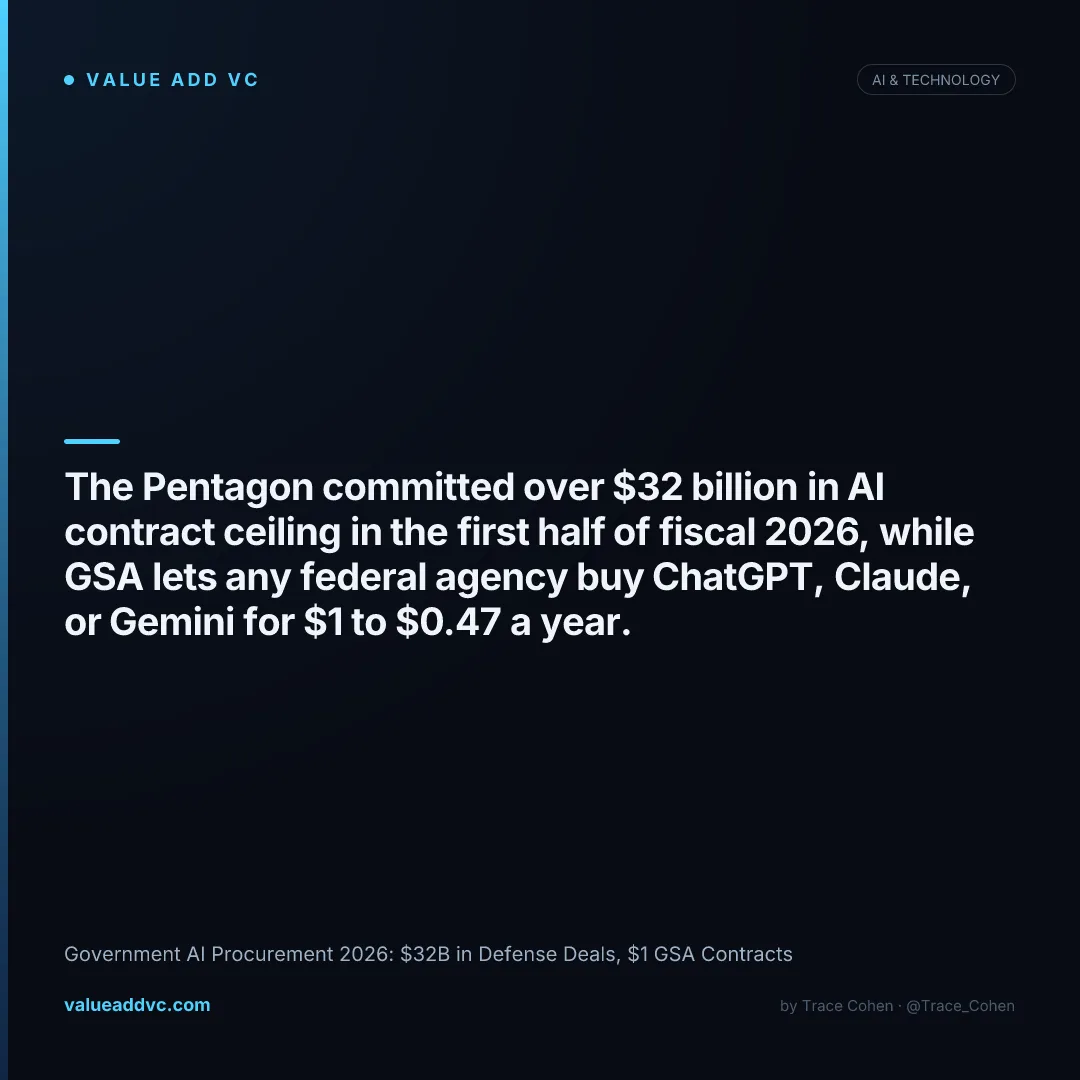
The Pentagon alone committed more than $32 billion in AI-related contract ceiling in the first half of fiscal 2026 — and that's before counting GSA's deals letting any federal agency buy ChatGPT Enterprise or Claude for $1 a year. The pattern to notice: Washington isn't procuring AI like it procures software; it's procuring AI like it procures weapons systems, tax infrastructure, and healthcare fraud controls, all at once and on wildly different terms.
I spend most of my time underwriting startups, not federal contracts, but government AI procurement has become impossible to ignore as an investor — it's now a real go-to-market channel for portfolio companies selling into defense, health, and fintech, and a demand signal for the entire AI capex story. Here's what's actually happening across the three agencies buying the most AI in 2026: Defense, Health and Human Services, and Treasury.
Figures are 2026 estimates blended from GSA, GAO, Fed-Spend, and public reporting via FedScoop, CNN Business, and Nextgov/FCW. See individual sources cited below each section.
What Does Government AI Procurement Look Like in 2026?
Government AI procurement in 2026 runs on two entirely separate tracks: GSA's OneGov framework, which lets civilian agencies buy commercial AI tools like ChatGPT and Claude for as little as $1 per agency per year through pre-negotiated government-wide deals, and direct agency contracting, where the Department of Defense alone has committed over $32 billion in contract ceiling to AI, cloud, and cybersecurity programs in just the first half of fiscal 2026.
The split matters because the two tracks move at completely different speeds and serve different buyers. OneGov is designed for breadth — GSA reported 3.4 million government users had gained AI access across more than 120 agency orders as of May 2026. Defense contracting is designed for depth — a small number of vendors capturing enormous, often classified, contract value inside a handful of agencies. Both are growing fast, and founders selling into government increasingly need a strategy for both.
A third track sits underneath both of those: agency-built systems that never show up as a headline vendor contract at all. CMS's fraud-detection AI and the IRS's audit-selection models were largely built and tuned in-house, which is why their dollar impact shows up as savings and recovered revenue rather than as a line item in a procurement database. Any founder benchmarking the size of the "government AI market" off contract announcements alone is undercounting it — a meaningful share of federal AI spend never gets procured from an outside vendor in the first place.
GSA's OneGov Deals: Buying Enterprise AI for a Dollar
GSA launched OneGov in April 2025 to modernize how agencies procure AI and cloud tools government-wide, and by August 2025 it had signed the deals that now define civilian-agency AI adoption: OpenAI's ChatGPT Enterprise for $1 per agency for a year (plus a 60-day unlimited-use window on advanced models), Anthropic's Claude for Enterprise and Claude for Government for $1 across all three branches of government, and Google's Gemini for Government for $0.47 per agency per year through 2026. Perplexity has a similar discounted OneGov arrangement. Under the new procurement rules, agencies are now required to use an existing government-wide vehicle like OneGov if one meets their need, rather than running a separate solicitation — meaning OneGov's reach only expands from here.
| Vendor / Program | Deal Type | Value / Terms | Agency |
|---|---|---|---|
| OpenAI (ChatGPT Enterprise) | GSA OneGov | $1 / agency / year | GSA, government-wide |
| Anthropic (Claude for Government) | GSA OneGov | $1, all 3 branches | GSA, government-wide |
| Google (Gemini for Government) | GSA OneGov | $0.47 / agency / year | GSA, government-wide |
| xAI, OpenAI, Google, Anthropic | Agentic AI prototypes | $200M each | DoD, July 2025 |
| OpenAI, Google, Microsoft, AWS, Nvidia, SpaceX, Reflection AI, Oracle | Classified IL6/IL7 deployment | Undisclosed value | Pentagon, May 2026 |
| Palantir | Data consolidation, Project Maven, Open DAGIR | $10B+ ceiling | Army, intel community |
| CMS internal fraud-detection AI | Agency-built system | $2B saved since Mar. 2025 | HHS / CMS |
| IRS audit-selection AI | Fraud/audit targeting | Pilot program approved 7/1/26 | Treasury / IRS |
Figures are 2026 estimates blended from GSA OneGov announcements, FedScoop, CNN Business, Fed-Spend, Nextgov/FCW, and GAO reports GAO-26-107859 and GAO-26-107522.
Defense: The Pentagon's $32 Billion AI Contract Surge
Defense is where government AI procurement gets the most money and the most controversy. In July 2025, the Pentagon awarded $200 million each to Google, OpenAI, Anthropic, and xAI to build agentic AI prototypes — autonomous systems that can interpret data and execute actions with less human direction. Then on May 1, 2026, the Pentagon went further, signing classified deals with eight companies — OpenAI, Google, Microsoft, AWS, Nvidia, SpaceX, Reflection AI, and Oracle — for deployment inside Impact Level 6 and 7 environments, the classification tiers reserved for the most sensitive national security data. Notably, Anthropic was left out of that May 2026 round after refusing to drop safety guardrails the administration wanted for autonomous-weapons and mass-surveillance use cases — a standoff that led the Pentagon to designate Anthropic a supply chain risk, a label a federal judge ruled unlawful in August 2026; talks reportedly reopened afterward. Separately, Palantir now holds more than $10 billion in contract ceiling across its Army data-consolidation agreement, Project Maven, Open DAGIR, and multiple intelligence-community programs — making it the single largest AI-adjacent defense contractor by disclosed ceiling value. At the state and local level, a similar dynamic is playing out in public safety: Peregrine Technologies raised a $250 million Series D at a $6.8 billion valuation in June 2026 to build a real-time data-integration platform for police departments and emergency-management agencies, underscoring that government technology procurement isn't just a federal, defense-budget story.
Health and Treasury: AI Procurement for Fraud Detection
Outside defense, the biggest AI procurement story is fraud detection. CMS says it has saved roughly $2 billion since March 2025 using an internally built AI system — described by one official as "a Netflix-type algorithm" — that flags high-risk providers and claims before payment goes out rather than trying to claw back fraudulent payments afterward. The Department of Justice's Fraud Division has since gained its own cloud-computing space inside CMS's Integrated Data Repository to run parallel AI analytics, and HHS launched a broader initiative called AERO to extend AI-driven fraud and waste detection across Medicare, Medicaid, and other federally funded health programs — HHS Secretary Kennedy has described the goal as replacing the old "pay and chase" model with real-time "detect and deploy."
Treasury and the IRS are moving on a similar track. The IRS already uses AI to flag high-risk returns for audit — with particular emphasis on large corporations, complex partnerships, high-wealth individuals, and digital-asset holders — and on July 1, 2026, the House Ways and Means Committee advanced legislation requiring Treasury to pilot AI tools specifically for identifying inaccurate returns tied to identity theft and fraudulent credit or refund claims. Treasury's AI Transformation Office and its AI Innovation Series with the Financial Stability Oversight Council are the policy scaffolding underneath both efforts, focused on fraud detection, cybersecurity, and credit-risk modeling across the financial system.
Government AI Procurement 2026: What It Means for Founders and Investors
The GAO reports that federal agencies more than doubled their AI use between 2023 and 2024, and every 2026 data point since then points the same direction — up, and fast. For founders building anything adjacent to defense, health, or fintech AI, government AI procurement in 2026 is now a real channel: OneGov's discounted, pre-negotiated terms lower the sales-cycle cost of landing a first agency logo, while the DoD's willingness to commit $200 million checks to prototype-stage agentic AI shows the Pentagon will fund unproven technology if the use case is compelling enough. I track this alongside the broader AI capex story on our Big Tech Earnings dashboard and defense-specific names on Defense Tech, because government demand is now a real input into how the hyperscalers and frontier labs justify their infrastructure spend.
For investors, the Anthropic exclusion from the Pentagon's May 2026 classified deals is the detail worth watching closest: it's the first clear case of a frontier lab losing a major government contract specifically over AI-safety terms, and it signals that "safety-forward" positioning carries real commercial cost in defense procurement even as it may carry brand value elsewhere. Portfolio companies selling into government should expect that tension — between speed of adoption and safety scrutiny — to keep shaping which vendors win which contracts through the rest of 2026, a dynamic worth tracking alongside how these same labs are priced on our AI Valuations dashboard.
$32B+ in Pentagon AI contract ceiling, $1 GSA deals reaching 3.4 million users, and a $2B CMS fraud save — all in the same fiscal year.
Government AI procurement in 2026 isn't one market — it's at least three, moving at three different speeds, and founders need a different playbook for each.
The Bottom Line
Government AI procurement in 2026 splits cleanly into three tracks: GSA's OneGov framework making commercial AI nearly free for civilian agencies, defense contracting committing tens of billions to classified deployments and prototype bets, and health and Treasury agencies buying AI specifically to catch fraud in real time. The dollar figures — $32B+ in DoD contract ceiling, $1 GSA deals, $10B+ for Palantir, $2B in CMS savings — are all real and all moving in the same direction. The open question isn't whether government AI spending keeps growing; it's which vendors keep winning as safety terms, not just price, start determining who gets the contract.
Track how hyperscaler AI capex compares across companies on Big Tech Earnings, or see which defense tech names are attracting the most capital on Defense Tech.
Follow VC and AI market data on Value Add VC. Reach out at t@nyvp.com or @Trace_Cohen.
Latest from the Pulse
Get VC data most people never see
— free to subscribe
Trace's notes on venture, AI and startups, a few times a week. Join 5,000+ subscribers. No spam.
No spam, unsubscribe anytime. Sent via Substack · Privacy · or subscribe on Substack ↗