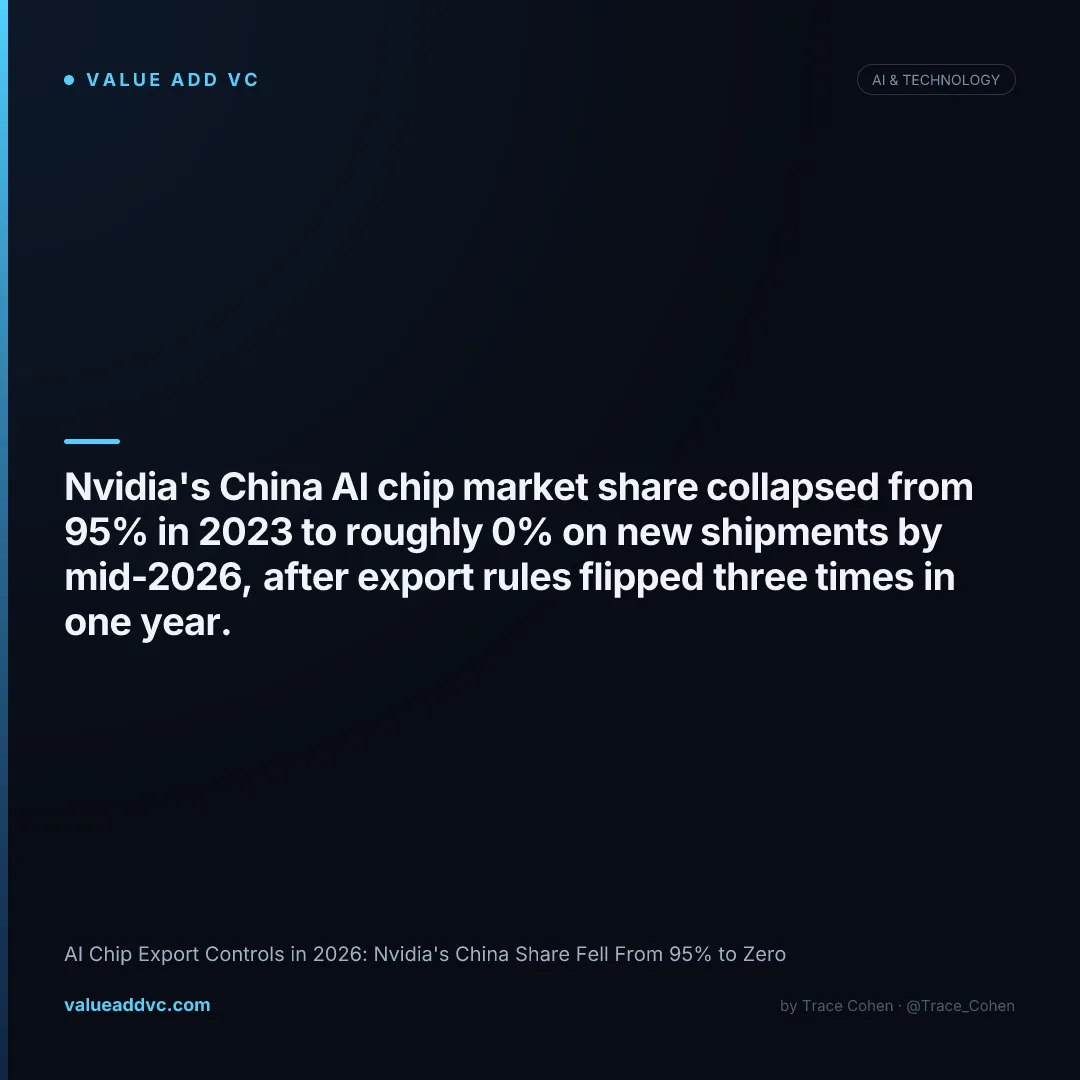
Nvidia's share of China's AI accelerator market collapsed from 95% in 2023 to roughly 0% on new shipments by mid-2026 — and Huawei's Ascend chips are the reason why.
How it got to zero involves three separate policy reversals in a single year, a $4.5 billion inventory write-down, and a Chinese chipmaker that went from an afterthought to a $12 billion-revenue rival in the space of eighteen months. Export controls were supposed to slow China's AI buildout. Instead they handed Huawei the best product launch of its history.
What are the AI chip export controls in 2026?
The 2026 AI chip export controls are a set of US Commerce Department rules, enforced through the Bureau of Industry and Security (BIS), that determine which Nvidia and AMD accelerators can legally ship to China. The rules changed direction three times in twelve months — from restrictive, to a licensed reopening, to restrictive again — creating exactly the kind of uncertainty that pushed Chinese buyers toward domestic alternatives.
In January 2026, the Commerce Department published a new regulation permitting the sale of Nvidia's H200 and AMD's MI325X to China, replacing a blanket presumption of denial with case-by-case review tied to total processing power (TPP) thresholds. In March 2026, Nvidia CEO Jensen Huang confirmed the company had received licenses to resume H200 shipments, ending a 10-month supply freeze. Then, on May 31, 2026, BIS issued a two-page notice tightening the rules again — requiring a license for any shipment to an entity "headquartered in Country Group D:5 or Macau," including Blackwell-series chips, and closing a loophole that let Chinese firms buy through overseas subsidiaries.
How AI chip export controls reshaped Nvidia's China business
The financial impact shows up directly in Nvidia's SEC filings. Even with the China setback, Nvidia's overall business kept growing — Q1 FY2026 revenue was up 69% year-over-year — but the China-specific numbers tell a starker story.
| Metric | Figure | Period |
|---|---|---|
| H20 inventory write-down | $4.5B | Q1 FY2026 |
| H20 revenue unable to ship | $2.5B | Q1 FY2026 |
| Total company revenue | Up 69% YoY | Q1 FY2026 |
| Q2 FY2026 revenue guidance | $45B (±2%) | Q2 FY2026 outlook |
| Estimated H20/H200 impact baked into guidance | ~$8B | Q2 FY2026 outlook |
| H200 supply freeze to China | 10 months | Mid-2025 to March 2026 |
| China AI chip share, new shipments | 95% → ~0% | 2023 to mid-2026 |
Sources: Nvidia Q1 FY2026 10-Q and earnings release (SEC filings), Futurum Group, Manufacturing Dive, Tom's Hardware, TechXplore reporting on 2026 China AI chip market share. Figures reflect company disclosures and analyst estimates as of mid-2026.
The pattern is clear: every time Washington tightens the rules, Nvidia loses billions in near-term revenue and cedes ground in China it may never fully recover, even after rules loosen again. Track how this feeds into broader model-company valuations on the AI Valuations dashboard.
Huawei's Ascend chips: the direct beneficiary of AI chip export controls
Huawei's Ascend AI accelerator line is the single biggest winner of the 2026 export control saga. Ascend chip revenue is projected to hit $12 billion in 2026, up from $7.5 billion in 2025, on orders already placed by Alibaba, ByteDance, and Tencent. Domestically, Huawei shipped roughly 812,000 Ascend chips, about 20% of the overall Chinese AI chip market by unit volume, and analysts now expect Huawei's share of China's AI accelerator market to reach approximately 50% in 2026 — up from single digits just three years ago. Alibaba isn't just buying Ascend chips, either — its own T-Head unit unveiled a competing accelerator, the Zhenwu V900, in September 2026.
The flagship Ascend 950PR entered mass production in March 2026, delivering up to 2 petaflops of FP4 performance with 128 GB of locally produced HBM memory — roughly comparable to Nvidia's H200 on paper, though the real gap is software. Huawei's CANN toolchain is still catching up to CUDA's maturity, and Chinese model developers like DeepSeek and Qwen are only now optimizing natively for Ascend hardware rather than porting from Nvidia-first codebases.
Nvidia vs Huawei: the AI chip export control scoreboard
Side-by-side, the shift in China's AI compute supply chain over three years is one of the fastest market-share reversals in semiconductor history.
| Attribute | Nvidia (H200 / H20) | Huawei (Ascend 950PR) |
|---|---|---|
| China market share, 2023 | ~95% | ~5% |
| China market share, mid-2026 | ~0% (new shipments) | ~50% (est., full year) |
| Peak performance (FP4) | ~2 petaflops (H200 class) | 2 petaflops (950PR) |
| Memory | 141 GB HBM3e (H200) | 128 GB HBM (locally produced) |
| 2026 China-relevant revenue | ~$8B lost to restrictions (Q2 guide) | ~$12B projected |
| Software ecosystem | CUDA — mature, dominant globally | CANN — improving, still behind CUDA |
| Export license requirement | Required for China/Macau-linked entities | None (domestic production) |
Sources: Nvidia and Huawei public disclosures, Tom's Hardware, Medium (Activated Thinker), BIS notices (May 31, 2026), and Congressional Research Service reporting on chip export policy. HBM and performance specs are manufacturer-published figures.
The bigger AI chip market these export controls sit inside
China is a meaningful slice of Nvidia's business, but the export control fight is playing out against a global AI chip market that's expanding regardless of who wins China. Deloitte projects generative AI chip revenue will approach $500 billion globally in 2026, roughly half of all chip sales worldwide, up from an estimated $120 billion in AI-specific semiconductor revenue in 2025. The data center GPU market specifically is projected to reach $112.85 billion in 2026, growing toward $304 billion by 2034.
That context matters: even a total loss of the China market — which Nvidia is close to experiencing on new H200 shipments — doesn't threaten Nvidia's core business the way it would have in 2022, because US hyperscaler demand (Microsoft, Google, Amazon, Meta) has grown large enough to absorb the difference. Track how that capital flows through to public company results on the Big Tech Earnings dashboard.
Where the money is: China restriction impact vs global AI chip market size, 2026 ($B)
Source: Nvidia Q2 FY2026 guidance; Deloitte 2026 Semiconductor Industry Outlook; data center GPU market sizing per Stratview Research.
What comes next for AI chip export controls
Three things to watch for the rest of 2026. First, whether the May 31 tightening holds or gets loosened again before year-end — the pattern so far is a policy reversal roughly every four months, which is its own kind of signal to chipmakers not to bank on stability. Second, whether Huawei's Ascend 950PR yield and CANN software maturity can scale past the current ~50% domestic share without stalling on advanced packaging capacity, which remains China's real bottleneck versus TSMC-fabricated chips. Third, whether AMD's MI325X sees any meaningful China volume at all, since it has largely been an afterthought relative to Nvidia in both the restrictions and the coverage.
For investors, the practical takeaway is that "China exposure" is no longer a single number in a 10-K risk factor — it's a policy variable that can swing a public company's quarterly guidance by billions of dollars with a single BIS notice. That volatility is now a permanent feature of AI infrastructure investing, not a temporary shock.
The scoreboard on AI chip export controls in 2026:
Nvidia went from 95% of China's AI chip market to near zero — and handed Huawei a $12 billion business it built almost entirely out of policy uncertainty.
Track AI infrastructure spending and model-company valuations on the AI Valuations dashboard and Big Tech Earnings dashboard at Value Add VC. Originally published in the Trace Cohen newsletter.
Latest from the Pulse
Get VC data most people never see
— free to subscribe
Trace's notes on venture, AI and startups, a few times a week. Join 5,000+ subscribers. No spam.