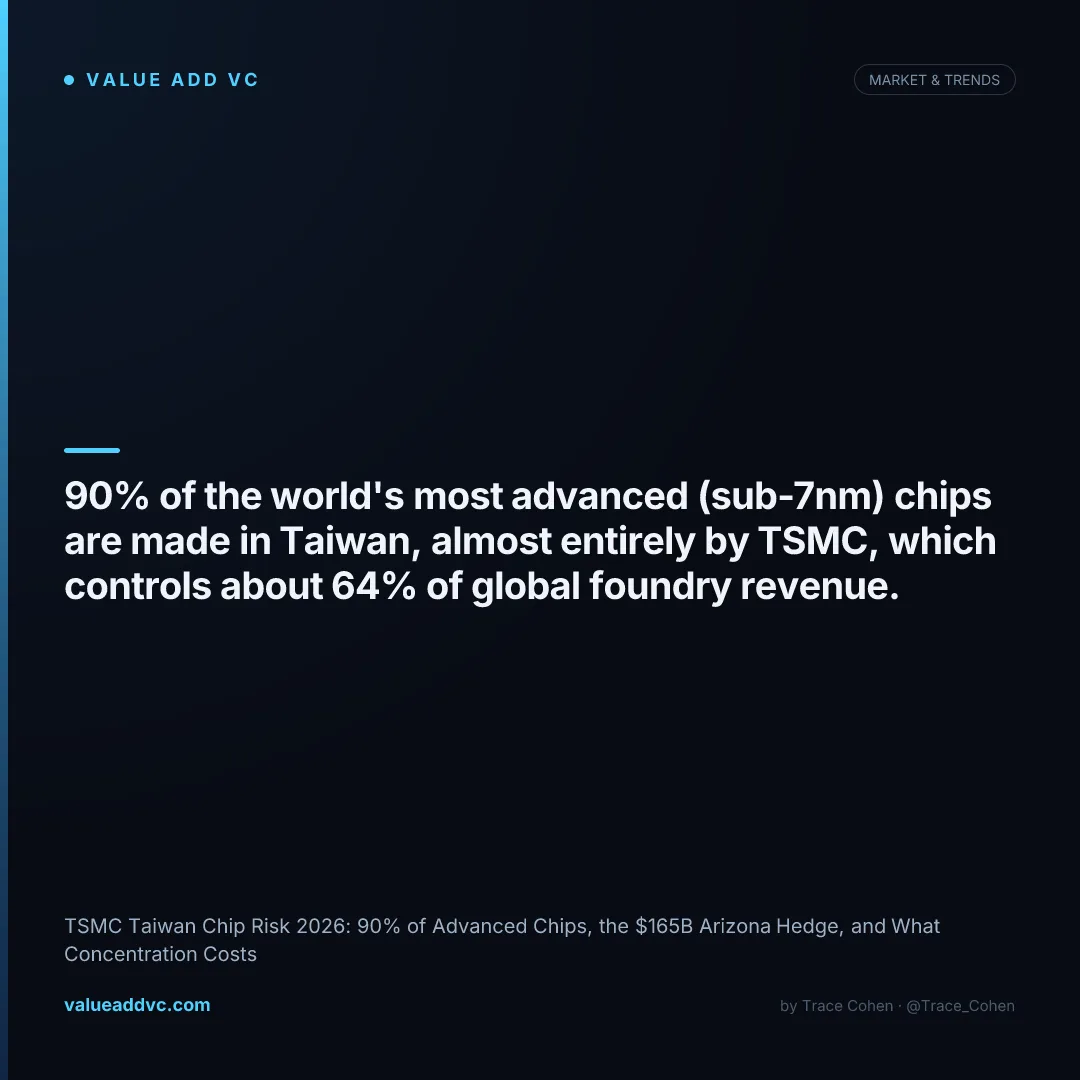
Roughly 90% of the world's most advanced chips are made on a single island by a single company — TSMC — and a serious disruption there could erase an estimated $10 trillion of global GDP. That's the short answer. The longer answer is more interesting.
I've made 65+ investments and built three companies, and the risk that keeps surfacing across every AI, hardware, and deep-tech deal is the same one nobody can underwrite: the entire modern economy runs on chips that are overwhelmingly fabricated within 100 miles of one of the most contested borders on earth. People call it the "silicon shield." I think of it as the single largest concentration risk in technology — and most cap tables, including the AI darlings, have no real hedge against it. Here are the actual numbers.
TSMC Taiwan Chip Risk in 2026, Explained
TSMC Taiwan chip risk is the concentration of the world's most advanced semiconductor manufacturing in one company on one island. TSMC fabricates roughly 90% of all sub-7nm logic chips and holds about 64% of global foundry revenue as of 2025. Because Apple, Nvidia, AMD, and Qualcomm all depend on its Taiwan fabs, any war, blockade, or major earthquake there would halt production of the chips that power phones, data centers, and AI at once.
That is the whole problem in two sentences. Decades of efficiency drove leading-edge manufacturing toward whoever could run the highest yields at the lowest cost, and TSMC won that race so decisively that the rest of the industry simply stopped competing at the frontier. The result is a supply chain optimized to a razor's edge with almost no redundancy. Efficiency and resilience are opposites here, and the world chose efficiency.
Why TSMC Concentration Risk Is Tech's Single Point of Failure
The reason TSMC concentration risk matters more than any other supply-chain dependency is the customer list. The companies that rely on TSMC are not a niche — they are the most valuable franchises in technology, and several of them have no second source for their flagship products. The table below lays out who depends on TSMC and how exposed each one is.
| Customer | What TSMC makes for them | Exposure |
|---|---|---|
| Apple | Every A-series & M-series chip | ~25% of TSMC revenue; no second source |
| Nvidia | H100/H200/Blackwell AI GPUs | Near-100% of advanced GPUs |
| AMD | EPYC, Ryzen, Instinct GPUs | All leading-edge CPUs & GPUs |
| Qualcomm | Snapdragon flagship SoCs | Leading-edge mobile chips |
| Broadcom | Custom AI ASICs & networking | High-end accelerators |
| MediaTek | Dimensity mobile chips | Most advanced nodes |
| Intel | Some leading-edge tiles | Partial outsourcing of top chips |
| Tesla / others | Auto & custom silicon | AI training & inference chips |
Figures are 2025 estimates blended from TSMC investor disclosures, Counterpoint Research, TrendForce, and company filings. Customer revenue shares are approximate; "no second source" reflects that leading-edge nodes (3nm/2nm) are not available at scale from any other foundry.
Look at that list and the AI boom suddenly looks fragile. Nvidia's entire $3T-plus market value rests on accelerators that only TSMC can currently produce in volume. For context on how that dependency feeds the valuation, our Big Tech earnings dashboard tracks the capex and revenue of the companies most exposed. The uncomfortable truth: the most important supply chain in AI has effectively one supplier.
How Concentrated Is Leading-Edge Manufacturing, Really?
People assume Samsung and Intel provide real redundancy. They do not — at least not at the frontier. The further down the process node you go, the more TSMC dominates, and the leading edge is where AI and high-performance computing live. The table below shows roughly how foundry market share collapses toward TSMC as nodes shrink.
| Segment | TSMC share | Next-closest competitor |
|---|---|---|
| All foundry revenue | ~64% | Samsung ~11% |
| Sub-7nm logic | ~90% | Samsung (rest) |
| 3nm production | ~90%+ | Samsung (low yields) |
| 2nm (N2) ramp 2025 | First to volume | Samsung / Intel (later) |
| Advanced packaging (CoWoS) | Dominant | Limited alternatives |
| AI accelerator fab | Near-total | Effectively none |
| Mature nodes (28nm+) | ~major share | SMIC, GlobalFoundries, UMC |
Figures are 2025 estimates blended from TrendForce, Counterpoint Research, and TSMC and Samsung earnings disclosures. Shares are approximate and vary by quarter; "sub-7nm" refers to advanced logic process nodes, where TSMC and Samsung are the only volume producers and Samsung continues to trail on yield.
The pattern is unmistakable: redundancy exists at mature nodes (the chips in cars, appliances, and microcontrollers) but evaporates at the leading edge. SMIC in China is roughly five years behind and constrained by export controls on the equipment it needs — a topic we cover in how export controls are reshaping chip competition. For the chips that matter most to AI, there is no plan B.
What a Taiwan Chip Disruption Would Actually Cost
The headline number is Bloomberg Economics' estimate that a war over Taiwan could cost the global economy around $10 trillion — roughly 10% of global GDP. That dwarfs the 2008 financial crisis and the 2020 pandemic shock. But a full war is only the tail scenario; the risk distribution is wider than that. A naval blockade short of war could idle the world's advanced-chip supply for months. A severe earthquake — Taiwan sits on a major fault line and saw a magnitude-7.4 quake in April 2024 — could damage fabs that take quarters to recalibrate, since a single particle of dust can ruin a wafer.
The cascade is what makes it terrifying. A new car contains hundreds to thousands of chips; a data center is nothing but chips. When TSMC sneezed during the 2021 shortage, automakers lost an estimated $210 billion in revenue and cut millions of vehicles from production — and that was a relatively mild, temporary squeeze. A genuine Taiwan outage would not be a shortage; it would be a stop. There is no strategic reserve of 3nm processors sitting in a warehouse.
The $165B Arizona Hedge: Can TSMC Diversify Out of Taiwan Chip Risk?
This is the part that gets oversold. TSMC has committed roughly $165 billion to its Arizona expansion — three fabs, two advanced-packaging plants, and an R&D center — after raising its initial $65 billion plan with an additional $100 billion announced in March 2025. The first Arizona fab has produced 4nm chips since late 2024, and it won about $6.6 billion in CHIPS Act grants from the U.S. government's $52.7 billion program. That is real diversification, and it matters.
But read the fine print. Arizona will account for only a low double-digit percentage of TSMC's output for years; the company's most advanced node — 2nm — still debuts in Taiwan first; and the advanced packaging that turns raw silicon into an Nvidia GPU largely stays in Taiwan. Building a leading-edge fab takes three to five years and tens of billions of dollars, and the scarce engineering talent is concentrated in Hsinchu, not Phoenix. The Arizona build reduces the risk at the margin. It does not relocate the chokepoint. Defense and dual-use supply chains are now treating this as a national-security problem, which you can see reflected across our defense tech dashboard.
TSMC Taiwan Chip Risk for Investors: What to Actually Watch
You cannot hedge this risk away, so the job is to price it and monitor it. TSMC trades around a $1 trillion market cap on roughly $90 billion of 2024 revenue (tracking toward an estimated $115–120 billion in 2025), with capex near $40 billion a year — a phenomenal business whose biggest discount is geopolitical, not financial. Every AI investor is implicitly long Taiwan stability whether they realize it or not. The signals worth tracking are concrete: the pace of the 2nm ramp, how fast Arizona and Japan capacity actually comes online, Samsung's yield progress, and U.S.–China military posture in the strait.
My practical take after years of watching deep-tech deals: the market chronically underprices low-probability, high-severity risks because they are hard to model and embarrassing to raise in a hot market. TSMC concentration is the textbook example. It will not show up in a DCF, but it is the assumption underneath every AI valuation. Knowing that — and watching the diversification timeline rather than trusting the "silicon shield" narrative — is the difference between understanding the AI trade and just riding it.
The verdict on TSMC concentration risk:
One company on one island makes ~90% of the world's advanced chips, and a serious disruption could cost ~$10 trillion. The $165B Arizona build helps at the margin but doesn't move the chokepoint. Every AI valuation is quietly long Taiwan stability.
Track the companies most exposed to chip supply on the Big Tech earnings and defense tech dashboards at Value Add VC. Originally published in the Trace Cohen newsletter.
Latest from the Pulse
Get VC data most people never see
— 100% free
Weekly benchmarks, valuations, and fund data. Join 5,000+ investors. No spam.