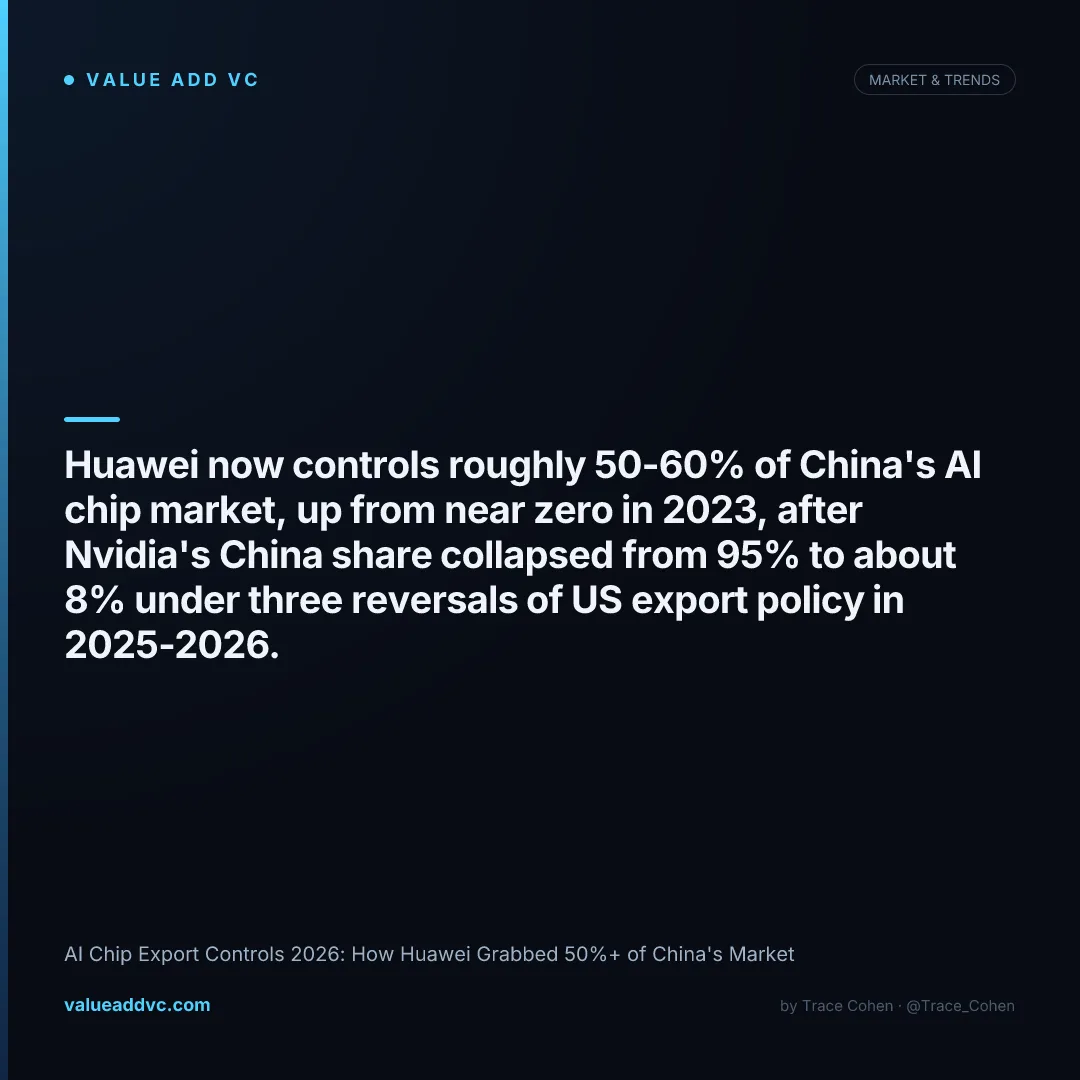
Huawei now controls an estimated 50-60% of China's AI chip market, up from almost nothing three years ago, while Nvidia's China share has collapsed from 95% in 2023 to roughly 8% in 2026. A policy meant to slow China's AI buildout ended up minting its chip champion — that reversal is the story.
Three reversals of U.S. export policy in eighteen months didn't just cost Nvidia billions in China revenue — they built Huawei a captive domestic customer base it couldn't have won on merit alone. Here's the full 2026 timeline, the numbers behind the shift, and what it means for every country now racing to control its own compute supply.
Figures are 2026 estimates blended from FourWeekMBA, SemiAnalysis, Nvidia's SEC filings, and CNBC reporting on export rule changes.
What Are AI Chip Export Controls in 2026?
AI chip export controls in 2026 are U.S. rules requiring a government license before advanced AI processors — including Nvidia's Blackwell and Rubin chips — can be shipped to China or Chinese-controlled entities anywhere in the world. The rules expand what counts as a controlled chip, close loopholes that routed hardware through third countries, and have already shifted roughly 50-60% of China's AI chip market from Nvidia to domestic supplier Huawei.
Unlike a single ban, the 2026 regime is a moving target: the same 18 months saw a total ban, a partial reopening with a revenue-share condition, and a fresh tightening — each version rewriting who could legally buy what. That instability is itself the policy's biggest side effect, because it made China's government decide it couldn't depend on Nvidia at all, license or no license.
The 2026 AI Chip Export Controls Timeline: Three Rule Reversals in 18 Months
| Date | Action | Effect |
|---|---|---|
| Oct 2022 – Oct 2023 | Initial Biden-era controls on advanced GPUs and fab tools | First licensing requirements for Nvidia A100/H100-class chips to China |
| Apr 2025 | H20 export license requirement imposed | Eliminated Nvidia's last broadly-legal China product; $4.5B Q1 charge |
| May 2025 | Nvidia guides to ~$8.0B lost H20 revenue for Q2 FY26 | Confirms scale of the China revenue hit |
| Aug 2025 | Limited H20 licenses granted to select China customers | Only ~$60M in H20 revenue recognized under the licenses |
| Sep 2025 | China directive tells domestic firms to stop buying Nvidia GPUs | Creates a captive market for Huawei Ascend chips |
| Dec 2025 | H200 sales to China approved with 25% revenue-share condition | ~10 Chinese firms cleared, capped at 75,000 units per customer |
| May 2026 | New rules require licenses for Blackwell/Rubin to any China-linked entity, anywhere | Closes third-country resale loophole |
| Jul 2026 | Nvidia tightens compliance checks on Asian buyers | Over half of prior approved customers failed re-evaluation |
Figures are 2026 estimates blended from Nvidia SEC filings, CNBC, Computer Weekly, and Model Diplomat reporting on U.S. Commerce Department actions.
How Huawei Built a 50%+ Share of China's AI Chip Market
Huawei's Ascend chip line went from a negligible share of China's AI compute market in 2023 to an estimated 50-60% in 2026, worth roughly $12.1 billion in annual sales, largely because Beijing's September 2025 directive removed the option to keep buying Nvidia. That's not organic market-share capture — it's policy-manufactured demand, and it comes with real supply constraints Huawei still hasn't solved.
SMIC, Huawei's domestic foundry partner, can produce die for more than 1 million Ascend chips a year, but domestic high-bandwidth memory (HBM) production — the bottleneck component every AI accelerator needs — caps actual shippable output at under 300,000 units without foreign HBM stockpiles. As of early 2026, Huawei's bank of TSMC-manufactured die (produced before the tightest controls) is reportedly exhausted, meaning future Ascend volume depends entirely on SMIC wafers paired with domestic CXMT memory. That constraint is why "50-60% market share" understates how far behind Huawei still is on raw compute capacity per chip compared to Nvidia's Blackwell generation — for the wider picture of how far SMIC's own domestic manufacturing has come, and what's still bottlenecked, see our breakdown of what's actually split in US-China tech.
AI Chip Export Controls 2026 and the New Global Tech Blocs
The US-China chip fight isn't actually bilateral — every advanced chip depends on a handful of allied chokepoints the US doesn't fully control on its own, which is why enforcement has pulled in the Netherlands, Japan, and Taiwan as de facto co-regulators of the export regime.
| Country / Bloc | Chokepoint | 2026 Stakes |
|---|---|---|
| United States | Chip design (Nvidia, AMD) + EDA software | Sets and enforces the license regime; lost ~$8B in a single quarter of H20 revenue |
| China | World's largest AI chip buyer + rare-earth export leverage | Directed domestic firms off Nvidia; building Huawei as a captive alternative |
| Taiwan (TSMC) | Advanced-node chip fabrication (sub-5nm) | Manufactures nearly all Nvidia and Apple leading-edge chips; central to any Taiwan-conflict risk scenario |
| Netherlands (ASML) | EUV lithography machines required to fab advanced chips | Export licenses on EUV/DUV tools to China are a second control lever beyond US rules |
| Japan | Chip-making equipment (Tokyo Electron) + materials | Coordinated controls alongside the US and Netherlands since 2023 |
| South Korea | HBM memory (SK Hynix, Samsung) | HBM supply is the binding constraint on both Nvidia's and Huawei's output in 2026 |
Figures are 2026 estimates blended from CSIS, CFR, SemiAnalysis, and Nvidia SEC filings. "Stakes" reflects each country's leverage point in the current export-control regime, not an official government position.
The Second-Order Effect: What Export Controls Did to Chinese AI Labs
The chip fight isn't abstract for the companies training frontier models in China. DeepSeek, Alibaba's Qwen team, and Moonshot AI have all had to adapt their training and inference stacks to run on a mix of stockpiled Nvidia A100/H800-class chips (bought before the tightest 2023-2025 rules) and newer Huawei Ascend hardware, which still trails Nvidia's Blackwell generation on raw interconnect bandwidth and per-chip memory. That gap is part of why DeepSeek's well-known 2025 training-efficiency breakthroughs mattered as much as they did: compute-constrained labs have a much stronger incentive to squeeze more model quality out of fewer, weaker chips than labs with open access to the newest Nvidia silicon.
That dynamic cuts both ways for competitive assessments of the US-China AI race. Export controls have almost certainly slowed the ceiling on China's largest training runs — nobody disputes that a cluster of Ascend 910C chips trains a frontier model more slowly and expensively than an equivalent Nvidia GB200 cluster. But they've also forced measurable gains in software efficiency, quantization, and mixture-of-experts architectures that reduce compute-per-token, which is one reason Chinese open-weight models have continued to post competitive benchmark scores despite the hardware gap. Investors evaluating exposure to Chinese AI labs, either directly or through portfolio companies competing against them, need both numbers — the raw compute deficit and the efficiency offset — to size the real gap correctly.
What AI Chip Export Controls Mean for Investors in 2026
For VCs and public-market investors, the practical takeaway is that China AI-chip exposure is now effectively un-investable through Nvidia or AMD directly — that $2 billion of remaining Nvidia China revenue is a rounding error against a company reportedly worth over $5 trillion in market cap, and management has already written most of it off in guidance, including the $4.5 billion Q1 FY26 charge and the roughly $8.0 billion in lost Q2 H20 revenue disclosed in Nvidia's Q1 fiscal 2026 earnings release. The real exposure is indirect: HBM suppliers (SK Hynix, Samsung, Micron), lithography (ASML), and foundries (TSMC) sit at chokepoints that matter regardless of which chip design wins in China.
It's also worth separating the China story from Nvidia's overall business, because the two have decoupled in a way that surprises people who haven't looked at the numbers closely. Nvidia's data center revenue outside China has grown fast enough that the roughly $8 billion in quarterly H20 losses barely dented total company growth — Nvidia's non-China hyperscaler demand from Microsoft, Google, Meta, and Amazon alone dwarfs what China ever represented as a share of total revenue. That's the main reason Nvidia's stock has continued climbing through three separate rounds of adverse China policy news in 2025-2026: the market has priced China as a bounded, largely known loss rather than an open-ended risk.
For funds underwriting AI infrastructure and defense-adjacent deals, the bigger signal is that compute has become explicit industrial policy — not just a Nvidia story. Track how sovereign chip strategy is reshaping company-level valuations on our AI valuations dashboard, and see which defense and dual-use chip startups are positioned to benefit from the reshoring push on our defense tech tracker.
Bottom line: Three reversals of U.S. AI chip export policy in 18 months handed Huawei an estimated 50-60% of China's AI chip market and cost Nvidia its China business almost entirely, dropping its share from 95% to roughly 8%. The controls didn't stop China's AI buildout — they redirected it toward a domestic supplier still bottlenecked on HBM memory, while turning Taiwan, the Netherlands, Japan, and South Korea into co-equal enforcement points in a fight that's no longer just about one company's chips.
Latest from the Pulse
Get VC data most people never see
— 100% free
Weekly benchmarks, valuations, and fund data. Join 5,000+ investors. No spam.