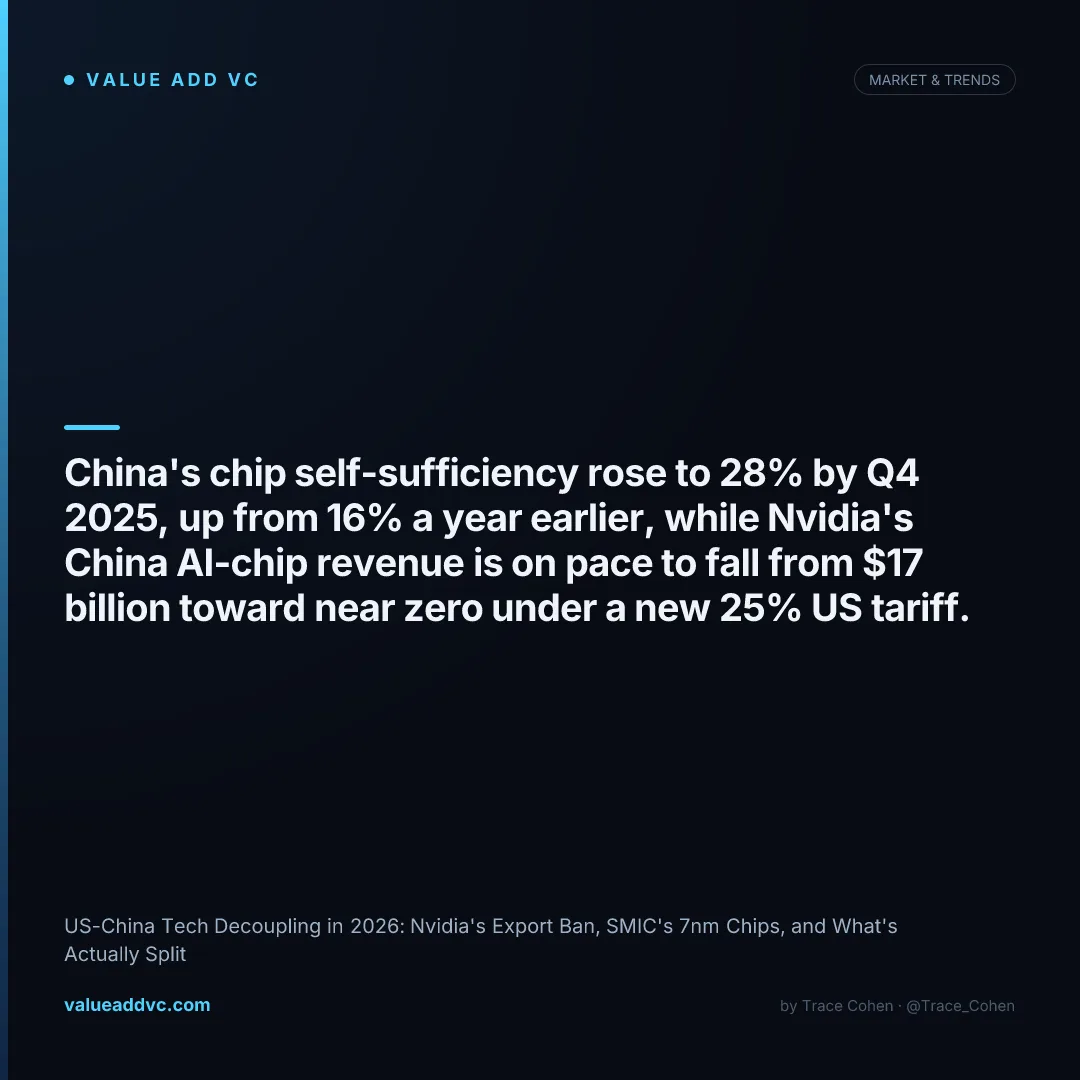
China's domestic chip production hit 28% self-sufficiency in Q4 2025, up from 16% a year earlier, while Nvidia's China Data Center revenue fell to $0 in Q1 FY2027 under a new 25% U.S. tariff — before the first small H200 shipments finally trickled into China in August 2026. That's the short answer. The longer answer is more interesting.
Every headline calls this a "decoupling," but the actual data shows something messier: a hardware supply chain splitting fast in AI chips and rare earths, while capital, equipment sales, and licensed trade keep flowing in both directions whenever either side needs the other more than it needs to punish it. If you're pricing AI companies exposed to this split, our AI valuations dashboard tracks how the market is repricing them in real time.
Figures from TechWireAsia, DigiTimes, CSIS, Morgan Stanley (via Seoul Economic Daily), Nvidia's Q1 FY2027 CFO commentary (SEC 8-K), and Enkiai's SMIC/Huawei chip analysis, 2025-2026.
What Does US-China Tech Decoupling Look Like in 2026?
US-China tech decoupling in 2026 means separated AI-chip supply chains rather than a clean economic split: the US restricts advanced chip exports and outbound investment into Chinese semiconductor, quantum, and AI companies, while China has pushed domestic chip self-sufficiency from 16% to 28% and retaliated with rare earth export controls. Less-sensitive trade and some licensed chip sales continue case by case.
The clearest evidence is in policy dates. On January 2, 2025, the Treasury Department's outbound investment screening rule took effect, restricting US capital from flowing into Chinese semiconductor, quantum computing, and AI firms. In January 2026, the Bureau of Industry and Security finalized a further tightening of advanced semiconductor export controls, adding new technical-performance thresholds and case-by-case review. Both sides have kept escalating since, but neither has cut the cord entirely — the broader Trump-Xi tariff truce reached in late 2025 paused reciprocal tariff hikes through November 10, 2026, even as a separate 25% tariff arrangement on Nvidia's H200 chips still allows licensed sales to resume and China's rare earth curbs remain calibrated and reversible rather than absolute.
China's Chip Self-Sufficiency Push: SMIC and Huawei's 2026 Numbers
China's semiconductor self-sufficiency climbed to roughly 28% in Q4 2025, up from just 16% in 2024, backed by an estimated $150 billion in state subsidies aimed at a stated 80% self-sufficiency target and a 2030 goal of a fully domestic-equipment 7nm production line. SMIC is doing the heaviest lifting: the foundry doubled its 7nm capacity plans for 2026, moved to take full control of its Beijing subsidiary for $5.79 billion in January 2026, and entered pilot runs on a 5nm process aimed at partners including Huawei and Alibaba.
Huawei's Ascend AI chip line is the closest thing China has to a domestic Nvidia competitor, and the growth numbers look real: the company is on track to roughly double production of its Ascend 910C to around 600,000 units, with total Ascend AI chip revenue projected to grow 60% year-over-year to $12 billion in 2026. Alibaba is building its own alternative too — the T-Head unit's Zhenwu V900 accelerator, unveiled in September 2026 alongside a 20-gigawatt data center target. The catch is yield — reported 910C yield rates sit between 20% and 40%, well below the 90%-plus yields Nvidia and TSMC achieve at the leading edge, meaning China is buying self-sufficiency at a real cost-per-chip premium for now.
The Number Investors Keep Missing: AI-GPU Self-Sufficiency Is Already at 41%
The 28% figure covers all semiconductors — memory, analog, legacy logic, and everything else China fabs domestically. Narrow the lens to the category that actually matters for AI investors, and the picture moves faster: Morgan Stanley's semiconductor team estimated China's AI-GPU-specific self-sufficiency at roughly 41% in 2026, up from about 20% in 2023, with a projected path to 85% by 2030 — outrunning the broader industry's 80% target for the same year.
That gap between the two numbers is the real story: the segment Washington's export controls were specifically designed to slow down is the segment localizing fastest, driven by three years of Huawei, Cambricon, and Moore Threads shipping into a vacuum Nvidia was legally barred from filling. China's chip push is really the hardware layer of a much larger pattern — dozens of nations now racing to control their own model layer rather than rent one from a US lab, with domestic compute as the prerequisite. It's also why treating "28% self-sufficient" as the ceiling on China's AI hardware capability understates the near-term competitive threat to Nvidia inside China, even as it overstates China's readiness to fully replace foreign chips everywhere else in the stack.
Nvidia's China Export Ban and the Collapse of a $17B Revenue Line
Nvidia's China business shows how fast decoupling can move once Washington acts. In April 2025, the US government required licenses for H20 chip exports to China, forcing Nvidia to take a $4.5 billion charge in Q1 fiscal 2026 for excess inventory and unable to ship an additional $2.5 billion of H20 orders already in the pipeline. China had been worth roughly $17 billion in Nvidia revenue in fiscal 2025, with analysts at Stifel and Bernstein initially projecting as much as $20 billion for fiscal 2026.
Then policy moved again. In January 2026, the Trump administration struck an arrangement imposing a 25% tariff on Nvidia's H200 chips bound for China, and while the Commerce Department granted licenses for a small amount of H200 sales on February 26, 2026, a Commerce official told Congress in July 2026 that actual shipments remained "very few." Nvidia's own fourth-quarter fiscal 2026 results called H20 sales "insignificant" for both Q3 and Q4, and its Q1 fiscal 2027 report (quarter ended April 26, 2026) showed zero Data Center Hopper shipments to China, versus $4.6 billion in the same quarter a year earlier.
The freeze finally cracked in mid-August 2026: small H200 shipments began reaching China, with ByteDance and Tencent each receiving roughly 10,000 chips under the licensing framework's cap of up to 75,000 units per approved customer — reportedly only about 13% of that legal ceiling so far. Nvidia's Q2 FY2027 guidance, covering the quarter that closed before those shipments landed, explicitly excluded any China Data Center compute revenue, and Nvidia reports full Q2 FY2027 results on August 26, 2026, which will be the first quarter where any of this trickle could actually show up in the numbers. That's a swing from a $17 billion FY2025 revenue base to functionally zero for five straight quarters — the single clearest data point that AI-hardware decoupling is not theoretical anymore. For context on how this plays into the broader capex build-out, see our Big Tech Earnings Tracker.
Rare Earths: China's Leverage in the US-China Tech Decoupling Fight
If chips are the US's chokepoint on China, rare earths are China's chokepoint on everyone else. In June 2026, China added roughly 10 more US firms, including a rare-earth mining company, to its export control list. It escalated again on July 24, 2026, when China's Ministry of Commerce added 14 European firms — including German defense contractor Rheinmetall and Dutch shipbuilder IHC Merwede — to the same list, in direct response to the EU's own sanctions package targeting Chinese firms over alleged support for Russia's war effort. Because China controls the large majority of global rare earth mining and an even larger share of refining capacity, these moves carry outsized weight for a relatively small trade category.
The response has been coordinated rather than unilateral: a G7 ministerial meeting in early 2026 focused specifically on rare earth supply chain resilience, discussing measures like price floors and joint incentives to fund alternative mining and refining outside China. The price effects are already showing up in the data — the NdPr alloy benchmark, a key rare-earth input for magnets, rose 21.4% in the single month through July 1, 2026, and enforcement has widened beyond paperwork: Chinese customs detained two Japanese nationals in Dalian in May 2026 and placed a Chinese optics-company chairman under compulsory measures in June 2026, both over alleged rare-earth-related export violations. That's evidence even non-US, non-China players are getting caught in the crossfire of a decoupling that was supposed to be bilateral.
US vs China: The 2026 Tech Decoupling Scoreboard
Laid side by side, the numbers show a lopsided but incomplete split — the US still dominates the leading edge and China still needs it, while China's leverage over rare earths cuts the other way.
| Metric | US / allies | China |
|---|---|---|
| Leading-edge node in mass production | TSMC/Samsung 3nm-2nm | SMIC 7nm mass production, 5nm pilot |
| Domestic chip self-sufficiency | ~100% design + fab access | 28% overall (Q4 2025); 41% in AI GPUs (2026) |
| 2026 flagship AI chip export policy | 25% tariff + case-by-case license on H200 | 10 US + 14 EU firms added to control list, June-July 2026 |
| State chip subsidy commitment | $52B CHIPS Act (committed) | $150B national semiconductor push |
| Outbound investment restrictions | Treasury rule effective Jan 2, 2025 | State Council supply-chain rules, April 2026 |
| Flagship AI chipmaker 2026 revenue trend | Nvidia China revenue: $4.6B (Q1 FY26) to $0 (Q1 FY27) | Huawei Ascend revenue: +60% YoY to $12B |
| Critical-materials leverage | G7 exploring price floors, early 2026 | NdPr prices +21.4% in one month (July 2026) |
Figures blended from CSIS, TechWireAsia, DigiTimes, Morgan Stanley (via Seoul Economic Daily), Nvidia earnings releases, S&P Global, Morgan Lewis, and Bruegel reporting on 2025-2026 policy actions. CHIPS Act figure reflects total committed funding as of prior legislation, not a 2026-specific allocation.
What's Actually Split vs. What Investors Are Overestimating
What's genuinely split: the frontier AI-chip supply chain. Nvidia's China revenue trajectory — from a $4.6 billion quarter to $0 across five consecutive fiscal quarters — is not a rounding error, and Huawei's Ascend line, despite a yield rate around 40% that would be unacceptable at TSMC, is scaling into that vacuum because it has no other choice. Capital flows into Chinese AI and semiconductor firms are also genuinely restricted now, not just discouraged, under the Treasury's outbound investment rule.
What's overestimated: a total decoupling of the two economies. China still needs Western semiconductor equipment for anything beyond 7nm, the US still needs Chinese rare earths for everything from EVs to fighter jets, and both governments have repeatedly built off-ramps — license approvals, tariff arrangements, ministerial dialogues — into policies that read as maximalist on the day they're announced. The August 2026 H200 trickle is itself an off-ramp in miniature: real chips moving again, just at roughly 13% of the legal ceiling. This likely means Washington and Beijing are each testing how much controlled trade they can tolerate without abandoning the underlying restriction — not a genuine reopening. For VCs and operators, the practical read is narrower than the headlines: underwrite AI-hardware and rare-earth-adjacent supply chain plays for continued volatility, not a clean bifurcation you can model with a single switch.
What US-China Tech Decoupling Means for AI Investors in 2026
For venture investors, the decoupling scoreboard argues for three concrete portfolio moves rather than a single macro call. First, domestic chip-adjacent plays — advanced packaging, EDA tooling, and US-based inference infrastructure — are structurally advantaged by both the CHIPS Act subsidy base and the outbound investment restrictions that make it harder for Chinese capital to compete for the same deals. Second, any startup with China-dependent supply chains for rare earths, magnets, or specialty materials needs a second-source plan now, not after the next export control list update; China's back-to-back additions of roughly 10 US firms in June 2026 and 14 EU firms in July 2026 show how quickly a company can land on the wrong side of a control list.
Third, defense tech is the clearest direct beneficiary of this environment: Pentagon budgets are shifting toward exactly the AI-agent, autonomy, and domestic-manufacturing capabilities that a contested chip and rare-earth supply chain makes more urgent, which is why firms like Anduril have expanded well beyond their original hardware footprint. Track how that capital is flowing on our defense tech dashboard. None of this means China's self-sufficiency push is failing — an AI-GPU self-sufficiency rate that doubled from 20% to 41% in three years, with an 85% Morgan Stanley projection for 2030, should worry anyone underwriting a decade-long Nvidia monopoly thesis rather than a two-to-three-year one.
Bottom line: US-China tech decoupling in 2026 is real and measurable in AI chips — China's overall self-sufficiency jumped from 16% to 28% in a year on $150 billion in subsidies, its AI-GPU-specific self-sufficiency has already reached 41%, and Nvidia's China Data Center revenue fell to $0 in Q1 FY2027 from $4.6 billion a year earlier under a 25% tariff, before the first small H200 shipments finally trickled in this August. But it's a targeted, contested split rather than a full divorce: rare earths, equipment sales, and licensed chip trade still move in both directions, and both governments have kept enough off-ramps open that the next policy reversal is never more than a quarter away.
Latest from the Pulse
Get VC data most people never see
— free to subscribe
Trace's notes on venture, AI and startups, a few times a week. Join 5,000+ subscribers. No spam.
No spam, unsubscribe anytime. Sent via Substack · Privacy · or subscribe on Substack ↗