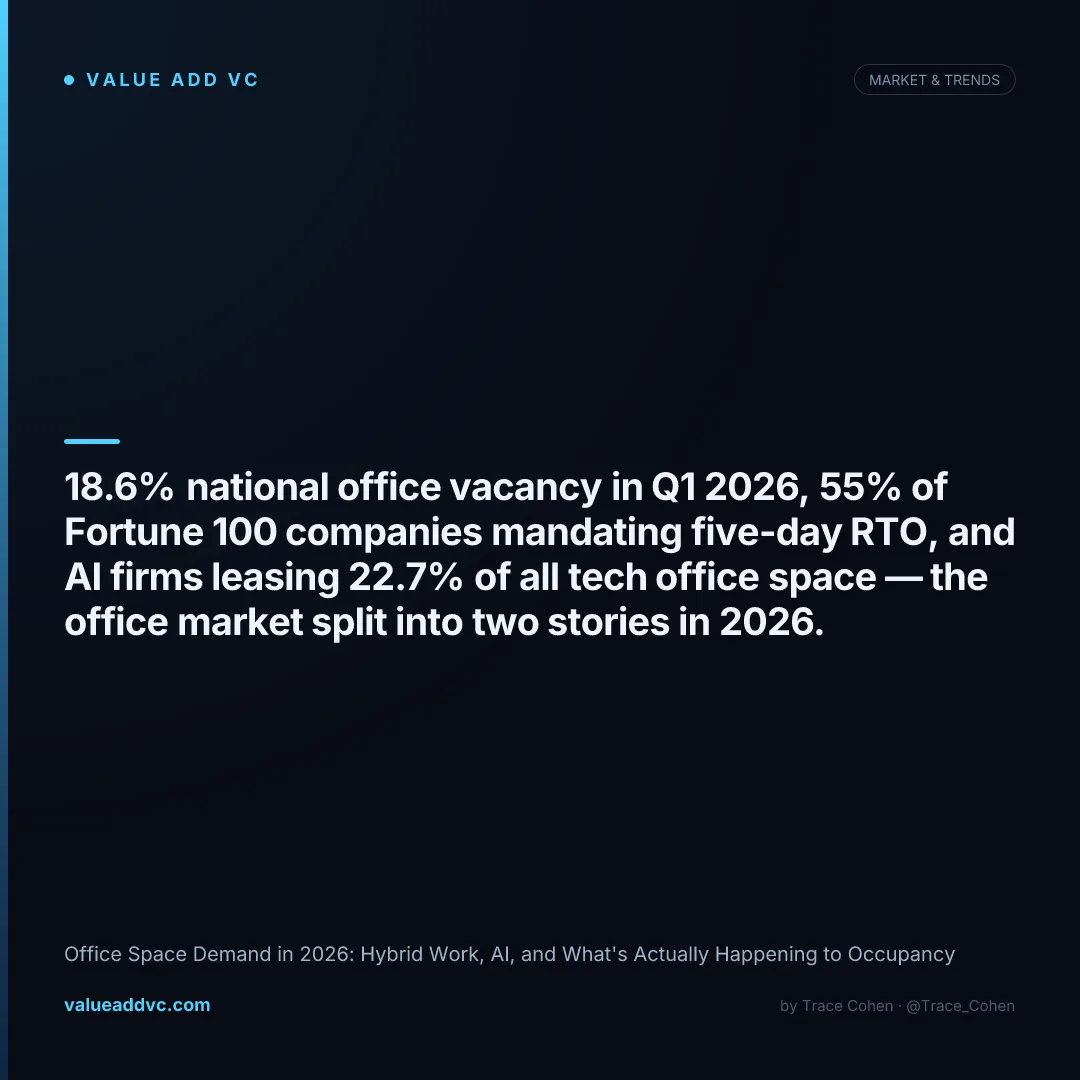
18.6% national office vacancy, 55% of Fortune 100 firms mandating five-day RTO, and AI companies leasing 22.7% of all tech office space — all true at the same time in 2026. That's the short answer. The longer answer is more interesting.
The office market didn't recover in 2026 so much as it split in two. One office market is old, half-empty, and stuck in secondary metros with no tenant demand at any price. The other is a handful of blocks in San Francisco, Manhattan, and Boston where AI companies are paying up for every square foot of high-power-density space they can find, sometimes before the building is even finished being retrofitted. Both stories are backed by real data, and treating either one as the whole picture will get your leasing, staffing, or investment thesis wrong.
Figures from JLL, CBRE, Moody's Analytics, Kastle Systems, and Newsweek reporting, Q1 2026.
What Is Happening to Office Space Demand in 2026?
Office space demand in 2026 is recovering unevenly: national vacancy sits at 18.6%, down slightly from 2025 but still near record highs, while a specific subset of the market — AI-native tenants in gateway tech cities — is leasing space at the fastest pace in nearly three decades. National sublease inventory has declined for eight consecutive quarters to 101 million square feet, a sign the oversupply glut from 2022-2024 is finally clearing, but the clearing is happening almost entirely in premium buildings that AI and finance tenants want, not in the commodity office stock that makes up most of the vacant square footage.
Prime-grade vacancy — the newer, amenity-rich, well-located buildings — is already down to 12.7%, essentially healthy by historical standards. It's the older Class B and C stock, concentrated in secondary business districts and suburban office parks, that is dragging the national average up and showing few signs of finding tenants at any price. That bifurcation, more than any single vacancy number, is the real office story of 2026.
Return-to-Office Mandates: How Many Companies Actually Require Five Days
55% of Fortune 100 companies are now mandating five days a week in the office, up from just 5% in 2021 — an eleven-fold increase in five years. 54% of Fortune 100 employees are subject to a five-day requirement, up from 11% a year earlier. Amazon's mandate alone covers roughly 350,000 corporate employees, and JPMorgan Chase, under CEO Jamie Dimon's public stance that "five is ideal," has been equally aggressive. Goldman Sachs rounds out the trio of the most visible full-RTO enforcers.
Outside the Fortune 100, the picture is softer: 28% of companies broadly required five days, 13% required four, and 28% required three as of late 2025, with 30% of employers planning to move to full five-day mandates in 2026, up from 28% the year before. In other words, RTO enforcement is heavily concentrated among the largest, most visible employers — the ones with the negotiating leverage and headline exposure to make a hard mandate stick.
The mandates are not costless. Job vacancy duration jumped from 51 days to 63 days after RTO mandates were imposed — a 23% increase — and 53% of remote-capable employees say they would look for a new job within a year if forced into a full five-day return. Some employers, notably Amazon and JPMorgan, have responded by leaning into flexible coworking space near employees' homes rather than forcing longer commutes into a single downtown tower, a hedge worth watching if you're modeling hiring and retention trends for 2026.
RTO Mandates and AI Leasing: Two 2026 Office Trends, Side by Side
Newsweek, Fortune, and CBRE data compiled 2026
Office Vacancy and AI Leasing by Market: 2026 City Comparison
Office space demand is not uniform across cities — the gateway tech markets pulling in AI tenants look nothing like the national vacancy average, while several secondary markets remain deep in oversupply with no AI leasing offsetting the gap.
| Market | Office vacancy (Q1 2026) | AI share of leasing | 2026 trend |
|---|---|---|---|
| San Francisco | 31.6% | ~40% of leasing volume | Vacancy down 570 bps YoY; leasing near 30-year high |
| Manhattan | 13.1% | Meaningful, not majority | Midtown prime vacancy just 2.9% |
| Seattle | 33.3% | Cloud/AI-linked demand present | Highest vacancy of any major US market |
| Austin | >20% | Present but secondary to SF/NYC | Among the highest vacancy in the region |
| Chicago | 18.1% | Limited AI-driven leasing | Near national average, little AI offset |
| Boston | Elevated (life-science-linked) | Reported among top AI leasing metros | 3.9M sq ft under construction |
| National average | 17.6%-18.6% | 22.7% of tech-market leasing | Bifurcated recovery, prime vs. secondary |
Figures are Q1 2026 estimates blended from JLL, CBRE, CommercialCafe/Yardi Matrix, and local reporting (SeattleRed, Commercial Property Executive). National vacancy is cited as 18.6% by JLL and 17.6% by CommercialCafe/Yardi Matrix depending on methodology; city figures reflect overall office stock, not prime-grade only.
Why AI Companies Are Driving Office Space Demand Higher
AI firms accounted for 22.7% of all office leasing — 11.5 million square feet — across major US tech markets in Q1 2026, up from around 17% the year before, per CBRE's Q1 2026 leasing data. San Francisco is the epicenter: AI companies drove nearly 40% of the city's leasing volume in the quarter, and total SF office leasing activity is running near its highest pace in almost 30 years. US-based AI startups raised $578 billion in venture capital between 2020 and Q1 2026, with roughly 80% of that flowing into the Bay Area — capital that has to eventually translate into desks, GPUs, and power-hungry office buildouts somewhere.
What AI tenants actually want is narrower than what most office landlords have to offer: high power density for on-site compute, flexible floor plates for rapidly scaling headcount, and move-in-ready space rather than a multi-year build-out. For leases under 10,000 square feet specifically, 80% signed in today's market are move-in ready, compared to just 50% in 2019 — landlords are repositioning vacant floors specifically to meet this demand rather than waiting for a traditional multi-year corporate tenant. This is the same capital-intensity dynamic playing out in our coverage of where AI data center infrastructure is actually being built — compute and office demand are increasingly two sides of the same geographic story.
The risk sitting underneath this leasing boom is that AI-driven efficiency gains could eventually shrink headcount-per-dollar-of-revenue at the very companies now leasing the most space, which would flip AI from an office-demand tailwind into a long-run headwind. Nobody in commercial real estate is pricing that risk into 2026 leases yet, but it's the single biggest variable for anyone underwriting a ten-year office investment in San Francisco or Manhattan right now.
Hybrid Work in 2026: Did It Actually Go Away?
No — hybrid work is still the default for most remote-capable employees, despite the RTO headlines. Kastle Systems' Back-to-Work Barometer, built from keycard and fob-entry data across more than 2,600 buildings in 47 cities, showed weekly office attendance averaging 56.3% as of the week of December 8, 2025 — well above 2021's lows but still far short of a full return to five-day, pre-pandemic norms. That number is an average across employers with three-day, four-day, and five-day mandates alike, which is exactly why it lands roughly in the middle.
For founders and operators thinking about their own office footprint, the practical takeaway is that a hard five-day mandate is now a genuine recruiting cost — measurable in a 23% longer time-to-fill and a majority of remote-capable staff who say they'd leave rather than comply — not just a cultural preference. That trade-off is worth running through the same lens we use on our layoffs and workforce tracker, since RTO mandates and headcount reductions are increasingly being used by the same employers as substitutes for each other.
What This Means for Founders and Investors
If you're a founder deciding on office space in 2026, the data argues for two different strategies depending on your growth stage. Early-stage AI companies competing for talent in San Francisco, Manhattan, or Boston are better off matching the market — flexible, move-in-ready, high-density space near your compute and your competitors for talent — because that's where 22.7% of the leasing market has already voted with its checkbook. Companies outside AI, or outside gateway metros, are negotiating from a position of real landlord desperation: 18.6% national vacancy and an even higher secondary-market number mean concessions are still generous almost everywhere else.
If you're an investor in commercial real estate or a related sector, the two-market story is the thesis: betting on "office recovery" broadly is still a weak bet given secondary-market vacancy near 20%, but betting on the specific subset of AI-adjacent, high-power-density, gateway-city office stock has real tailwinds backed by a $578 billion venture capital wave that isn't slowing down yet. Confusing the two markets — treating a Class B suburban office park like a San Francisco AI-leasing building — is the single most common mistake we're seeing in 2026 CRE underwriting.
Bottom line: Office space demand in 2026 isn't one trend, it's two colliding trends. National vacancy at 18.6% and 55% of Fortune 100 firms mandating five-day RTO tell you the broad office market is still oversupplied and enforcement-driven. AI firms leasing 22.7% of all tech office space — up from 17% a year ago — tell you a narrow, capital-flush slice of that same market is running hotter than it has in decades. Both numbers are real. The mistake is picking one and ignoring the other.
Latest from the Pulse
Get VC data most people never see
— free to subscribe
Trace's notes on venture, AI and startups, a few times a week. Join 5,000+ subscribers. No spam.
No spam, unsubscribe anytime. Sent via Substack · Privacy · or subscribe on Substack ↗