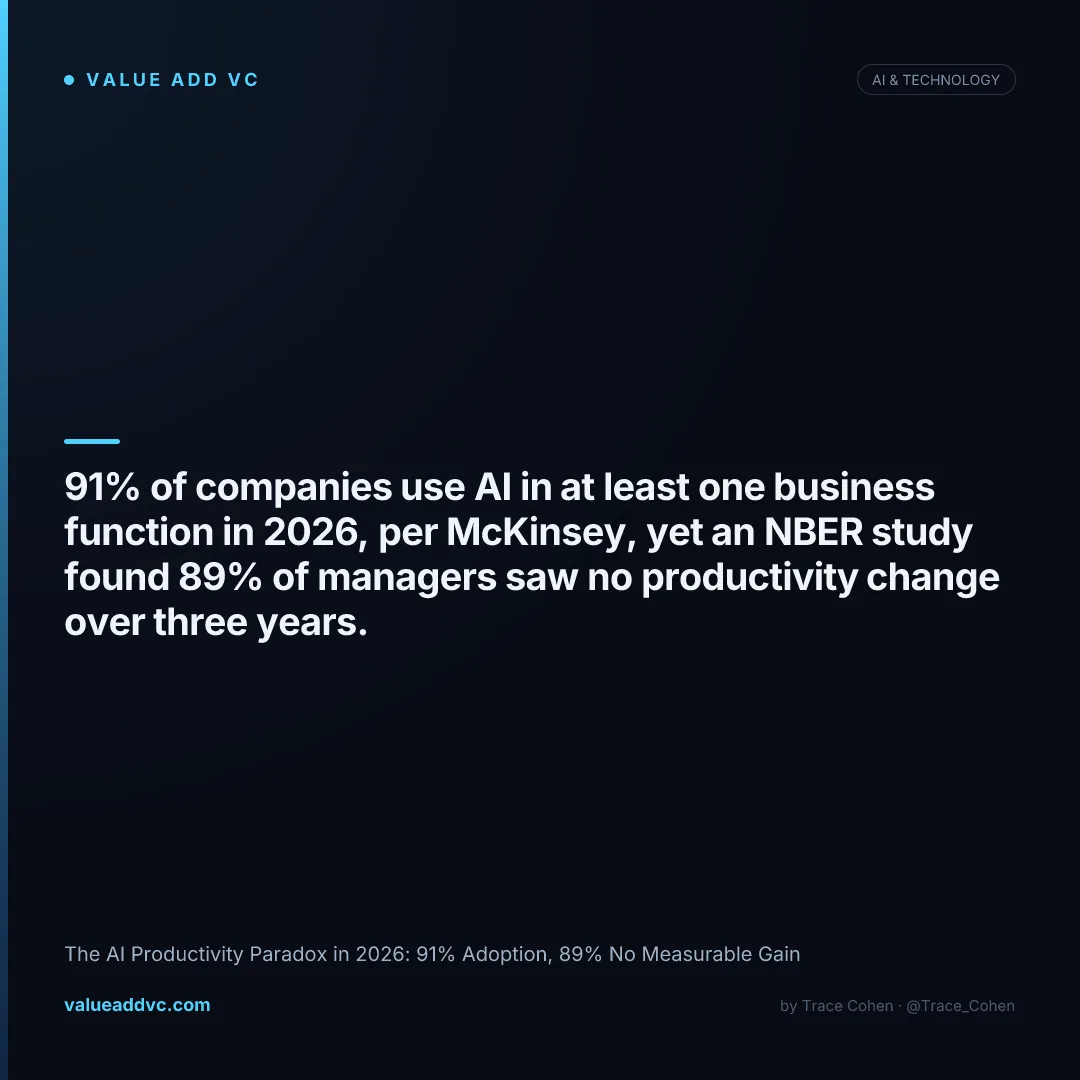
91% of companies now use AI in at least one business function, yet 89% of managers say productivity hasn't changed in three years. That's the short answer. The longer answer is more interesting.
Every enterprise software vendor, every earnings call, every McKinsey deck says the same thing: AI adoption is at an all-time high. That part is true. What's also true, and far less discussed, is that the productivity data isn't following. NBER researchers surveying thousands of firms found the vast majority of managers can't detect any change in output per employee, and McKinsey's own numbers show only 39% of organizations can point to a measurable EBIT impact from any of it. This is the AI productivity paradox — and in 2026, it has enough data behind it to stop being a hunch and start being a pattern worth underwriting around.
What Is the AI Productivity Paradox in 2026?
The AI productivity paradox in 2026 describes the gap between near-universal AI adoption and the near-total absence of measurable company-wide productivity gains. 91% of firms report using AI in at least one function, and 72% have a generative AI workload in production, yet an NBER study of managers found 89% saw no change in productivity over three years, and McKinsey found only 39% of organizations can trace any enterprise-level EBIT impact to their AI spending.
The name is a deliberate callback to economist Robert Solow's 1987 line about computers: "You can see the computer age everywhere but in the productivity statistics." It took roughly a decade for IT spending to show up in national productivity data in the 1990s. Some economists now expect AI to follow a similar, if compressed, timeline — but 2026's numbers suggest the lag is real and worth pricing into how VCs underwrite AI-native companies claiming productivity-driven revenue models.
The Adoption Numbers vs. the Impact Numbers
Line up the adoption statistics next to the impact statistics and the paradox becomes obvious. Adoption keeps climbing every quarter. The share of firms that can point to a bottom-line result from that adoption barely moves.
| Metric | 2026 Figure | Source |
|---|---|---|
| Firms using AI in at least one function | 91% | McKinsey / Azumo, 2026 |
| Gen AI workload in production | 72% (up from 55% in 2024, 20% in 2020) | McKinsey State of AI, Q1 2026 |
| Managers reporting no productivity change | 89% | NBER firm survey, 2026 |
| Orgs with any measurable EBIT impact | 39% | McKinsey Global AI Survey |
| Gen AI deployments with zero P&L impact | 95% | MIT / industry survey aggregation, 2026 |
| CEOs reporting a revenue increase from AI | 30% | PwC CEO Survey, 2026 |
| CEOs reporting costs went up because of AI | 22% | PwC CEO Survey, 2026 |
| Median AI ROI, enterprise-wide | 2.4x (vs 1.6x in 2024) | McKinsey, 2026 |
| Worker confidence in AI's utility, YoY change | down 18% | ManpowerGroup Global Talent Barometer, 2026 |
| Regular AI use among workers, YoY change | up 13% | ManpowerGroup Global Talent Barometer, 2026 |
Figures are 2026 estimates blended from McKinsey's State of AI and Global AI Survey, NBER firm-level research, PwC's annual CEO Survey, and ManpowerGroup's Global Talent Barometer (nearly 14,000 workers across 19 countries). Adoption and impact figures are drawn from different survey populations and are not perfectly apples-to-apples, but the directional gap is consistent across all four sources.
Why Knowing More Hasn't Made Companies Act Faster
The individual-task data is genuinely strong. A Stanford/MIT study of customer service agents found a 14% average productivity increase from AI assistance, with the largest gains going to less-experienced workers who benefited most from having an expert system to lean on. Across other controlled studies, researchers have documented gains ranging from 14% to 55% on specific, well-defined tasks. If those numbers scaled linearly to the enterprise level, the 2026 productivity paradox wouldn't exist.
It doesn't scale linearly for a simple reason: task-level speed isn't the same as firm-level throughput. NBER researchers tracking AI adoption from 61% to 71% of firms between early 2025 and early 2026 found that 89% of managers saw no change in sales volume per employee over the same period. AI often produces a temporary performance dip when it's introduced, followed by stronger output later — a J-curve pattern familiar from every prior general-purpose technology, including electrification and the PC. The firms seeing the strongest gains tended to be the ones that were already digitally mature before they adopted AI, meaning AI amplified existing organizational capability rather than creating it from scratch.
There's also a scaling gap hiding inside the adoption number itself: nearly two-thirds of organizations that say they use AI haven't actually begun scaling it across the enterprise. Most of that 91% adoption figure is pilots, point solutions, and one-off tools bolted onto existing workflows — not the kind of integrated, workflow-level redesign that historically produces measurable productivity gains from new technology. That distinction matters enormously for how AI-native companies are valued: a startup selling a point solution into that 91% is selling into demand that's real but shallow, while one redesigning core workflows is selling into a much smaller, much harder, much more defensible market.
The Coding Version of the AI Productivity Paradox
Software engineering produced the single most-cited data point in this whole debate. In July 2025, METR published a study showing AI coding tools made experienced developers 19% slower on real tasks pulled from their own open-source repositories — even though those same developers estimated AI had made them 20% faster. The gap between felt speed and measured speed was the headline, and it reframed how CTOs think about engineering productivity claims from AI vendors across the industry.
METR revisited the finding in February 2026 and found its original methodology had a real flaw: developers who benefited most from AI tools refused to participate in the no-AI control condition, even when offered $50 an hour to do so, which skewed the sample toward AI-skeptical participants. The retest found an 18% slowdown persisted for the original cohort, but only a 4% slowdown for newly recruited developers — a narrower, noisier effect that still didn't show a clear productivity win, but moved meaningfully closer to neutral as tooling and prompting habits matured over six months.
What the AI Productivity Paradox Means for VCs and Operators
Discount productivity-gain claims in pitch decks that cite individual-task studies (the 14-55% range) as if they translate directly to company-wide EBIT — the enterprise data says they mostly don't, at least not yet, and diligence should ask for firm-level output metrics, not task-level demos
Favor AI startups selling into workflow redesign over point-solution tools — the 89% no-change figure is concentrated in firms bolting AI onto existing processes, while the minority of firms seeing real gains had already restructured how the work gets done
Expect a J-curve in portfolio companies' own AI rollouts — a temporary dip in output after AI tools are introduced is normal and consistent with every prior general-purpose technology transition, not a signal the investment failed
Treat 'AI adoption rate' as a vanity metric on its own — 91% adoption and 72% production deployment tell you almost nothing about whether a company is capturing value; ask specifically what share of AI deployments have moved past pilot into the 39% that show measurable EBIT impact
Worker sentiment is diverging from usage — regular AI use is up 13% among workers while confidence in AI's utility is down 18% over the same period, a gap worth watching in any company whose AI strategy depends on voluntary employee adoption rather than mandated workflow change
Is the AI Productivity Paradox Just a Timing Problem?
Partly, yes. Electrification took roughly three decades to show up fully in U.S. manufacturing productivity data because factories initially just bolted electric motors onto steam-era floor plans instead of redesigning the layout around distributed power. Enterprise IT took about a decade to show up in the 1990s productivity statistics for similar reasons — Solow's paradox was ultimately resolved by patience and organizational redesign, not by better computers. If AI follows even a compressed version of that curve, 2026's 39% EBIT-impact figure could look very different by 2028 or 2029.
But timing isn't the whole story, and treating it as the whole story is itself a risk. McKinsey's own 5.8x average ROI figure for AI investments that reach production within 14 months shows the gains are real and fast once a deployment actually scales — the bottleneck isn't the technology maturing, it's the two-thirds of organizations that haven't restructured their workflows around it yet. That's a management and change-management problem more than a technology-adoption-curve problem, and it means the paradox won't resolve itself just by waiting for better models.
The Bottom Line
91% adoption and 89% no measurable productivity change can both be true at once, and in 2026 they are. The individual-task gains — 14% for customer service agents, up to 55% in some controlled studies — are real, but they're getting absorbed by organizations that adopted AI as a point solution instead of a workflow redesign. The 39% of firms seeing real EBIT impact prove the gains are achievable; the other 61% prove adoption alone isn't the same as capturing value. For VCs, that gap is exactly where the next wave of AI-native winners and pretenders gets sorted.
For more on how AI productivity claims hold up under scrutiny, see our breakdown of the METR and McKinsey coding studies. Track how AI-native companies are being valued on the AI Valuations dashboard at Value Add VC.
Latest from the Pulse
Get VC data most people never see
— free to subscribe
Trace's notes on venture, AI and startups, a few times a week. Join 5,000+ subscribers. No spam.
No spam, unsubscribe anytime. Sent via Substack · Privacy · or subscribe on Substack ↗