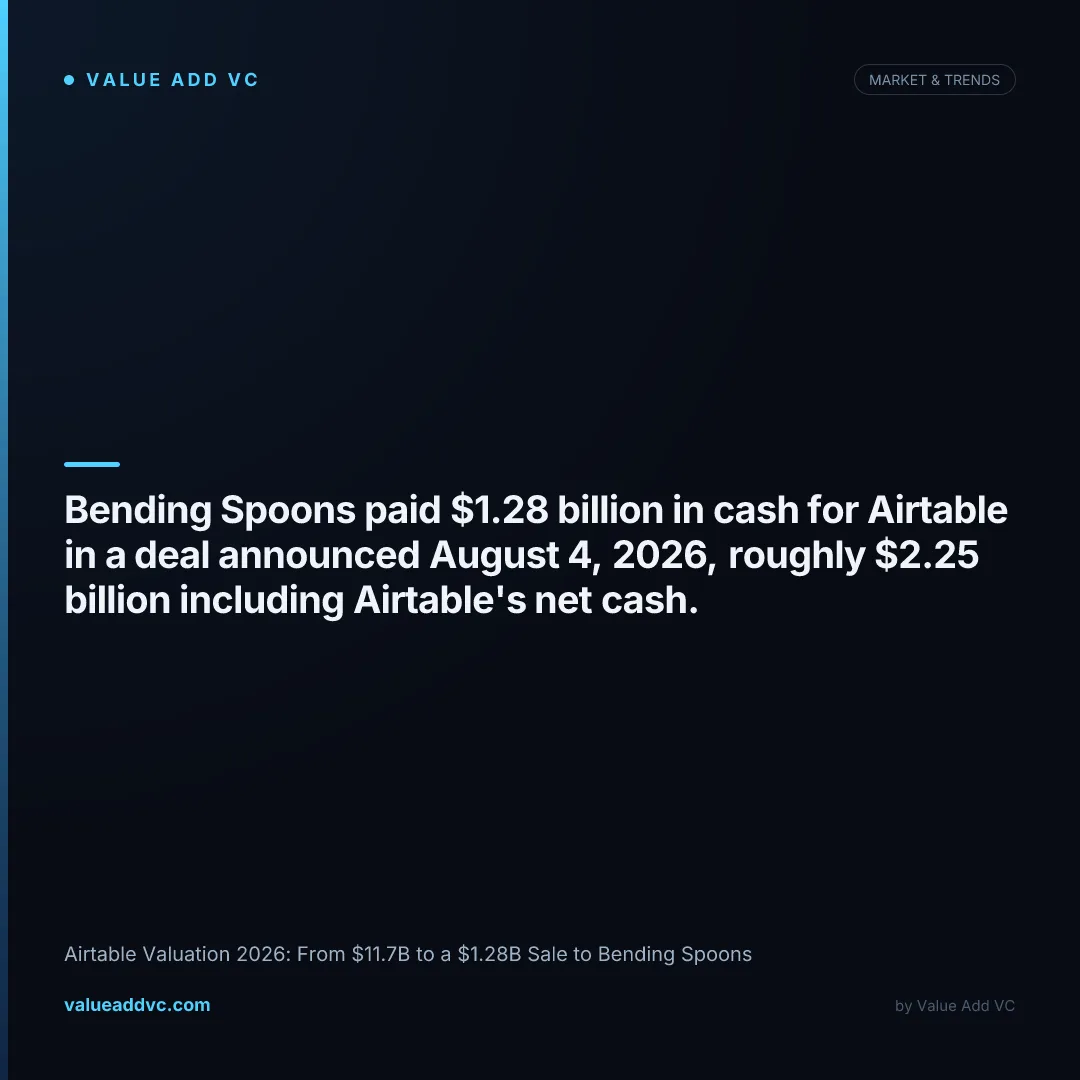
Airtable sold to Bending Spoons for $1.28 billion in cash, announced on August 4, 2026, about 2.7x its roughly $480 million of ARR. In December 2021 investors had valued the no-code database company at $11.7 billion, so the sale settles what Airtable is worth and shows how far 2021 software prices have fallen.
"Airtable valuation" now has two answers that both matter: the price a buyer paid in 2026, and the paper marks that employees and investors held before it. This page lays out each mark with its source, explains the gap between the $1.28 billion headline and the roughly $2.25 billion equity value, and covers what the preference stack meant for who got paid. All figures are as of October 2026.
Sources: TechCrunch (Aug 4, 2026); SaaStr deal analysis (Aug 2026).
Airtable Valuation 2026: What Bending Spoons Paid
Bending Spoons agreed to acquire Airtable for $1.28 billion in an all-cash transaction, TechCrunch reported, which valued the company at approximately $2.25 billion once Airtable's net cash is counted. SaaStr described the same deal as a $1.285 billion enterprise value and roughly $2.25 billion of equity value. The deal closed on September 4, 2026, per SaaStr's October 14 review of Bending Spoons' results.
The difference between the two numbers is cash Airtable already had. In January 2026 founder and CEO Howie Liu told TechCrunch that Airtable had raised $1.4 billion and still had about half of it in the bank while "throwing off cash." A buyer paying $1.28 billion for the business effectively also takes ownership of that balance, which is why shareholders received more than the headline price.
How Did Airtable's Valuation Change Over Time?
Airtable's price more than doubled twice in 2021, then fell for four years. Its $270 million Series E in March 2021 set a $5.77 billion post-money valuation, "more than doubling" the price of its $185 million Series D the previous September, TechCrunch reported; Greenoaks led, with WndrCo, Caffeinated Capital, CRV and Thrive. Nine months later a $735 million Series F valued it at $11.7 billion, when Airtable's ARR was about $156 million, per SaaStr.
| Mark | Date | Amount | Valuation | Source |
|---|---|---|---|---|
| Series D | Sep 2020 | $185M | Less than half the Series E price | TechCrunch |
| Series E | Mar 2021 | $270M | $5.77B post-money | TechCrunch |
| Series F | Dec 2021 | $735M | $11.7B | TechCrunch, SaaStr |
| Secondary market | Jan 2026 | n/a | ~$4B | TechCrunch |
| Bending Spoons sale (EV) | Aug 2026 | $1.28B cash | ~$2.25B incl. net cash | TechCrunch, SaaStr |
| Sale / ARR multiple | Aug 2026 | n/a | ~2.7x of ~$480M ARR | SaaStr |
Sources: TechCrunch (Mar 2021, Jan 2026, Aug 2026); SaaStr (Aug 2026). Secondary-market prices are indicative trades, not a priced round.
What Was Airtable's Revenue When It Sold?
Airtable had approximately $480 million of annual recurring revenue as of June 2026, growing more than 20% year over year, TechCrunch reported at the deal announcement. SaaStr added that gross margins ran about 90% and that the company had been cash-flow positive since late 2024, generating more than $100 million a year. Airtable served more than 500,000 organizations, including 80% of the Fortune 100.
On those numbers Airtable was a healthy business, just not a fast-growing one. Going from about $156 million of ARR at the 2021 peak to about $480 million in mid-2026 is roughly a tripling in four and a half years. The 2021 price had assumed something closer to a doubling every year or two. Value Add VC's arithmetic: the Series F priced Airtable at about 75x its ARR at the time; Bending Spoons paid about 2.7x.
Who Got Paid in the Airtable Sale?
Liquidation preferences decided most of the outcome. SaaStr estimated that Series F investors recovered roughly 1x their $735 million, Series E and D holders also roughly 1x, Series C between 1x and 1.7x, and Series A investors an estimated 15-25x. SaaStr put common shareholders, which includes most employees, at about $18-25 per share against $187.28 per share in the last priced round. Those are outside estimates; the deal terms by share class were not disclosed.
Airtable: 2021 Peak vs 2026 Sale
TechCrunch, Aug 2026; SaaStr estimates, Aug 2026
Preferred stock is generally paid back before common stock in a sale, which is how a sale far below the last round can return capital to late-stage funds while common stock takes most of the markdown. See liquidation preferences explained.
Why Did Bending Spoons Buy Airtable?
Bending Spoons buys established software products and runs them with smaller teams; it also owns Evernote, WeTransfer, Eventbrite and Vimeo, and Airtable was its first acquisition after a July 2026 IPO at an $18 billion valuation, per TechCrunch. Founder Luca Ferrari called Airtable "a pioneering brand reshaping how teams organize data and manage critical workflows." Its stated operating view, quoted in its October layoff announcement, is that "small teams ship more and better."
For founders and investors, the read-across is direct. Two well-known 2021-vintage unicorns sold at 2-3x revenue within weeks of each other to the same cost-focused acquirer, which put $1.08 billion of ARR under Bending Spoons for $2.64 billion of enterprise value across deals signed 37 days apart, per SaaStr. That sets a reference price for software companies with good margins and modest growth that last raised at peak multiples. Our SaaS valuation multiples guide covers how growth rate drives that range, and the Bending Spoons valuation breakdown covers the buyer.
How Much Money Did Airtable Raise?
Airtable raised more than $1.4 billion over its life as a private company, most of it in 2021. By the time of its March 2021 Series E it had raised $617 million in total and served 250,000 organizations, TechCrunch reported then; the $735 million Series F later that year more than doubled the total. That timing is the root of the valuation problem: more than half of Airtable's capital came in at the two highest prices it ever set.
Much of that money was never spent. When Airtable cut about a fifth of its staff in December 2022, Liu told TechCrunch the company had "more than enough runway to get to profitability and then some" and that the Series F funds were still intact. Three years later he told TechCrunch that about half of the $1.4 billion was still in the bank. A company that kept roughly $700 million of unspent cash and was cash-flow positive did not need to sell, which suggests the sale was a choice about price and liquidity rather than survival. That is our read; neither company has described the board's reasoning.
Airtable vs Miro: Two 2021 Unicorns, One Buyer
Bending Spoons signed a second, almost identical deal on September 10, 2026: a definitive agreement to acquire Miro at an enterprise value of $1.355 billion, or about $1.79 billion including Miro's net cash, per Bending Spoons' SEC filing. Miro had around $600 million of ARR, nearly 90% from business and enterprise customers, and the deal is expected to close in the fourth quarter of 2026. The same filing confirmed that Bending Spoons had completed the Airtable acquisition the week before. Miro's last round, in 2021, had valued it at $17.5 billion, SaaStr noted, adding that "Airtable got one offer. Miro got one offer."
| Metric | Airtable | Miro |
|---|---|---|
| Deal announced | Aug 4, 2026 | Sep 10, 2026 |
| Enterprise value | $1.285B | $1.355B |
| Equity value incl. net cash | ~$2.25B | ~$1.79B |
| ARR at sale | ~$480M (June 2026) | ~$600M |
| EV / ARR (Value Add VC arithmetic) | ~2.7x | ~2.3x |
| 2021 peak private valuation | $11.7B | $17.5B |
| Status, Oct 2026 | Closed Sep 4, 2026 | Expected to close Q4 2026 |
Sources: TechCrunch and SaaStr (Airtable, Aug 2026); Bending Spoons SEC filing (Miro, Sept 10, 2026); SaaStr (Miro's 2021 valuation).
Did AI Change Airtable's Price?
Airtable spent its last independent year rebuilding around AI, and the sale price suggests buyers did not pay for it. Starting in June 2025 it shipped Omni and Field Agents and acquired DeepSky, which brought in ChatGPT's former business-products engineering lead as CTO, SaaStr reported; in January 2026 it launched Superagent, its first stand-alone product in 13 years, a coordinating agent that dispatches specialist agents in parallel, per TechCrunch. SaaStr's verdict was that the rebuild "did not move the trajectory to a number that changes the multiple." Growth of a little over 20% is what the buyer priced.
What Happened to Airtable After the Sale?
Bending Spoons closed the deal on September 4, 2026, a month after signing, and in October announced that it was "laying off a large part of the Airtable team," SaaStr reported. Airtable had 935 employees when the agreement was signed, up from the "more than 700" Liu cited in January. On our read, the cuts follow the buyer's usual playbook and help explain why it can pay only 2-3x revenue and still earn a return: a business with 90% gross margins and lower headcount can throw off far more cash than it did under venture ownership.
The buyer's own numbers show why it keeps buying. Bending Spoons reported second-quarter 2026 revenue of $704 million, up 126%, but organic growth of only 3%, down from 6% in the first quarter, per the same SaaStr analysis. In other words, acquisitions such as Airtable are most of its growth. For Airtable's product, that likely means the priority shifts from new bets toward retention and pricing on its existing base of more than 500,000 organizations.
What the headline misses
"Airtable lost 89% of its value" is true only against a 2021 paper mark that few shares ever traded at. Airtable reached real scale, was profitable on a cash basis, sold for cash and returned capital to most preferred investors. The losers were holders of common stock and options priced near the peak, and the employees cut after the sale. Airtable had also cut 491 people across two layoff rounds before the deal, per SaaStr, including about 254 roles, 20% of staff, in December 2022, TechCrunch reported.
The Bottom Line
Airtable's final valuation is a $1.28 billion cash sale, about $2.25 billion with its cash pile, for a business with roughly $480 million of ARR and 90% gross margins. The distance from $11.7 billion is the clearest single example of how the 2021 software marks have resolved, and it gives every late-stage SaaS cap table a concrete number to test against. Follow the deal coverage on the Airtable company page.
Published by Value Add VC · Editor-in-chief: Trace Cohen. Get the weekly read on startup funding in the Value Add newsletter.
Latest from the Pulse
Get VC data most people never see
— free to subscribe
Trace's notes on venture, AI and startups, a few times a week. Join 5,000+ subscribers. No spam.
No spam, unsubscribe anytime. Sent via Substack · Privacy · or subscribe on Substack ↗