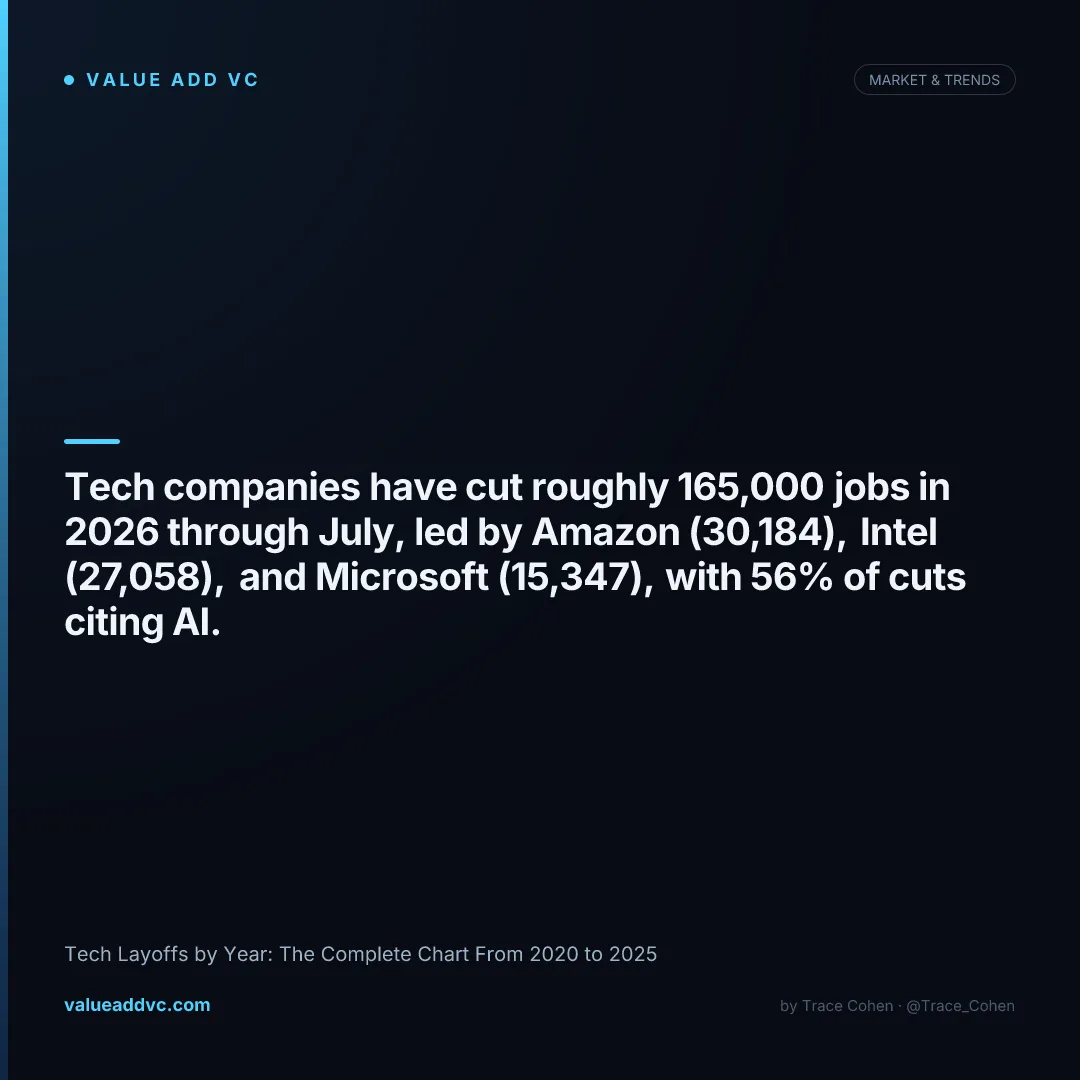
Roughly 165,000 tech workers have been laid off in 2026 through early July, led by Amazon's 30,184 cuts, while IT unemployment has simultaneously fallen to 2.9% and software engineering postings are up 11% year over year.
That contradiction — record layoffs and a genuine hiring rebound happening at the same time — is the defining feature of the 2026 tech labor market. It isn't one story of "tech is cutting" or "tech is hiring." It's the same companies doing both: pruning legacy headcount while racing to hire senior, AI-fluent engineers. Here's who's cutting, who's hiring, and what the actual numbers say about where this settles.
Tech layoffs 2026: which companies are still cutting
Tech layoffs in 2026 have already surpassed most full prior years on some trackers. TrueUp counts 438 layoff events affecting 165,331 workers through early July, Skillsyncer counts 267 events affecting 185,894 workers, and the narrower Layoffs.fyi tracker puts the tech-sector-specific total near 120,000 — the spread reflects different definitions of "tech company," not disagreement on the trend. Q1 2026 alone produced 81,747 layoffs, the highest single quarter the industry has recorded in at least two years, averaging roughly 984 job losses per day industry-wide.
Amazon leads every 2026 ranking with 30,184 disclosed layoffs, including about 16,000 corporate roles cut in January alone — more than half of that quarter's entire industry total — even as AWS posted 24% growth, its fastest in 13 quarters. Intel follows with 27,058 cuts, Microsoft with 15,347, Oracle with roughly 21,000 over a trailing twelve months, and Meta with 5,800 disclosed so far, with reports suggesting Meta may pursue cuts reducing headcount by as much as 20% later in 2026.
Biggest tech layoffs of 2026, ranked
| Company | 2026 Disclosed Cuts | Stated Driver |
|---|---|---|
| Amazon | 30,184 | Corporate restructuring, AI efficiency |
| Intel | 27,058 | Cost cuts, foundry restructuring |
| Oracle | ~21,000 (TTM) | AI/cloud reorganization |
| Microsoft | 15,347 | Management layer reduction, AI investment |
| Meta | 5,800 | Reality Labs, org restructuring |
| Industry total (TrueUp, YTD) | 165,331 | n/a |
Sources: TrueUp and Skillsyncer layoff trackers, Layoffs.fyi, Visual Capitalist "Biggest Tech Layoffs by Company" ranking, and company disclosures, compiled through early July 2026. Some company figures reflect trailing twelve-month periods rather than strict calendar-year totals.
How much of tech layoffs 2026 is actually about AI
AI, automation, or machine learning is explicitly cited in 56% of 2026 layoff events, affecting roughly 156,270 workers across about 150 companies, based on tracker analysis of company statements. That's a meaningfully higher attribution rate than in 2023 or 2024, when most layoffs were framed around "macro headwinds" or "efficiency." Whether AI is the true driver or a convenient narrative for cuts that would have happened anyway from slower growth and margin pressure is genuinely contested — companies rarely disclose the full internal calculus behind a layoff announcement.
What's less contested is the correlation with capex: the same companies citing AI as a layoff driver — Amazon, Microsoft, Meta, Oracle — are also the ones spending the most on AI infrastructure, with combined 2026 hyperscaler capex estimated near $725 billion. That pattern is consistent with companies reallocating spend from headcount to compute rather than cutting to survive. For more on how that capex is showing up across earnings, see our Big Tech earnings dashboard.
Who's hiring again: the 2026 tech hiring rebound
At the same time layoffs have hit a two-year high, tech hiring is genuinely rebounding on the aggregate labor data. IT unemployment fell to 2.9% in June 2026, dropping below 3% for the first time this year, with employers adding roughly 50,000 IT workers that month, listing 280,000 fresh tech postings, and keeping open tech roles above 600,000 for a second consecutive month. Software engineering job postings are up 11% year over year, and Q1 2026 openings hit 67,000 — the highest level since early 2023.
IT and CS job postings specifically rose 14.2% year over year in April 2026, reinforcing that the rebound isn't a one-month blip. But the composition has shifted hard: AI skills now appear in 42% of software job descriptions, up from just 8% in 2022, meaning the jobs coming back look structurally different from the ones that were cut.
The catch: entry-level tech jobs aren't part of the rebound
The 2026 tech hiring rebound is concentrated almost entirely at the senior level. Junior and entry-level postings fell from 8.1% to 7.4% of the total IT job mix year over year, while senior postings climbed from 38.8% to 43.1% over the same period. Big Tech — the same companies whose 2022-2024 layoffs dominated headlines — is not leading the recovery; their hiring exists, but it's described by labor-market analysts as "surgical," targeting specific AI and infrastructure roles rather than broad-based headcount growth.
That divergence matters for how founders and investors read the "tech is back" headlines. A 2.9% IT unemployment rate and 11% posting growth are real, positive signals, but they mask a labor market that's become more senior-skewed and AI-gated than it was in 2021-2022, when nearly any computer science graduate could find an entry-level role within months. For a broader look at how hiring trends are moving across the tech sector, see our hiring dashboard and layoffs tracker.
What tech layoffs 2026 mean for startup hiring
For founders, the 2026 layoff wave is a genuine talent-acquisition opportunity, but a narrower one than in past cycles. The pool of available senior engineers laid off from Amazon, Intel, and Microsoft is real and large — over 72,000 combined from just those three companies — but competition for that talent is fierce given how tight senior-level hiring has become across the rest of the market. Startups that can move fast on comp and equity for AI-fluent senior engineers are seeing some of the best available talent in years; startups looking for cheap junior hires will find that market has actually tightened, not loosened.
For VCs, the 165,000-plus layoffs are also a portfolio signal: companies still cutting aggressively in mid-2026 — more than four years after the original 2022 correction began — suggests some of this isn't cyclical anymore. It's a structural reallocation of headcount budget toward compute, which has direct implications for how growth-stage companies should be modeling opex as they build their own AI roadmaps. Track how these dynamics are showing up in valuations on our SaaS valuations dashboard.
Tech layoffs 2026 by sector: not every corner of tech is cutting
The 2026 layoff wave is heavily concentrated in a handful of sub-sectors rather than spread evenly across the industry. Semiconductor and legacy hardware (Intel), cloud infrastructure reorganizations (Oracle, parts of Microsoft), and e-commerce logistics/corporate overhead (Amazon) account for the large majority of 2026's disclosed cuts. Cybersecurity, applied-AI tooling, and infrastructure-as-code companies have been far less represented on the layoff trackers, and several have posted net headcount growth even as their larger peers cut thousands.
That sector split lines up with where AI capex is actually flowing. Companies building the AI stack — chips, cloud compute, model infrastructure — are simultaneously the ones cutting adjacent legacy headcount hardest, because the capex bill for AI infrastructure is enormous and something has to give in the budget. Amazon's pattern is the clearest example: 16,000 corporate layoffs in a single January quarter alongside AWS's fastest growth in 13 quarters is not a company in distress, it's a company reallocating tens of thousands of headcount-dollars into compute and senior AI engineering talent.
Severance and re-employment: what happens to the 165,000 cut in 2026
Most large 2026 layoffs at Amazon, Microsoft, and Intel came with severance packages in the range of 2-6 months of base pay plus extended healthcare coverage, broadly consistent with 2023-2024 severance norms at large-cap tech companies. Re-employment data is harder to track precisely, but the same labor-market indicators showing 2.9% IT unemployment and rising senior postings suggest a meaningfully faster re-employment window than during the 2022-2023 layoff wave, when senior engineers routinely reported 4-6 month job searches.
The gap between "165,000 people laid off" and "2.9% IT unemployment" is itself informative: it implies the market is absorbing most of that displaced talent within the same measurement window rather than accumulating a growing pool of long-term unemployed tech workers, which was a real concern earlier in the 2022-2024 cycle. That's a meaningfully healthier churn pattern than the headline layoff totals alone would suggest, even if it doesn't make any individual round of cuts easier for the people affected.
Bottom line
Tech layoffs and tech hiring are both accelerating in 2026 at the same time — roughly 165,000 jobs cut through early July, led by Amazon's 30,184 and Intel's 27,058, while IT unemployment falls to 2.9% and software engineering postings climb 11% year over year. The reconciling story is that this is a reallocation, not a contraction: companies are cutting legacy and mid-level headcount to fund AI capex and senior, AI-fluent hiring. That's good news for experienced engineers and for startups that can compete for them, and a harder market than the headline numbers suggest for anyone looking for an entry-level tech job in 2026.
Latest from the Pulse
Get VC data most people never see
— 100% free
Weekly benchmarks, valuations, and fund data. Join 5,000+ investors. No spam.