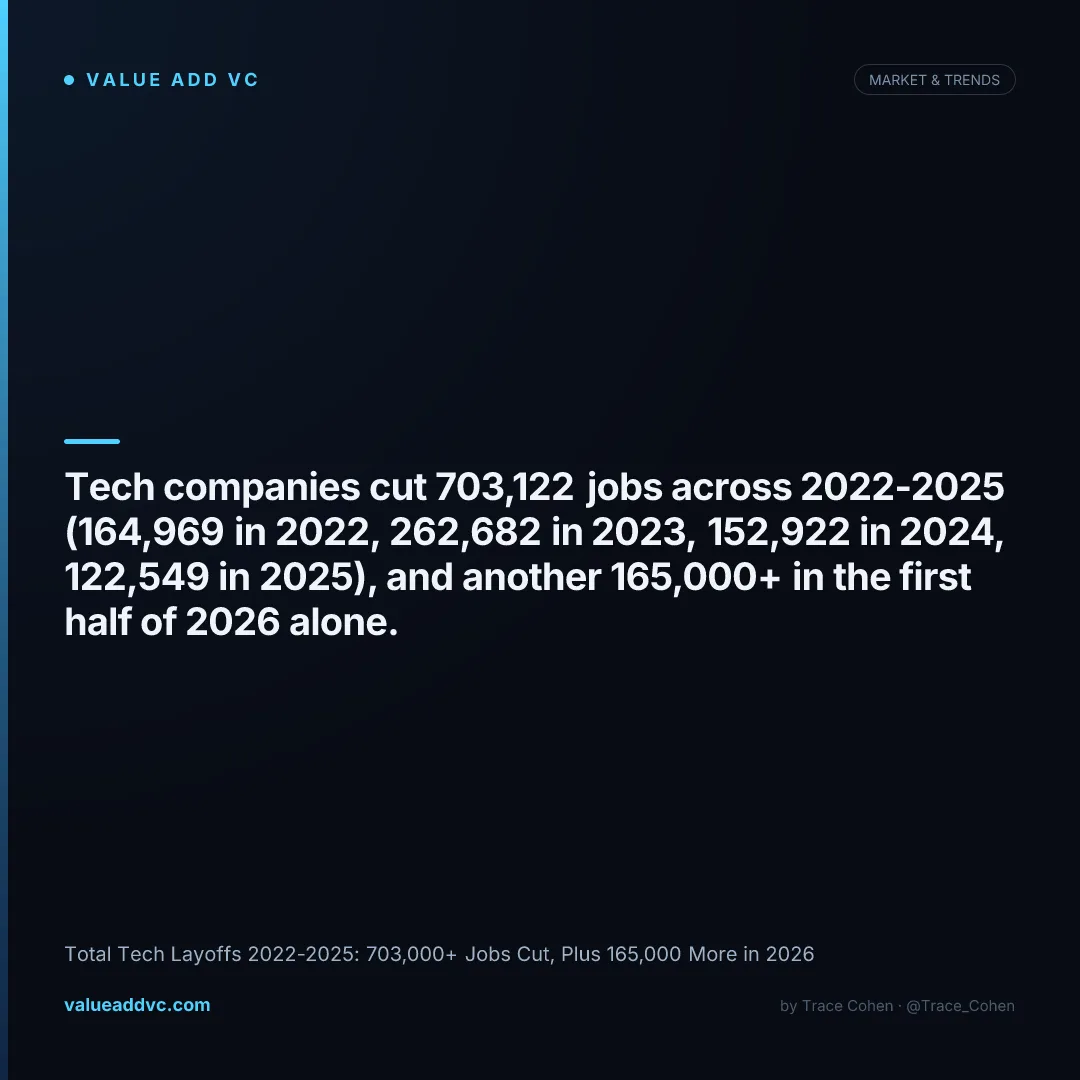
Tech companies cut 703,122 jobs across 2022-2025, and another 165,000+ in the first half of 2026 alone — pushing the cumulative total since 2020 past 950,000. That's the short answer. The longer answer is that the driver has shifted from a post-pandemic hiring correction to something closer to an AI-driven payroll reallocation.
2023 remains the single worst year on record at 262,682 job cuts, nearly 60% above 2022's 164,969. Layoffs then fell two years running — down to 152,922 in 2024 and 122,549 in 2025 — before reaccelerating sharply in 2026, when Oracle alone cut roughly 30,000 positions in a single announcement. Here's the year-by-year total, the cumulative math, and what actually drove each wave.

Annual totals per layoffs.fyi (2020-2025); 2026 H1 figure blended from TrueUp and Crunchbase trackers as of July 2026; AI-attribution share per Challenger, Gray & Christmas monthly reports.
Total Tech Layoffs 2023, 2024, and 2025 Cumulative: The Numbers
Combined, 2023, 2024, and 2025 accounted for roughly 538,153 tech layoffs — 262,682 in 2023, 152,922 in 2024, and 122,549 in 2025. Add 2022's 164,969 and the four-year total from 2022 through 2025 comes to 703,122 jobs cut across more than 2,000 tracked companies, per layoffs.fyi. That figure alone exceeds the entire tech workforce of most mid-sized countries' capital cities.
The trend line from 2023 to 2025 looked like recovery: cuts fell 42% from 2023 to 2024, then another 20% from 2024 to 2025. That narrative broke in 2026. With more than 165,000 jobs already cut by midyear across roughly 300-470 tracked layoff events (trackers vary on exact company counts), 2026 is on pace to be the worst year since 2023 — and the reason cited has changed from "over-hired during COVID" to "AI is doing the work."
The Cumulative Total: What 950,000+ Layoffs Since 2020 Looks Like
Stacking every year since the pandemic hiring boom began unwinding produces a cumulative total north of 950,000 tech jobs cut since January 2020. The math: roughly 79,232 in 2020 (mostly pandemic-onset cuts), 15,268 in 2021 (a brief trough during the hiring boom), then the four-year run of 164,969, 262,682, 152,922, and 122,549 from 2022-2025, plus 165,000+ so far in 2026. That's a running total of roughly 962,622 — and climbing, since 2026 isn't even half over.
For context on how this compares to hiring trends on the other side of the ledger, see our Hiring dashboard, and track the layoff pace in real time on our Layoffs dashboard.
What Drove Each Wave of Layoffs
The 2022-2023 wave (427,651 combined cuts) was driven almost entirely by pandemic over-hiring correction. Companies like Meta, Amazon, and Salesforce had staffed for a growth curve that assumed 2020-2021 e-commerce and remote-work demand would persist, and when it normalized, headcount didn't match revenue. Rising interest rates compounded the problem by cutting off cheap growth capital for unprofitable startups almost overnight.
The 2024-2025 wave (275,471 combined cuts) was a mix of continued cost discipline and the first visible signs of AI-driven efficiency — companies kept trimming middle-management layers and support functions even as revenue stabilized, a pattern documented in our startup hiring data post. The 2026 wave is different in kind, not just scale: Challenger, Gray & Christmas data shows AI cited as the reason for roughly 40% of announced cuts in May 2026, up from just 7% in January — a nearly 6x jump in six months.
Oracle's roughly 30,000-person cut (about 20% of its global workforce) targeted legacy database administration and on-premises support — functions AI tooling and cloud migration have made structurally smaller. Meta cut 8,000 roles (about 10% of headcount), concentrated in recruiting and HR, where AI-driven applicant screening and internal tooling reduced the need for large support teams. Amazon cut an estimated 14,000-16,000 corporate roles in Q1 2026 even as AWS revenue grew 24% — a signal that the cuts track cost discipline and AI leverage, not business weakness.
Total Tech Layoffs by Company: The Biggest Single Cuts
The table below shows the largest individual layoff events across the 2022-2026 window, illustrating how the drivers shifted from broad pandemic-correction cuts to targeted, AI-justified restructurings.
| Company | Year | Jobs Cut | % of Workforce | Stated Driver |
|---|---|---|---|---|
| Meta | 2023 | ~21,000 (two rounds) | ~24% | Pandemic over-hiring correction |
| Amazon | 2023 | ~27,000 (two rounds) | ~9% | Cost discipline, e-commerce normalization |
| Google/Alphabet | 2023 | ~12,000 | ~6% | Pandemic over-hiring correction |
| Salesforce | 2023 | ~8,000 (two rounds) | ~10% | Growth-rate normalization |
| Intel | 2024 | ~15,000 | ~15% | Chip market share losses |
| Cisco | 2024 | ~6,000 (two rounds) | ~7% | Cost restructuring |
| Oracle | 2026 | ~30,000 | ~20% | AI/cloud migration, legacy support cuts |
| Amazon | 2026 | ~14,000-16,000 | ~1-2% | AI efficiency, corporate role cuts |
| Meta | 2026 | ~8,000 | ~10% | AI-driven recruiting/HR efficiency |
| 2026 | ~1,000+ | n/a | AI restructuring under Microsoft |
Compiled from layoffs.fyi, TechCrunch layoff trackers, and company press releases/SEC filings, 2023-2026. Percentages are approximate and based on workforce size at time of announcement; some companies conducted layoffs in multiple rounds within a year.
Is the AI-Driven Layoff Wave Different From 2022-2023?
Yes, structurally. The 2022-2023 wave was a correction — companies gave back headcount they'd added on the assumption pandemic-era growth rates would continue, and once trimmed, the cuts largely stopped (2024 and 2025 both declined). The 2026 wave is happening at profitable, growing companies: Amazon cut corporate roles while AWS grew 24%, and Big Tech overall is simultaneously increasing capex to roughly $730 billion in 2026 (up 78% from $410 billion in 2025), largely to fund AI data centers and chips.
That combination — cutting payroll while raising capex — suggests 2026's layoffs function partly as a funding mechanism for the AI infrastructure buildout, not purely a response to weak demand. Track how that capex reallocation is showing up in earnings on our Big Tech Earnings dashboard. If the pattern holds, 2026 could close out above 300,000 total cuts — which would make it the second-worst year on record after 2023, and the first year where a majority of cuts explicitly cite AI as the driver rather than macro correction.
How Founders and VCs Should Read the Cumulative Number
For founders building a hiring plan in the second half of 2026, the practical takeaway isn't the headline 950,000 figure — it's where the cuts are concentrated. The 2026 wave is overwhelmingly a large-company phenomenon: Oracle, Amazon, Meta, and Salesforce collectively account for the majority of this year's job losses, while venture-backed startups under 500 employees have been a smaller share of total cuts than in 2022-2023. That matters for recruiting, because a fresh supply of laid-off senior engineers, product managers, and AI specialists from large companies is now hitting the market at a pace not seen since 2023 — and early-stage startups with cash in the bank are in a stronger position to hire that talent than they were even a year ago.
It also changes how LPs and VCs should model portfolio company burn. A startup that assumed 2021-era headcount costs to hit a revenue milestone is now competing for talent against a labor market with meaningfully more senior supply, which has kept comp growth flat to slightly down at the senior level in 2026 even as demand for AI-specific skills has pushed up pay for that narrower slice of roles. Funds tracking portfolio company efficiency should expect burn multiples to keep compressing through the back half of 2026 as this labor supply shift plays out — a dynamic worth watching alongside broader capital efficiency trends on our VC Performance dashboard.
There's a regional dimension too. Layoffs in 2022-2023 were heavily concentrated in the Bay Area and Seattle, home to the largest hyperscalers. The 2026 wave, driven more by legacy enterprise software and cloud infrastructure restructuring at companies like Oracle and Cisco, has a broader geographic footprint, including significant cuts in Austin, the Research Triangle, and parts of the Midwest where those companies run large operational centers. That's a meaningfully different labor-market shock than the coastal-tech-hub-specific corrections of 2022-2023, and it's part of why total 2026 cuts are already competitive with full prior years despite starting from a lower base than 2023.
What Happens to Total Tech Layoffs for the Rest of 2026
If the current pace holds — roughly 165,000 cuts in six-plus months, an average that has been accelerating rather than decelerating month over month through 2026 — the full-year total could land anywhere from 280,000 to 330,000, which would make 2026 the second-worst year on record behind only 2023's 262,682. That range assumes no single mega-layoff on the scale of Oracle's 30,000-person cut repeats in the second half of the year; if one does, the full-year number could challenge the 2023 record outright.
The bigger structural question is whether the AI-driven share of cuts (40% and rising as of May 2026) plateaus or keeps climbing. Challenger, Gray & Christmas data shows the AI-attribution share moved from 7% in January to 40% in May — if that trajectory continues even at a slower rate, AI could be cited in a majority of tech layoff announcements by the end of 2026, which would mark the first year where AI, rather than macro correction, is the dominant stated driver of job cuts in the sector.
That shift has knock-on effects worth tracking closely: it changes what "recovery" even means for tech employment, since a rebound in revenue and profitability no longer implies a rebound in headcount the way it did after the 2022-2023 correction. For real-time tracking of company-level cuts and hiring as the second half of 2026 plays out, see our Layoffs dashboard.
Bottom line: Tech companies cut 703,122 jobs from 2022-2025, and another 165,000+ in the first half of 2026 alone, pushing the cumulative total since 2020 past 950,000. 2023 remains the worst single year at 262,682 cuts, but the character of the layoffs has changed — 2026's cuts are happening at profitable companies citing AI in roughly 40% of announcements, up from 7% in January, while capex to fund AI infrastructure rises 78% to about $730 billion. Watch whether 2026 closes above 300,000, which would make it the worst year since the 2023 peak.
Latest from the Pulse
Get VC data most people never see
— free to subscribe
Trace's notes on venture, AI and startups, a few times a week. Join 5,000+ subscribers. No spam.
No spam, unsubscribe anytime. Sent via Substack · Privacy · or subscribe on Substack ↗