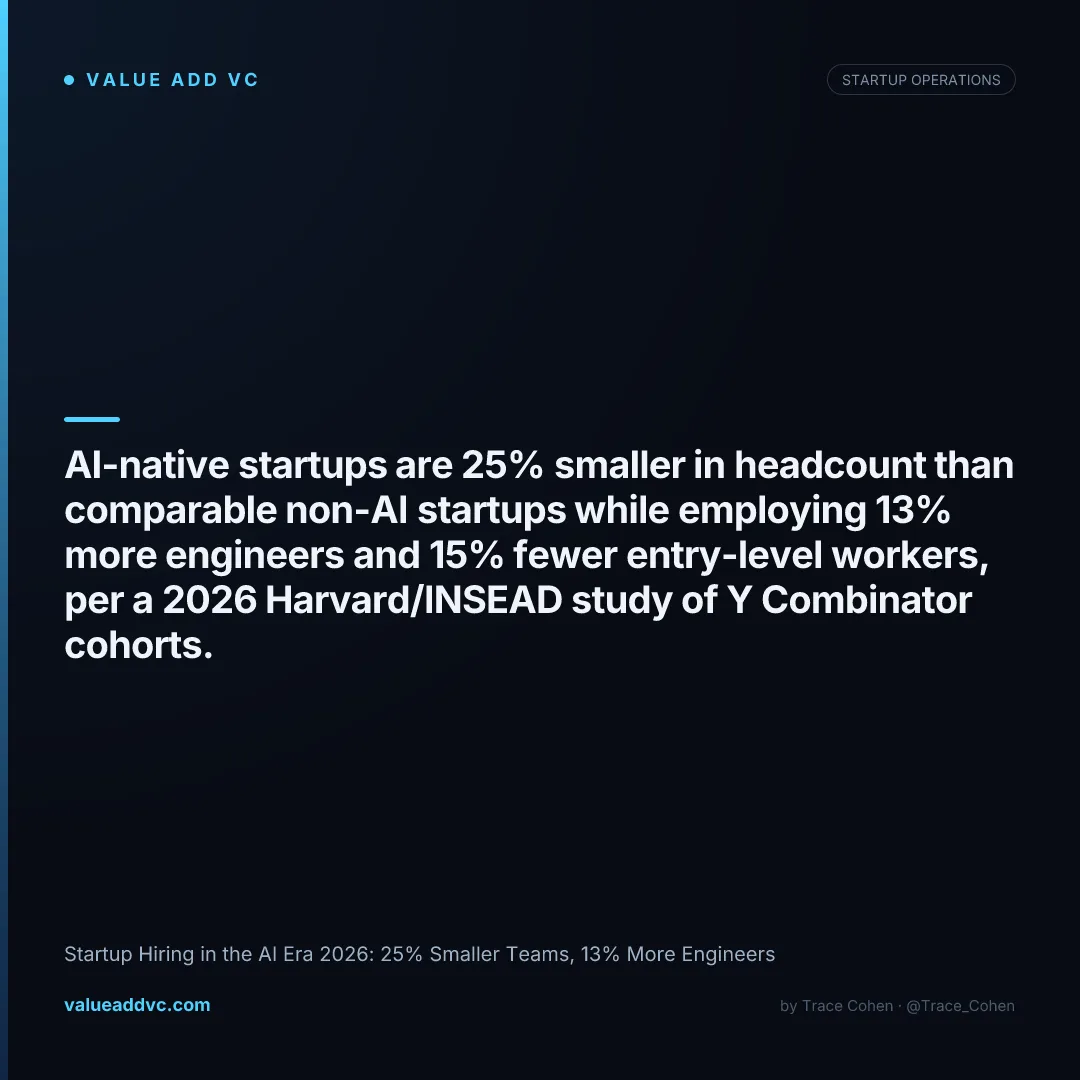
AI-native startups run 25% smaller headcount than comparable non-AI startups while employing 13% more engineers, per a 2026 Harvard Business School and INSEAD study of Y Combinator cohorts. But the cuts aren't happening evenly — they're falling almost entirely on entry-level and middle-management roles.
The working paper analyzed venture-backed companies funded between 2020 and 2024, covering thousands of hires, and found AI-native firms hit similar valuations to their non-AI peers with a fraction of the payroll. That gap shows up starkly in revenue-per-employee data: top AI startups now average roughly $3.5M in annual revenue per employee, against $600K at leading SaaS firms and about $350K cross-industry. Here's what the hiring data actually shows, role by role.
Figures blended from a 2026 Harvard Business School/INSEAD working paper on Y Combinator and venture-backed cohorts (2020-2024), Forbes' March 2026 revenue-per-employee analysis, and company-reported ARR/headcount figures for Gamma, Lovable, Midjourney, and Anysphere.
Startup Hiring in the AI Era: What the Data Actually Shows
Startup hiring in the AI era means smaller total teams staffed with more engineers and fewer generalists, junior hires, and middle managers. The Harvard/INSEAD study found AI-native startups are about 25% smaller in headcount than comparable non-AI startups while employing roughly 13% more engineers, about 15% fewer entry-level employees and managers, and about 20% more senior workers — and they reach similar valuations doing it.
The mechanism is straightforward: AI tooling is absorbing work that used to require dedicated headcount — first-draft code, customer support triage, QA passes, basic data analysis — which shifts the org chart toward senior engineers who can direct AI output and away from the junior staff who used to do that work manually. That's a structural change in how a startup gets from seed to Series A revenue milestones, not a temporary hiring freeze.
AI-Native vs. Non-AI Startup Headcount, Indexed to 100
Harvard Business School / INSEAD working paper on YC and venture-backed cohorts, 2020-2024, published 2026
Revenue Per Employee: The Metric Defining 2026 Startup Hiring
Revenue per employee has become the headline metric investors use to judge whether a startup's hiring philosophy is working. Across the top AI startups, average revenue per employee runs about $3.5M, roughly 5.7x the $600K average among leading traditional SaaS firms and 10x the roughly $350K cross-industry average. The extremes are what get attention: Anysphere, maker of Cursor, reportedly runs over $2B in ARR with around 50 employees — near $40M in revenue per head — and Midjourney generates roughly $200M in annual revenue with about 11 employees, or about $18M per head.
More broadly representative examples show the same pattern at less extreme scale. Gamma, the AI presentation startup, crossed $100M ARR with roughly 50 people, about $2M per employee. Lovable reached $400M ARR in early 2026 with 146 full-time employees, about $2.7M per employee. Compare that to the pre-AI SaaS benchmark, where reaching $100M ARR typically required 300-500+ employees — the ratio has compressed by roughly 6-10x in four years.
Track how these efficiency gains are showing up in valuation multiples on our AI Valuations dashboard, and see current hiring and headcount trends across the broader startup market on our Hiring dashboard.
Why AI Startups Are Hiring Fewer Entry-Level Workers
AI-native companies are more likely to hire graduates from elite universities and candidates with prior AI/ML experience, effectively raising the bar for a role that used to be an entry point into tech. The Harvard/INSEAD data shows this isn't a hiring freeze on juniors specifically — it's that the total number of junior-suited tasks has shrunk, because AI tools now handle the first-draft code review, ticket triage, and basic research work that used to be assigned to new hires as a training ground.
The knock-on effect is a widening seniority gap across the industry. AI-native startups run workforces skewing roughly 20% more senior than non-AI peers of the same stage and size, and that pattern is now visible in 2026 hiring data across Silicon Valley specifically, where AI-native firms are concentrated. For founders raising a seed or Series A round in 2026, that means budgeting for a smaller but more senior — and more expensive per head — engineering team than the 2020-2022 playbook assumed.
This shift also changes how VCs underwrite headcount-based burn projections. A $2M seed round that used to fund a 12-person team of mixed seniority in 2021 now more commonly funds a 6-8 person team skewed senior, with AI tooling covering the gap — which is one reason seed valuations have held up even as check sizes per employee have risen. For the broader funding-stage picture, see our VC Performance dashboard.
AI-Native Startup Hiring by the Numbers: Comparison Table
The table below breaks out the specific hiring and revenue metrics separating AI-native startups from comparable non-AI peers, so you can see exactly which numbers each 2026 data point is measuring.
| Metric | AI-Native Startups | Source |
|---|---|---|
| Total headcount vs. non-AI peers | 25% smaller | Harvard/INSEAD working paper, 2026 |
| Engineering headcount vs. non-AI peers | 13% more | Harvard/INSEAD working paper, 2026 |
| Entry-level + manager hiring vs. non-AI peers | 15% fewer | Harvard/INSEAD working paper, 2026 |
| Senior worker share vs. non-AI peers | 20% higher | Harvard/INSEAD working paper, 2026 |
| Avg. revenue per employee, top AI startups | $3.5M | Forbes, March 2026 |
| Avg. revenue per employee, leading SaaS firms | $600K | Forbes, March 2026 |
| Gamma: ARR and headcount | $100M ARR / 50 employees | Company-reported, 2026 |
| Lovable: ARR and headcount | $400M ARR / 146 employees | Company-reported, early 2026 |
| Anysphere (Cursor): ARR and headcount | $2B+ ARR / ~50 employees | Company-reported, 2026 |
| 2026 global VC funding to AI companies | $211B (2025), ~50% of total VC | Dealroom / Bain, 2026 |
Figures are 2026 estimates blended from a Harvard Business School/INSEAD working paper on Y Combinator and venture-backed cohorts (2020-2024), Forbes' "AI-Native Firms Lead In Revenue Per Employee" (March 2026), company-reported ARR and headcount disclosures, and Dealroom/Bain 2025-2026 VC funding data. Company-specific ARR-per-employee figures are approximate and based on public reporting, not audited financials.
Which Startup Roles AI Is Actually Replacing in 2026
The role-by-role data is more specific than a blanket "AI is replacing jobs" headline. Customer support and QA are the two functions showing the steepest AI-driven headcount compression in 2026 hiring data — support tickets increasingly route through AI agents before ever reaching a human, and QA cycles that used to require dedicated testers now lean on AI-generated test suites reviewed by a single senior engineer. Recruiting and general operations roles are next, as AI tools handle first-pass resume screening, scheduling, and vendor research that used to justify a full-time ops hire at the 15-20 person mark.
Sales development representative (SDR) roles are following a similar pattern, with AI-driven outbound and qualification tools compressing the number of junior SDRs a startup needs to book the same volume of qualified meetings. What's notably not shrinking: founding engineers, product leads, and anyone directly responsible for prompt design, model evaluation, or AI infrastructure — those roles are growing in both headcount and average compensation across 2026 venture-backed hiring data, which is consistent with the Harvard/INSEAD finding that senior technical headcount is up even as total headcount falls.
Marketing content production shows a more mixed picture. AI has compressed the time to produce a first draft of blog posts, ad copy, and social content dramatically, but 2026 hiring data shows startups keeping — and in some cases growing — senior marketing headcount responsible for strategy, brand, and distribution, while cutting the junior content-writer roles that used to exist purely to produce volume. The pattern across every function is the same: AI absorbs the repeatable, lower-judgment slice of the work, and the headcount that remains skews toward people making the calls AI can't yet make on its own.
What This Means for Founders Hiring in 2026
If you're building a headcount plan for a 2026 raise, the data argues against the old rule of thumb that revenue scales roughly linearly with headcount. A founder pitching a $150M valuation on a 40-person team in 2026 is now a normal story, not an outlier — investors have seen enough $2M+ ARR-per-employee companies that a lean, senior-heavy team is read as a positive signal about AI leverage, not a red flag about under-resourcing.
The trade-off is real, though: fewer entry-level roles means startups are losing their traditional pipeline for training the next generation of senior operators internally, and the 2026 data on AI-native hiring skewing toward elite-university, experienced candidates suggests venture-backed companies are increasingly buying seniority rather than building it. For founders, the practical takeaway is to budget 2026 headcount plans around 60-75% of what a 2021-era model would have suggested for the same ARR target, with the savings redirected into fewer, more senior, more expensive hires rather than assumed as pure margin.
Bottom line: AI-native startups are running 25% leaner than comparable non-AI startups while hiring 13% more engineers and reaching similar valuations — the headcount savings are coming almost entirely out of entry-level and management roles, not engineering. Revenue per employee at the top AI startups now runs 5-70x traditional SaaS benchmarks, and that gap is reshaping how VCs underwrite headcount, burn, and Series A milestones in 2026.
Latest from the Pulse
Get VC data most people never see
— free to subscribe
Trace's notes on venture, AI and startups, a few times a week. Join 5,000+ subscribers. No spam.