
The Great Debate
Six years after COVID forced every company on Earth into an unplanned remote work experiment, the startup ecosystem is still arguing about what the right answer is. Some of the most successful companies built in the 2020s were fully remote from day one — GitLab, Zapier, and dozens of unicorns never had a headquarters. Others, like OpenAI and Anduril, doubled down on in-person work and point to their pace of innovation as evidence.
The honest answer is that there is no universal right answer. The best structure depends on your stage, your industry, your team composition, and the kind of product you are building. What we can do is look at the data, understand the real trade-offs, and give you a framework for making the decision that fits your specific situation.
As someone who has invested in 65+ companies — some fully remote, some in-office, some hybrid — I have seen every configuration succeed and fail. The configuration is never the reason a startup dies. But it can be a meaningful accelerant or headwind depending on how deliberately you approach it.
The Data: Remote Startup Performance
Let us start with what we actually know from the data. The picture is more nuanced than either camp wants to admit.
Funding
Remote-first startups now account for approximately 30 to 40 percent of seed and Series A rounds, up from under 10 percent pre-pandemic. Investors are far more comfortable with distributed teams than they were five years ago, though in-person teams in strong ecosystems still receive a slight premium on average valuations at the earliest stages.
Growth Rates
Multiple analyses of startup cohorts show no statistically significant difference in revenue growth rates between remote and in-person companies at the seed and Series A stages. By Series B, the gap narrows even further. What matters far more than location is product-market fit, team quality, and execution speed.
Hiring Speed
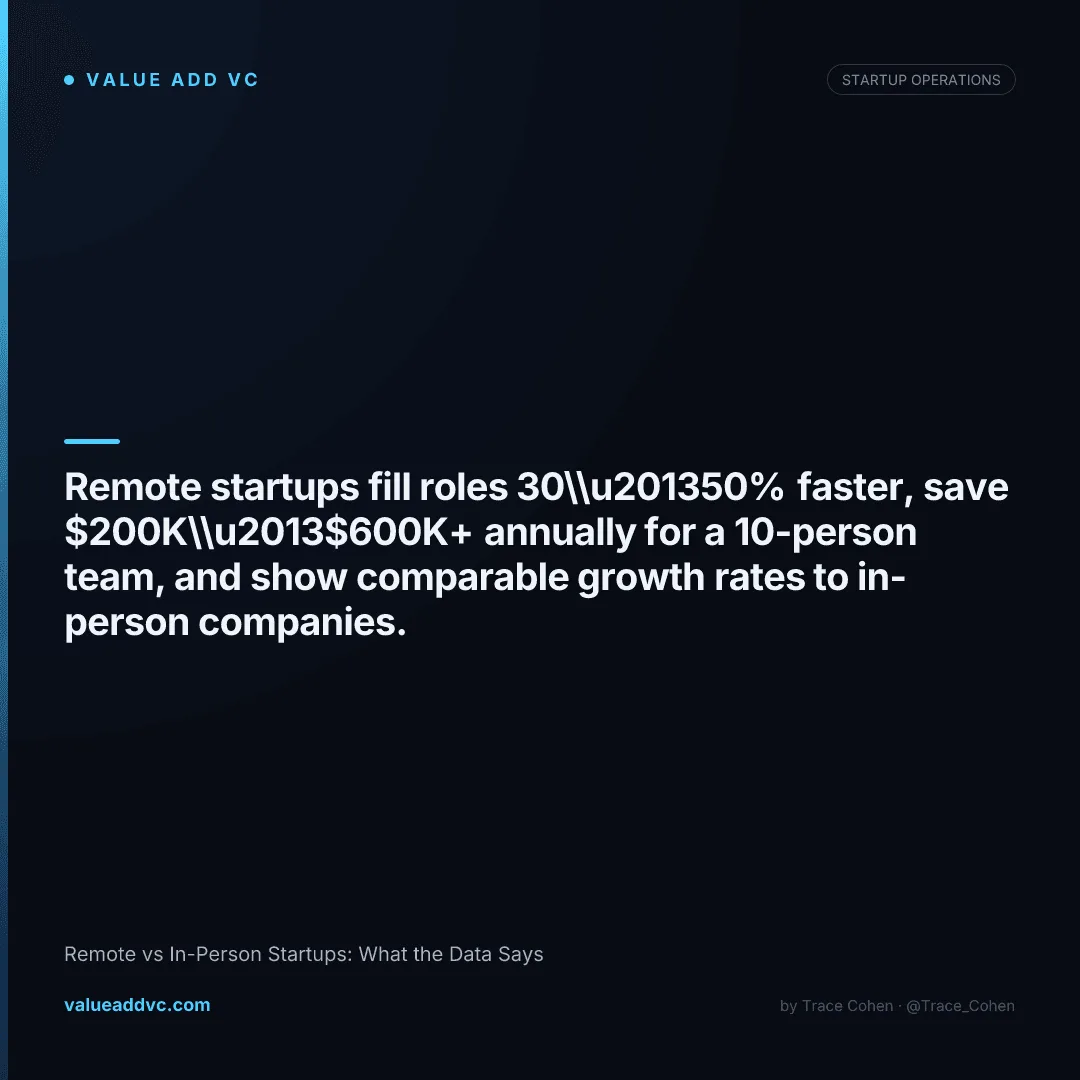
Remote startups consistently fill roles 30 to 50 percent faster than location-restricted companies. The math is simple — when your talent pool is global instead of limited to a 30-mile radius, you find qualified candidates faster. Check our tech hiring dashboard for current market trends.
Employee Retention
Remote and hybrid companies report 25 to 35 percent lower voluntary turnover than fully in-office companies. Flexibility is consistently the number one non-compensation benefit that employees value, and companies that offer it retain talent longer. Lower turnover means lower recruiting costs and more institutional knowledge retained.
The data tells a clear story: remote work does not inherently hurt startup performance, and in many measurable dimensions it helps. But data does not capture everything. The hardest-to-measure factors — culture, serendipitous innovation, speed of decision-making — are where the real debate lives.
Advantages of Remote
Remote-first is not just about saving on office rent. When done well, it fundamentally changes how a startup operates, who it can hire, and how fast it can scale.
Global Talent Pool
This is the single biggest advantage and it is not close. A remote startup can hire the best person for every role regardless of where they live. A senior engineer in Lisbon, a designer in Buenos Aires, a growth marketer in Toronto — you get world-class talent at a fraction of San Francisco or New York compensation. Platforms like Deel make hiring internationally compliant and straightforward. See our full Deel review for details.
Significant Cost Savings
Office space in major tech hubs runs $500 to $1,500 per person per month. For a 10-person team, that is $5,000 to $15,000 per month — $60,000 to $180,000 per year — going to a landlord instead of product development, marketing, or runway extension. Remote startups redirect that capital into growth. For a full breakdown, read our guide on the real cost of starting a startup.
Flexibility and Autonomy
Remote work gives employees control over their environment and schedule. For deep-focus roles like engineering and design, this is transformative. Developers consistently report higher productivity when they can structure their day around their most productive hours without commute time, open-office interruptions, or mandatory in-person meetings that could have been an email.
Built-In Documentation Culture
Remote-first companies are forced to write things down. Decisions, context, processes, and institutional knowledge live in documents rather than hallway conversations. This is painful at first but becomes a massive competitive advantage as the company scales. New hires onboard faster, knowledge does not disappear when someone leaves, and teams across time zones stay aligned.
Advantages of In-Person
In-person work has real advantages that remote advocates tend to dismiss too quickly. These are not nostalgia — they are genuine operational benefits, especially at the earliest stages.
Speed of Iteration
When your entire team is in the same room, the feedback loop between identifying a problem, discussing solutions, and implementing a fix is measured in minutes, not hours or days. For an early-stage startup that is rapidly iterating on product-market fit, this speed can be the difference between finding fit in three months versus six. The compound effect of thousands of micro-decisions made faster is enormous.
Culture and Trust
Building a strong culture from scratch is harder over Zoom. Shared meals, spontaneous conversations, body language, and the energy of working alongside people who are equally committed to the mission — these things create bonds that are difficult to replicate digitally. The first ten employees define a company's culture, and that culture formation happens more naturally in person.
Spontaneous Collaboration
Some of the best ideas at every company I have been part of came from overheard conversations, whiteboard sessions that started as a quick question, or an engineer and a designer sitting next to each other and solving a problem in real time. Remote work makes every interaction intentional, which is great for focus but bad for serendipity. You cannot schedule the unexpected.
Investor Perception
Fair or not, some investors still prefer in-person teams, particularly at the pre-seed and seed stage. The reasoning is that co-located founding teams can move faster, communicate more effectively, and are easier to evaluate during diligence. This bias is fading quickly, but it still exists in certain VC circles, especially among older firms and in markets like New York and San Francisco.
The Hybrid Middle Ground
The majority of startups in 2026 are landing somewhere in the middle. Pure remote and pure in-office are becoming the minority positions. Hybrid models attempt to capture the best of both worlds — the talent access and cost savings of remote work combined with the collaboration benefits of in-person time.
The most common hybrid models that are working in practice fall into a few patterns. The first is hub-and-spoke, where the company has a small headquarters or coworking space in one city and the rest of the team is remote. The core team comes in two to three days per week, and remote employees fly in quarterly for team weeks. This gives you a physical base for culture and spontaneous work while still accessing global talent.
The second model is structured remote with regular offsites. The company is fully remote day-to-day but brings the entire team together for one to two weeks per quarter. Companies like GitLab and Buffer have refined this model over years. The offsites focus on relationship building, strategic planning, and the kind of collaborative work that benefits most from being in person. The rest of the time, people work from wherever they are most productive.
The third model is flexible local, where the company has an office that people can use but attendance is optional. This works well in cities with strong startup talent but requires discipline to avoid creating a two-tier culture where office-goers get more face time with leadership and remote workers feel like second-class citizens. If you go this route, every meeting must be remote-friendly even if some participants are in the office.
How Remote Changes Your Cost Structure
Going remote does not just eliminate office rent. It fundamentally reshapes your entire cost structure in ways that are both obvious and surprising. Understanding these shifts is critical to accurate financial planning.
| Cost Category | In-Person | Remote |
|---|---|---|
| Office space (10 people) | $5K - $15K/mo | $0 |
| Remote stipends | $0 | $100 - $300/person/mo |
| Team offsites (quarterly) | $0 | $2K - $5K/person/quarter |
| Collaboration tools | $200 - $500/mo | $500 - $1,500/mo |
| Average salary (same role) | $150K (US hub) | $80K - $120K (global) |
| Net annual savings (10-person team) | Baseline | $200K - $600K+ |
The savings are real, but they are not as simple as "no office equals cheaper." Remote companies spend more on tools, offsites, and stipends. The net savings come primarily from salary arbitrage when hiring globally and the elimination of commercial real estate costs. For most startups, the net savings range from $200,000 to $600,000+ per year for a 10-person team, which translates directly into extended runway and more capital for growth.
Tools for Remote Teams
A remote startup lives and dies by its tool stack. The right tools make remote work feel seamless. The wrong ones create friction, miscommunication, and frustration. Here is what the best remote startups are using in 2026.
Deel — Global Hiring and Payroll
ESSENTIALIf you are hiring internationally, Deel is the platform that makes it possible without setting up legal entities in every country. It handles contracts, payroll, compliance, and benefits for contractors and employees in 150+ countries. For remote-first startups, this is infrastructure, not optional.
Try DeelKrispCall — Business Phone System
Remote teams still need a professional phone presence. KrispCall provides virtual business numbers, call routing, and team calling features that work from anywhere. Essential for customer-facing teams that need to make and receive calls without giving out personal numbers.
Read our KrispCall reviewCommunication and Project Management
Slack or Discord for real-time communication, Linear or Notion for project management, Loom for async video updates, and Figma for collaborative design. The key is picking one tool per category and committing to it rather than spreading communication across five different platforms. Browse our full tools directory for recommendations in every category.
Email Marketing and Outreach
For remote teams running marketing and sales, tools like Kit (formerly ConvertKit) handle email marketing, and CRM platforms keep customer relationships organized across distributed teams. The important thing is that every customer interaction is logged in a shared system so that no context is lost when team members are in different time zones.
What Investors Actually Think
I will give you the honest VC perspective because I sit on this side of the table. The investor view on remote versus in-person has shifted dramatically since 2020, but it is not a clean consensus. Here is what is really happening in partner meetings and investment committee discussions.
Most VCs in 2026 are functionally agnostic about location for seed and beyond. If you have traction, a strong team, and a clear path to growth, nobody is passing because your team is remote. The companies that raised the biggest rounds in 2024 and 2025 included plenty of fully distributed teams. The stigma is largely gone at the growth stage.
At the pre-seed stage, there is still a subtle preference among some investors for co-located founding teams. The reasoning is not irrational — two founders sitting in the same room can iterate faster, resolve conflicts more quickly, and build the kind of intensity needed to go from zero to one. When you are evaluating a team with no product and no revenue, the founding dynamic is one of the few things you can assess. Physical proximity is a signal, albeit an imperfect one, of commitment and alignment.
That said, I have invested in many remote-first teams that outperformed co-located ones. The quality of the founders matters infinitely more than their zip codes. If you are remote, what investors want to see is that you have thought intentionally about how you communicate, build culture, and maintain velocity without an office. A remote team that has clear processes, strong documentation, and a track record of shipping fast will beat a co-located team that is disorganized every time. You can track the broader tech layoff trends and hiring trends on our dashboards to understand how the market is moving.
How to Decide for Your Startup
Instead of defaulting to whatever seems trendy, use this decision framework based on the factors that actually matter for your specific company.
Decision Framework
Stage
Pre-product companies often benefit from co-location during the intense zero-to-one phase. Once you have product-market fit and established processes, remote becomes much easier to execute well. Consider starting co-located and transitioning to hybrid or remote as you scale past 10 to 15 people.
Industry
Pure software companies can be remote with minimal friction. Hardware, biotech, and companies that require physical prototyping need at least some in-person presence. Customer-facing businesses like retail tech or local marketplaces may benefit from being embedded in the market they serve.
Team Composition
If your founding team is already distributed — one founder in Austin, another in Berlin — forcing co-location means someone uproots their life. Start remote and build the processes from day one. If everyone is in the same city already, take advantage of that proximity during the early sprint. Read our guide on when to make your first hire for more on building your early team.
Capital Constraints
If you are bootstrapped or running lean, remote is a massive financial advantage. The $100,000 to $200,000 per year you save on office space can fund two additional engineers or extend your runway by 6 to 12 months. If capital is tight, let the math make the decision for you.
Talent Needs
If you need highly specialized talent — machine learning engineers, specific domain experts, niche skill sets — restricting yourself to one city dramatically shrinks your candidate pool. Go remote and hire the best person in the world for the role, not the best person within commuting distance.
Whatever you choose, commit to it intentionally. The worst outcome is a company that is accidentally remote — no documentation culture, no async processes, no intentional team-building — because the founders never made a deliberate decision. Remote, hybrid, or in-person, the companies that win are the ones that design their operating model on purpose and invest in making it work.
Build Your Team the Right Way
Whether you go remote, hybrid, or in-person, the right tools and data make all the difference. Track hiring trends, explore global hiring with Deel, and understand your true startup costs.
Latest from the Pulse
Get VC data most people never see
— free to subscribe
Trace's notes on venture, AI and startups, a few times a week. Join 5,000+ subscribers. No spam.
No spam, unsubscribe anytime. Sent via Substack · Privacy · or subscribe on Substack ↗