
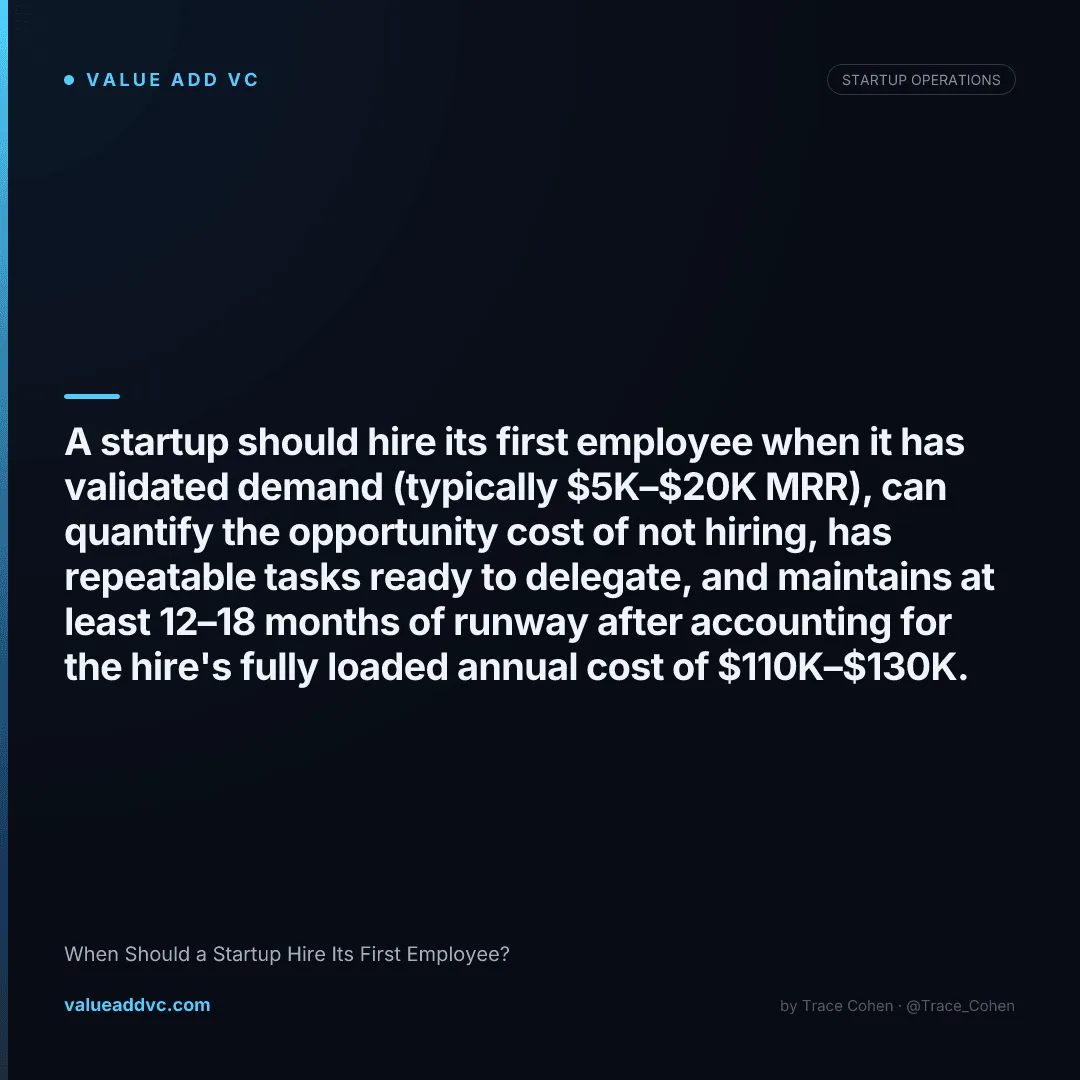
The Timing Question
Every founder hits the same wall. You're working 14-hour days, context-switching between product, sales, support, bookkeeping, and whatever fire erupted at 6 AM. You know you need help. But hiring someone — actually putting another human on payroll — feels like stepping off a cliff. And in many ways, it is. Your first hire is the single most consequential operational decision you'll make in the first two years of your company.
Hire too early, and you burn through your runway before you've found product-market fit. Founders raise a $500K pre-seed round, immediately hire two engineers and a marketing person, and run out of cash in eight months with nothing to show for it. The problem isn't the people — it's that the founders haven't yet figured out what to build. They're paying salaries to execute on a hypothesis that turns out to be wrong.
Hire too late, and you miss the window. Growth stalls because you physically cannot do everything yourself. Customers churn because response times slip. You burn out, make bad decisions, and the momentum you spent months building evaporates. Founders lose six-figure contracts because they couldn't onboard fast enough, or watch competitors overtake them because they refused to delegate.
The right answer is somewhere in between, and it's different for every company. There are clear signals that tell you when it's time. The key is knowing what to look for, and being honest with yourself about where you actually are versus where you want to be.
5 Signals You're Ready to Hire
Don't hire because you feel busy. Founders are always busy — that's the job. Hire because specific, measurable conditions in your business tell you that not hiring is now the bigger risk. Here are the five signals that matter most for a first hire.
1. You've Hit a Revenue Milestone That Proves Demand
Revenue is the clearest signal that what you're building has value. For most startups, the threshold is somewhere between $5K and $20K in monthly recurring revenue — enough to demonstrate that customers will pay, that churn isn't catastrophic, and that there's a repeatable sales or acquisition motion emerging.
Revenue alone doesn't mean you should hire. But revenue combined with growth — even modest 10-15% month-over-month growth — means demand is outpacing your capacity. That's the sweet spot. Track your burn rate carefully to understand how hiring will change your runway math.
2. You're the Bottleneck and It's Costing You Growth
There's a difference between being busy and being the bottleneck. You're the bottleneck when specific, high-value activities are not happening because you're stuck doing lower-value work. Leads go cold because you can't respond fast enough. Features ship late because you're doing customer support instead of writing code. Partnership conversations stall because you don't have time to follow up.
When you can quantify the opportunity cost of not hiring — “I'm losing approximately $X per month in revenue because I can't handle more than Y customers” — the decision becomes a math problem, not an emotional one. And math problems are much easier to solve.
3. You Have Repeatable Tasks That Don't Require Founder Judgment
If every task in your business requires your specific judgment, domain expertise, or relationships, you're not ready to hire. You'd just be paying someone to shadow you. You're ready when chunks of your work have become systematic — customer onboarding follows a playbook, support tickets have predictable answers, content follows a template, sales calls follow a script.
The test: could you write a one-page document explaining how to do this task well enough that a competent person could execute it at 80% of your quality within two weeks? If yes, that task is ready to delegate. If you have 15-20 hours per week of such tasks, you have enough work to justify a hire.
4. Customers Are Asking for More Than You Can Deliver
When customers start requesting features, integrations, or service levels that you simply cannot provide as a solo founder or two-person team, that's demand signaling capacity needs. Enterprise prospects want a dedicated account manager. Users want faster iteration on the product. Customers are willing to pay more for a premium tier you don't have bandwidth to build.
This is particularly powerful because it's market-validated hiring. You're not guessing that you need someone — your customers are telling you. And when customers are willing to pay for what the new hire will deliver, the hire can be close to revenue-neutral from day one.
5. You've Closed a Fundraise with Hiring in the Plan
If you raised capital with a budget that explicitly includes your first hires, and your investors agreed to that plan, the clock is ticking. Investors expect you to deploy capital against the milestones you pitched. Sitting on the money for six months because you're nervous about hiring is a red flag to your board — it signals indecision, not prudence.
That said, don't hire blindly just because you have money in the bank. The fundraise should accelerate a plan that already makes sense. If you raised capital and still aren't sure what your first hire should do, that's a strategy problem, not a hiring problem. Solve the strategy first.
What Role to Hire First
This is the question founders ask most often, and the honest answer is: it depends entirely on your business model, your own skill set, and where your biggest constraint is. There's no universal “first hire” that works for every startup. But there is a decision framework that works.
Start by asking yourself: What is the single biggest constraint on growth right now, and is it something I cannot learn or do well enough myself? The intersection of “high impact” and “not my strength” is where your first hire should live.
Decision Framework by Business Type
Technical Product, Non-Technical Founder
First hire: Engineer (or technical co-founder)
If your product requires custom software and you can't build it, your first hire must be someone who can. No amount of no-code tools, agencies, or outsourced dev shops will replace having a technical person who owns the product. This is the one scenario where it's worth hiring (or finding a co-founder) even before you have revenue, because you literally cannot build the thing without them.
Technical Product, Technical Founder
First hire: Sales / Business Development or Customer Success
You can build the product. What you can't do is build and sell at the same time, at least not at scale. Your first hire should be someone who can run the sales pipeline, handle inbound leads, manage customer relationships, and free you to focus on product. In B2B SaaS, this often looks like a hybrid sales/CS person who can do demos, close deals, and handle onboarding.
Service-Based or Marketplace Business
First hire: Operations / Customer Operations
If your business involves coordinating between multiple parties — a marketplace, an agency model, a logistics company — operations is usually the bottleneck. Your first hire should be someone detail-oriented who can manage workflows, handle customer communication, solve operational fires, and build the processes that will let you scale beyond what you can personally oversee.
Content or Community-Led Business
First hire: Content / Community Manager
If your growth engine is content, community, or audience building, your first hire should amplify that engine. This might be a content writer, a community manager, a social media specialist, or a generalist who can do all three. The key is finding someone who can maintain quality and cadence while you focus on strategy and product.
Regardless of business type, I almost never recommend hiring a full-time marketer as your first employee. Marketing at the earliest stages is too experimental — you're still figuring out messaging, channels, and ICP. Founders should own marketing until the playbook is clear enough to hand off. Track hiring trends in tech using our hiring tracker to understand what roles companies at your stage are actually filling.
Full-Time vs Contractor vs Agency
Before you post a job listing, consider whether a full-time hire is even the right move. Many founders default to full-time when a contractor or agency would be faster, cheaper, and lower-risk. Here's how to think about it.
| Full-Time | Contractor | Agency | |
|---|---|---|---|
| Cost | Highest (salary + benefits + equity) | Medium (hourly or project-based) | Variable (retainer or project fee) |
| Commitment | Long-term, high | Flexible, can scale up/down | Project-based, defined scope |
| Ramp Time | 2–4 weeks onboarding | Days to 1 week | 1–2 weeks kickoff |
| Loyalty / Alignment | High — invested in mission | Moderate — juggling clients | Low — transactional |
| IP / Ownership | You own everything (with proper agreement) | Depends on contract | Typically work-for-hire |
| Best For | Core functions, long-term needs | Specialized skills, variable workload | Defined projects, expertise gaps |
When to go full-time: The role is core to your business (engineering, sales, operations), the work is ongoing and growing, and you need someone who deeply understands your product, customers, and culture. Full-time hires build institutional knowledge and compound in value over time.
When to go contractor: The work is specialized (design, data engineering, legal, accounting), variable in volume, or you're not sure the role will exist in six months. Contractors let you test a function before committing to a full-time headcount. They're also ideal when you need senior expertise you can't afford full-time.
When to go agency: You need a defined deliverable (a website redesign, a PR campaign, a recruiting sprint) with a clear start and end date. Agencies bring process and breadth but won't learn your business the way an employee or dedicated contractor will.
The True Cost of a Hire
Most founders dramatically underestimate the all-in cost of their first employee. The salary number on the offer letter is just the beginning. Before you make an offer, understand the real math — and make sure your burn rate can handle it.
Cost Breakdown: $90K Base Salary Employee
- Base salary$90,000
- Payroll taxes (employer side: FICA, FUTA, SUTA)$7,200 – $9,000
- Health insurance (if offering)$6,000 – $12,000
- Equipment (laptop, monitor, software licenses)$2,000 – $4,000
- Recruiting costs (job boards, recruiter fees, time)$1,000 – $5,000
- Onboarding & training (your time, lost productivity)$3,000 – $6,000
- Tools & subscriptions (Slack, email, project management)$1,200 – $3,000
- Total Year-One Cost$110,000 – $129,000
That means a $90K employee actually costs you $110K–$129K in the first year — a 22–43% premium over base salary. And this doesn't account for the biggest hidden cost: your time. For the first 30–60 days, you'll spend 5–10 hours per week managing, training, and answering questions. If your time is worth $200/hour to the business, that's another $4,000–$8,000 in opportunity cost during onboarding alone.
There's also the equity question. Early employees typically receive 0.5%–2% equity, depending on the role, seniority, and stage. At a $10M valuation, 1% equity is worth $100,000 on paper. That's real dilution with real long-term cost. Make sure you're giving equity deliberately, not arbitrarily.
The rule of thumb: make sure you have at least 12–18 months of runway after adding the new hire's fully loaded cost. If hiring drops your runway below 12 months, you should either raise more capital first or start with a part-time contractor to validate the role before going full-time.
How to Hire Internationally
One of the most powerful levers available to early-stage founders in 2026 is hiring internationally. The talent pool is global, remote work is normalized, and the cost differential can be dramatic. A senior engineer in the US might cost $150K–$200K fully loaded. A comparably skilled engineer in Eastern Europe, Latin America, or Southeast Asia might cost $40K–$80K. That's not cutting corners — it's smart capital allocation.
The challenge used to be legal complexity: setting up foreign entities, managing international payroll, navigating local labor laws, handling tax compliance across jurisdictions. It was a nightmare that effectively locked out startups with fewer than 50 employees.
That's changed. Platforms like Deel allow you to hire full-time employees or contractors in 150+ countries without setting up a local entity. They handle payroll, benefits, compliance, and contracts — all through a single platform. You focus on finding the right person; they handle the legal and administrative infrastructure. Check out our Deel overview and international hiring guide for a deeper dive.
Tips for International Hiring Success
- Overlap hours matter. Aim for at least 3–4 hours of overlapping work time with your core team. Latin America and Eastern Europe are popular with US-based founders for exactly this reason.
- Pay fairly for the local market. Don't pay SF salaries in Bogota, but also don't lowball. Paying top-of-local-market rates gets you top-of-local-market talent, and the retention will be worth it.
- Invest in async communication. Remote international teams thrive on clear written communication, documented processes, and recorded video updates. Build these habits early.
- Start with contractors, convert to full-time. Use a 30–60 day contractor trial period to evaluate fit before committing to a full-time offer. Most global hiring platforms support both arrangements.
- Understand IP assignment laws. In some countries, IP created by employees doesn't automatically belong to the employer. Make sure your contracts — or your EOR provider — handle this correctly.
International hiring is one of the few genuine cheat codes for early-stage startups. It lets you extend your runway, access world-class talent, and build a diverse team from day one. The tools to do it compliantly now exist. The only question is whether you're willing to look beyond your local market.
Common First-Hire Mistakes
These mistakes repeat across early-stage companies. Each one seems reasonable in the moment but can set your company back months or cost you tens of thousands of dollars. Learn from the people who made them before you.
Hiring a Friend Because It's Comfortable
Your college roommate is great at dinner parties. That doesn't mean they're the right first employee for your startup. Hiring friends creates a dual relationship that makes honest feedback, performance management, and (worst case) termination incredibly difficult. The friendship rarely survives a bad professional outcome. Hire based on skills, work ethic, and culture fit — not familiarity. If your friend genuinely is the best candidate, put them through the same process as everyone else. If they're not, you'll know.
Hiring Too Senior Before You Know What You Need
First-time founders often think they need a “VP of Engineering” or a “Head of Sales.” What they actually need is someone who can write code or make calls. Senior hires are expensive, expect structure and resources that don't exist yet, and often struggle in the chaos of a two-person startup. Your first hire should be a doer, not a manager. Hire senior leaders when you have a team for them to lead and a strategy for them to execute against.
No Job Description, No Clear Expectations
“We're a startup, everyone does everything” is not a job description. Your first hire needs to know: what are the three most important things they'll own? How will success be measured in the first 30, 60, and 90 days? What decisions can they make autonomously, and what needs your input? Without this clarity, you'll both be frustrated within weeks — you because they're not reading your mind, and them because they have no idea what good looks like.
Getting Equity Wrong
Giving too much equity to early employees is a mistake you'll feel for years. Giving too little means they leave when a better offer comes along. The most common error is not having a vesting schedule (always use 4-year vesting with a 1-year cliff) or not understanding the difference between ISOs and NSOs. Before you offer anyone equity, talk to a startup lawyer. A one-hour consultation will save you from cap table disasters that cost 10x more to fix later.
Not Checking References
When you're excited about a candidate and desperate for help, reference checks feel like a formality. They're not. References have saved me from bad hires more times than I can count. Call at least two professional references. Ask specific questions: “What does this person struggle with?” “Would you hire them again, and for what role?” “How do they handle ambiguity and changing priorities?” The answers will surprise you more often than you think.
Building Your Hiring Process from Scratch
You don't need a 12-step interview process for your first hire. But you do need a process. Winging it leads to inconsistent evaluations, gut-feel decisions, and regrettable hires. Here's a lean, effective framework that takes about two weeks from posting to offer.
Step 1: Define the Role (1–2 Days)
Write a one-page job description that includes: a 2–3 sentence company description, the top 3–5 responsibilities, the must-have skills (be ruthless — only list what's genuinely required), the nice-to-have skills, compensation range, and what the first 90 days look like. Skip the corporate fluff. Candidates at startups want to know what they'll actually do, not read a buzzword salad about “synergizing cross-functional paradigms.”
Step 2: Source Candidates (3–5 Days)
Post on the platforms where your ideal candidate actually hangs out. For tech roles: LinkedIn, Hacker News (Who's Hiring), AngelList/Wellfound, and relevant Slack or Discord communities. For non-tech roles: LinkedIn, Twitter, and industry-specific job boards. For international hires, platforms like Deel can help you reach global talent pools compliantly. Don't underestimate the power of your own network — post on Twitter, ask your investors for intros, and tell everyone you're hiring. The best early-stage hires almost always come through warm referrals.
Step 3: Screen (2–3 Days)
Do a quick 15–20 minute phone screen with promising candidates. You're evaluating three things: communication skills, genuine interest in your specific company (not just “any startup”), and basic qualification alignment. Reject fast and kindly. Every day a good candidate is waiting to hear back is a day they might accept another offer.
Step 4: Working Interview (3–5 Days)
For your first hire, a traditional multi-round interview is overkill. Instead, give candidates a paid work trial — a small, realistic project that mirrors what they'd actually do on the job. Pay them for their time ($200–$500 depending on the role). This tells you more about a candidate in 4 hours than 4 interviews ever could. You'll see their actual work quality, how they communicate, how they handle ambiguity, and whether their working style meshes with yours.
Step 5: References & Offer (2–3 Days)
Check at least two references (see the mistakes section above). If everything checks out, move to an offer. Don't wait. Good candidates in this market have options, and speed is one of your advantages as a startup. Present a clear offer that includes: base salary, equity (shares, not percentage — with a strike price or valuation context), vesting terms, benefits, start date, and any relevant details about remote/in-person expectations.
Step 6: Onboarding (First 2 Weeks)
Your first employee's onboarding experience sets the tone for your entire company culture. Prepare before their first day: set up accounts, write a one-page “how we work” document (communication tools, meeting cadence, decision-making norms), and have their first week of work planned out. Give them a meaningful project on day one — nothing kills momentum like spending the first week reading wikis that don't exist yet.
Schedule daily 15-minute check-ins for the first two weeks, then shift to weekly. Be explicit about feedback: “I'm going to give you a lot of feedback in the first month, and I want you to do the same for me. This isn't criticism — it's how we get aligned quickly.”
Set a formal 90-day review where you both evaluate whether the role and the relationship are working. This isn't a gotcha — it's a mutual checkpoint. If things are going well, great. If not, it's better to address it at 90 days than let it fester for a year.
Bottom Line
Your first hire will shape your company's culture, velocity, and trajectory in ways that are hard to overstate. Don't rush it because you're overwhelmed, and don't delay it because you're afraid. Look for the signals: revenue that proves demand, bottlenecks that cost you growth, tasks that are ready to delegate, customers asking for more, and capital that was raised to be deployed.
Hire for the constraint, not the title. Start with a lean process, pay fairly, check references, and invest in onboarding. And consider the global talent pool — the best person for the job might be in Lisbon, not Los Angeles.
Use our hiring tracker to stay current on tech hiring trends, explore Deel for international hiring, and read our guide to hiring internationally for a step-by-step walkthrough.
Latest from the Pulse
Get VC data most people never see
— free to subscribe
Trace's notes on venture, AI and startups, a few times a week. Join 5,000+ subscribers. No spam.
No spam, unsubscribe anytime. Sent via Substack · Privacy · or subscribe on Substack ↗