
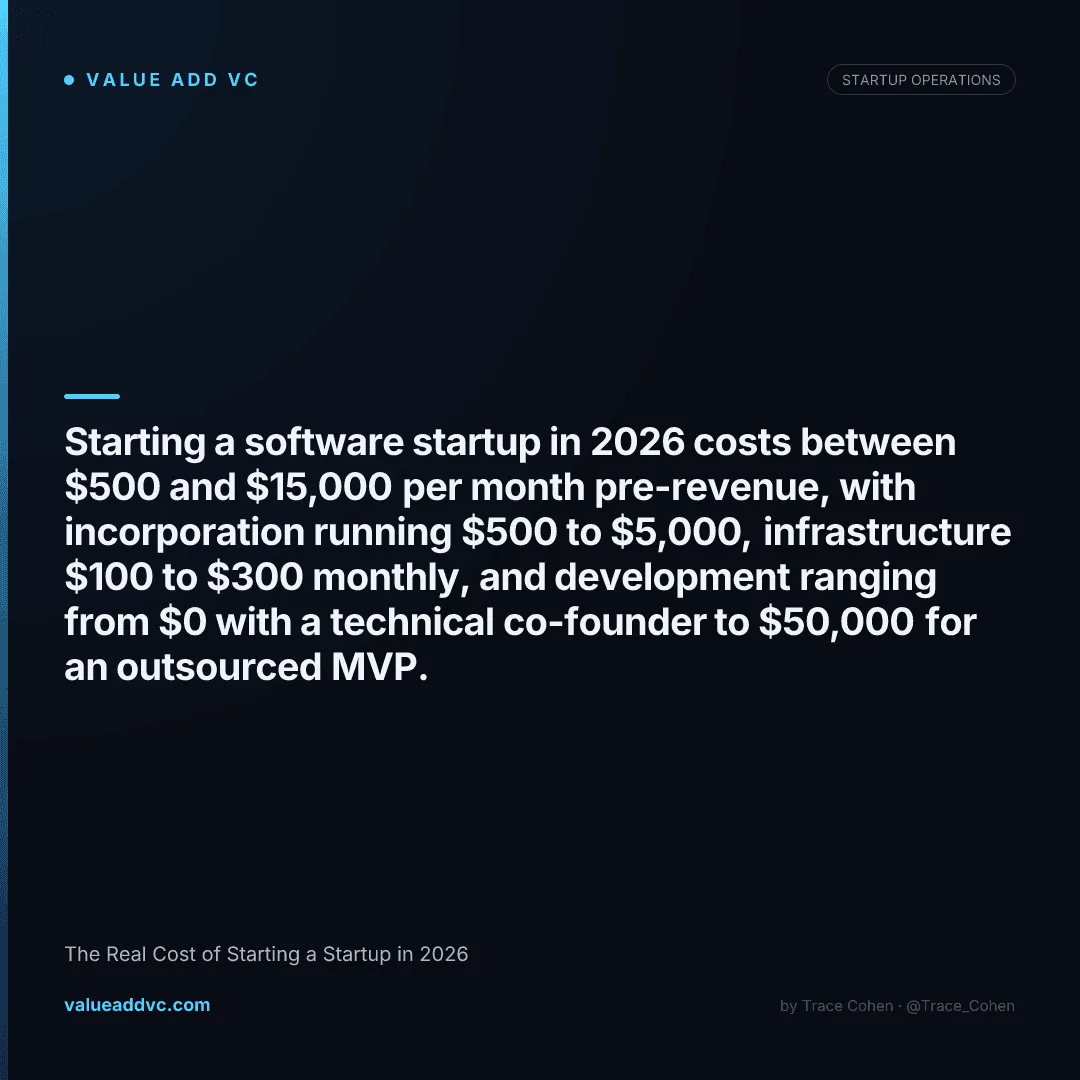
The Myth of the Garage Startup
There is a romantic notion baked into startup culture that you can build a billion-dollar company from a garage with nothing but a laptop and a dream. The stories of Apple, Amazon, and Google starting in garages have calcified into a myth that starting a company costs nothing. The truth is more nuanced. Starting a startup in 2026 is cheaper than it has ever been in the history of entrepreneurship. Cloud computing eliminated server costs. Open-source software replaced six-figure license fees. AI tools now do work that used to require entire teams. But cheaper does not mean free.
The founders who get burned are the ones who underestimate the real costs, run out of money too early, and make avoidable mistakes because they never sat down and mapped out what building a company actually requires. After making 65+ investments and building three companies myself, I have seen every version of this story. Some founders spend $500 to get started. Others burn through $50,000 before they have a single customer. The difference is rarely about the quality of the idea — it is about knowing where to spend, where to save, and where to get creative.
This guide breaks down every cost category you will encounter from day zero to first revenue, with real numbers from 2026. Whether you are bootstrapping or planning to raise a pre-seed round, knowing your cost structure is the foundation of everything else.
Legal and Incorporation: $500 to $5,000
The first real expense most founders encounter is incorporating the company. If you plan to raise venture capital, the standard structure is a Delaware C-Corporation. Delaware is the default because its corporate law is well-established, VCs are familiar with it, and the Court of Chancery specializes in business disputes. Nearly every institutional investor expects a Delaware C-Corp, and deviating from this creates unnecessary friction during fundraising.
The cost of incorporating depends on whether you do it yourself or hire a lawyer. The DIY route using Stripe Atlas, Clerky, or FirstBase runs between $500 and $800 all-in. These platforms handle the state filing, EIN application, initial board consent, and basic stock issuance. For a straightforward two-founder company with a standard equity split, this is often sufficient.
If you are not planning to raise venture capital, an LLC is often the simpler structure. LegalZoom sells LLC packages from $0 plus state filing fees, and its higher tiers add an operating agreement, an EIN, and business advisors for setup and compliance, with an attorney and accountant available in Expert Service. Compare it against the venture-focused options in our best legal tools for startups ranking. LegalZoom is a Value Add VC partner.
If your situation is more complex — multiple co-founders with different vesting schedules, IP assignment from a previous employer, or international founders — you should budget $2,000 to $5,000 for a startup attorney. Firms like Goodwin, Cooley, Gunderson, and Wilson Sonsini all have startup practices that handle incorporation packages at fixed fees. Some will defer fees until your first funding round, which is worth asking about.
Legal Cost Breakdown
Do not skip the legal fundamentals to save money. A poorly structured cap table, missing IP assignments, or sloppy founder agreements will cost you 10x to fix later — and some investors will simply pass if they find legal issues during diligence. Get the basics right from day one.
Product and Development: $0 to $50,000
This is the widest cost range because it depends entirely on your technical capabilities and what you are building. The spectrum runs from completely free to tens of thousands of dollars, and there are legitimate paths at every price point.
Technical Co-Founder
$0 cashThe ideal scenario for most startups. A technical co-founder builds the product in exchange for equity. No cash outlay, but you are giving up 30 to 50 percent of the company. This is the path VCs strongly prefer because it signals the founding team can execute independently.
No-Code / AI Tools
$0 - $500/moIn 2026, the no-code and AI-assisted development landscape is mature enough to build real products. Tools like Cursor, Bolt, Lovable, Bubble, and Webflow can get an MVP to market without writing traditional code. Great for validation, but plan to rebuild as you scale.
Dev Shop / Freelancers
$10K - $50K+Outsourcing an MVP to a development agency or freelance developers. Domestic agencies charge $15K to $50K+ for an MVP. Offshore developers run $5K to $20K. Quality varies wildly. Get references, see previous work, and start with a small scoped project before committing.
The biggest mistake I see non-technical founders make is spending $40,000 on a development agency before they have validated that anyone wants the product. Before you write a check, validate demand with a landing page, a waitlist, manual processes, or a concierge MVP. You can test most ideas for under $500 before committing to a real build.
Infrastructure and Tools: $100 to $500 per Month
Every startup needs a baseline set of tools to operate. The good news is that most of the essential infrastructure has generous free tiers or startup programs. The bad news is that tool creep is real, and you can easily end up spending $2,000 per month on SaaS subscriptions before you have any revenue. Here is what you actually need and what it costs. Check our full recommended tools directory for detailed reviews of each platform.
Monthly Tool Stack
The key principle is to start on free tiers and upgrade only when you hit real limits. Nearly every tool on the market offers a free plan that is sufficient for a pre-revenue startup with fewer than five team members. Do not pay for enterprise plans you do not need yet.
Marketing and Customer Acquisition: $500 to $5,000 per Month
At some point, you need customers. How much that costs depends on your go-to-market strategy and your target customer. B2C companies generally need more upfront marketing spend than B2B companies, which can often acquire early customers through outbound sales and personal networks.
For a pre-revenue startup, the most capital-efficient marketing channels are content marketing, social media, cold outreach, and community building. These are time-intensive but low-cost. Paid acquisition — Google Ads, Meta Ads, LinkedIn Ads — can accelerate growth but requires budget and expertise to run profitably. Most early-stage startups should budget $500 to $2,000 per month for initial paid experiments to learn their unit economics.
What you should not do is dump $10,000 into paid ads before you have product-market fit. Paid acquisition amplifies whatever you already have. If your product converts and retains, ads scale it. If your product leaks users, ads just make you lose money faster. Nail retention first, then pour fuel on growth.
Low-Cost Channels
- Content marketing / SEO — $0 (your time)
- Social media / Twitter / LinkedIn — $0
- Cold email outreach — $50-$200/mo (tools)
- Product Hunt launch — $0
- Community building — $0
Paid Channels
- Google Ads — $500-$3,000/mo
- Meta / Instagram Ads — $500-$2,000/mo
- LinkedIn Ads — $1,000-$5,000/mo
- Influencer partnerships — $500-$5,000/post
- Sponsorships / newsletters — $200-$2,000/placement
People Costs: Your Biggest Expense
People are where most of your money will go. Whether it is co-founder salaries, contractor fees, or your first hire, payroll is almost always the largest line item in a startup budget. Understanding the real cost of people — not just salary, but the fully loaded cost — is critical to accurate financial planning.
At the pre-seed and seed stage, most founders take little to no salary. This is effectively a hidden cost — you are subsidizing the company with your own living expenses. If you have raised a round, a reasonable founder salary in 2026 ranges from $60,000 to $120,000 depending on your city, the stage, and the amount raised. VCs generally expect founders to take enough to live comfortably without distraction but not so much that it signals misaligned incentives.
When you are ready to make your first hires, the fully loaded cost of an employee is typically 1.25x to 1.4x their base salary once you account for payroll taxes, health insurance, equipment, and software licenses. A $100,000 salary really costs you $125,000 to $140,000 per year. For global hiring, platforms like Deel make it possible to hire international contractors and employees compliantly, which can significantly reduce costs while accessing a global talent pool. Read our full Deel review for more on how it works.
People Cost Ranges (Annual)
The most important thing to remember about people costs is that every hire extends your burn rate significantly. A single full-time hire at $150,000 per year adds $12,500 per month to your burn. Hire carefully, hire slowly, and make sure every person you add is directly contributing to reaching your next milestone.
The Complete Cost Breakdown by Stage
Here is what a realistic startup budget looks like at three key stages. These numbers assume a software / SaaS company with a small team. Hardware, biotech, and physical product companies will have significantly higher costs.
| Category | Pre-Revenue | Post-Revenue | Scaling |
|---|---|---|---|
| Legal / Incorporation | $500 - $5K | $2K - $10K/yr | $10K - $50K/yr |
| Product / Development | $0 - $50K | $5K - $20K/mo | $20K - $100K/mo |
| Infrastructure / Tools | $100 - $300/mo | $500 - $2K/mo | $2K - $10K/mo |
| Marketing / Acquisition | $0 - $2K/mo | $2K - $10K/mo | $10K - $100K/mo |
| People (founders + team) | $0 - $10K/mo | $15K - $60K/mo | $60K - $300K/mo |
| Office / Coworking | $0 - $500/mo | $500 - $3K/mo | $3K - $20K/mo |
| Total Monthly Burn | $500 - $15K | $25K - $90K | $100K - $500K+ |
These ranges are wide because every startup is different. A solo founder building a SaaS product with AI tools might run at $1,000 per month. A two-person team with a hired developer in a coworking space might run at $15,000 per month. Both can be the right approach depending on the business, the market, and the founders' financial situation.
Where to Save Money
Capital efficiency is not about being cheap — it is about spending money where it creates the most value and avoiding waste everywhere else. Here are the highest-leverage ways to reduce your startup costs without sacrificing quality or speed.
Maximize Free Tiers
Almost every SaaS tool offers a free tier sufficient for early-stage startups. AWS, Google Cloud, and Azure all have startup credit programs worth $5,000 to $100,000. Stripe Atlas gives you a bundle of tools. HubSpot, Notion, Slack, and GitHub are free for small teams. Browse our recommended tools to find the best free options for every category.
Use AI to Replace Headcount
In 2026, AI tools can handle work that previously required dedicated hires: copywriting, customer support, data analysis, basic design, code generation, and more. Before hiring for a role, ask whether an AI tool can handle 80 percent of the work. You will be surprised how often the answer is yes.
Defer Hiring as Long as Possible
Every hire is a fixed cost that reduces runway. Use contractors for project-based work, fractional executives for strategic guidance, and freelancers for specialized tasks. Only convert to full-time when the workload is consistent and the role is critical to your core operations.
Hire Globally
A senior developer in Eastern Europe, Latin America, or Southeast Asia costs 40 to 60 percent less than the same caliber of talent in San Francisco. Platforms like Deel handle compliance, payroll, and contracts in 150+ countries so you can hire globally without legal headaches.
Skip the Office
A WeWork desk costs $400 to $800 per month per person. A dedicated office can run $2,000 to $10,000 per month depending on the city. If your team is small and can work remotely, that money is better spent on product and customer acquisition. Consider a coworking day pass for in-person meetings instead of a full lease.
Negotiate Everything
Annual SaaS contracts are almost always negotiable. Ask for startup discounts, extended trials, or deferred billing. Most vendors would rather give you a 30 percent discount than lose you to a competitor. The same goes for legal fees, office space, and contractor rates.
How Much Runway Do You Need?
Runway is the number of months your company can operate before running out of cash. It is the single most important number in your financial model because when runway hits zero, the company dies. Understanding your burn rate and projecting your runway accurately is not optional — it is survival.
The general rule in 2026 is to maintain 18 to 24 months of runway at all times. This gives you enough time to hit milestones, iterate on the product, and raise your next round without desperation. Fundraising typically takes 3 to 6 months, so if you start raising when you have 6 months of runway left, you are already in a precarious position.
Runway Planning Guide
The math is straightforward. If your monthly burn is $15,000 and you raise $500,000, you have roughly 33 months of runway. If your burn is $40,000 and you raise $1 million, you have 25 months. Every dollar you save extends that number. Every unnecessary hire shortens it. For a detailed walkthrough on calculating and managing burn rate, read our complete guide to burn rate.
Build Smart From Day One
Knowing your costs is the first step to building a fundable company. Explore our recommended tools to optimize your stack, learn the difference between fundraising stages, and master your burn rate before it masters you.
Latest from the Pulse
Get VC data most people never see
— free to subscribe
Trace's notes on venture, AI and startups, a few times a week. Join 5,000+ subscribers. No spam.
No spam, unsubscribe anytime. Sent via Substack · Privacy · or subscribe on Substack ↗