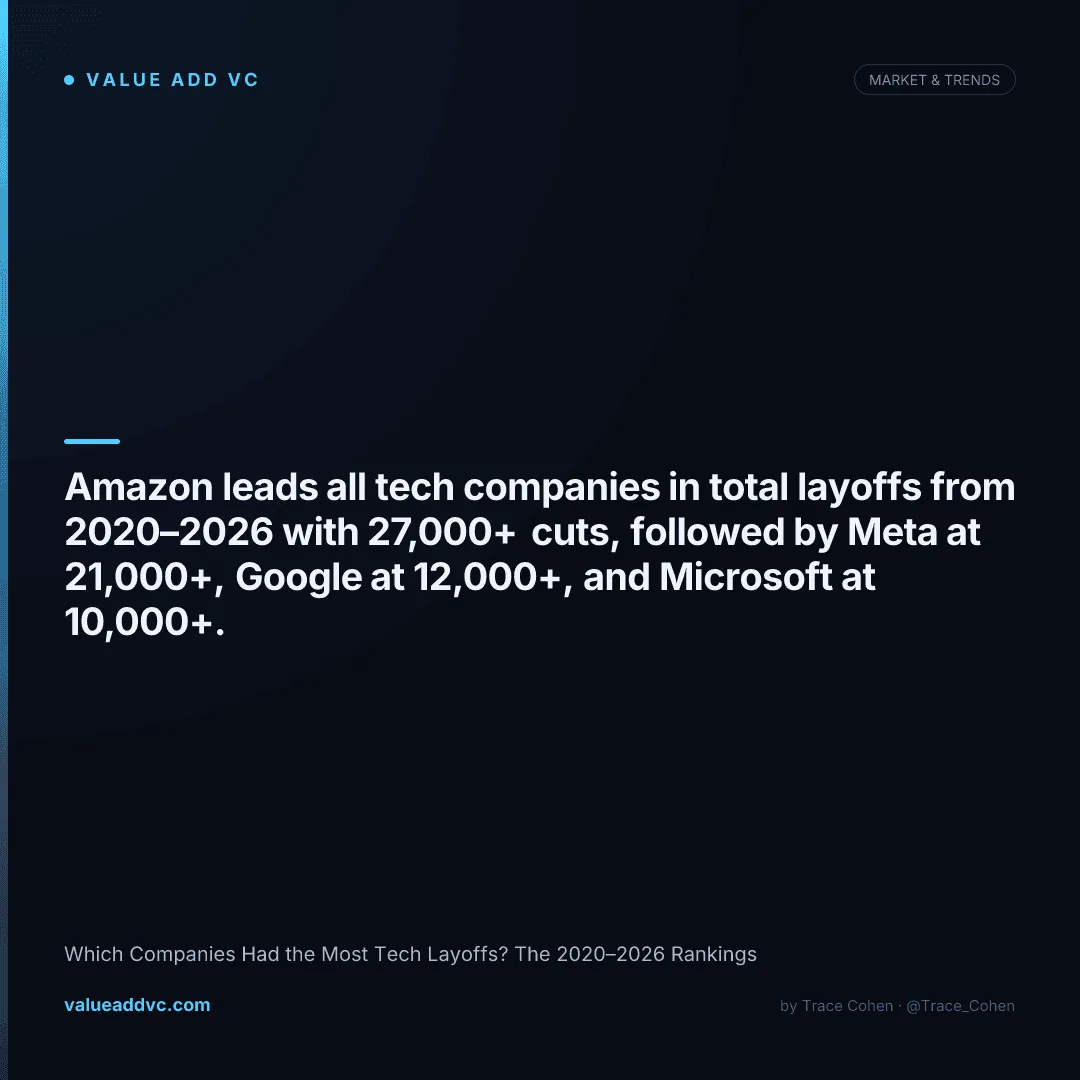
Between 2020 and 2025, over 800,000 tech workers lost their jobs. But the distribution is wildly unequal — a handful of mega-cap companies account for a disproportionate share of the total tech layoff count.
This is not a story about the industry collapsing. It is a story about two distinct waves — one caused by a macro shock, one caused by AI — hitting the same companies twice. Track the current tech layoff count week by week on our Layoffs Dashboard.
Tech Layoff Count by Company: The Top 20 Rankings (2020–2025)
These are the confirmed cuts per company across the full 2020–2025 period, sourced from SEC filings, earnings calls, and company announcements:
| Company | Total Cuts | When |
|---|---|---|
| Amazon | 27,000+ | 2022–2023 |
| Meta | 21,000+ | Nov 2022 + Mar 2023 |
| Intel | 16,500+ | 2024–2025 |
| Google (Alphabet) | 12,000+ | Jan 2023 + 2024 |
| Microsoft | 10,000+ | Jan 2023 + May 2025 |
| Salesforce | 10,000+ | Jan 2023 + 2024 |
| Dell | 6,650+ | Feb 2023 + 2024 |
| Twitter / X | 6,500+ | Oct–Nov 2022 |
| SAP | 8,000+ | Jan 2024 |
| Cisco | 4,000+ | 2024 |
| Spotify | 1,700+ | Dec 2023 |
| Workday | 1,750+ | Jan 2025 |
| PayPal | 2,500+ | Jan 2024 |
| Zoom | 1,300+ | Feb 2023 |
| Stripe | 1,100+ | Nov 2022 |
| Lyft | 1,072+ | Apr 2023 |
| Duolingo | 10% of contractors | Jan 2024 |
| Dropbox | 500+ | Apr 2024 |
| ByteDance / TikTok | 700+ | 2024 |
| eBay | 1,000+ | Jan 2024 |
Wave One (2022–2023): The Rate-Shock Correction
The Federal Reserve hiked interest rates from 0.25% to 5.25% between March 2022 and July 2023 — the steepest tightening cycle since Paul Volcker. For tech companies that had gorged on cheap capital and hired at 2x their sustainable pace during 2020–2021, this was a reckoning.
The Nasdaq Composite fell 33% in 2022. Growth-at-all-costs was dead. Every major tech CEO came out in January 2023 with the same script: "We over-hired during the pandemic. We are resizing for the environment ahead." Meta's Mark Zuckerberg called 2023 the "Year of Efficiency." He cut 11,000 in November 2022 and another 10,000 in March 2023.
Amazon's cuts were spread across more roles — AWS engineers, Alexa (which lost billions annually), devices, and retail tech. In total, Amazon announced 18,000 cuts in January 2023 on top of earlier rounds, making them the single largest employer to cut in this cycle. The common thread across all Wave One cuts: these were headcount additions from 2020–2021 being reversed, not structural declines in underlying business demand.
Wave Two (2024–2025): The AI Restructuring
By 2024, the macro excuse was gone — rates had peaked and tech revenue was recovering. But a new round of layoffs started anyway. This wave is structurally different: companies are eliminating roles because AI is absorbing the work, not because the business is shrinking.
Intel is the clearest case: 15,000+ cuts driven by falling PC chip revenue and foundry losses, with AI accelerators eating into their traditional compute market share. SAP announced 8,000 cuts in January 2024 — not because SAP is failing, but because AI-embedded workflows require fewer implementation consultants and support engineers. Duolingo publicly cited AI as the reason they cut their contract content workforce.
I have seen this pattern in the portfolios I track: companies running AI-assisted customer support, AI-assisted legal review, and AI-assisted code generation are hiring fewer junior roles and eliminating middle-management layers that existed purely to coordinate labor. The productivity gains are real — but they show up in the layoff count first, before the output gains are visible in earnings.
What the Tech Layoff Count Misses
Aggregate layoff data is noisy. Here is what the raw tech layoff count does not capture:
- •Gross vs. net: Amazon cut 27,000 but also hired throughout this period. Net headcount change is often far smaller than the announced cut number.
- •Role quality: The cuts are concentrated in non-core roles — Alexa, VR hardware, middle management, content moderation — while engineering and AI talent stayed flat or grew.
- •Geography: US cuts dominate the headlines. Many companies simultaneously added headcount in lower-cost markets (India, Poland, Romania, Brazil) at lower salary bands.
- •Rehiring cycles: Meta, Google, and Microsoft all began re-hiring within 6–12 months of their largest announced cuts. Total headcount at big tech actually grew from 2022 to 2025 at most firms.
- •Startup layoffs: The 800K figure is dominated by public-company numbers. Private startup cuts — often quieter, no SEC filing required — are undercounted by an estimated 30–40%.
How to Track the Tech Layoff Count in Real Time
If you are looking for the current week's tech layoff count — because you are hiring, investing, or just tracking the market — the best sources are:
- •Layoffs.fyi — the most comprehensive crowd-sourced tracker, updated daily. Best for company-level and week-level granularity.
- •valueaddvc.com/layoffs — our own dashboard aggregates the data with sector breakdowns and trend charts. Free, no sign-up.
- •SEC WARN Act filings — public companies must file 60 days before large layoffs. Searchable by state. More accurate but slower than Layoffs.fyi.
- •LinkedIn headcount data — compare current employee count against 6- and 12-month prior snapshots on any company page. Useful for private companies that don't file WARN notices.
- •Earnings call transcripts — CEOs and CFOs almost always signal headcount actions 1–2 quarters before public announcements. Keyword-search for 'efficiency,' 'restructuring,' and 'cost discipline.'
The companies with the highest layoff counts are often the fastest to rehire — because cutting headcount is a quarter-end decision, but talent strategy is a decade-long one.
Track the current tech layoff count on our Layoffs Dashboard at Value Add VC. Originally published in the Trace Cohen newsletter.
Latest from the Pulse
Get VC data most people never see
— 100% free
Weekly benchmarks, valuations, and fund data. Join 5,000+ investors. No spam.