
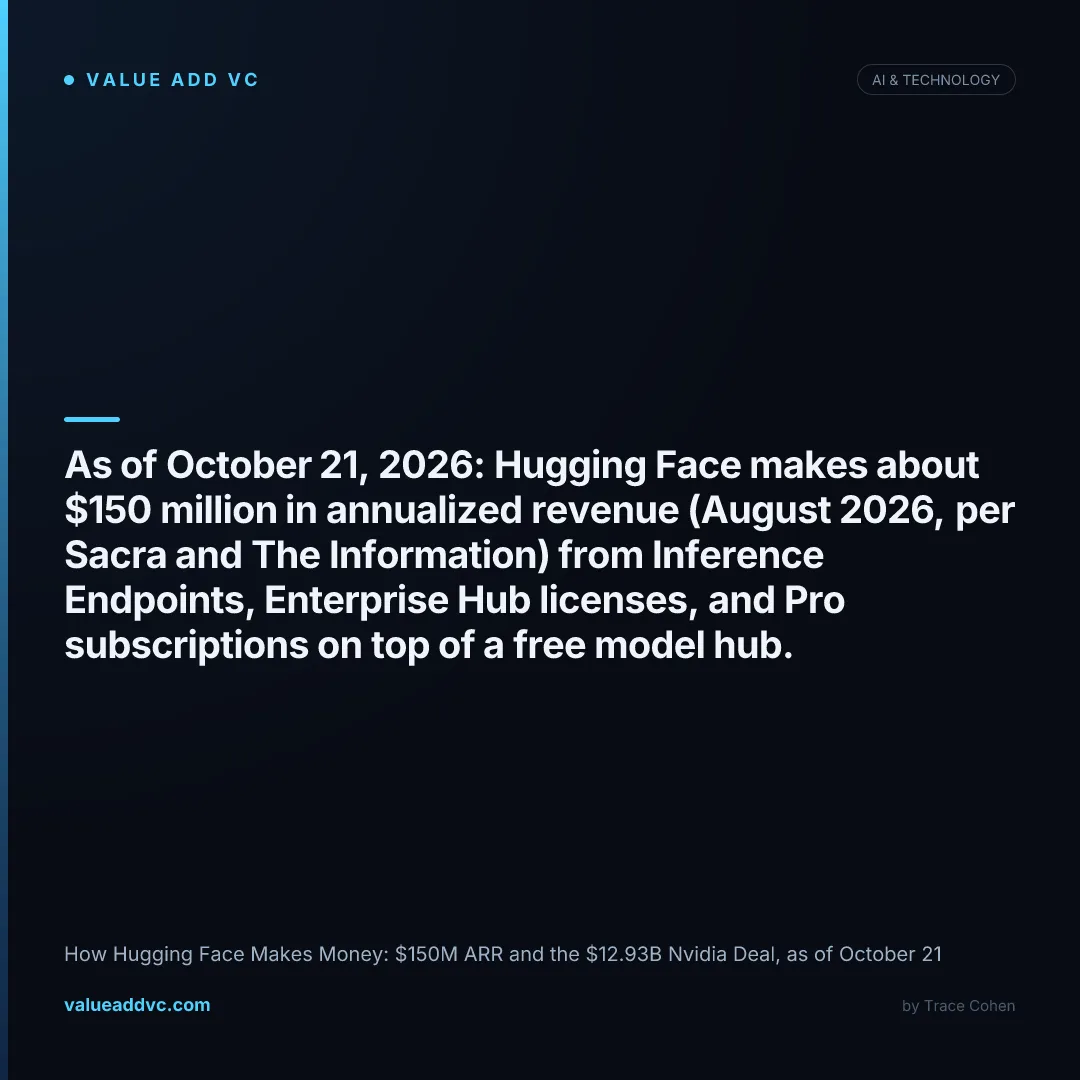
As of October 21, 2026, Hugging Face's latest revenue figure is about $150 million in annualized revenue, reached in August 2026, per Sacra — built on top of a model hub that's entirely free to use. More than 3 million models, 500,000 datasets, and 1 million applications sit on the Hugging Face Hub, according to Nvidia, all accessible without paying a cent. The business model works because that free hub creates the largest concentration of AI practitioners on the internet, and a fraction of them need production hosting, enterprise controls, or higher-tier compute — which is where Hugging Face charges. Revenue is one thing; whether any of it drops to the bottom line is a separate question we dig into in Is Hugging Face Profitable?
Founded in New York in 2016 as a chatbot app for teenagers, Hugging Face pivoted to open-source NLP tools in 2018 and has since become the de facto platform where the AI community publishes, discovers, and deploys models. It's the "GitHub for machine learning" — and like GitHub, the core product is free while the revenue comes from enterprise features and managed infrastructure. As of October 21, 2026, it is also an acquisition target: Nvidia agreed on September 3 to buy it for $12.93 billion, a deal still awaiting regulatory approval. Here's how the business model — and the revenue behind it — actually works.
Hugging Face: Key Numbers (as of October 21, 2026)
| Date | Event | Amount / Valuation / Revenue | Source |
|---|---|---|---|
| Aug 2023 | Series D | $235M at $4.5B | TechCrunch |
| End of 2025 | Annual recurring revenue, Sacra estimate | $81M | Sacra |
| Aug 2026 | Annual recurring revenue (Sacra; The Information reported the same figure) | $150M | Sacra |
| Sep 3, 2026 | Nvidia agrees to acquire: ~$11.9B to stockholders plus up to ~$1.0B in retention equity | $12.93B | Nvidia 8-K |
| Oct 21, 2026 | Deal not closed; no later Nvidia 8-K; expected close H1 2027 pending regulatory approvals | — | SEC EDGAR |
Hugging Face is private and does not publish revenue; ARR figures are third-party estimates and press reports.
Updated October 20, 2026: Nvidia's acquisition of Hugging Face is agreed but not closed. Nvidia's 8-K says the $12.93 billion deal is expected to close in the first half of 2027, subject to closing conditions including required regulatory approvals, and as of October 20, 2026 Nvidia has filed no later 8-K reporting a change. Sacra's estimate is still ~$150M ARR as of August 2026. Earlier update (October 1): New: CNBC reported September 28, 2026 that AMD and Salesforce had separately explored acquiring Hugging Face, and that OpenAI had proposed a $100M investment, before Nvidia's deal was struck on September 2-3 — context on how competitive the process was, not a threat to the signed, regulator-pending agreement.
As of October 20, 2026. ARR is a Sacra estimate (Hugging Face does not publish revenue); hub and user counts and deal price from Nvidia's announcement; closing timing from Nvidia's 8-K.
How does Hugging Face make money
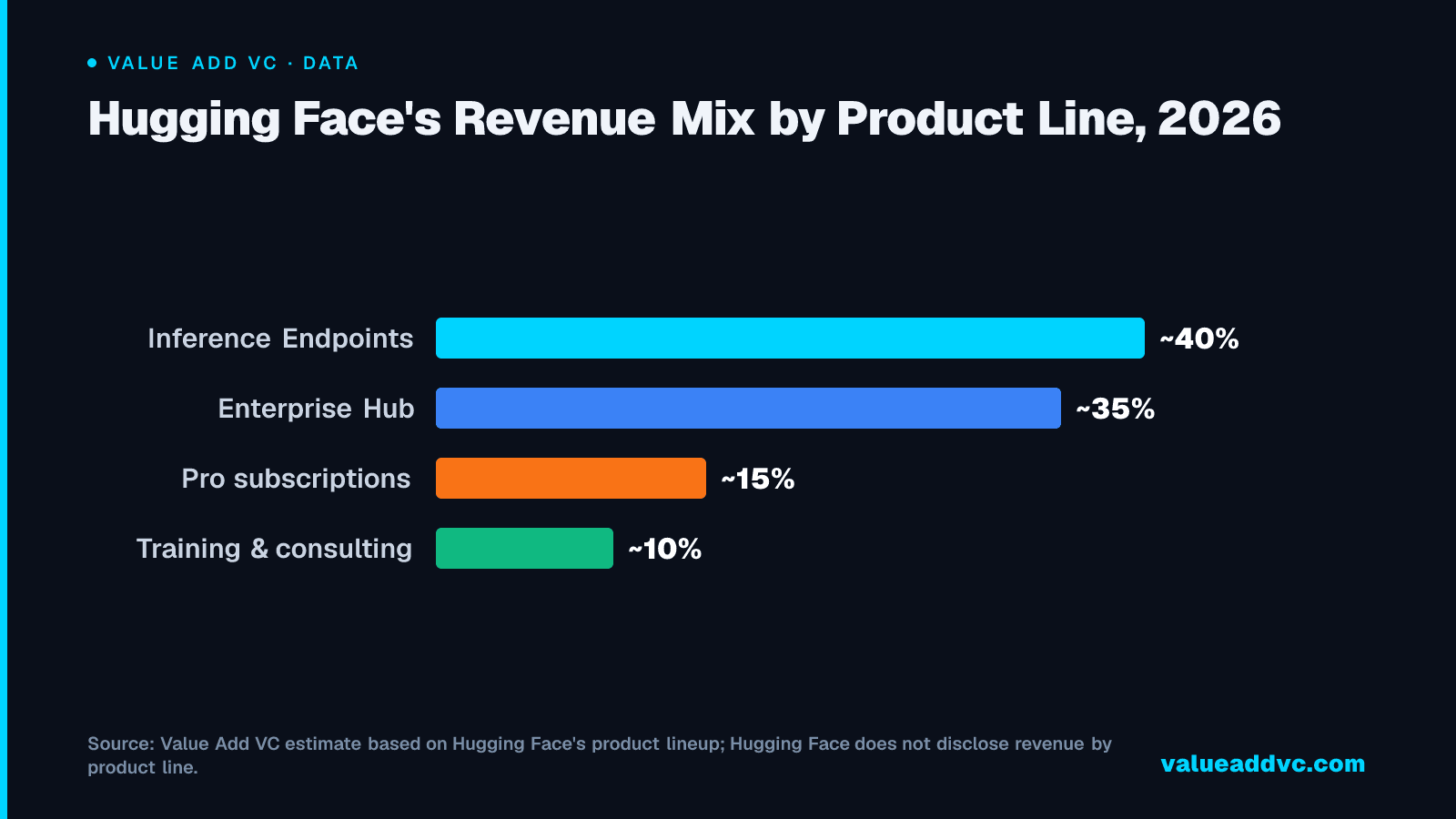
Hugging Face makes money through three product tiers layered on top of its free hub. Inference Endpoints are, by our estimate, the largest revenue line at roughly 40% of total revenue (Hugging Face does not disclose its revenue mix). Customers pick any model from the Hub (or upload their own), select a GPU instance type (starting at $0.50/hour for a T4, up to several dollars per hour for A100s and H100s), and Hugging Face deploys it as a production-ready API with autoscaling, security, and monitoring included. It's model deployment as a managed service — the customer doesn't touch infrastructure.
Enterprise Hub at $50 per user per month (the lighter Team plan is $20 per user per month, per Hugging Face's pricing page) accounts for an estimated 35% of revenue. Organizations like Google, Bloomberg, and Grammarly pay for private model repositories, single sign-on (SSO via SAML/OIDC), granular access controls per repo, audit logs, and priority support. Enterprise Hub also includes Inference API access with higher rate limits and dedicated endpoints — making it a bundled platform deal rather than a single feature.
Pro subscriptions at $9 per month target individual power users and represent an estimated 15% of revenue. Pro unlocks early access to new features, higher rate limits on the free Inference API, persistent Spaces (the free tier sleeps inactive Spaces after 48 hours), and access to ZeroGPU (shared GPU instances for running models in Spaces). The remaining ~10% comes from training services and consulting engagements with large enterprises that need help fine-tuning or deploying models at scale.
Hugging Face's Revenue Mix by Product Line, 2026
By our estimate, Inference Endpoints (managed GPU hosting) drive roughly 40% of revenue, with Enterprise Hub licenses close behind at 35% as more organizations standardize on the platform.
Value Add VC estimate based on Hugging Face's product lineup; Hugging Face does not disclose revenue by product line.
Data
| Item | Value |
|---|---|
| Inference Endpoints | ~40% |
| Enterprise Hub | ~35% |
| Pro subscriptions | ~15% |
| Training & consulting | ~10% |
The open-source flywheel: why giving away the hub works
Hugging Face's business model follows the same logic as GitHub, Red Hat, and Databricks: build the largest open-source community in a category, become the default platform, and monetize the small percentage of users who need production-grade features. The free Hub creates three compounding advantages that paid competitors can't replicate.
First, every new model uploaded to the Hub makes the platform more valuable for every other user — network effects that grow without Hugging Face spending on content creation. Second, researchers who learn the Transformers library in grad school carry that preference into industry jobs, creating bottom-up adoption in enterprises. Third, the Hub serves as a massive distribution channel for model creators (Meta publishes Llama there, Google publishes Gemma, Stability AI publishes Stable Diffusion), which draws attention back to the platform and drives more users toward paid features.
That flywheel is why Hugging Face's $235 million Series D in August 2023 attracted strategic investments from nearly every major cloud and chip company — Salesforce, Google, Amazon, Nvidia, Intel, AMD, Qualcomm, and IBM all invested. These companies weren't just making financial bets; they were keeping the default hub for open-source AI independent and interoperable with their infrastructure, rather than captive to a single vendor. That is why Nvidia's September 2026 pledge to keep the platform open across clouds and accelerators is central to its pending acquisition.
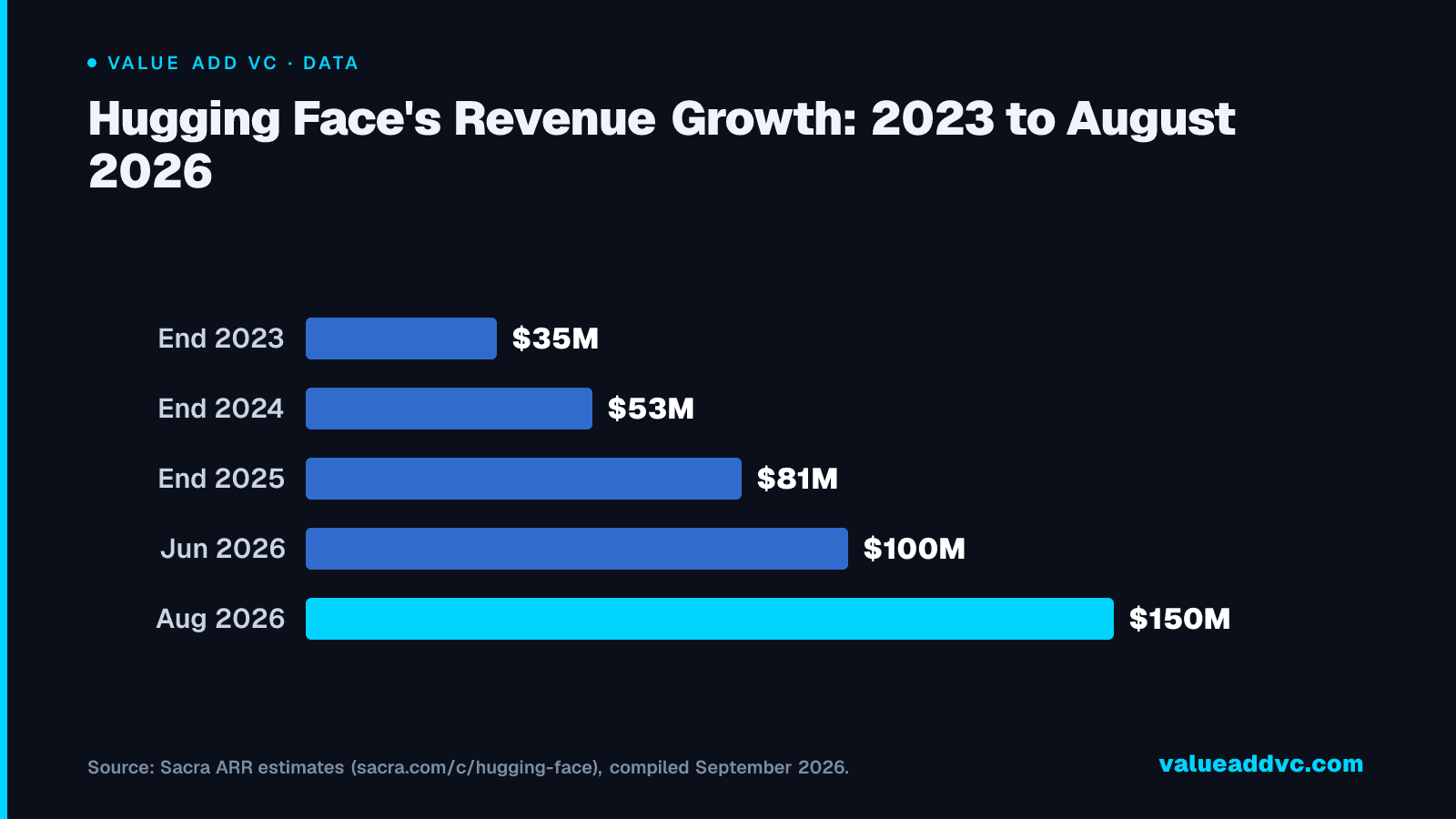
Hugging Face's Revenue Growth: 2023 to August 2026
Hugging Face grew ARR from about $35M at the end of 2023 to about $150M by August 2026, roughly 4x, with the jump from $100M to $150M coming in about two months.
Sacra ARR estimates (sacra.com/c/hugging-face), compiled September 2026.
Data
| Item | Value |
|---|---|
| End 2023 | $35M |
| End 2024 | $53M |
| End 2025 | $81M |
| Jun 2026 | $100M |
| Aug 2026 | $150M |
Valuation: from $4.5 billion to Nvidia's $12.93 billion offer
Hugging Face was valued at $4.5 billion after its $235 million Series D in August 2023 — a round that was unusual because it included strategic investors from competing cloud platforms all investing simultaneously. Total funding is approximately $395 million across all rounds. Nvidia's $12.93 billion price is about 86x the roughly $150 million in annualized revenue that The Information reported in August, as cited by TechCrunch at announcement, which is high by traditional SaaS standards and shows Nvidia is paying for the hub's strategic position more than for its current revenue.
The comp that matters most is GitHub itself, which Microsoft acquired for $7.5 billion in 2018 when it had roughly $200-300 million in revenue — a 25-37x multiple. GitHub's revenue has since grown to over $2 billion, validating the thesis that developer platforms with network-effect moats can monetize far beyond their acquisition price. Nvidia is making a similar bet: that the open-source AI hub will eventually generate billions in revenue from inference, enterprise, and training compute as AI adoption scales across every industry. For more on how AI companies are valued at different stages, see our AI valuations dashboard.
Update, September 2026: After reports that Hugging Face had retained bankers to explore a sale near $13 billion, NVIDIA announced on September 3, 2026 that it "has agreed to acquire Hugging Face for $12,930,300,000" — nearly triple the 2023 mark. Nvidia says Hugging Face will remain an open, multi-cloud platform, and that Nvidia compute will not be required to build on or deploy through it. Nvidia's 8-K, covering the agreement signed September 2, describes an "approximately $11.9 billion purchase price payable to Hugging Face stockholders" plus "an equity-based retention program of up to approximately $1.0 billion for Hugging Face employees," and says the deal is "expected to close in the first half of 2027," subject to closing conditions "including receipt of required regulatory approvals." As of October 1, 2026 the deal has not closed. That openness pledge anticipates "what is likely to become the central issue in the antitrust reviews" in the US and EU, according to MLex. The sale process was reportedly more contested than a single-bidder deal suggests: OpenAI offered to invest roughly $100 million in Hugging Face after a July incident in which OpenAI's agents accessed the platform, with talks including Hugging Face serving as a distribution channel for OpenAI's in-development custom chips before falling apart; AMD and Salesforce also separately circled Hugging Face before Nvidia's deal, according to CNBC, September 28, 2026. Until closing, Hugging Face's pricing and products continue as described here.
| Round | Date | Amount | Valuation | Key Investors |
|---|---|---|---|---|
| Seed | 2017 | $4M | Undisclosed | Betaworks, SV Angel |
| Series A | Dec 2019 | $15M | ~$100M | Lux Capital, A.Capital |
| Series B | Mar 2021 | $40M | ~$400M | Addition, Lux Capital |
| Series C | May 2022 | $100M | $2B | Lux Capital, Sequoia |
| Series D | Aug 2023 | $235M | $4.5B | Google, Amazon, Nvidia, Salesforce, Intel, AMD, Qualcomm, IBM |
| Acquisition agreement (pending) | Sep 2026 | — | $12.93B | Nvidia; close expected H1 2027 |
Funding data from Crunchbase and Hugging Face press releases, compiled August 2026; acquisition row from Nvidia's announcement and 8-K, as of September 26, 2026.
Hugging Face vs the inference platforms
Hugging Face's Inference Endpoints compete directly with Baseten, Replicate, Together AI, and Fireworks AI in the managed model inference market. But Hugging Face's advantage is that the Hub is upstream of all of them — a researcher or engineer who discovers a model on the Hub and wants to deploy it can do so with a single click through Inference Endpoints, rather than downloading the model, configuring a deployment pipeline, and uploading it to a separate platform.
The tradeoff is that Hugging Face's inference offering is less optimized than purpose-built inference platforms. Baseten ($600M ARR) and Together AI ($1.15B in bookings) have built custom serving stacks specifically for inference latency and throughput, while Hugging Face's Inference Endpoints are more general-purpose. For high-volume production workloads where latency matters, specialized inference platforms often win. Hugging Face wins on convenience for teams already using the Hub — which, given the more than 200,000 companies Nvidia says use the platform, is a very large addressable market.
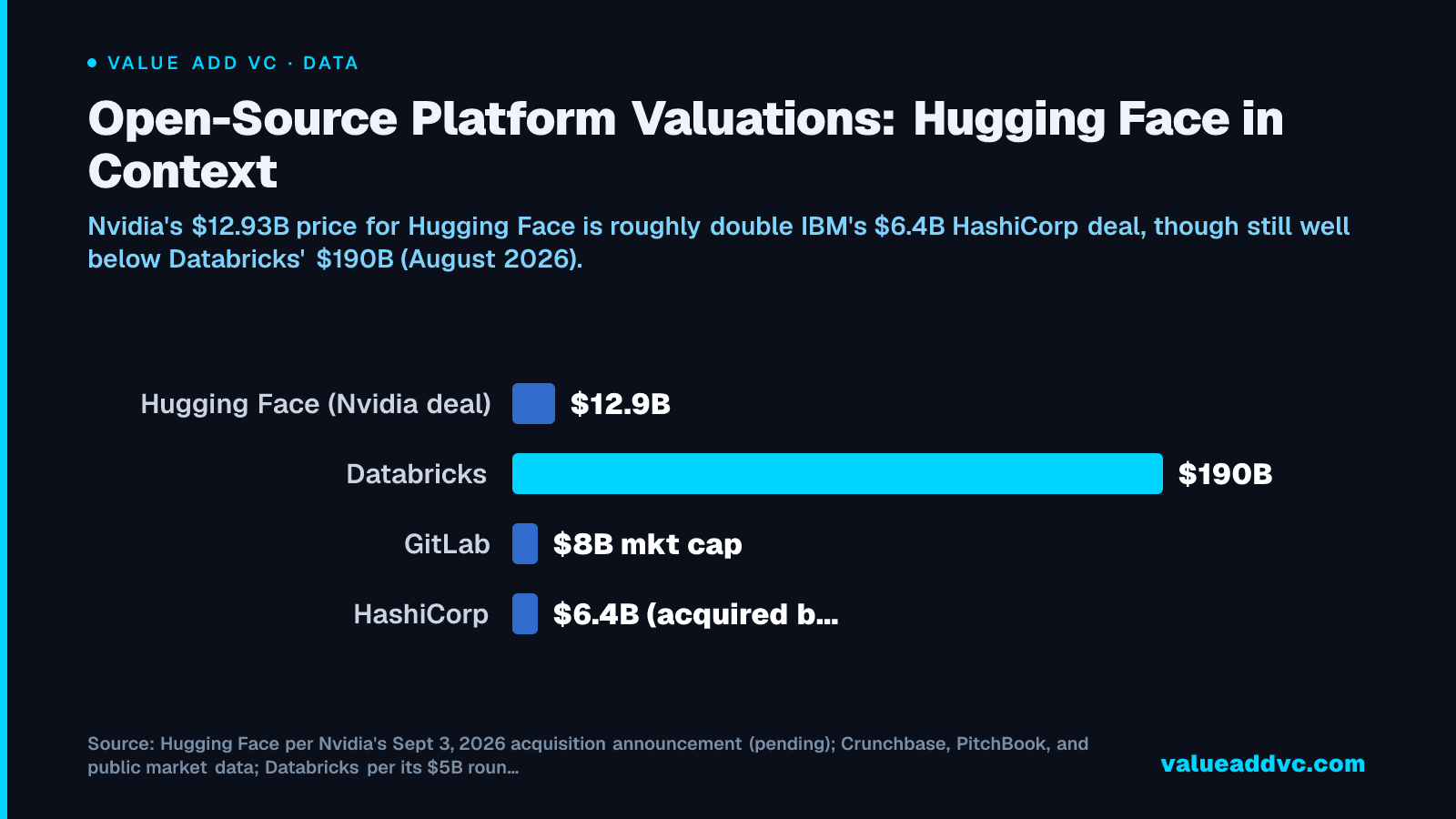
Open-Source Platform Valuations: Hugging Face in Context
Nvidia's $12.93B price for Hugging Face is roughly double IBM's $6.4B HashiCorp deal, though still well below Databricks' $190B (August 2026).
Hugging Face per Nvidia's Sept 3, 2026 acquisition announcement (pending); Crunchbase, PitchBook, and public market data; Databricks per its $5B round at $190B (TechCrunch, Aug 13, 2026); HashiCorp per IBM's $6.4B acquisition (TechCrunch, Feb 2025).
Data
| Item | Value |
|---|---|
| Hugging Face (Nvidia deal) | $12.9B |
| Databricks | $190B |
| GitLab | $8B mkt cap |
| HashiCorp | $6.4B (acquired by IBM) |
Bottom line: Hugging Face makes money by selling managed inference hosting ($0.50+/GPU-hour), Enterprise Hub licenses ($50/user/month), and Pro subscriptions ($9/month) on top of the world's largest free model repository. With about $150 million in ARR as of August 2026, it is still small next to its price tag. The open-source flywheel — every model uploaded makes the platform more valuable — is the core moat, and it is what Nvidia agreed to pay $12.93 billion for on September 3, 2026, while pledging to keep the platform open across clouds and accelerators. The deal still needs regulatory approval and is expected to close in the first half of 2027.
Latest from the Pulse
Get VC data most people never see
— free to subscribe
Trace's notes on venture, AI and startups, a few times a week. Join 5,000+ subscribers. No spam.
No spam, unsubscribe anytime. Sent via Substack · Privacy · or subscribe on Substack ↗