Replit's annualized revenue jumped from $300 million to $525 million in four months, and the company is now valued at $9 billion after a $400 million Series D in March 2026. Replit is quietly running one of the fastest revenue ramps in software history, and it's almost entirely powered by AI Agent usage fees layered on top of a plain subscription business.
Replit started as a browser-based coding sandbox for students and hobbyists. In 2026 it's something closer to a full AI software factory — an Agent that plans, writes, tests, and deploys entire applications, billed by the unit of work it actually does. That shift from seat-based SaaS to consumption-based AI is the single biggest thing to understand about how Replit makes money right now.
Figures from Sacra, Replit's Series D announcement, and Getlatka reporting as of April–July 2026.
How Does Replit Make Money in 2026?
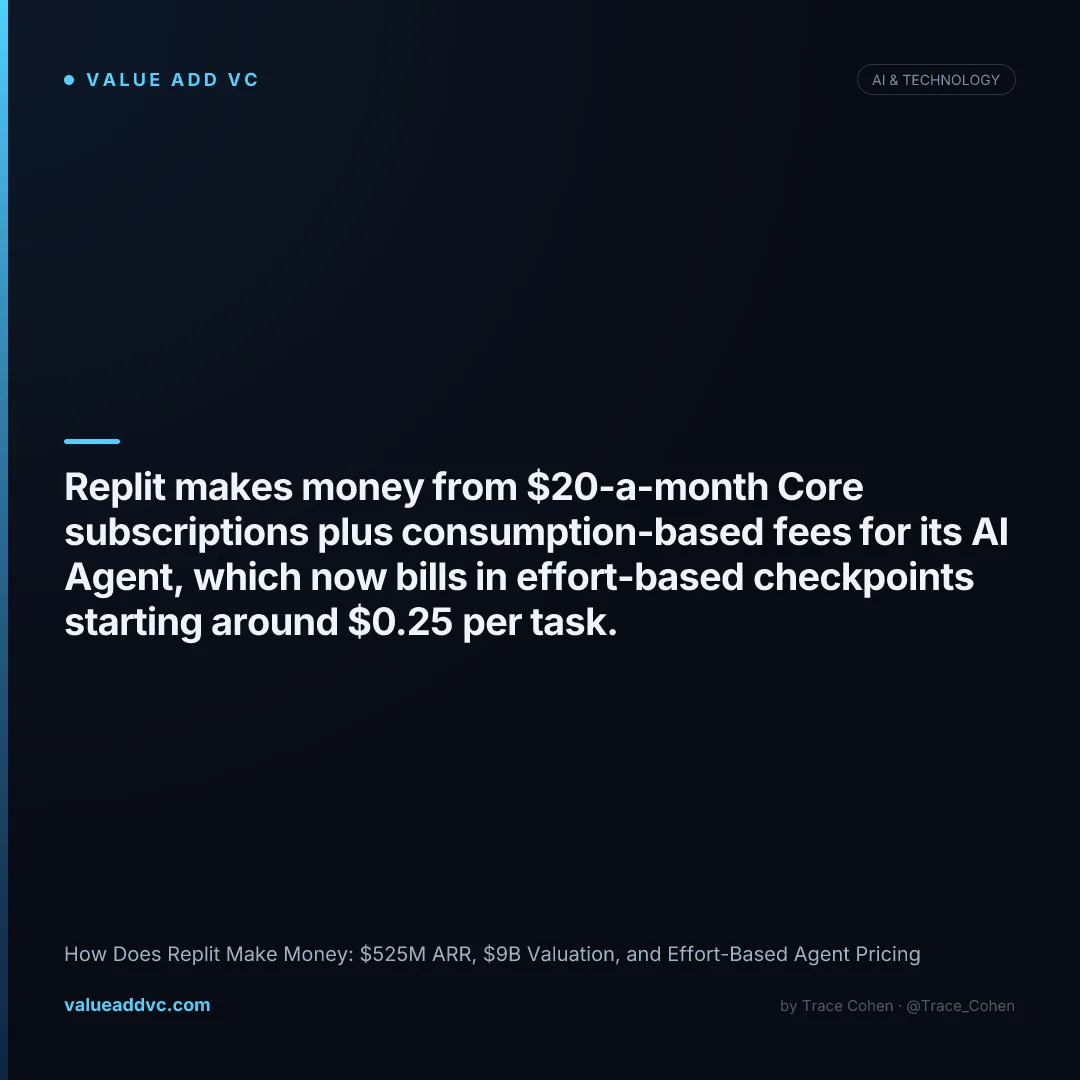
Replit makes money through a two-layer model: flat monthly subscriptions (Core, Pro, Teams, and Enterprise plans starting around $20 a month) plus consumption-based charges for its AI Agent, which builds, debugs, and deploys software on a user's behalf. The subscription layer buys baseline access and compute; the Agent layer is metered separately using an effort-based checkpoint system introduced in July 2026, so heavy AI users pay proportionally more than someone using Replit as a free code playground.
That blended model is why revenue accelerated so much faster than the user base did. Registered users have grown steadily past 30 million, but revenue nearly doubled between December 2025 and April 2026 — growth that tracks Agent adoption and usage intensity, not just new sign-ups.
What Is Replit's Valuation and How Much Funding Has It Raised?
Replit is valued at $9 billion as of March 2026, after closing a $400 million Series D led by Georgian Partners with G Squared, Prysm Capital, Coatue, Andreessen Horowitz, Craft Ventures, Y Combinator, Accenture Ventures, Okta Ventures, and Databricks Ventures participating. That price is 3x the $3 billion valuation Replit carried just six months earlier, when it raised $250 million in September 2025 with backing from Amex Ventures and Google's AI Futures Fund.
How Much Revenue Does Replit Actually Make?
Replit generated an estimated $525 million in annualized revenue in April 2026, up from $300 million at the end of 2025 — a 75% increase in roughly four months, per Sacra's tracking. The company has publicly stated it's targeting $1 billion in run-rate revenue by the end of 2026, which would mean more than tripling its 2025 year-end revenue base within a single calendar year, almost entirely on the strength of Agent usage growth rather than new subscription sign-ups alone.
| Milestone | Date | Detail |
|---|---|---|
| Founded | April 2016 | Amjad Masad, Faris Masad, Haya Odeh — San Francisco |
| Series C | Sept 2025 | $250M raised at $3B valuation |
| 2025 year-end ARR | Dec 2025 | ~$300M annualized revenue |
| Series D | March 2026 | $400M raised at $9B valuation, led by Georgian Partners |
| April 2026 ARR | April 2026 | ~$525M annualized revenue (Sacra estimate) |
| Effort-based pricing | July 1, 2026 | Agent billing shifts from flat rates to per-checkpoint cost |
| 2026 ARR target | Dec 2026 (goal) | ~$1B run-rate revenue, per company statements |
Timeline compiled from Replit's funding announcements, Sacra revenue tracking, and Replit's official pricing blog as of July 2026.
How Does Replit's Effort-Based AI Agent Pricing Work?
Replit's Agent now bills based on the actual time and computation a task consumes, rather than a flat per-prompt or per-message charge. The rollout started for new users first and began reaching existing Core and Teams subscribers on July 1, 2026. Under this model, a simple change — fixing a typo, tweaking a style rule — typically costs less than $0.25, while a complex multi-file build gets bundled into a single, larger checkpoint that can cost several dollars, and users only find out the exact price once the Agent has finished the work.
This isn't a cosmetic pricing tweak — it's a direct response to the economics of running AI Agents at scale. Flat-rate AI subscriptions are notoriously easy for power users to arbitrage against a provider's underlying compute cost, and Replit's move to checkpoint billing is the same playbook OpenAI and Anthropic have used with token-metered API pricing, applied to a consumer-facing product. That underlying compute cost is itself a fast-growing business — inference providers like Fireworks AI have scaled past $1B ARR largely by selling the token-metered capacity that companies like Replit now have to price around. Expect more AI-native software companies to make this same shift as usage-based revenue becomes a larger share of the AI software stack — a trend we track more broadly on the SaaS Valuations Dashboard.
How Does Replit Make Money Compared to Cursor and Lovable?
All three leading AI coding companies — Replit, Cursor, and Lovable — combine flat subscriptions with usage-based AI fees, but they sit at very different points on the valuation and revenue curve as of mid-2026. Cursor (built by Anysphere) leads by a wide margin: it raised $2.3 billion at a $29.3 billion valuation in November 2025 and is estimated to be generating roughly $4 billion in annualized revenue, with SpaceX separately paying $10 billion for exclusive collaboration rights plus an option to acquire the company at a $60 billion valuation. Lovable sits in the middle at a $13.2 billion valuation on roughly $500 million ARR. Replit is the smallest of the three by valuation and revenue, at $9 billion and $525 million ARR, but its 75% revenue jump in four months is the fastest relative growth rate of the group.
AI Coding Companies: Valuation vs Estimated ARR, Mid-2026
Valuation and ARR figures from CNBC, Sacra, and company funding announcements, 2025–2026.
The three products also target different users, which shapes how each company monetizes: Cursor is built for developers who already know how to code and pay for productivity, Lovable targets non-technical builders generating full apps from plain-English prompts, and Replit sits in between — a cloud IDE that scales from a free student sandbox up to an enterprise Agent platform. At fifteen seats, that positioning shows up directly in pricing: Replit Pro runs about $100 a month, Cursor Teams runs about $600 a month, and Lovable holds steady near $25 a month.
Is Replit Profitable in 2026?
Replit has not disclosed GAAP profitability figures, and there's no public evidence the company is net-income positive in 2026. Like most venture-backed AI coding companies, Replit is almost certainly still spending more on GPU inference and R&D than it collects in revenue, even at $525 million in annualized revenue. The clearest signal of that gap is the move to effort-based Agent pricing itself: companies with comfortable margins rarely rebuild their entire billing system mid-year, and Replit did exactly that on July 1, 2026, explicitly to tie what it charges more tightly to what each task actually costs to run.
That doesn't make the business unhealthy — it makes it typical of the category. Track how Replit, Cursor, and other AI-native software companies compare on growth and valuation multiples on our AI Valuations Dashboard.
Replit went from $300M to $525M in annualized revenue in four months.
Almost none of that came from new users — it came from teaching an AI Agent to bill for its own work.
The Bottom Line on How Replit Makes Money
Replit makes money by pairing a familiar $20-a-month subscription business with a fast-growing, consumption-priced AI Agent — and in 2026 the second piece is doing almost all the work. Annualized revenue climbed from $300 million to $525 million in four months, the valuation tripled to $9 billion in six months on a $400 million Series D, and the July 2026 shift to effort-based checkpoint billing shows a company trying to make its pricing match its actual compute costs before it chases a $1 billion ARR target by year-end.
Compared to Cursor's $29.3 billion valuation and Lovable's $13.2 billion, Replit is the smallest of the three major AI coding companies — but it's also compounding revenue the fastest, and its 30 million-plus user base gives it the widest funnel to convert into paying Agent users over the next year.
Track AI coding companies and other 2026 mega-rounds on the AI Valuations Dashboard at Value Add VC. Reach out at t@nyvp.com or @Trace_Cohen.
Latest from the Pulse
Get VC data most people never see
— 100% free
Weekly benchmarks, valuations, and fund data. Join 5,000+ investors. No spam.