
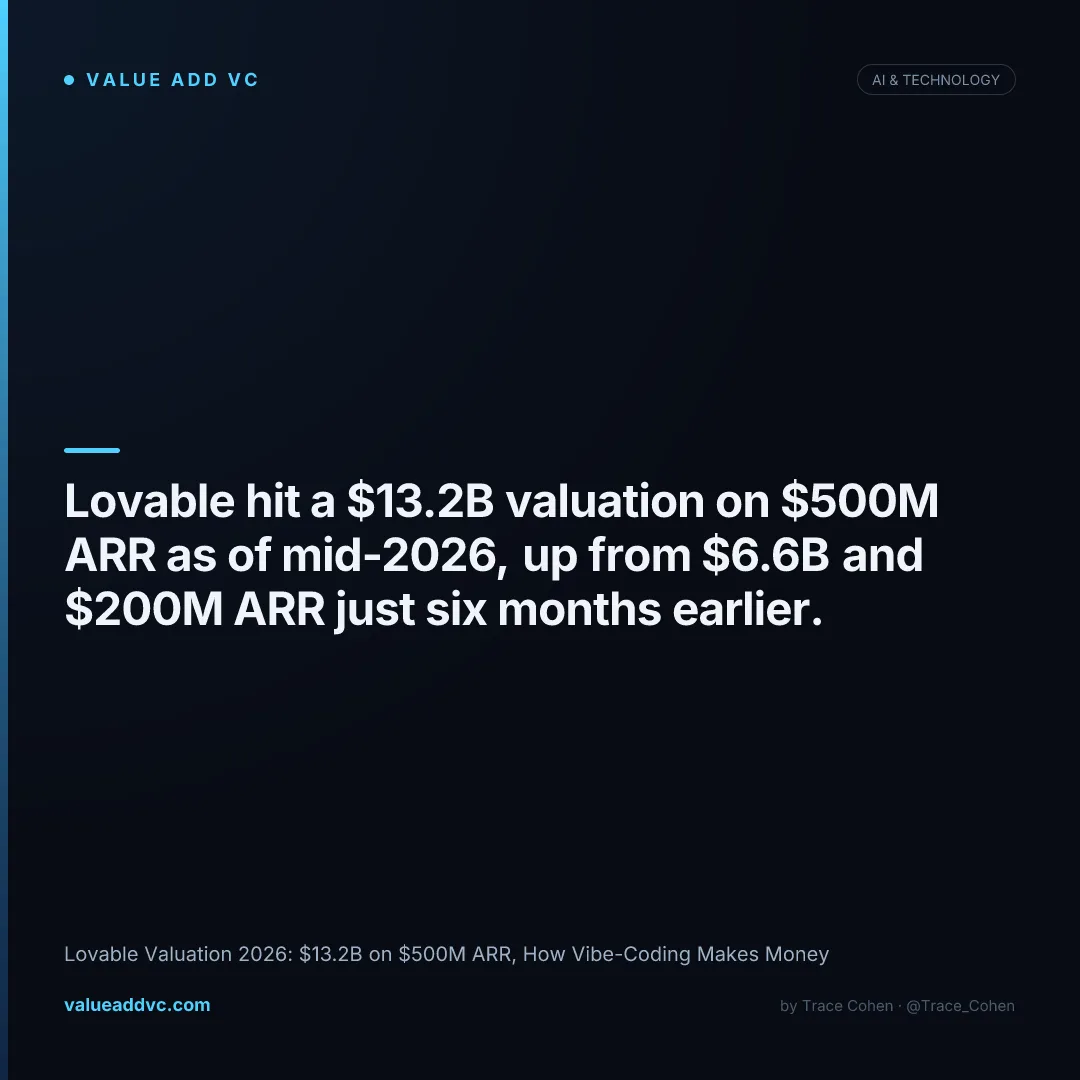
As of October 21, 2026, Lovable is worth $13.3B, set by its August 12, 2026 Series C, and says its run-rate revenue passed $600M in September — up from a $6.6B valuation and $200M run rate in late 2025. A doubled valuation on a tripled revenue base, inside a single fundraising cycle, is the part worth explaining.
Developer tool categories get created and re-created constantly, but valuation and revenue rarely compound the way Lovable's have. This isn't a story about a clever wrapper riding a model API — it's a story about a credit-based pricing model that captures usage upside as fast as usage grows, in a category (AI app builders) whose leading companies have multiplied their revenue several times over in a year. The question worth asking isn't whether the growth is real. It's whether a $13.3B mark on a $600M run rate (roughly 22x) is a price the market will still pay once the category stops doubling every few months — and whether the same logic applies now that its most direct developer-first rival, Cursor, is exiting the category entirely via a $60B acquisition rather than staying independent.
Lovable: Key Numbers (as of October 21, 2026)
| Date | Event | Amount / Valuation / Revenue | Source |
|---|---|---|---|
| Dec 2025 | $330M Series B led by CapitalG and Menlo Ventures | $6.6B valuation | TechCrunch |
| Jun 2026 | Annualized run-rate revenue, per the company | $500M run rate | TechCrunch |
| Aug 12, 2026 | $400M Series C led by Menlo Ventures, co-led by EQT's Scaleup Europe Fund; Tencent joins | $13.3B valuation | Lovable; TechCrunch |
| Sep 24, 2026 | Co-founder Fabian Hedin says run-rate revenue has passed $600M | $600M+ run rate | TechCrunch; The Next Web |
| Oct 21, 2026 | No newer round or valuation reported | $13.3B | Value Add VC news review |
Run-rate revenue is a company-reported annualized figure, not audited annual revenue. The $13.3 billion valuation is the company's stated figure; it did not say pre- or post-money.
Lovable Valuation 2026: How a Vibe-Coding Startup Got to $13.3B
Lovable's valuation reached $13.3B in a $400M Series C announced August 12, 2026 (TechCrunch), co-led by Menlo Ventures and the EQT-managed Scaleup Europe Fund, with Tencent, Salesforce Ventures, HubSpot Ventures, DST Global, and CapitalG among the syndicate — up from $6.6B in December 2025, itself set by a $330M Series B led by CapitalG and Menlo Ventures. Reports from June 2026 had the company in talks at a $12B target; the round that ultimately closed came in above even that number, which is a signal of how much demand there was for the deal once ARR data started circulating. Total funding across five rounds now sits around $952.5M, meaning Lovable has raised roughly 7% of its own valuation in cash — a capital efficiency ratio that's still unusually strong by AI-startup standards, even after the new round pushed cumulative funding past $950M.
Lovable's ARR Growth: $200M to $600M+ in About Ten Months
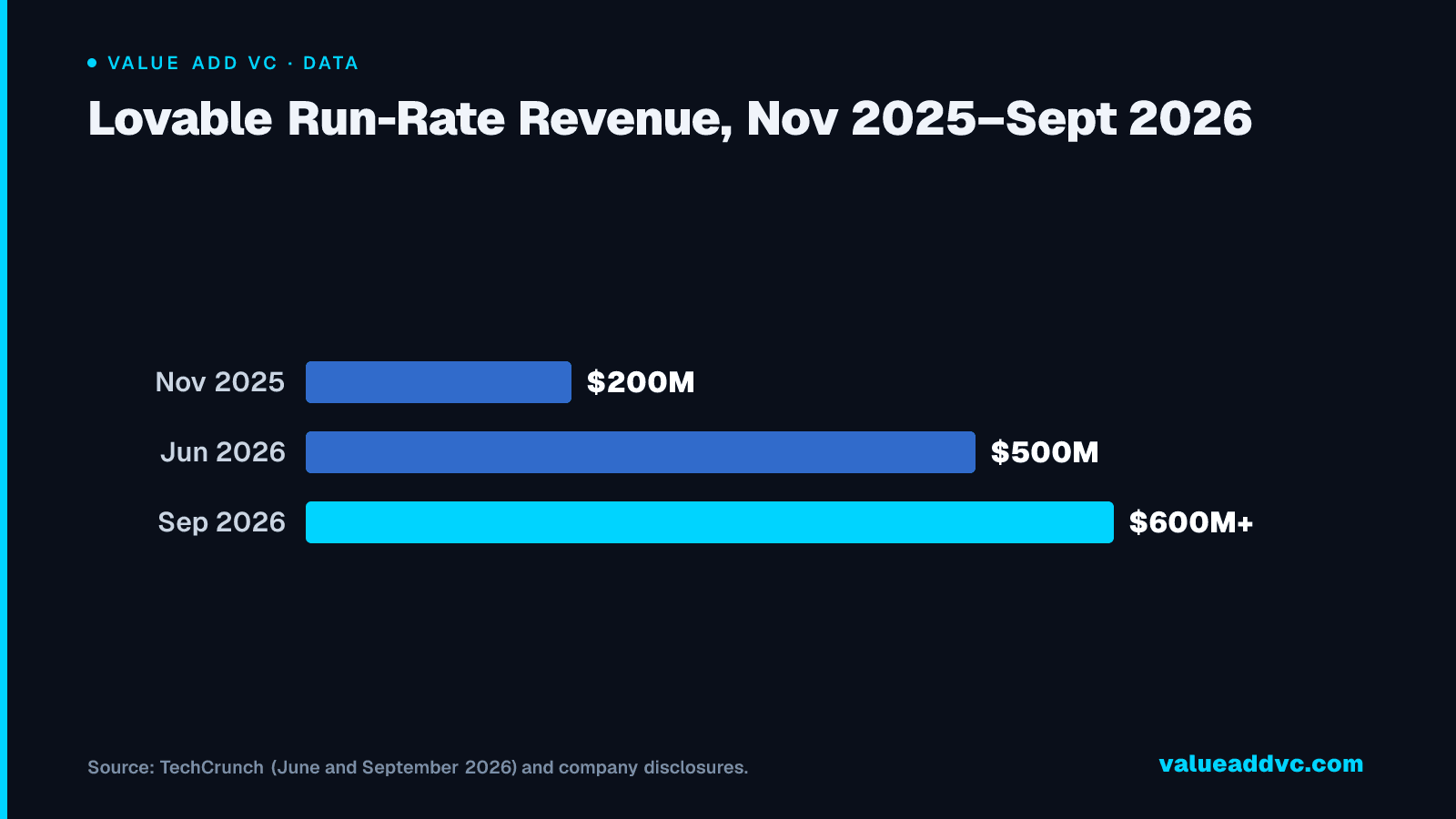
The revenue trajectory is the real story behind the valuation. Lovable's annualized run rate went from $200M in November 2025 to $500M by June 2026, then crossed $600M by September 24, 2026, co-founder Fabian Hedin said at HumanX Amsterdam — roughly tripling in about ten months. For context, that's a faster ARR ramp than most vertical SaaS companies achieve in their first three years combined, and it's happening on top of an already-large $200M base rather than off a small seed-stage number where percentage growth is easy to inflate.
Lovable Run-Rate Revenue, Nov 2025–Sept 2026
Run-rate revenue roughly tripled in about ten months — a growth rate that, if it decelerates even modestly, would still put Lovable on pace for a $1B+ run rate in 2027.
TechCrunch (June and September 2026) and company disclosures.
Data
| Item | Value |
|---|---|
| Nov 2025 | $200M |
| Jun 2026 | $500M |
| Sep 2026 | $600M+ |
How Does Lovable Make Money? The Credit-Based Business Model
Lovable runs a tiered subscription model layered with usage-based credits, which is what lets its revenue scale faster than its user count. The base plans are Free ($0), Pro ($25/month billed annually), Business ($50/month billed annually), and Enterprise (custom, with reported minimums around $500/month). Each paid tier includes a monthly credit allotment, and credit consumption depends on task complexity — how many files the agent touches, how much of the codebase it has to search, and which tools it invokes (browser checks, web search, image generation). That's the mechanism that captures upside from power users: a founder building a quick prototype burns through credits slowly, but a team running Lovable as a daily internal tool blows through the monthly allotment and buys top-ups, turning what looks like a flat $25-$50/month plan into a much larger real ARPU.
On top of subscriptions and credit top-ups, every workspace carries metered cloud hosting — a $25/month free allowance before hosting charges kick in — plus a small $1/month charge for in-app AI features. It's the same three-layer model (subscription + usage credits + hosting) that Cursor uses for its own token-based pricing, and it's becoming the default architecture for AI coding tools generally: flat pricing alone under-monetizes heavy users, and pure usage-based pricing alone scares off casual ones, so nearly every serious player in the category has converged on some blend of both.
Lovable vs Cursor vs Replit vs Bolt: Who's Actually Winning Vibe Coding
The vibe-coding market has split into two distinct segments rather than crowning one winner — and the developer-first segment just lost its independent leader. Lovable and Replit lead the prompt-to-app, browser-native segment aimed at non-technical builders and fast prototyping; v0 leads what remains of the code-owning, developer-first segment now that Cursor's parent company, Anysphere, agreed in June 2026 to be acquired by SpaceX/xAI for $60B in an all-stock deal. Bolt sits closer to Lovable's segment and was the fastest mover on pure velocity in 2025, reaching $40M ARR in just five months, though Emergent's own rapid unicorn run shows the pace isn't limited to just those four. Replit has grown into a $9B company on roughly $525M ARR as of April 2026 with a 30M+ user base, well ahead of Lovable's 8M, but Lovable's ARR-per-user economics still look stronger, which is what you'd expect from a credit-consumption model against a broader freemium base.
What the SpaceX/xAI deal changes: Cursor was the clearest apples-to-apples comparison for Lovable on revenue multiple and growth rate — both were independent, venture-backed, AI-coding companies converting usage into ARR at similar speed. Once Anysphere is absorbed into SpaceX/xAI, Cursor's product roadmap and pricing will likely be shaped by that parent company's priorities rather than by pure category competition, which could either loosen competitive pressure on Lovable in the near term or, if SpaceX/xAI decides to bundle Cursor aggressively into a broader platform play, tighten it in ways Lovable hasn't had to plan for yet. This likely means the next twelve months tell us more about how consolidated the vibe-coding category becomes than the last twelve did.
| Company | Valuation | ARR | Users | Segment |
|---|---|---|---|---|
| Lovable | $13.3B | $600M+ (Sep 2026) | 8M | Prompt-to-app, browser-native |
| Replit | $9B (Mar 2026 round) | $525M (Apr 2026) | 30M+ | All-in-one browser platform |
| Cursor (Anysphere) | $29.3B priced; $60B pending SpaceX/xAI sale | $2B+ (Feb 2026) | Not disclosed | Code-owning, IDE-native |
| Bolt (StackBlitz) | Not disclosed 2026 | $40M | Not disclosed | Prompt-to-app, browser-native |
| v0 (Vercel) | Part of Vercel ($9.3B, Sep 2025) | Not broken out | Not disclosed | Code-owning, developer-first |
Figures blended from Bloomberg, TechCrunch, Dealroom, and company funding announcements, 2025-2026. Bolt's ARR figure dates to early 2025 and StackBlitz has not disclosed a newer number; Bolt and v0 do not publicly disclose standalone valuation.
Lovable vs Bolt: ARR Growth Speed
TechCrunch, Dealroom, company disclosures, 2026.
Data
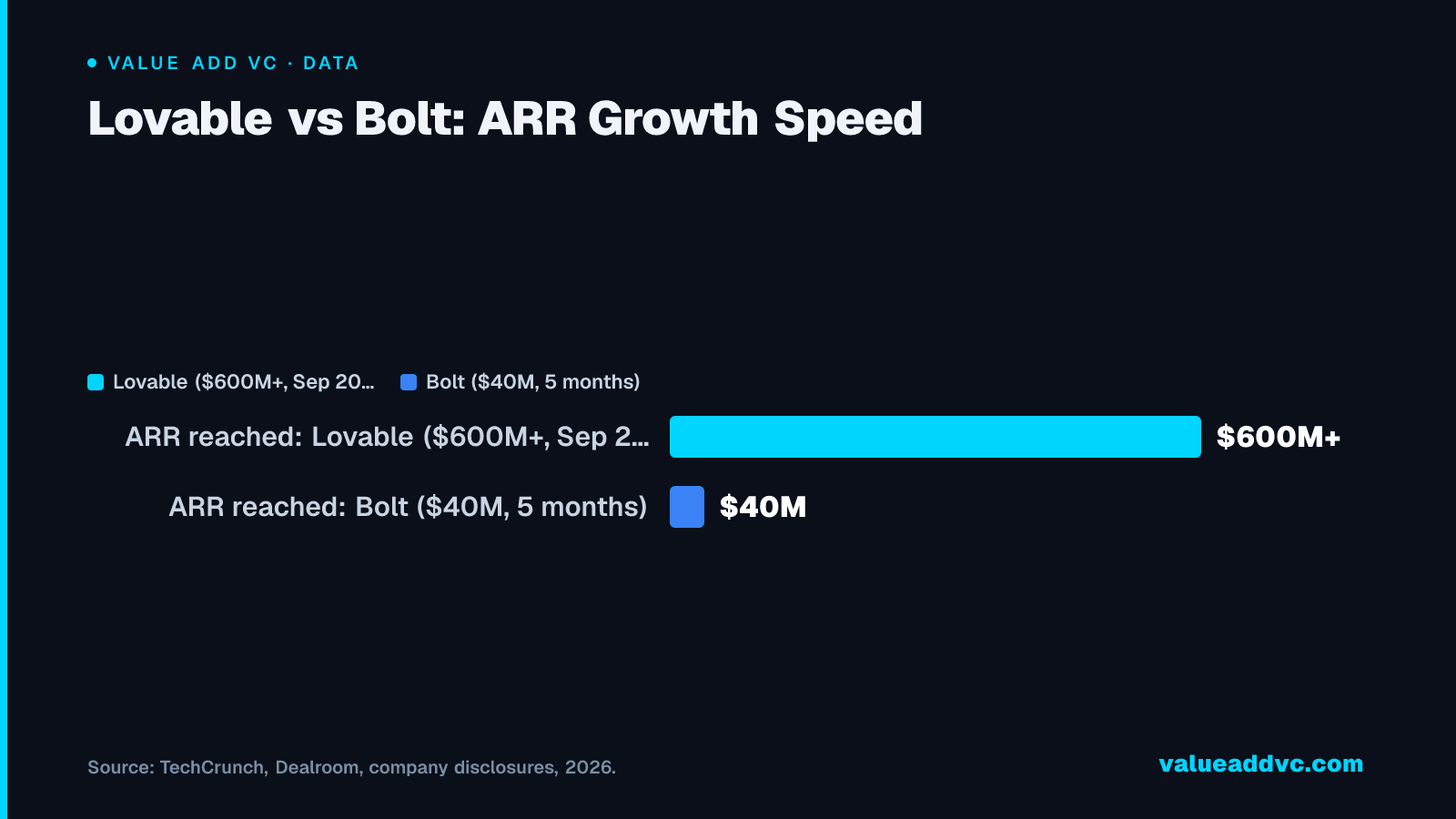
That comparison undersells Bolt somewhat since it's measuring absolute ARR rather than growth rate off each company's own base, but it captures the current gap in scale: Lovable is roughly an order of magnitude larger in revenue than the next fastest-growing pure-play prompt-to-app competitor. The gap that matters more for LPs and later-stage investors underwriting this category is whether that scale advantage compounds into a moat (data, workflow lock-in, enterprise trust) or whether it's just a temporary lead in a market where switching costs are still low and most of the underlying model capability is licensed from the same handful of foundation-model providers.
Does Lovable's $13.3B Valuation Actually Make Sense?
At $13.3B against a $600M run rate, Lovable is valued at roughly 22x run-rate revenue — rich even by 2026 AI-startup standards, but not obviously irrational given the growth rate underneath it, and lower than the roughly 27x the same price implied against the $500M run rate it reported in June. If ARR merely holds its trailing pace for another two quarters rather than accelerating further, Lovable could plausibly be north of $1B ARR in 2027, which would bring the multiple down to something closer to 13x — still a premium multiple, but one that looks far more defensible in hindsight. The bigger risk isn't the multiple on today's number; it's whether the underlying AI app-builder category keeps growing or whether growth concentrates entirely in two or three winners while the rest of the field, including some well-funded names, struggles to differentiate on pricing alone.
For founders and operators, the more useful lesson from Lovable's trajectory isn't the valuation number — it's the pricing architecture. A credit-based model that scales with actual usage, layered under a simple subscription tier, is proving to be the most durable monetization pattern across this entire generation of AI-native tools, not just coding assistants. If you're building anything where usage intensity varies wildly across your user base — which describes most AI products — the Lovable/Cursor blended model is worth studying closely before you default to flat SaaS seat pricing, which tends to systematically under-monetize your best customers and over-charge your worst ones. You can track how these valuation and revenue multiples compare across the broader AI and SaaS landscape on our SaaS valuations dashboard.
What Lovable's Round Means for Founders Raising in AI Tools Right Now
The gap between Lovable's June 2026 talks (a $12B target) and where the round actually closed on August 12, 2026 ($13.3B, on $400M raised) is itself a data point worth sitting with. In most fundraising environments, a company that leaks a target valuation to press ends up closing at or below that number once diligence runs its course — investors use the leaked figure as a ceiling, not a floor. Lovable closing above its own reported target tells you two things: the ARR data that came in during diligence (the run rate crossing $500M in June, on its way past $600M by September) materially outpaced what the market had priced in when the $12B number first circulated, and there was genuine competitive tension among growth investors to get into the round, evidenced by a syndicate that grew to include Tencent, Salesforce Ventures, and HubSpot Ventures alongside Menlo Ventures and the EQT-managed Scaleup Europe Fund.
For founders in adjacent categories — AI agents, AI-native vertical SaaS, anything with a usage-metered pricing layer — the practical takeaway is that revenue velocity is currently buying more valuation credit than absolute revenue scale. A company passing $600M in run-rate revenue that got there in under two years commands a materially higher multiple than one that took six years to reach the same number, even when today's dollar-for-dollar economics look identical. That's not a new dynamic in venture, but the compression of the timeline here — three valuation step-ups (from $1.8B at Series A in July 2025, to $6.6B, to $13.3B) inside thirteen months — is happening faster than in prior SaaS cycles, largely because credit-based and usage-based pricing models convert new users into revenue almost immediately, without the multi-quarter sales cycles that gated growth in the pre-AI SaaS era.
It's also worth flagging the risk sitting underneath all of this for anyone underwriting a check into this category today: none of Lovable, Bolt, Replit, or v0 have disclosed gross margins, and credit-based pricing models can mask deteriorating unit economics if the underlying foundation-model inference costs rise faster than the credit prices charged to end users. A vibe-coding platform that looks like a 90%-gross-margin software business on ARR alone could look a lot more like a 40%-margin reseller of frontier-model compute once inference costs are fully loaded — a distinction that matters enormously for what multiple the business actually deserves, and one that won't be visible in headline ARR or valuation figures until a company files for an IPO or discloses financials in a later round.
What the Headline Misses
The $13.3B figure is a private-market mark set by growth investors in a single round, not a public, liquid price — there's no secondary market or index checking it in real time, and the last two Lovable rounds have both closed inside eight months of each other, which is not enough time to see how the number holds up through a slower quarter. The $600M run rate Lovable announced in September is also a company-reported annualized figure rather than audited revenue the way a public company's would be. And Cursor's exit into SpaceX/xAI removes the cleanest direct comparable for judging whether Lovable's multiple is rich or reasonable, since the two companies were priced by an overlapping set of growth investors on similar revenue-multiple logic until now.
The Bottom Line
Lovable's valuation doubled from $6.6B to $13.3B in eight months on a run rate that roughly tripled from $200M to more than $600M by September, putting it at roughly 22x run-rate revenue in a vibe-coding category that is still growing fast. The credit-based pricing model — subscription base plus usage-metered credits plus hosting — is the real mechanism behind the growth, and it's becoming the standard architecture across AI coding tools generally, not just at Lovable. Whether the multiple holds depends less on Lovable's own execution, which has been strong, and more on whether the category keeps compounding at its current rate once the current wave of easy differentiation (raw model capability, novelty) gives way to a harder fight over retention, enterprise trust, and switching costs — now playing out against a field with one fewer independent scoreboard now that Cursor has agreed to sell.
Latest from the Pulse
Get VC data most people never see
— free to subscribe
Trace's notes on venture, AI and startups, a few times a week. Join 5,000+ subscribers. No spam.
No spam, unsubscribe anytime. Sent via Substack · Privacy · or subscribe on Substack ↗