
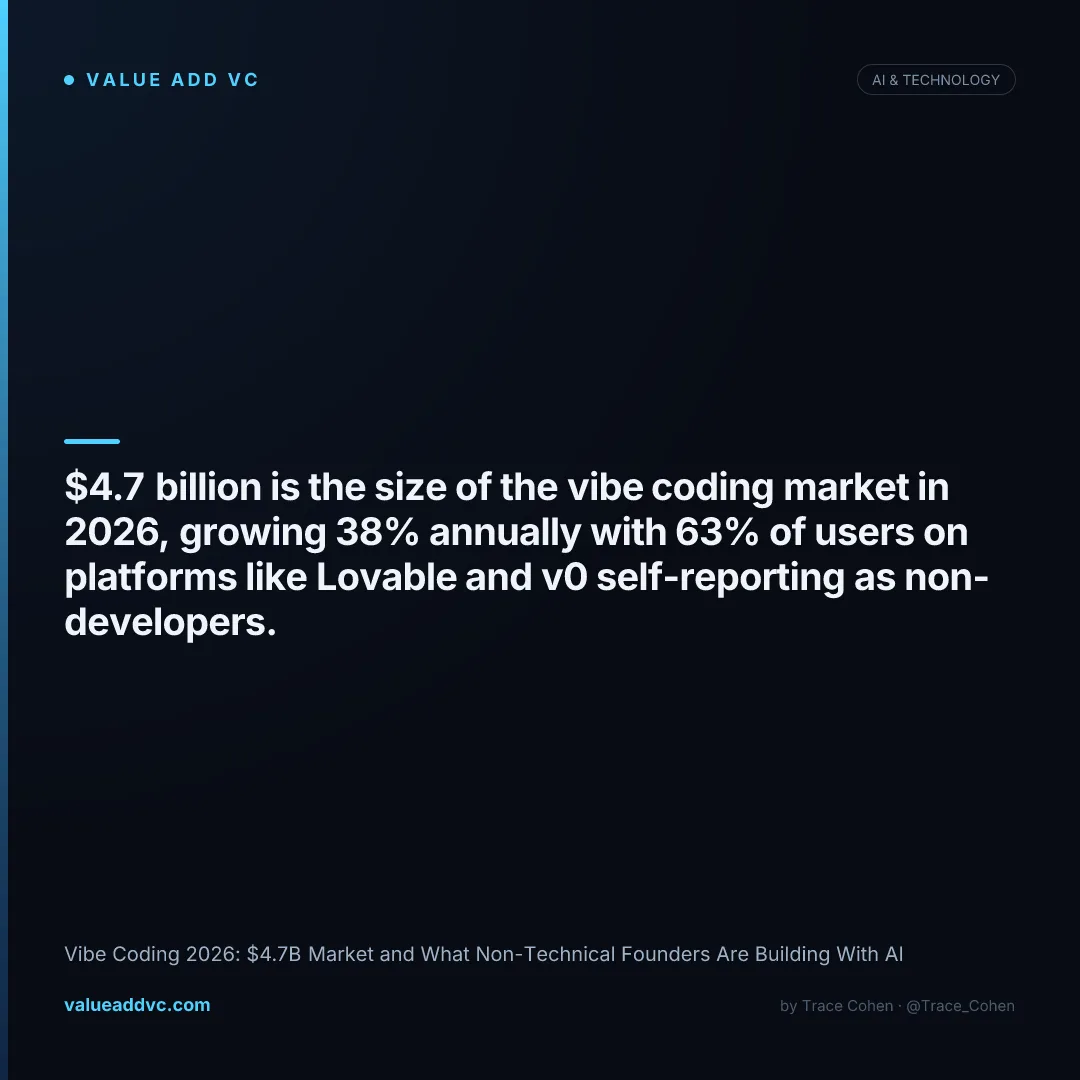
Vibe coding is now a multibillion-dollar revenue category — Lovable alone hit $500 million in annualized revenue in June 2026 — and 63% of the people using tools like Lovable and v0 have never written a line of code professionally.
That's the short answer. The longer answer is more interesting: this isn't a niche hobbyist trend anymore, it's a real, fast-growing software category with its own ARR leaderboard, its own venture rounds, and — increasingly — its own security incident data. Lovable alone has crossed 8 million users and reports more than 1 million new projects started per week. The question worth asking isn't whether non-technical founders can build with AI now. It's what they're actually producing, what it costs, and what breaks when nobody who understands the codebase ever looks at it.
What is vibe coding and how are non-technical founders using AI to build products?
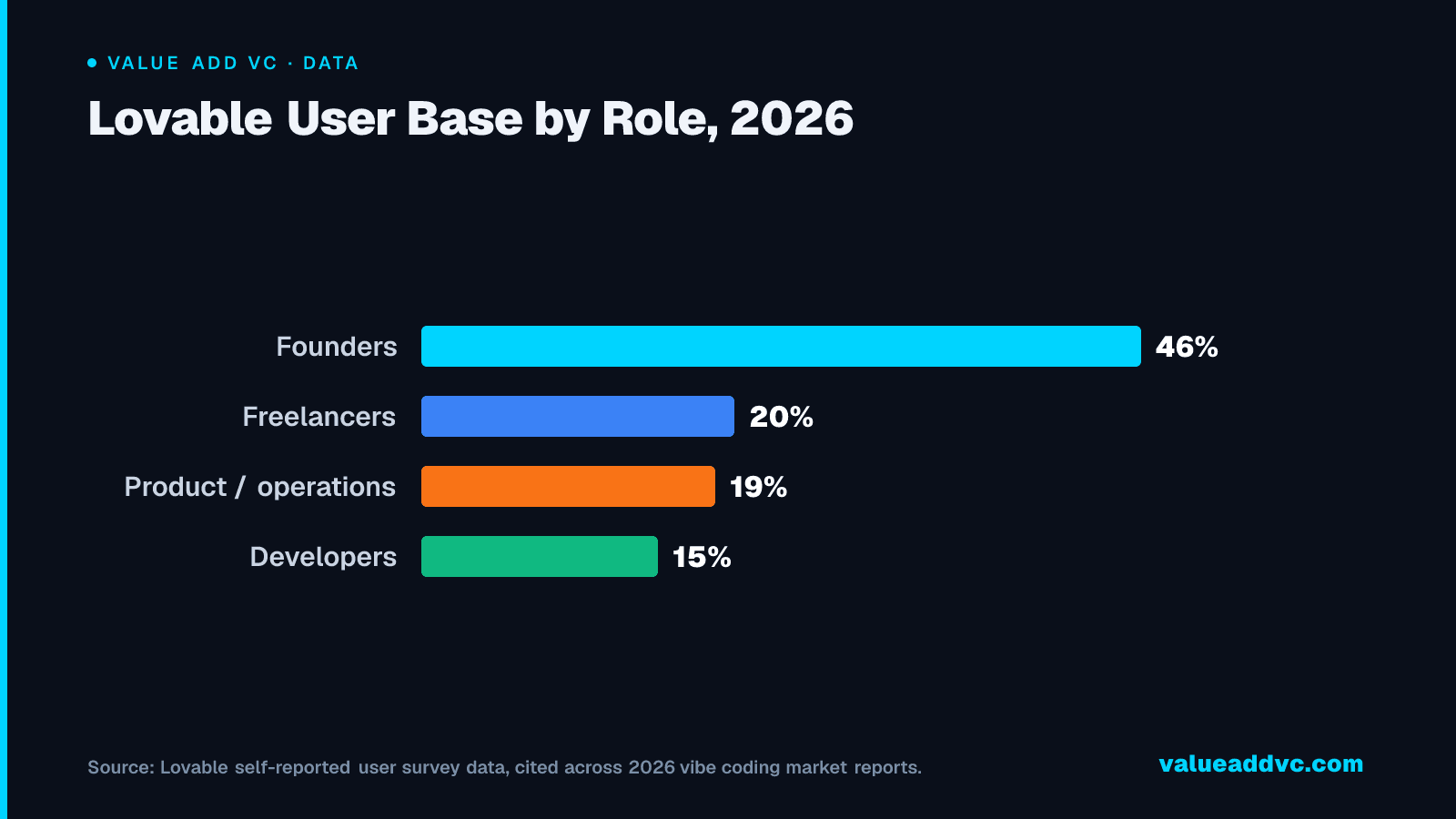
Vibe coding is the practice of describing a product in plain English — "build me a booking app with Stripe payments and an admin dashboard" — and letting an AI tool generate the working software, rather than a founder or engineer writing the code line by line. Non-technical founders are the fastest-growing user base for this category: 45.7% of Lovable's users identify as founders, ahead of freelancers, product managers, and operations staff, spanning industries from education and retail to health care and real estate.
Who are the non-technical founders building with AI, and what platforms do they use?
Four platforms dominate the category, each with a slightly different bet on who its user actually is. Cursor built for professional developers first and has since become the revenue leader by a wide margin. Lovable, Bolt.new, and Vercel's v0 built explicitly for the non-coder, and it shows in their user composition — v0 reports 63% of its 4 million users are non-developers, nearly identical to Lovable's mix.
AI Coding Platform ARR, 2026 ($M)
Source: Fortune (Cursor, June 2026), TechCrunch (Lovable, June 2026), Sacra estimate (Replit, April 2026), company disclosures (Bolt.new).
Data
| Item | Value |
|---|---|
| Cursor | ~$4.0B |
| Replit | ~$525M (est.) |
| Lovable | $500M |
| Bolt.new | $40M |
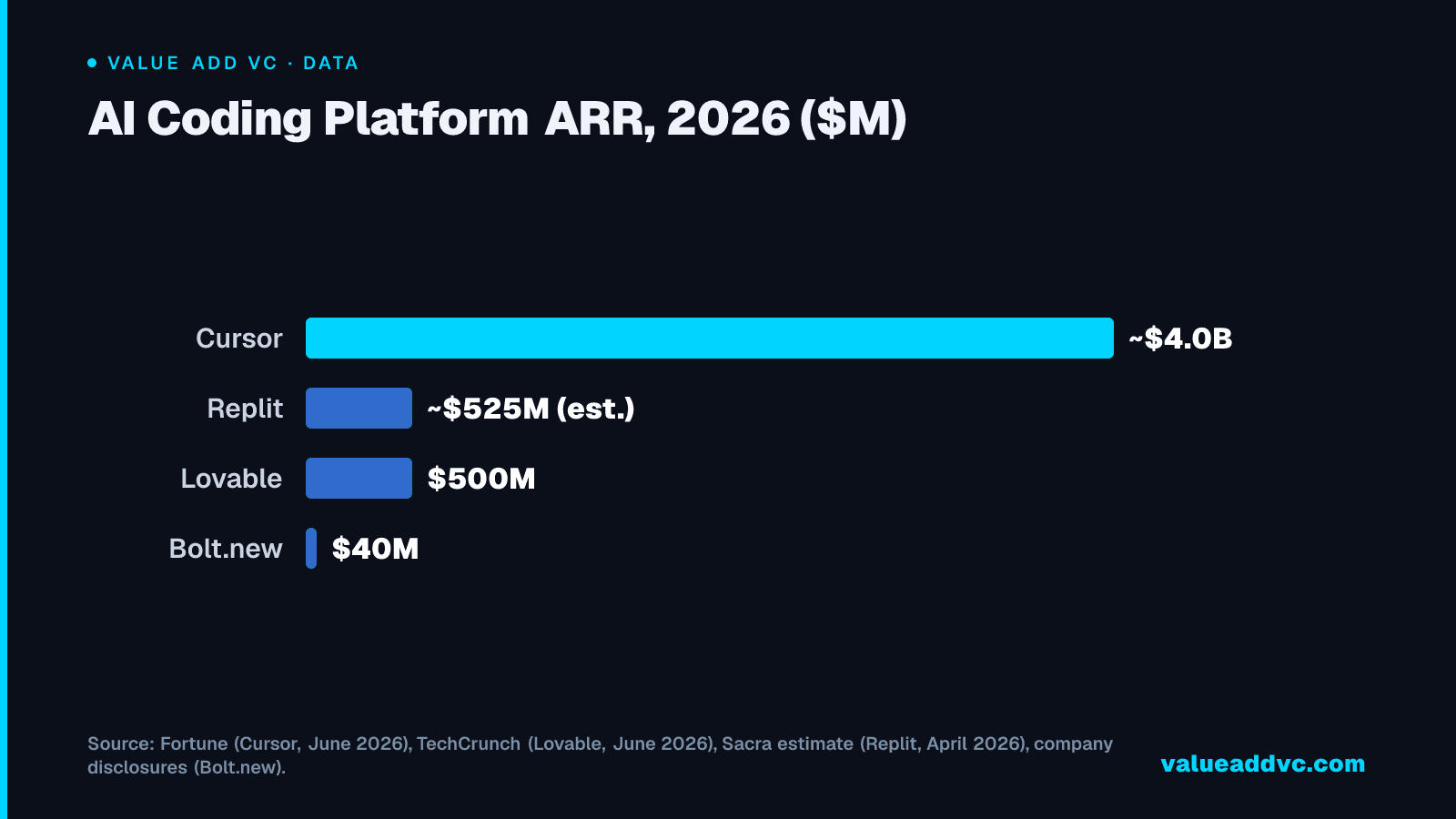
Replit is the platform most explicitly chasing that gap — it hopes to hit $1 billion in ARR by the end of 2026, and Sacra estimates it reached $525 million in annualized revenue in April 2026, up from $300 million at the end of 2025 (Replit has not disclosed a current figure). Its March 2026 funding round valued the company at $9 billion, up threefold in six months. Lovable, meanwhile, hit $500 million in annualized run-rate revenue in June 2026 and raised at a $13.3 billion valuation in August. Bolt.new is the newest big name in the category and the fastest to scale from zero: $40 million ARR in five months is a pace that would have been unheard of in developer tools before AI code generation existed. We keep the latest valuations, run-rates and user counts for these companies, each dated and sourced, on our vibe coding market tracker.
Cursor vs Lovable: the professional-developer tool vs the non-coder tool
| Platform | 2026 ARR | Users | Non-developer share | Primary user | Pricing entry point |
|---|---|---|---|---|---|
| Cursor | ~$4B (Jun 2026) | Not disclosed | Low — dev-first | Professional software engineers | $20/month |
| Lovable | $500M (Jun 2026) | 8M | ~80% | Non-technical founders | Free tier; $25/month paid |
| Replit | ~$525M (Sacra est., Apr 2026) | 40M+ registered | Mixed | Students, indie hackers, founders | Free tier; $20/month paid |
| Bolt.new | $40M | Not disclosed | High | Rapid prototypers, founders | Free tier; $20/month paid |
| v0 (Vercel) | Bundled in Vercel | 4M | 63% | Founders, designers, PMs | Free tier; usage-based |
| GitHub Copilot | Bundled in GitHub/Microsoft | 20M+ | Low — dev-first | Professional software engineers | $10/month |
Figures are 2026 estimates blended from company disclosures, Sacra, TrendingTopics, and Startup Riders growth reporting. ARR figures reflect most recently reported run rates as of May-June 2026; user counts are self-reported by each company.
The split is clean in the data: Cursor monetizes professional engineers who already know how to ship software and just want to move faster, which is why its ARR dwarfs everyone else's despite serving the smallest addressable non-technical audience. Lovable, Bolt.new, and v0 are competing for the opposite customer — someone who has never shipped software before — and none of them has cracked Cursor's revenue per user yet, because that customer is harder to convert to a durable, expensive subscription.
What non-technical founders building with AI are actually shipping
Lovable User Base by Role, 2026
Source: Lovable self-reported user survey data, cited across 2026 vibe coding market reports.
Data
| Item | Value |
|---|---|
| Founders | 46% |
| Freelancers | 20% |
| Product / operations | 19% |
| Developers | 15% |
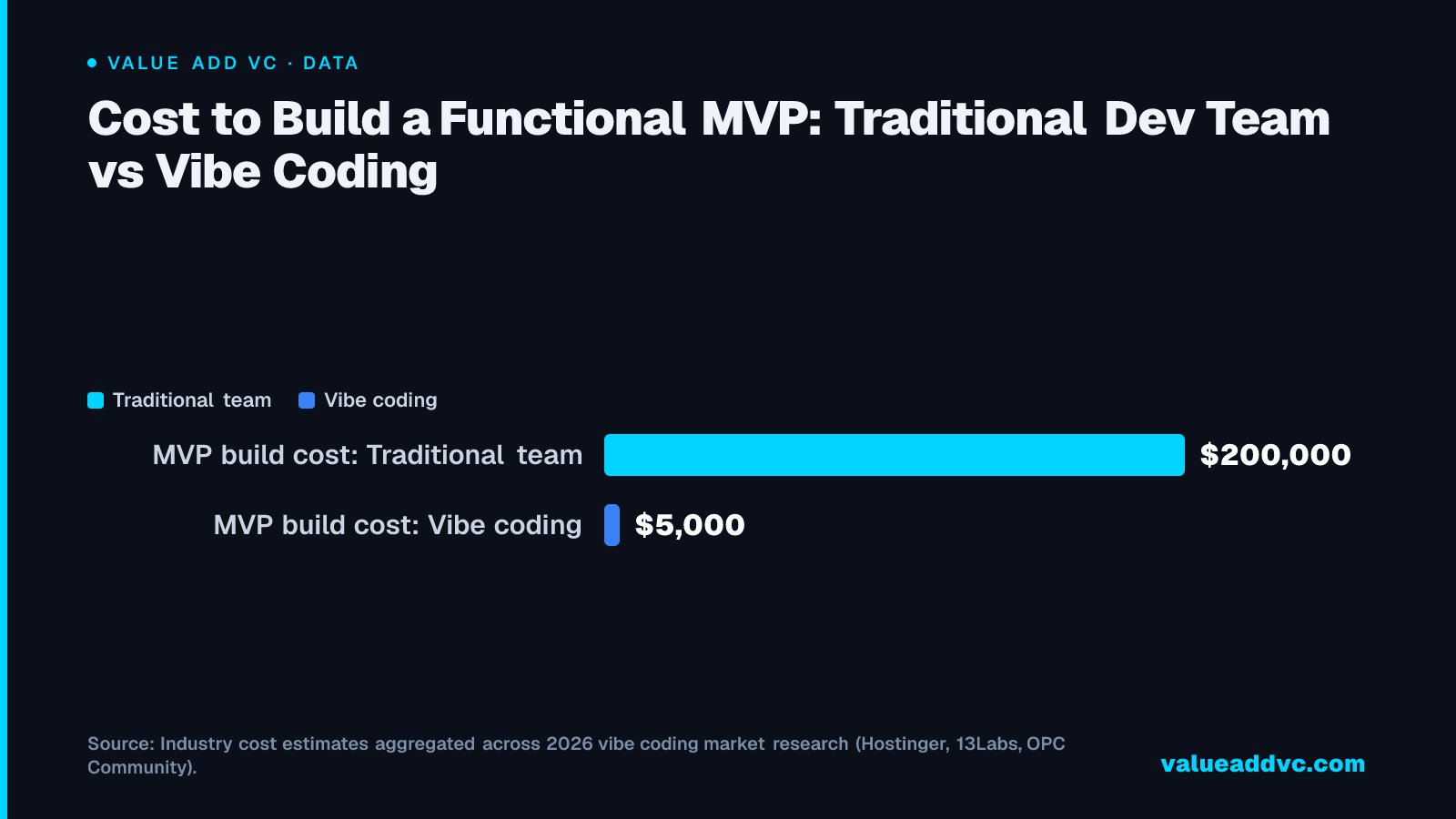
What gets built skews toward internal tools, booking and scheduling apps, e-commerce storefronts, and thin SaaS wrappers around an existing API or AI model — products where the value is in the workflow and the UX, not in novel backend engineering. The cost collapse is the real story here: building a functional MVP has dropped from roughly $200,000 with a traditional contract dev team to about $5,000 using AI coding tools, a more than 97% reduction. That's cheap enough that 25% of Y Combinator's Winter 2025 batch shipped with codebases that are 95%+ AI-generated, according to YC's own accelerator data.
Cost to Build a Functional MVP: Traditional Dev Team vs Vibe Coding
Source: Industry cost estimates aggregated across 2026 vibe coding market research (Hostinger, 13Labs, OPC Community).
Data
What kinds of products are non-technical founders actually shipping with AI?
Walk through any Lovable or Bolt.new showcase gallery and the pattern is consistent: internal ops tools that replace a spreadsheet, booking and scheduling apps for local service businesses, thin e-commerce storefronts wired to Stripe and Shopify's API, and lightweight SaaS wrappers that sit on top of an existing foundation model and add a workflow or UI on top. These are not, for the most part, products that require novel distributed systems work or custom infrastructure — they're products where the hard part was always the workflow design and the interface, and that's exactly the layer large language models have gotten good at generating from a plain-English description.
That's also why the failure mode looks different from a traditional MVP. A founder who can't code isn't going to accidentally introduce a subtle race condition in a payments queue — they're more likely to ship an app that works perfectly in the demo and then falls over the first time it hits an edge case the AI didn't anticipate, like a webhook retry, a currency edge case, or an auth flow that was never actually load-tested. Industry surveys of vibe-coded founder products consistently cite the same three gaps: no automated test suite, no monitoring or alerting, and no plan for what happens when the AI-suggested database schema needs to change under real production load.
The security debt piling up under vibe-coded products
The part of this story that gets less attention on social media is what happens after launch. A scan of more than 1,400 vibe-coded production applications by Escape.tech found that 65% had at least one security issue and 58% contained a critical vulnerability — including over 400 exposed secrets and 175 instances of exposed personally identifiable information, in some cases bank account data. Separately, a December 2025 study of open-source repositories found AI-generated code introduced vulnerabilities in 45% of development tasks, and AI-authored pull requests generated 2.74 times more security issues than human-written ones.
AI-Generated Code CVEs Tracked by Georgia Tech's Vibe Security Radar, 2026
Source: Georgia Tech Systems Software and Security Lab, Vibe Security Radar, Jan-Mar 2026.
Data
| Item | CVEs attributed to AI-generated code |
|---|---|
| 6 | |
| 15 | |
| 35 |
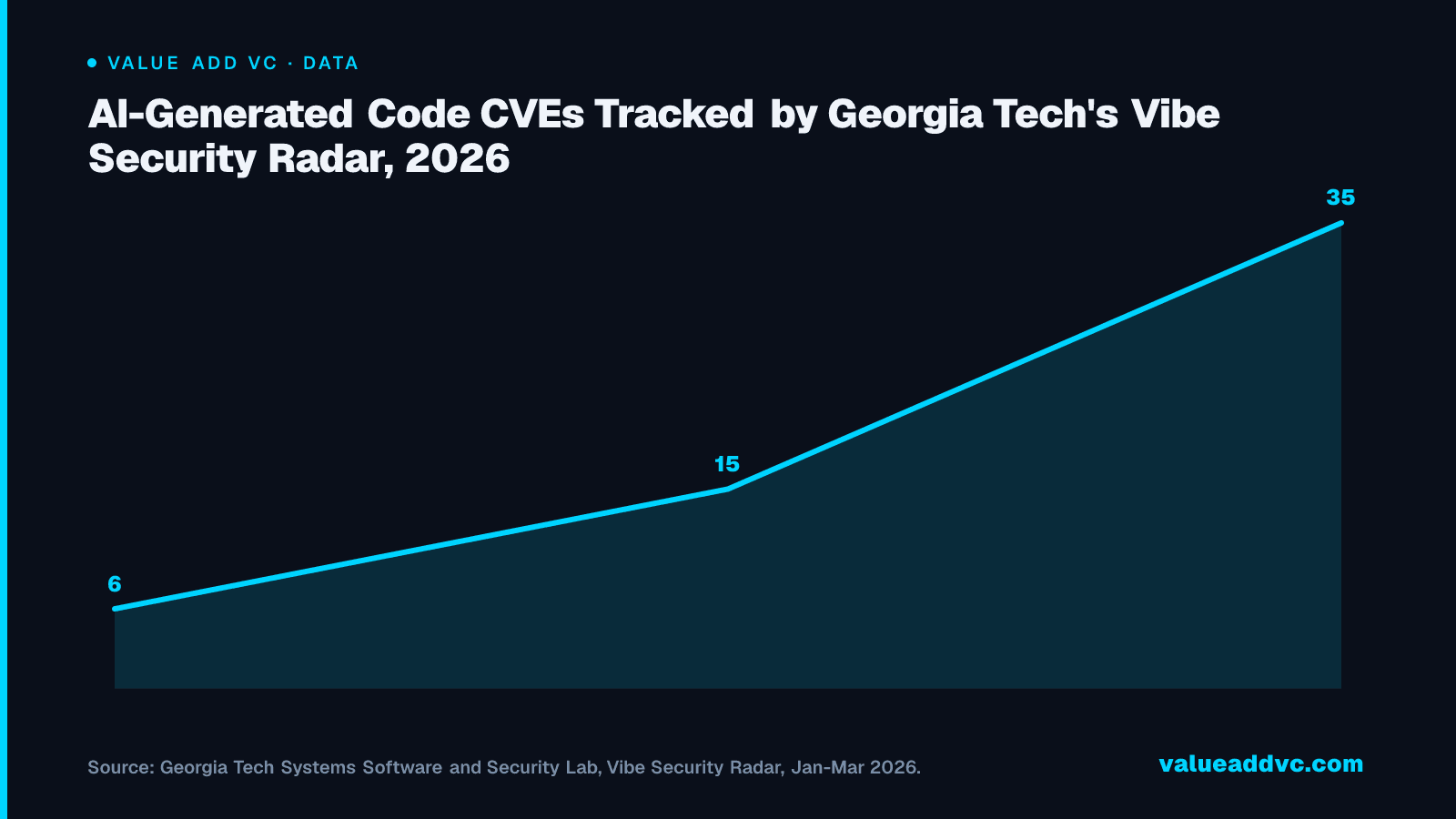
That trajectory — 6 CVEs in January, 15 in February, 35 in March — isn't a plateau, it's compounding, and it's tracking the same growth curve as adoption itself. GitGuardian's 2026 secret-sprawl research adds a specific wrinkle for teams using Claude Code and similar assistants: AI-assisted commits exposed secrets more than twice as often as human-only commits, and 64% of credentials exposed in 2022 were still live and unrevoked as of January 2026. None of this means vibe coding is a bad way to build a first version. It means almost nobody in this category is running the equivalent of a security review before shipping to real users.
Why the professional-developer platforms still out-earn the non-coder platforms
It's worth sitting with why Cursor's roughly $4 billion in annualized revenue so thoroughly dwarfs the combined revenue of Lovable, Bolt.new, and v0, even though the non-coder platforms have larger and faster-growing user bases in raw count. Professional developers already have budget authority, already pay for developer tools as a matter of course, and are upgrading an existing workflow rather than being asked to trust an entirely new one with their business. A non-technical founder deciding whether to pay $25 a month for Lovable is making a much more discretionary call, and a much larger share of that user base churns out after building one or two projects rather than converting into a durable subscriber.
That gap is narrowing, though. Replit's push toward $1 billion ARR by the end of 2026 — more than 3x its 2025 exit rate, per Sacra — is a bet that enough of its non-technical user base will convert into paying, retained accounts to close the distance with the developer-first platforms. If that bet plays out, expect Lovable and Bolt.new to raise growth rounds on the same thesis within the next two to three quarters, since a16z, Accel, and other multi-stage funds have already shown they'll pay premium multiples for ARR growth rates in this category that would look unremarkable in traditional enterprise SaaS.
How I'm thinking about vibe coding as an investor
I've made 65+ investments and I'm seeing this show up in pitch decks constantly now — founders who shipped a working product solo in a weekend, something that would have taken a $150,000 seed round and three months of engineering hires two years ago. That's a genuine unlock for pre-seed founders, and it's part of why round sizes and burn expectations at the earliest stages keep compressing. But when I'm diligencing a company whose MVP was vibe-coded, the security data above is exactly what I'm asking about: who's reviewed this code, is there a real CI/CD and secrets-management process, and does the team actually understand the codebase they're now responsible for at scale. Stack Overflow's 2025 survey found 84% of developers use or plan to use AI tools and 51% of professional developers use them daily, though 72% say vibe coding itself isn't part of their professional work. That tells me AI-assisted coding isn't a founder-only phenomenon — it's becoming the default way software gets written, even if professionals still review what the model produces.
The practical read for founders: use vibe coding to get to a real, testable product fast — the $5,000 MVP is a legitimate strategic advantage over a $200,000 one. Just budget for a security and code-quality pass before you take real customer data, because the vulnerability rates in the data above are not edge cases, they're closer to the median outcome for unreviewed AI-generated production code.
The Bottom Line:
Vibe coding has grown into a real multibillion-dollar revenue category, and 63% of the people using platforms like Lovable and v0 have never written production code before. The economics are genuinely disruptive — a $5,000 MVP instead of a $200,000 one — but 58% of scanned vibe-coded production apps carry a critical security vulnerability. The tools are real. The security review most builders are skipping is the part that will decide which of these products survive contact with real customers.
Track how AI is reshaping software valuations on the AI Valuations Dashboard and see how new AI-native companies compare to the broader market on SaaS Valuations at Value Add VC. Originally published in the Trace Cohen newsletter.
Latest from the Pulse
Get VC data most people never see
— free to subscribe
Trace's notes on venture, AI and startups, a few times a week. Join 5,000+ subscribers. No spam.
No spam, unsubscribe anytime. Sent via Substack · Privacy · or subscribe on Substack ↗