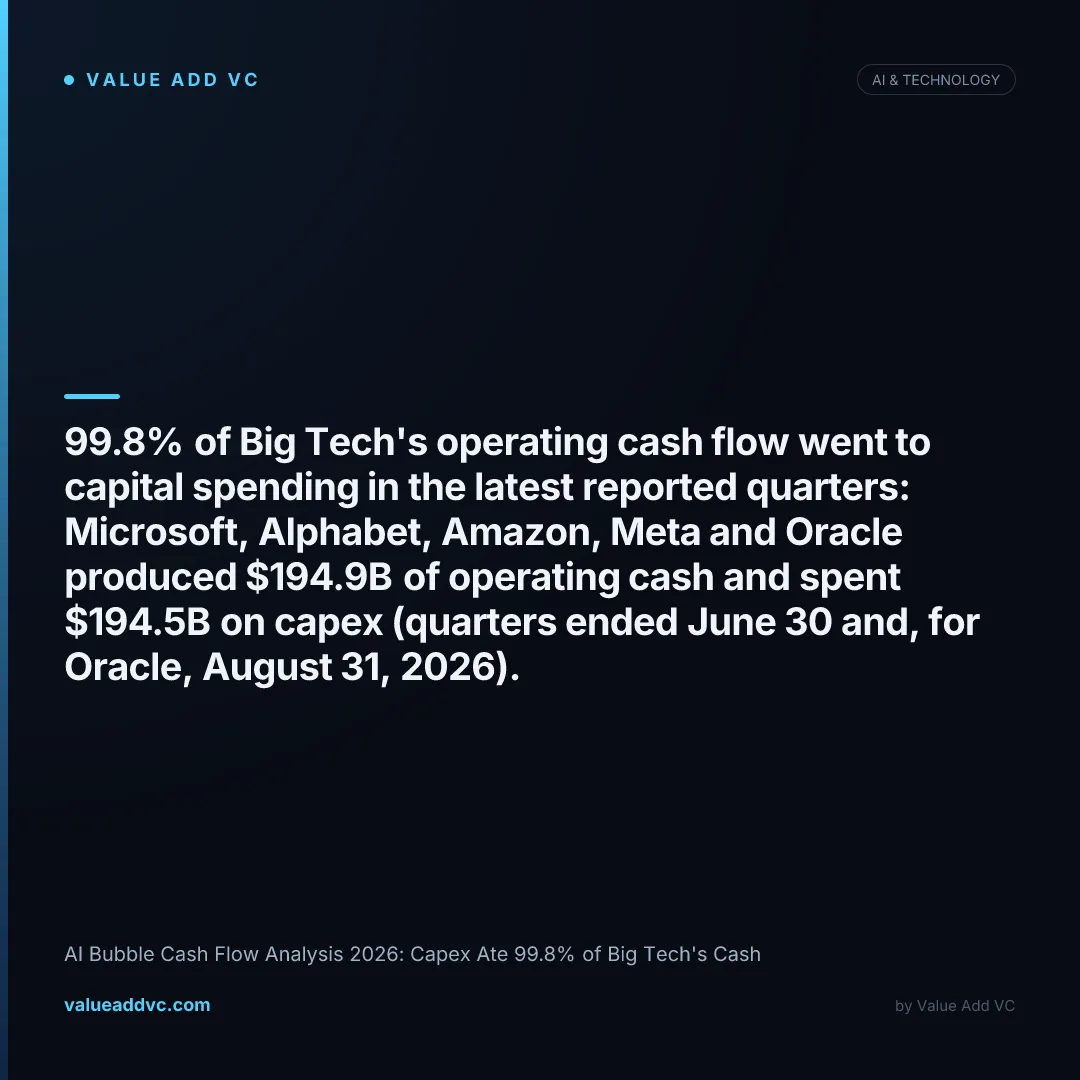
In their latest reported quarters (ended June 30, 2026, and August 31 for Oracle), Microsoft, Alphabet, Amazon, Meta and Oracle spent $194.5 billion on capital expenditures against $194.9 billion of operating cash flow, so 99.8% of the cash their businesses produced went straight back into data centers, chips and power.
That is the cash flow core of the 2026 AI bubble debate. The question is no longer whether Big Tech can afford AI out of pocket change; on the latest numbers, three of the five largest AI spenders reported negative free cash flow, and all five have tapped bond or stock markets this year. Every figure below comes from the companies' own earnings releases filed with the SEC unless labeled otherwise.
AI Bubble Cash Flow Analysis 2026: The Numbers by Company
Alphabet reported Q2 2026 free cash flow of -$5.855 billion, with $39.07 billion of operating cash flow and $44.92 billion of purchases of property and equipment, in its July 22, 2026 earnings release. Oracle reported fiscal Q1 2027 free cash flow of -$5.396 billion on $23.10 billion of operating cash flow and $28.50 billion of capex, in its September 10, 2026 release. Amazon reported trailing-12-month free cash flow of -$7.6 billion as of June 30, 2026, which its Q2 release says was "driven primarily by a year-over-year increase of $66.1 billion in purchases of property and equipment."
| Company | Quarter | Operating cash flow | Capex | Free cash flow | Basis |
|---|---|---|---|---|---|
| Microsoft | Apr-Jun 2026 (FY26 Q4) | $55.4B | $35.8B | +$19.6B | OCF minus additions to P&E (our calc; excludes finance leases) |
| Alphabet | Apr-Jun 2026 (Q2) | $39.1B | $44.9B | -$5.9B | Company-reported FCF |
| Amazon | Apr-Jun 2026 (Q2) | $45.4B | $54.2B | -$7.7B | Our calc using Amazon's FCF definition; TTM FCF -$7.6B reported |
| Meta | Apr-Jun 2026 (Q2) | $31.9B | $31.1B | +$0.8B | Company-reported FCF; capex includes finance-lease principal |
| Oracle | Jun-Aug 2026 (FY27 Q1) | $23.1B | $28.5B | -$5.4B | Company-reported FCF |
How we counted: operating cash flow and capital expenditures as each company reports them in its SEC-filed earnings release (8-K Exhibit 99.1); latest reported quarter per company (calendar Q2 2026 for Microsoft, Alphabet, Amazon and Meta; June-August 2026 for Oracle); 5 companies; as of October 20, 2026. Free cash flow is company-reported for Alphabet, Meta and Oracle and calculated by Value Add VC for Microsoft and Amazon, so definitions differ slightly.
Did Google Really Go Free Cash Flow Negative?
Yes. Alphabet's own non-GAAP table shows free cash flow of -$5.855 billion for the quarter ended June 30, 2026, after +$24.5 billion and +$10.1 billion in the two prior quarters (Alphabet Q2 2026 release). Fortune reported on August 16, 2026 that this was the first time in Google's history. We checked that claim against Alphabet's SEC XBRL data: across 72 quarters from Q3 2008 to Q2 2026, Q2 2026 is the only quarter in which operating cash flow minus property and equipment purchases was negative.
Context matters. Alphabet's trailing-12-month free cash flow was still +$53.3 billion as of June 30, 2026, and the company raised $49.6 billion of net proceeds from a June 2026 sale of Class A and Class C stock plus mandatory convertible preferred stock, per the same release. Alphabet's full-year 2026 capex outlook was raised to $195-205 billion from $180-190 billion, CFO Dive reported on July 30, 2026. Alphabet president Ruth Porat defended the pace at Fortune's Most Powerful Women Summit, saying Alphabet is spending roughly $200 billion this year on AI capacity and that "by the time you need it, it's too late," Fortune reported on October 12, 2026. Our Pulse coverage of her remarks is here.
How Much Will Big Tech Spend on AI Capex in 2026?
Amazon said on its July 30, 2026 call: "We now believe we will spend approximately $220 billion in cash CapEx in 2026," per an Investing.com transcript. Meta narrowed its 2026 capex guidance, including finance-lease principal, to $130-145 billion from $125-145 billion in its July 29, 2026 release. Microsoft's calendar-2026 capex expectation was adjusted to about $175 billion from about $190 billion because of a lease accounting change rather than lower spending, CFO Dive reported, and Microsoft guided to more than $50 billion of capex for the September 2026 quarter in an SEC filing dated September 2, 2026. Oracle reportedly expects $90-95 billion of gross capex in fiscal 2027, per ScanX's September 10, 2026 earnings coverage; we could not confirm that range in a primary source. Our AI Spending Tracker keeps these numbers current.
How Is Big Tech Paying for AI If Free Cash Flow Is Gone?
With internal cash covering little more than capex, the gap is being filled by capital markets. Each of these issuances is listed in the company's own 8-K filing; the filings do not tie the bond proceeds specifically to AI, so the link below is our reading, except for Alphabet's equity raise.
- Oracle issued $25 billion of notes on February 4, 2026 (8-K) and sold $20 billion of common stock through an at-the-market program in its fiscal Q1 2027 (Q1 FY27 release). Oracle's fiscal 2026 free cash flow was -$23.7 billion on $55.7 billion of capex.
- Amazon closed a $37 billion US-dollar notes sale on March 13, 2026 (8-K) and a $25 billion sale on July 9, 2026 (8-K), plus euro, Canadian-dollar and sterling deals.
- Meta completed a $25 billion senior notes offering on May 4, 2026 (8-K).
- Alphabet closed a $25 billion US-dollar notes offering on August 10, 2026 (8-K), after $20 billion in February and euro, Canadian-dollar and yen deals in May, on top of its $49.6 billion June equity raise.
Is the AI Bubble About to Burst? What the IMF and BIS Say
The Bank for International Settlements wrote on June 28, 2026 that "the five largest hyperscalers are set to spend over a trillion US dollars on AI-related capital expenditure from 2025 through 2026," and that these commitments "are outpacing earnings and the free cash flow" of those firms. The IMF's October 2026 Global Financial Stability Report warned that "weaker or less durable investment and profitability in artificial intelligence could lead to a correction in AI-related asset prices," amplified by rising leverage.
The forward math points the same way. Reuters calculated in late July 2026 that the five companies were on pace for capex to overtake free cash flow by 2027, Fortune reported; The Next Web, summarizing the same Reuters analysis on July 22, 2026, put the expected 2025-2027 rise in capex at about $534 billion against a roughly $340 billion rise in operating cash flow. For the strategist view that this is a "rolling sequence" of smaller bubbles rather than one, see our explainer on Dhaval Joshi's thesis.
Where I Could Be Wrong
Negative free cash flow during a build-out is not the same as a broken business. Microsoft still produced roughly $19.6 billion of free cash flow in its June quarter, Alphabet's trailing-year free cash flow was $53.3 billion, and Oracle's operating cash flow rose 184% year over year in its August quarter. These companies are converting cash into long-lived assets, and if the AI revenue arrives the capex will look cheap in hindsight. The bear case needs revenue to disappoint, not just spending to be high. Two caveats on the data: the five quarters do not line up exactly (Oracle's ends in August), and Microsoft's figure excludes finance leases, which understates its true capex. Calendar Q3 2026 results, due from late October, are the next test.
Explore Related Dashboards
Interactive tools with live data on this topic
Track every hyperscaler's AI capex with sources on the AI Spending Tracker at Value Add VC.
Latest from the Pulse
Get VC data most people never see
— free to subscribe
Trace's notes on venture, AI and startups, a few times a week. Join 5,000+ subscribers. No spam.
No spam, unsubscribe anytime. Sent via Substack · Privacy · or subscribe on Substack ↗