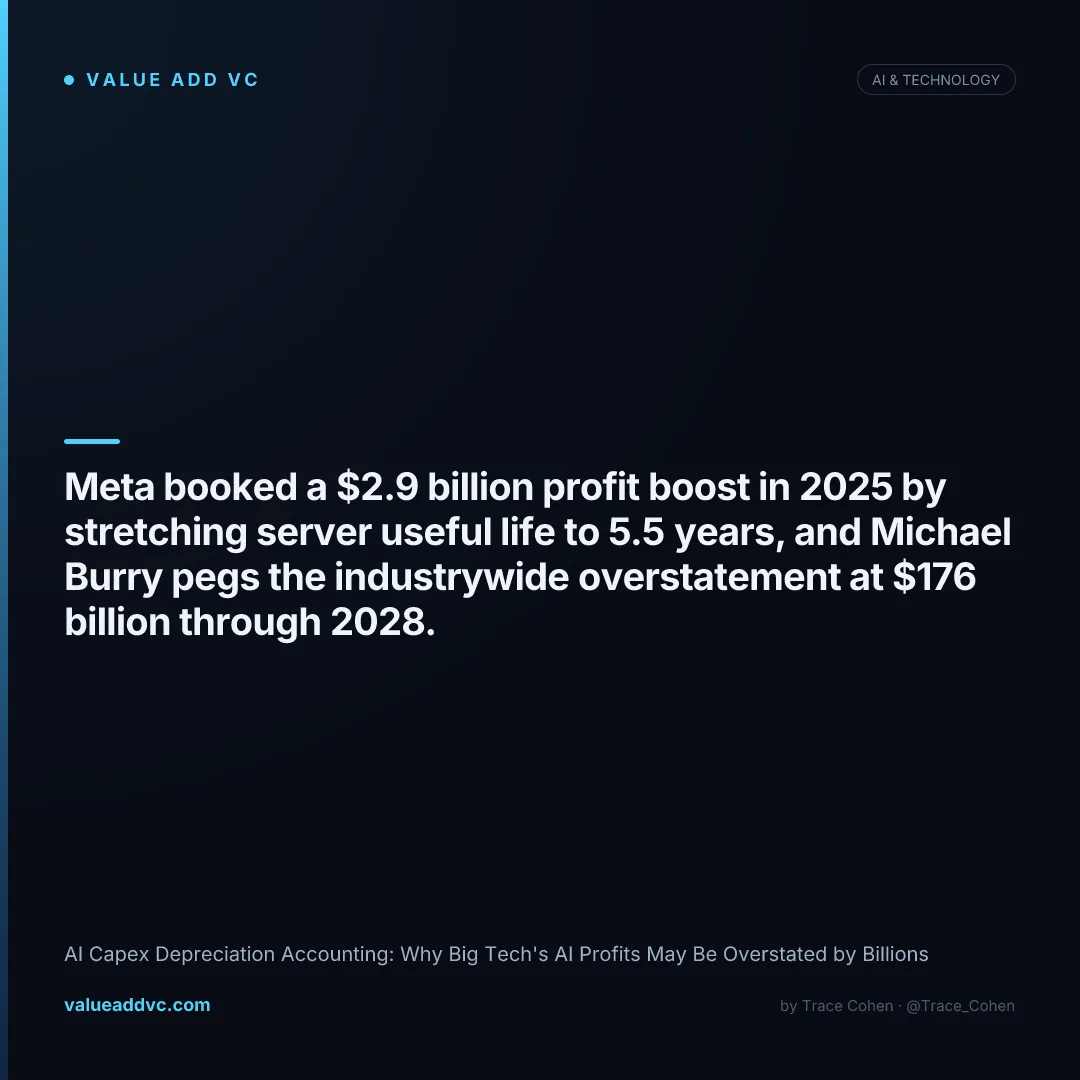
Meta added $2.9 billion to its 2025 profit by changing one assumption on a spreadsheet — how long a server lasts. That's the short answer. The longer answer is more interesting.
Every quarter, Wall Street cheers another beat from Meta, Microsoft, Google, or Amazon and credits it to AI demand. That doesn't appear to be the whole story. A meaningful slice of those beats is coming from an accounting knob nobody outside 10-K footnotes reads: how many years the company assumes a GPU-loaded server will last before it needs replacing. Stretch that number and depreciation expense drops, operating income rises, and the AI story looks better than the underlying cash economics.
The AI capex depreciation accounting question, in plain terms
AI capex depreciation accounting is the practice of spreading the cost of GPU servers over an assumed "useful life" — the number of years a company estimates before the hardware needs replacing. Big Tech spent an estimated $1.34 trillion on this hardware between 2026 and 2028 combined, and several of the largest buyers lengthened that assumed life right as AI spending accelerated, which lowers the annual expense hitting the income statement.
Why the consensus view is too generous
The consensus among most public-market analysts is that this is a minor accounting footnote — immaterial next to hundreds of billions in real revenue growth. That framing no longer holds up. Depreciation isn't a rounding error at this scale; it is the single line item standing between "AI capex is a rational bet on future cash flow" and "AI capex is being expensed too slowly to see the real margin picture." When a $2.9 billion swing at one company (Meta) is close to 4% of its annual pre-tax profit, and the industry total is estimated in the hundreds of billions, that is not noise. That is the earnings story.
Nvidia is the tell. The company has compressed its own architecture cadence from roughly two years to about one — Blackwell followed Hopper, and Rubin is already on the roadmap for 2026-2027. The company that makes the chip is telling you, through its own product roadmap, that last year's GPU is aging fast. Meanwhile the companies buying that chip are telling their auditors the opposite: that the server housing it will keep earning its keep for five or six years. Both statements can't be fully true at once, and Nvidia's architecture cadence looks like the more reliable guide when pricing a used H100 today.
What the headline numbers miss
The $176 billion figure gets cited as if it were a single fraud allegation, and it isn't — it's a modeled estimate from Michael Burry's public letter, built on an assumption (2-3 year real economic life) that reasonable people can and do dispute. Hyperscalers would counter, correctly, that GPUs retired from frontier training work don't get scrapped; they get repurposed for inference, which is less demanding and extends genuine economic usefulness. Amazon's 2025 move in the opposite direction — shortening life on a subset of servers and taking a roughly $920 million to $1 billion hit — is real evidence that not everyone is gaming the number the same way. That complicates the "big tech is lying" narrative — and rightly so.
It also matters that a chunk of the Microsoft change is about lease classification, not just expense timing — extending server life shifts more future datacenter capacity from finance leases into operating leases, which changes the capex line more than it changes true operating income. Disclosure quality varies company to company, and lumping all five hyperscalers into one number flattens real differences in how conservative each one is being.
The bear case: why AI capex depreciation accounting could unwind badly
If useful-life assumptions were set too optimistically in 2024-2025, the reversal isn't gradual — it shows up as a step change in depreciation expense the year a company admits the hardware is aging faster than modeled. Meta's own disclosure makes the mechanics explicit: shortening its assumption by just one year would add over $5 billion to 2026 depreciation and cut operating profit by a similar amount. Multiply that kind of swing across five companies simultaneously reassessing the same category of asset, and you get exactly the kind of synchronized earnings shock that turns a soft landing into a real one.
2025 Depreciation Assumption Changes: Direction and Disclosed Dollar Impact
Company 10-K/10-Q filings 2025; deepquarry.substack.com; footnotebrief.com
What this means if you're allocating capital around AI
Reported net income is a story, not a fact — it's assembled from choices, and depreciation schedules are one of the biggest and least scrutinized. If you're evaluating whether hyperscaler AI capex is paying off, don't stop at operating margin. Ask what the margin would look like at a 3-year useful life instead of 5.5, because that's a legitimate stress test, not a gotcha. For founders building on top of these platforms — inference pricing, GPU cloud costs, API margins — the same physics applies to your own infrastructure spend, and a vendor's compressed hardware cycle should show up in your model too. See our broader Big Tech earnings tracker and AI valuations dashboard for how this connects to the pricing of the private AI labs sitting on top of this infrastructure.
None of this means the AI buildout is fake, or that Meta, Microsoft, Google, and Amazon are cooking their books. It means the reported profit numbers coming out of this cycle deserve the same skepticism applied to any founder's adjusted EBITDA slide — check the assumption before you trust the output. Burry's $176 billion figure is a bet, not a fact, but the direction of his argument looks increasingly right: a meaningful share of "AI profits" in 2026 headlines is a scheduling choice on how fast to expense a chip that its own maker is retiring faster than ever.
The bottom line on AI capex depreciation accounting
Watch the 2026 and 2027 10-Ks closely. If Nvidia keeps shipping annual architecture refreshes and hyperscalers keep their 5-6 year assumptions unchanged, the gap between reported and economic depreciation widens every quarter — and eventually someone marks it to reality the way Amazon already did once. That's the number worth tracking more closely than the next capex guidance raise.
Sources: CNBC, "The question everyone in AI is asking," Nov 2025, Deep Quarry, "Depreciation of GPUs: between useful lives and useful myths", and Footnote Brief, "The $200 Billion Question Hiding in Big Tech's AI Spending".
Latest from the Pulse
Get VC data most people never see
— free to subscribe
Trace's notes on venture, AI and startups, a few times a week. Join 5,000+ subscribers. No spam.
No spam, unsubscribe anytime. Sent via Substack · Privacy · or subscribe on Substack ↗