
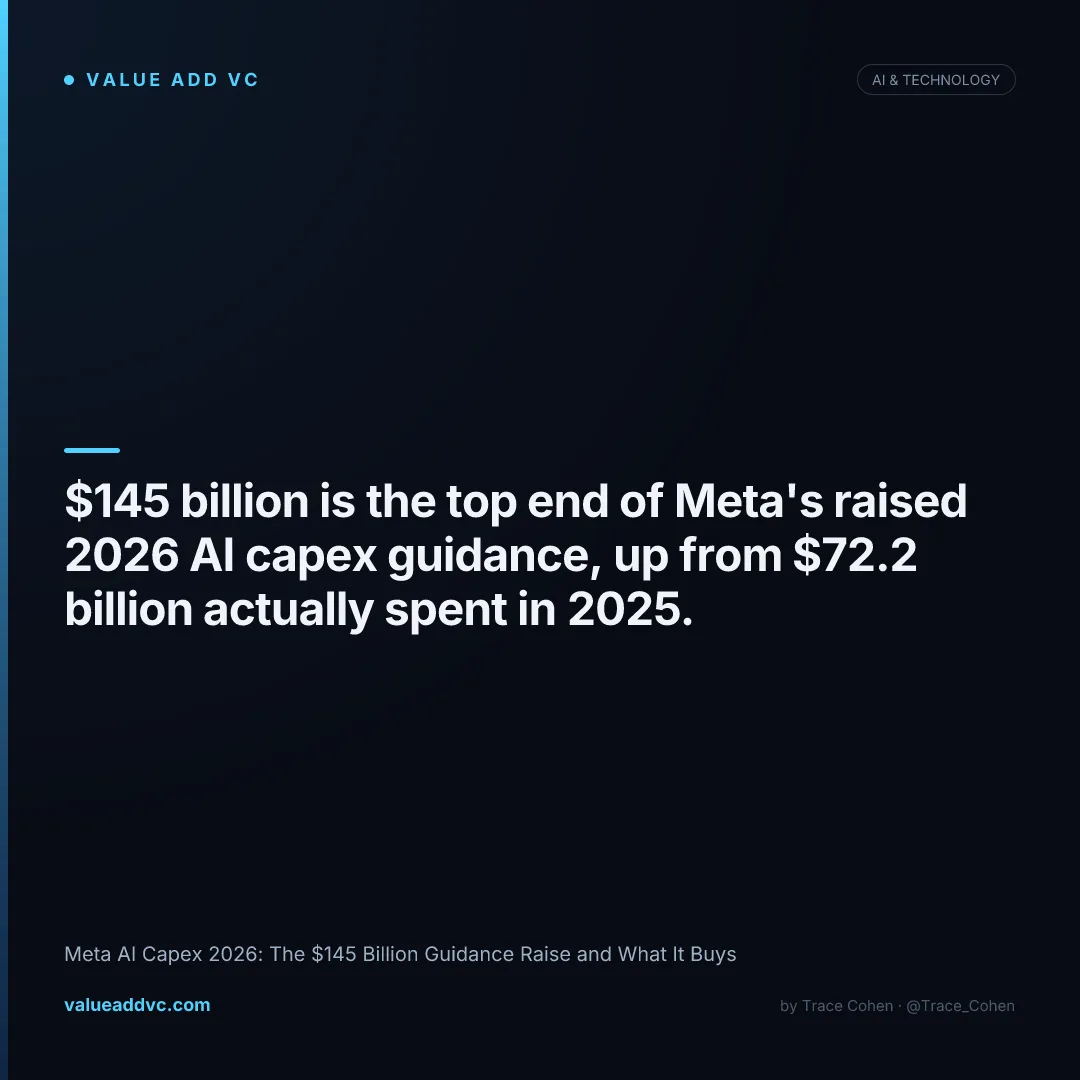
$130-145 billion is Meta's narrowed 2026 AI capex guidance after Q2 2026 earnings — the third raise this year — up from $72.2 billion actually spent in 2025. That's the short answer. The longer answer is about why Zuckerberg keeps raising the range.
Meta entered 2026 guiding to $115-135 billion in capital expenditures. After Q1 2026 earnings on April 29, it raised that range to $125-145 billion, then after Q2 earnings on July 29 narrowed it upward again to $130-145 billion as quarterly capex jumped to $31.1 billion — consuming roughly 98% of operating cash flow. The stock fell nearly 8% in after-hours trading on the Q2 print, even as Meta reported 28% revenue growth. Understanding why capex raises keep spooking investors more than the growth numbers reassure them says a lot about where the AI infrastructure cycle actually stands heading into September 2026.
Figures from Meta's Q1 and Q2 2026 and full-year 2025 earnings releases, Seeking Alpha, CNBC, and Fortune, April-September 2026.
Meta AI Capex 2026: The $145 Billion Guidance Raise Explained
Meta's meta ai capex 2026 guidance now sits at $130-145 billion, up from an original $115-135 billion range set at the start of the year. The company raised the range at its Q1 2026 earnings call on April 29, 2026, telling investors the increase "reflects our expectations for higher component pricing this year and, to a lesser extent, additional data center costs to support future year capacity." In plain terms: chips and servers cost more than Meta budgeted for, and it's building ahead of demand it expects to materialize in 2027 and beyond.
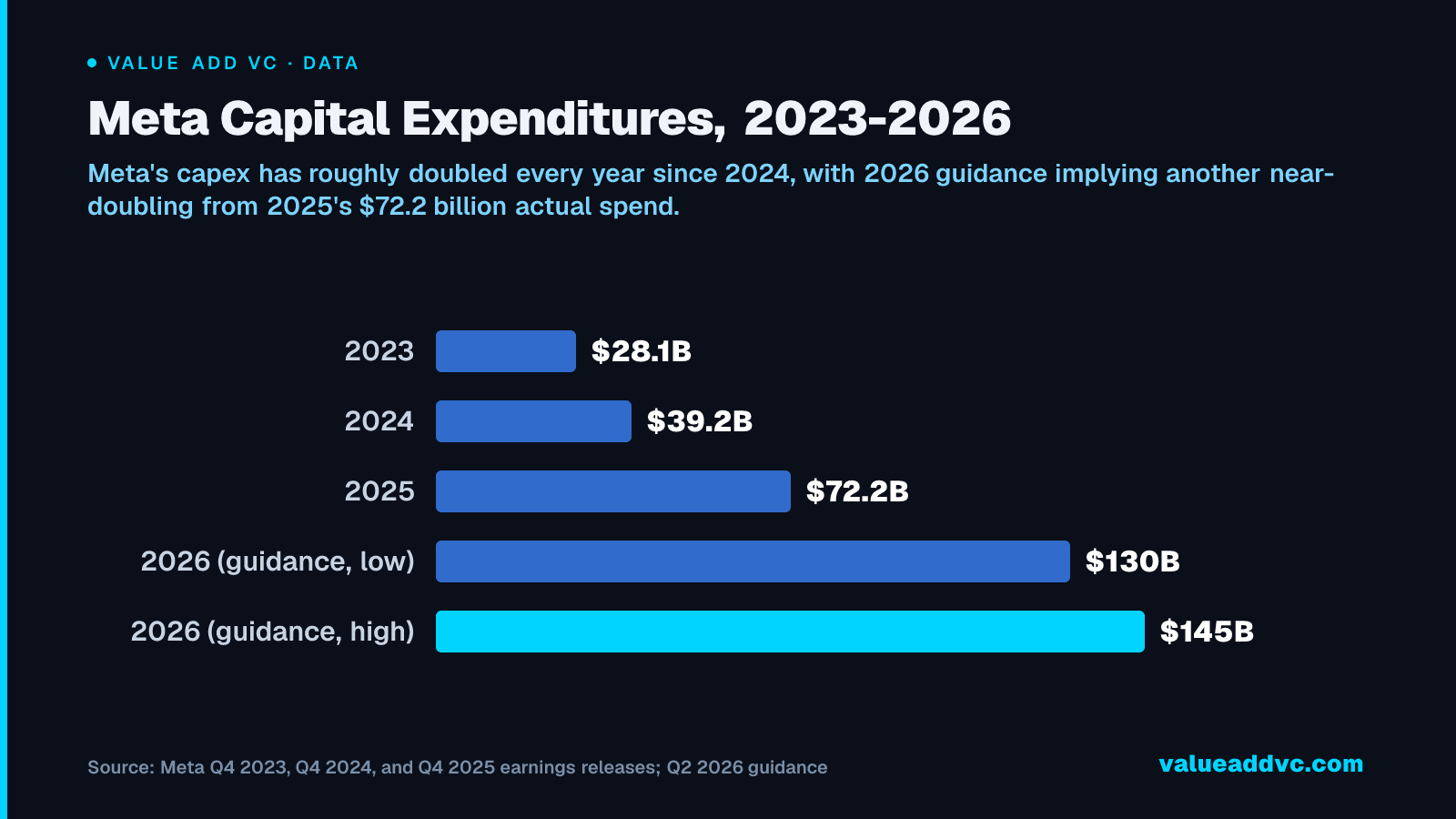
That $145 billion top end is roughly double the $72.2 billion Meta actually spent in 2025, which was itself up 84% from $39.2 billion in 2024 and 40% higher than the $28.1 billion spent in 2023. Accelerating capex growth in each of the past three years is not a company hedging its AI bet — it's a company treating compute as the primary constraint on growth. Track how this compares against the rest of the sector on our Big Tech Earnings Tracker.
Meta Capital Expenditures, 2023-2026
Meta's capex has roughly doubled every year since 2024, with 2026 guidance implying another near-doubling from 2025's $72.2 billion actual spend.
Meta Q4 2023, Q4 2024, and Q4 2025 earnings releases; Q2 2026 guidance
Data
| Item | Value |
|---|---|
| 2023 | $28.1B |
| 2024 | $39.2B |
| 2025 | $72.2B |
| 2026 (guidance, low) | $130B |
| 2026 (guidance, high) | $145B |
Q2 2026 earnings: capex jumps 57% quarter-over-quarter
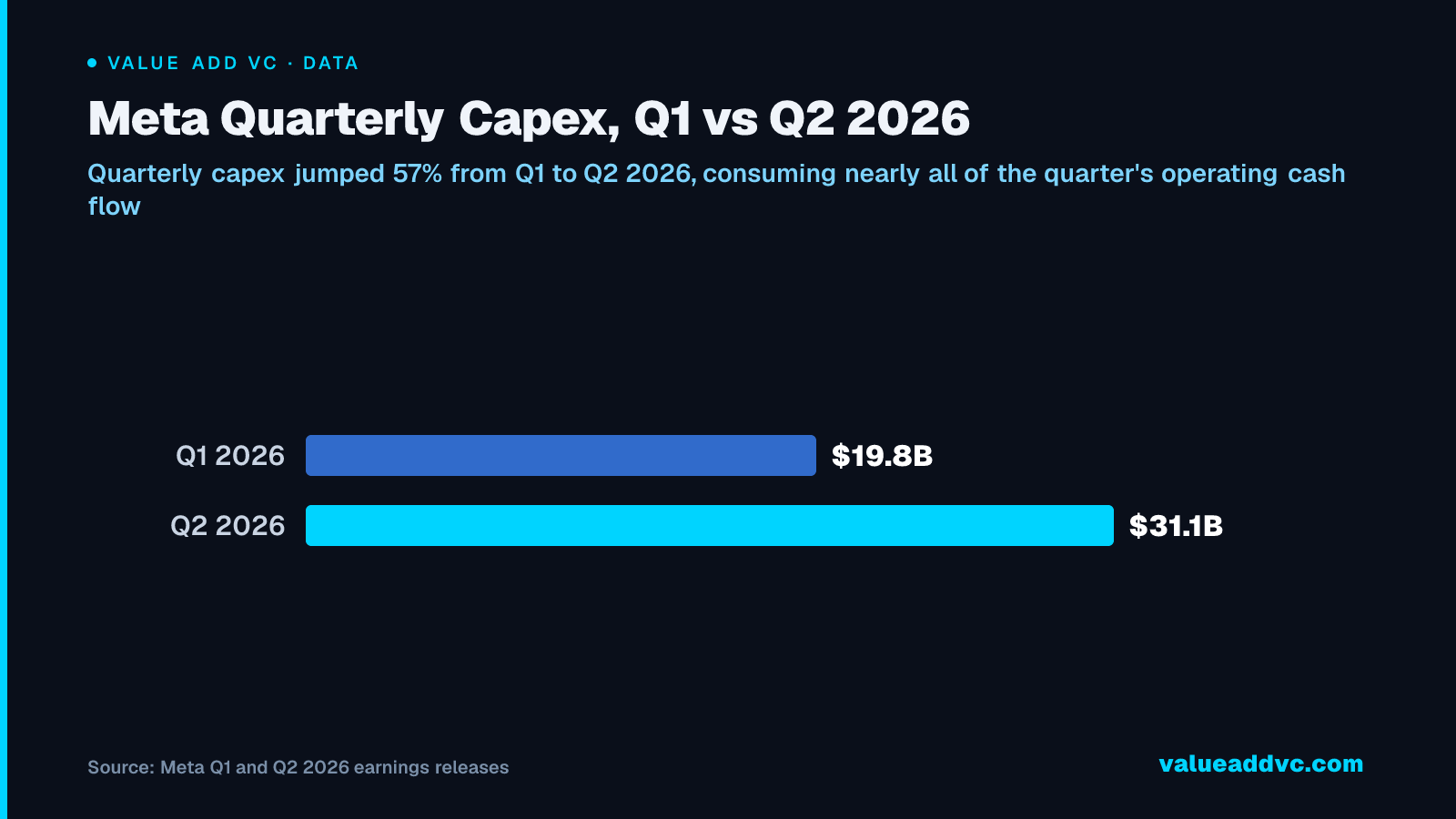
Meta's Q2 2026 earnings, reported July 29, showed the capex ramp accelerating faster than even the raised guidance implied. Quarterly capital expenditures hit $31.1 billion, up 57% from $19.8 billion in Q1, and consumed roughly 98% of the quarter's $31.86 billion in operating cash flow — leaving Meta's free cash flow near breakeven for the period. Revenue still grew 28% year-over-year to $60.8 billion, with ad revenue of $59.4 billion on 14% more impressions and 12% higher average price per ad, but EPS of $6.18 missed the roughly $7.14 consensus estimate. Shares fell nearly 8% in after-hours trading, on top of the more than 6% drop after the April Q1 report.
Meta Quarterly Capex, Q1 vs Q2 2026
Quarterly capex jumped 57% from Q1 to Q2 2026, consuming nearly all of the quarter's operating cash flow
Meta Q1 and Q2 2026 earnings releases
Data
| Item | Value |
|---|---|
| Q1 2026 | $19.8B |
| Q2 2026 | $31.1B |
The day before earnings, Meta announced a $14 billion data center partnership with BlackRock in Texas — one more data point that the spending is accelerating into new commitments, not just absorbing cost inflation on projects already underway. That's the context for the third guidance raise of the year: the low end of the 2026 range moved up $5 billion in a single quarter, from $125 billion to $130 billion, even as the high end held at $145 billion.
Why Zuckerberg Has Raised Guidance Three Times in 2026
The first raise came at Meta's Q4 2025 earnings call in late January, when the company widened its initial 2026 estimate into the $115-135 billion range as it locked in orders for Nvidia GPUs and custom silicon ahead of expected shortages. The second raise, three months later, pushed that range up another $10 billion on each end to $125-145 billion — driven not by a change in ambition but by input costs. Memory and networking component prices rose sharply through the first half of 2026 as every hyperscaler competed for the same supply chain. The third raise, after Q2 earnings on July 29, narrowed the range upward again to $130-145 billion as realized quarterly capex outpaced even the revised plan.
CFO Susan Li has repeatedly said Meta retains flexibility to adjust future-year spending "to align with returns," which is corporate-speak for: if the AI products built on this infrastructure don't monetize, 2027 guidance could come down. For now, Meta is choosing to overbuild data center capacity rather than risk being compute-constrained the way it was during parts of 2024, when GPU scarcity capped how fast new models could ship.
Meta vs Microsoft vs Amazon vs Google: How the 2026 Capex Guidance Compares
Meta's $130-145 billion is the smallest of the four major hyperscalers' 2026 capex plans in absolute dollars, though its guided growth rate off 2025 is in the same range as its larger peers'. Amazon leads at roughly $220 billion, followed by Alphabet's $195-205 billion and Microsoft's approximately $175 billion for calendar 2026 (including finance leases, after a lease-accounting change). Combined, the four companies plan to spend approximately $730 billion on capex in 2026, up about 78% from roughly $410 billion in 2025.
| Metric | Meta | Microsoft | Alphabet | Amazon |
|---|---|---|---|---|
| 2026 capex guidance | $130-145B | ~$175B | $195-205B | ~$220B |
| 2025 actual capex | $72.2B | ~$118B | ~$91B | ~$128B |
| YoY capex growth (guided) | ~80-101% | ~48% | ~113-124% | ~72% |
| Latest quarter revenue growth | +33% YoY (Q1 2026) | Azure +39.6% (Q3 FY26) | Cloud +30%+ (Q1 2026) | AWS +20%+ (Q1 2026) |
| Primary AI spend driver | Data centers, GPUs, Llama training | Azure capacity, OpenAI commitment | TPU v7, Gemini cloud demand | Trainium, Nitro, data centers |
| Stock reaction to capex raise | -6%+ after-hours | Mixed, capex-dependent | Mixed, capex-dependent | Sharp decline on $200B reveal |
Figures blended from company earnings releases, Seeking Alpha, TechCrunch, and mlq.ai reporting, 2026. YoY capex growth ranges reflect guidance midpoints versus 2025 actuals and are subject to revision as each company finalizes full-year results.
2026 AI Capex Guidance vs 2025 Actuals: The Four Hyperscalers
Company earnings releases and Seeking Alpha, TechCrunch, mlq.ai reporting, 2026
Data
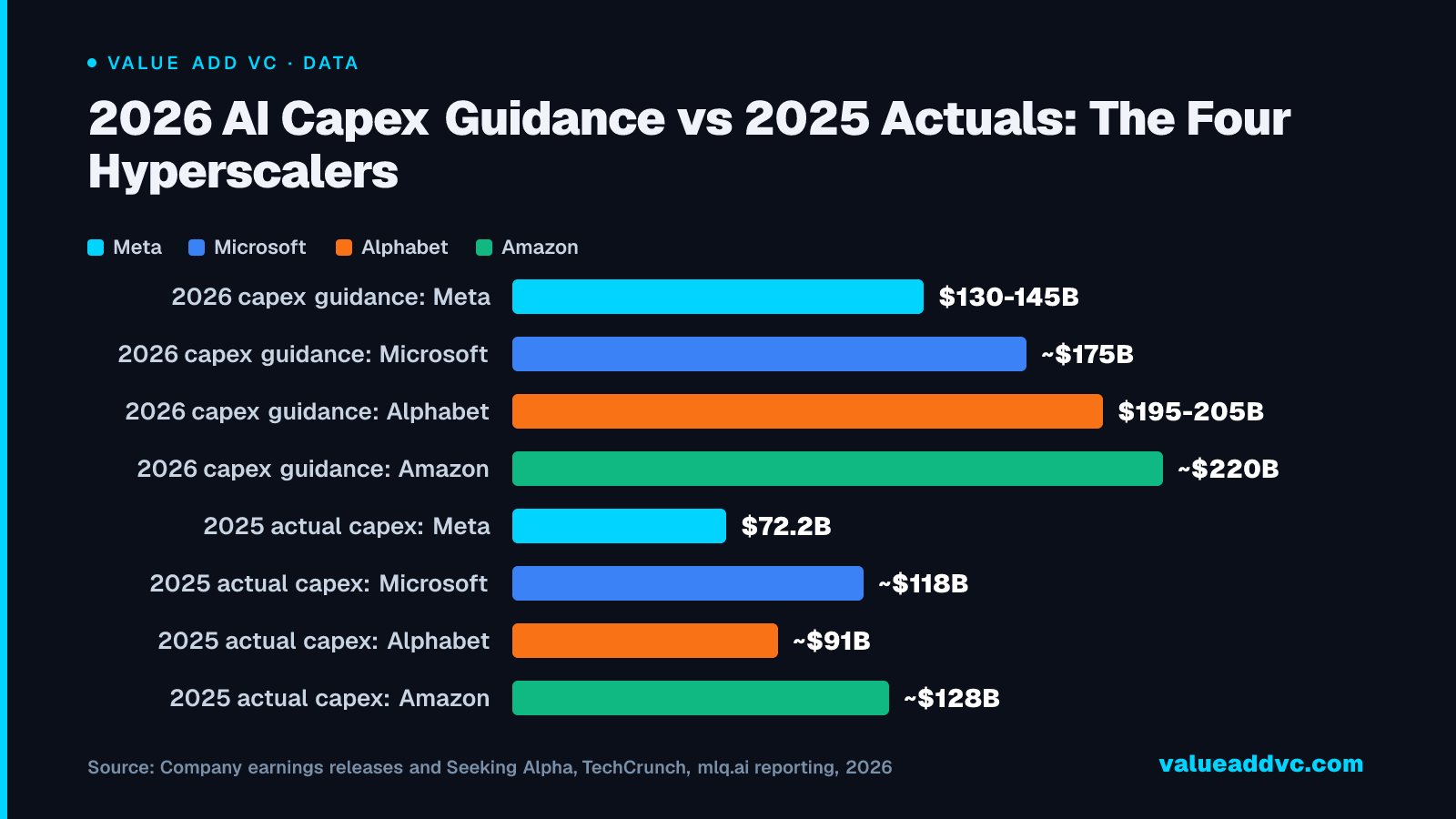
Every major hyperscaler is guiding to 2026 capex that roughly doubles or more than doubles 2025 actual spend — Meta's percentage increase is in the same range as the other three, even though its absolute dollar figure remains the smallest.
Is Meta's AI Spending Paying Off?
The revenue side of Meta's Q1 2026 report was strong on its own terms: $56.3 billion in revenue, up 33% year-over-year, with a 41% operating margin and 19% growth in ad impressions. Advertisers are paying 12% more per ad on average, evidence that AI-driven targeting and recommendation improvements are showing up in the core business, not just in speculative new products. Free cash flow of $12.4 billion for the quarter, against $19.8 billion in capex, showed the company was still comfortably self-funding the buildout in Q1 — though that cushion narrowed to near breakeven by Q2, when $31.1 billion in capex ate roughly 98% of operating cash flow.
The tension investors are pricing in is timing: capex spending shows up on the balance sheet immediately, while the AI products it's meant to fund — better ad targeting, new consumer AI features, Reality Labs bets — monetize gradually over a multi-year horizon. That mismatch, repeated across all four hyperscalers this earnings cycle, is why capex raises keep triggering sharp stock reactions even when the underlying revenue growth beats expectations. If you're tracking how private AI companies are being priced against a similar revenue-timing gap, see our AI valuations dashboard.
The Bear Case: Depreciation and the ROI Question
The most common pushback on Meta's 2026 AI capex guidance isn't that the company can't afford it — Q1 2026 free cash flow of $12.4 billion showed it could, though that margin for error had all but disappeared by Q2 — it's that GPU-heavy infrastructure depreciates fast, typically over a 4-6 year useful life on Meta's books, while the payoff from better ad targeting or new consumer AI products is uncertain and multi-year — and Meta itself stretched that assumption to 5.5 years in 2025, a change worth nearly $2.9 billion in reported profit. Every dollar of capex today becomes a depreciation expense that starts hitting the income statement almost immediately, well before any associated revenue shows up. When Zuckerberg told analysts that measuring ROI on the buildout was "a very technical question," it read to some investors as an admission that Meta itself doesn't have a clean payback model yet.
The counterargument, which Meta's own numbers partly support, is that the AI spend is already showing up in results that predate any new product launches: 19% growth in ad impressions and 12% growth in average price per ad in Q1 2026 are both attributed internally to AI-driven improvements in targeting, ranking, and measurement across the existing Facebook and Instagram ad business. That's a different bet than OpenAI or Anthropic spending on frontier model training with no revenue product yet — Meta is layering AI spend onto a business that already converts attention into ad dollars at scale, which is part of why the market's punishment for the capex raise was a 6% pullback rather than the double-digit drops seen at some AI-native companies after disappointing guidance. We break down exactly how much of that top-line number is actually AI-driven versus organic ad-business growth.
What Meta's AI Capex Actually Buys
The $130-145 billion figure isn't a single line item — it's split across three buckets: data center construction (land, buildings, and the power infrastructure to run them), networking gear to link tens of thousands of GPUs into training clusters, and the compute silicon itself, a mix of Nvidia's latest accelerators and Meta's own custom MTIA inference chips. Meta has publicly discussed building "titan" clusters — campuses designed to house well over a gigawatt of compute capacity each — with sites in Louisiana and Ohio among the largest known buildouts. That gigawatt-scale power draw is exactly the bottleneck a new crop of grid-flexibility startups is targeting — Emerald AI raised $150M at a $1.05B valuation in August 2026 on the bet that software, not new transmission lines, is the faster way to power clusters this size.
Unlike Microsoft or Amazon, which sell a meaningful share of their compute buildout to third-party cloud customers through Azure and AWS, almost all of Meta's capex is self-consumed — training and running Llama models, powering the AI features inside Facebook, Instagram, and WhatsApp feeds, and building toward Reality Labs and consumer AI hardware — including Muse Gadgets, the open-source firmware kit Meta launched in October 2026 to seed a third-party hardware ecosystem around its Muse AI assistant. That makes Meta's capex-to-revenue ratio a cleaner read on how much the core advertising business is willing to bet on AI: capex of $19.8 billion against $56.3 billion in Q1 2026 revenue works out to roughly 35 cents spent on infrastructure for every revenue dollar earned that quarter, well above the ratio Meta ran through 2022 and 2023.
Bottom line: Meta's 2026 AI capex guidance now sits at $130-145 billion, roughly double the $72.2 billion it actually spent in 2025, after three guidance raises driven by component pricing, future-capacity planning, and a Q2 spending pace that outran even the revised plan. It's still the smallest of the four major hyperscalers' 2026 capex plans in absolute terms, with a percentage increase in the same range as its larger peers' — and with Q2 2026 revenue growth of 28% now funding most of the buildout while free cash flow runs near breakeven, the real test is whether that growth rate holds as the AI product payoff arrives on a longer timeline than the spending does. See how Meta compares to the full $730B hyperscaler capex race, and track live spending on our AI Spending Tracker.
Latest from the Pulse
Get VC data most people never see
— free to subscribe
Trace's notes on venture, AI and startups, a few times a week. Join 5,000+ subscribers. No spam.
No spam, unsubscribe anytime. Sent via Substack · Privacy · or subscribe on Substack ↗