
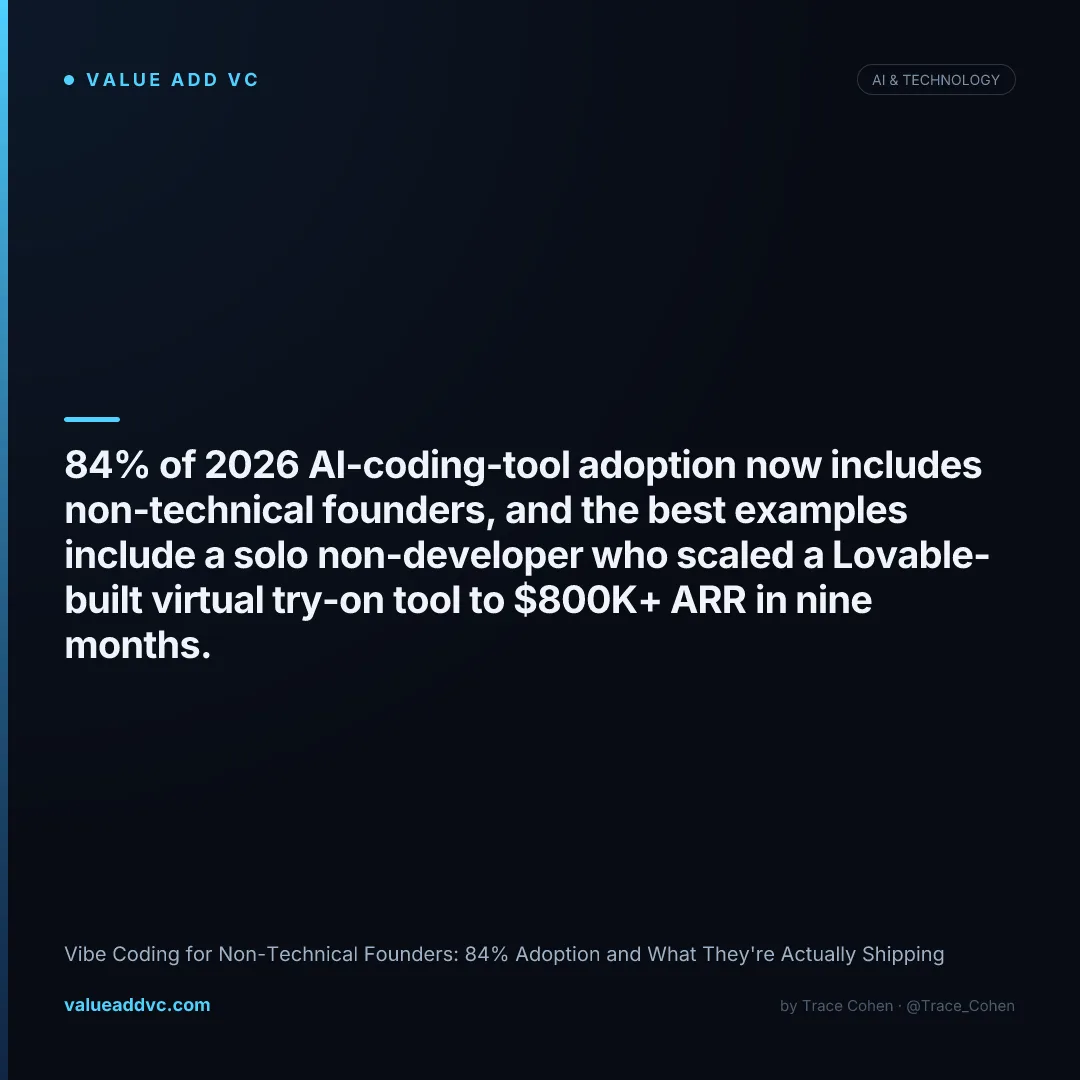
84% of AI coding tool adoption in 2026 now includes people with no engineering background at all. That's the short answer. The longer answer is more interesting.
Vibe coding stopped being a novelty around the time Lovable's annualized revenue hit $400 million in February 2026, up from $100 million just eight months earlier. Non-technical founders are now shipping real, paying products by describing them in plain English rather than writing a line of code. But the same data that shows adoption exploding also shows 65% of the resulting apps carry security vulnerabilities and technical debt rising 30-41% after teams adopt these tools. Both things are true at once, and founders need to understand both before betting a company on it.
What Is Vibe Coding for Non-Technical Founders?
Vibe coding for non-technical founders means describing a product in natural language to an AI tool like Lovable, Bolt.new, or Replit Agent and receiving a deployable, real codebase in return, rather than writing or even reading the underlying code. It differs from older no-code platforms because the AI generates actual source code that can be exported and modified, not a fixed template locked to one platform's constraints.
Can a Non-Technical Founder Really Build a Startup With AI in 2026?
Yes, for an initial version — and increasingly for a lot more than that. The methodology's biggest mistake, per builders who've done it repeatedly, is trying to tell the AI model how to code rather than focusing entirely on what the product should do and let the tool handle implementation. Non-technical founders using tools like Lovable and Replit Agent commonly report getting roughly 80% of a working app built almost instantly. The founders who make it past that point are the ones pairing the tool with real customer insight and a clear product vision, not the ones relying on the AI alone to figure out what to build.
What Do Non-Technical Founders Actually Build With Vibe Coding Tools?
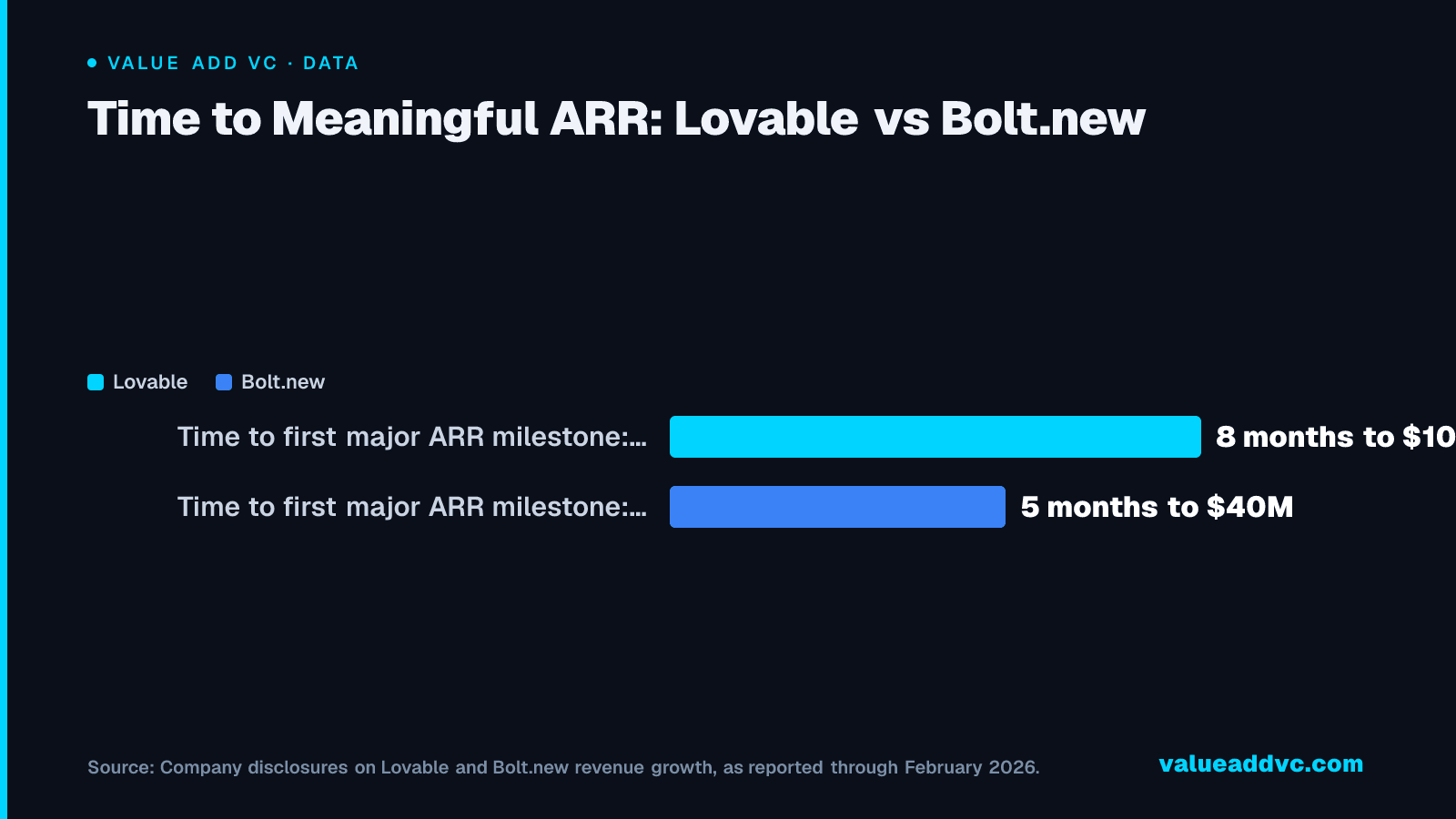
Most non-technical founders are building narrow, single-purpose SaaS tools and internal business apps rather than complex multi-sided platforms — the category where AI code generation is most reliable. One documented example: a non-developer used Lovable to build a virtual try-on tool for e-commerce and scaled it to over $800,000 in ARR within nine months, with no direct coding involved at any stage. Bolt.new, which reached $40 million in ARR within five months of its own launch, has seen similar patterns among its user base — narrow tools solving one workflow problem, shipped fast, then iterated on with more AI-generated code rather than a rewrite.
How Much Revenue Have Vibe-Coded Startups Actually Generated?
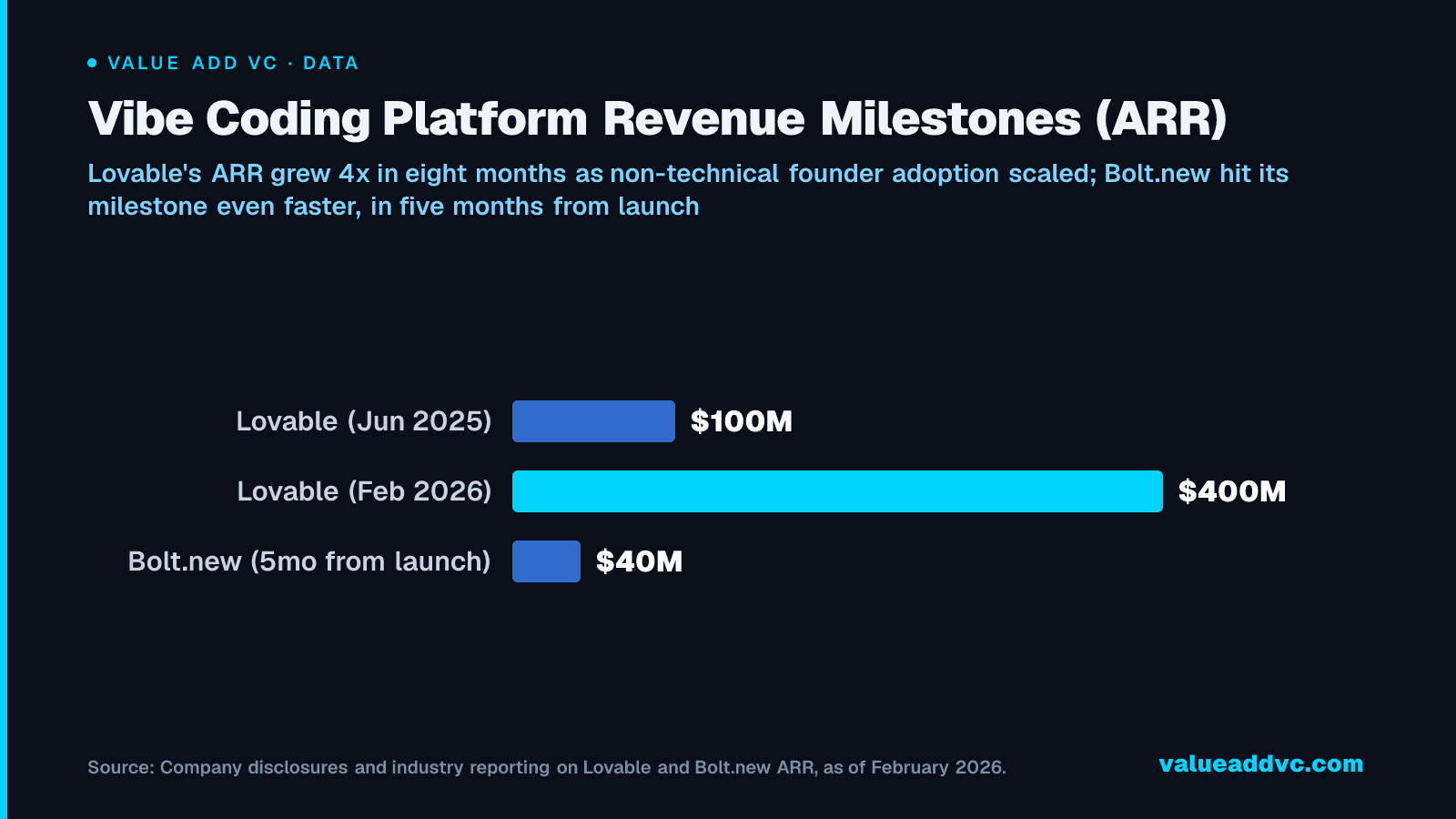
$400 million in annualized revenue is what Lovable itself was generating as of February 2026, up 4x from $100 million eight months earlier, largely from non-technical founders building SaaS MVPs on the platform. Bolt.new hit $40 million ARR within five months of launch. At the individual product level, the numbers are smaller but concrete — the $800K ARR virtual try-on tool is the most-cited example of a solo non-technical founder reaching real revenue, though most vibe-coded products never publish numbers at all, making platform-level ARR the more reliable signal of how much economic activity is actually happening.
Vibe Coding Platform Revenue Milestones (ARR)
Lovable's ARR grew 4x in eight months as non-technical founder adoption scaled; Bolt.new hit its milestone even faster, in five months from launch
Company disclosures and industry reporting on Lovable and Bolt.new ARR, as of February 2026.
Data
| Item | Value |
|---|---|
| Lovable (Jun 2025) | $100M |
| Lovable (Feb 2026) | $400M |
| Bolt.new (5mo from launch) | $40M |
What Are the Risks of Vibe Coding for Non-Technical Founders?
65% of over 1,400 production vibe-coded applications scanned by Escape.tech had security issues, and 58% contained at least one critical vulnerability, including more than 400 exposed secrets and 175 instances of exposed personally identifiable information. Separately, a Tenzai review of 15 production apps built with five major AI coding tools found every single application lacked CSRF protection and had no security headers configured, and every tool tested introduced server-side request forgery vulnerabilities. Veracode's broader testing of over 100 LLMs on security-sensitive coding tasks found 45% of AI-generated code samples introduce OWASP Top 10 vulnerabilities. AI-assisted commits also expose secrets at more than twice the rate of human-only commits — 3.2% versus 1.5%.
Which AI Coding Tools Do Non-Technical Founders Actually Use?
Lovable and Replit Agent lead usage among founders with zero coding background because both are built around plain-English prompting and one-click deployment, while Bolt.new and v0 fill narrower prototyping roles. Cursor and Claude Code are the most powerful of the group but are built for people who can already read code, making them better fits for a technical co-founder or first engineering hire than for a solo non-technical operator.
| Tool | Best for | Non-tech friendliness | Notable data point |
|---|---|---|---|
| Lovable | Full-stack SaaS MVPs | Highest | $400M ARR (Feb 2026) |
| Replit Agent | Founders who also want hosting/DB built-in | Highest | Core rival to Lovable for non-tech users |
| Bolt.new | Fast prototypes and landing-page apps | High | $40M ARR within 5 months |
| v0 (Vercel) | UI/frontend prototyping | Medium-High | Narrower scope than full-stack tools |
| Cursor | Technical co-founders reviewing AI output | Low | Built for people who can read code |
| Claude Code | Full app builds with debugging/deploy | Medium | Most powerful, steepest learning curve |
Figures are 2026 estimates blended from company disclosures, Escape.tech, Tenzai, Veracode, and industry reporting (Lovable, Bolt.new, Startup Fortune, Altar.io). Non-tech friendliness is a qualitative ranking based on documented onboarding flow and target user base, not a standardized benchmark.
Time to Meaningful ARR: Lovable vs Bolt.new
Company disclosures on Lovable and Bolt.new revenue growth, as reported through February 2026.
Data
Where Do Non-Technical Founders Hit a Wall With Vibe Coding?
The wall shows up right around the last 20% of the build — the point where a founder has an app that demos well but isn't secure, scalable, or resilient to edge cases, and keeps burning AI credits in debugging loops trying to close the gap. That's also where a study of 8.1 million pull requests found technical debt rising 30-41% after AI tool adoption, and where analysts project 75% of companies will carry moderate-to-high severity technical debt by the end of 2026. Georgia Tech's Vibe Security Radar project tracked 35 CVEs in a single month (March 2026) directly attributable to AI coding tools, with researchers estimating the true count across the broader open-source ecosystem could be five to ten times higher. For a non-technical founder, this is usually the moment a technical co-founder or contractor becomes non-optional rather than optional — before an investor's technical diligence or a security incident forces the issue.
The founders who navigate this stage well tend to do one of three things: bring on a technical co-founder before the first paying customer rather than after, budget for a paid security and code-quality audit once the product clears roughly $10K in monthly recurring revenue, or deliberately keep the initial scope narrow enough that the AI-generated codebase never needs to handle the complexity that produces most of these vulnerabilities in the first place. None of those moves are exotic — they're the same discipline any early-stage engineering team should apply — but skipping them is exactly what turns a fast, cheap vibe-coded prototype into an expensive rebuild six months later.
The Bottom Line
Vibe coding has made it genuinely possible for a non-technical founder to ship a real, revenue-generating product in 2026 — 84% of tool adoption now includes people with no coding background, and the best examples run from a solo $800K ARR tool to Lovable's own $400 million platform-level ARR. The same data shows 65% of vibe-coded apps carry security issues and technical debt rising 30-41% after adoption, so the founders who actually make it past the prototype stage are the ones who treat AI-generated code as a fast first draft that still needs a technical review, not a finished product.
Track AI company valuations, including Lovable and other vibe-coding platforms, on the AI Valuations dashboard at Value Add VC.
Latest from the Pulse
Get VC data most people never see
— free to subscribe
Trace's notes on venture, AI and startups, a few times a week. Join 5,000+ subscribers. No spam.
No spam, unsubscribe anytime. Sent via Substack · Privacy · or subscribe on Substack ↗