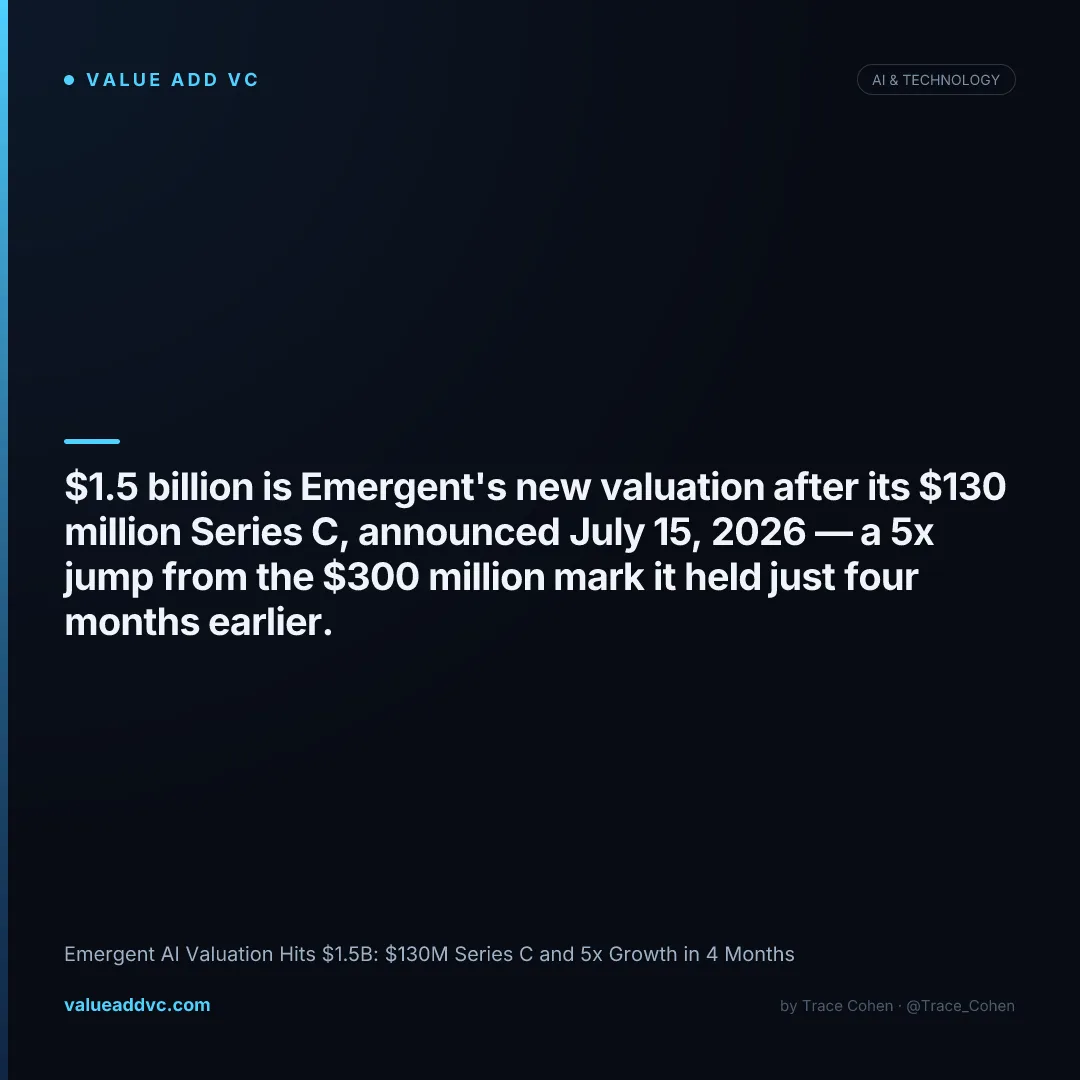
Emergent just raised $130 million at a $1.5 billion valuation — 5x higher than the $300 million mark it held four months ago. What the markup really prices is how fast the vibe-coding category is moving, and who's actually making money at it.
On July 15, 2026, Emergent — an AI coding startup founded just over a year ago by brothers Mukund Jha (CEO) and Madhav Jha (CTO) — announced a $130 million Series C led by Creaegis, with Claypond Capital and Sentinel Global co-leading. The round values the company at $1.5 billion, officially making it a unicorn and bringing its total funding to $230 million. It's the third notable vibe-coding valuation headline in a single month, following Replit's $9 billion round in the spring and reports that Lovable was in talks to double its own valuation to $13.2 billion.
What Is Emergent's Valuation and Why Did It 5x in Four Months?
Emergent's valuation is $1.5 billion as of its July 2026 Series C, up from roughly $300 million after its $70 million Series B in March 2026 — a fivefold increase in about four months. The company says it has 4x'd its revenue and paying-user count since that last raise, reaching a $120 million annualized revenue run rate and more than 200,000 paying customers, with 1.5-2 million monthly active users building on the platform.
That kind of valuation velocity isn't unique to Emergent this year — it's the defining feature of the entire AI valuation environment in 2026. Replit tripled its own valuation from $3 billion to $9 billion in about six months. Lovable went from $6.6 billion in December 2025 to reported talks at $13.2 billion by July 2026. When ARR is compounding at 4x every few months, investors are pricing the trajectory, not the trailing twelve months.
Emergent vs. Lovable, Replit, and Cursor: The Vibe-Coding Valuation Race
"Vibe coding" — a term coined by Andrej Karpathy in February 2025 to describe building software by describing it in plain language and letting AI generate and refine the code — has become one of the most heavily funded categories in venture in 2026. FindSkill.ai pegs the current vibe-coding market at roughly $4.7 billion. Here's how the four best-funded players compare on the metrics that matter most.
| Metric | Emergent | Replit | Lovable | Cursor (Anysphere) |
|---|---|---|---|---|
| Latest valuation | $1.5B (Jul 2026) | $9B (Mar 2026) | $13.2B (talks, Jul 2026) | $50B (talks, Apr 2026) |
| Latest round size | $130M Series C | $400M Series D | $300M (in talks) | $2.3B Series D (Nov 2025) |
| Reported ARR | $120M | $265M (end of 2025) | $500M (Jun 2026) | ~$1B (Nov 2025) |
| Approx. valuation-to-ARR | ~12.5x | ~34x | ~26x | ~50x |
| Founded | June 2025 | 2016 | 2023 | 2022 (as Anysphere) |
| Prior valuation (months earlier) | $300M (4 mo. earlier) | $3B (6 mo. earlier) | $6.6B (7 mo. earlier) | $29.3B (5 mo. earlier) |
| Lead investors (latest round) | Creaegis, Claypond, Sentinel | Georgian | Undisclosed (in talks) | Thrive, Accel (reported) |
Figures are 2026 estimates blended from TechCrunch, Crunchbase News, DealStreetAsia, YourStory, and company statements. Valuation-to-ARR multiples are approximate and use the most recently disclosed ARR figure against the most recent valuation; Cursor and Lovable ARR are self-reported run-rate figures, not audited revenue.
Emergent's Valuation Trajectory Since Launch
What makes Emergent's Series C notable isn't the absolute number — at $1.5 billion, it's the smallest of the four major vibe-coding unicorns — it's the speed. The company launched publicly in June 2025, raised a $70 million Series B at roughly $300 million in early 2026, and reached $1.5 billion just four months later on the back of a genuine 4x in ARR and paying users, not a valuation markup on flat metrics.
For comparison, Emergent's roughly 12.5x valuation-to-ARR multiple is meaningfully lower than Cursor's ~50x or Replit's ~34x — which either means Emergent is undervalued relative to its growth rate, or that investors are pricing in more uncertainty around retention in the "non-technical founder" segment it targets, versus Cursor and Replit's larger base of professional developers.
What Emergent's Round Signals for AI-Native SaaS Investing
Growth is still the primary valuation driver in vibe coding — Emergent's 4x revenue growth since its Series B is the justification for its 5x valuation markup, not multiple expansion alone.
The category now has real revenue, not just usage — $120M ARR, $265M ARR, and $500M ARR at Emergent, Replit, and Lovable respectively means diligence can finally underwrite trailing revenue instead of pure top-of-funnel signups.
Non-technical-founder-focused platforms (Emergent) are being priced at a discount to developer-focused tools (Cursor, Replit) on a revenue-multiple basis — worth watching whether that gap closes as Emergent's retention data matures.
Total vibe-coding funding across just these four companies now exceeds $3.5B in disclosed rounds since late 2025, concentrated in a handful of repeat-investor names: Khosla Ventures, SoftBank, Lightspeed, and Y Combinator all appear across multiple cap tables in this category.
The Bottom Line
Emergent's $1.5 billion valuation is small next to Cursor's reported $50 billion talks, but its underlying math — $120 million ARR, 200,000+ paying customers, 4x growth in four months — is exactly the kind of real, revenue-backed trajectory VCs are still willing to pay up for in 2026, even after two years of AI valuation scrutiny. The vibe-coding category has gone from a meme term coined in February 2025 to a $4.7 billion market with four separate unicorns inside eighteen months. Watch the valuation-to-ARR multiples, not just the headline numbers, to see which of these four is actually priced correctly.
Track how AI-native companies are being valued across the market on the AI Valuations dashboard, and see the full list of newly minted AI unicorns on the Unicorn Tracker at Value Add VC.
Latest from the Pulse
Get VC data most people never see
— 100% free
Weekly benchmarks, valuations, and fund data. Join 5,000+ investors. No spam.