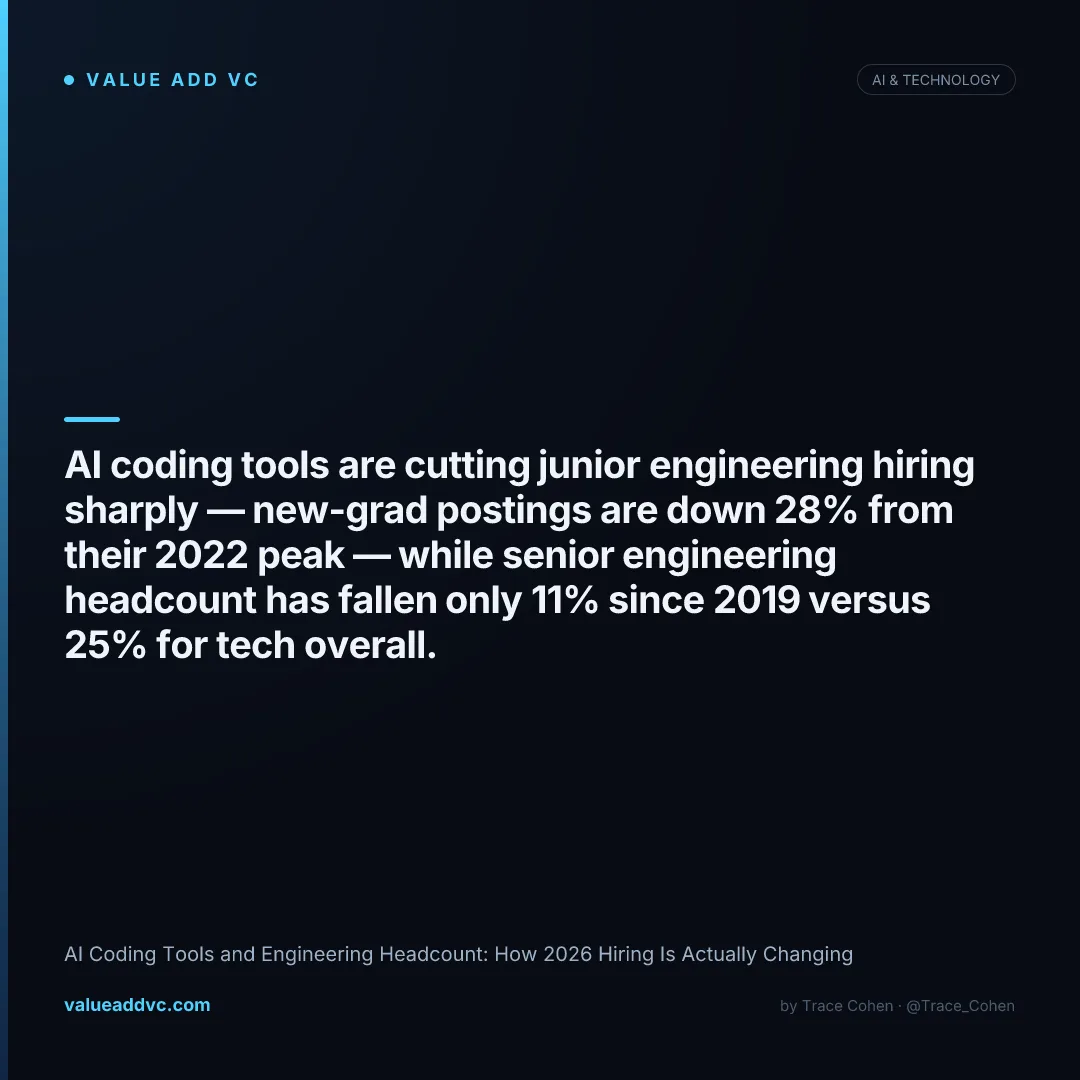
Claude Code went from zero to roughly $8 billion in run-rate revenue in twelve months, and Cursor hit $2 billion in ARR faster than any B2B SaaS company in history — while new-grad engineering job postings are down 28% from their 2022 peak. Those three numbers are connected, and the connection is what this post unpacks.
I sit on the board of and advise a handful of companies wrestling with this exact question right now: if a senior engineer with Claude Code or Cursor can ship what used to take a team of three, do you still hire the team of three? The data says the answer is level-specific — senior engineering headcount is proving remarkably resilient while entry-level hiring is getting hollowed out, and that split is going to reshape how founders build engineering orgs for the next five years.
How Are AI Coding Tools Changing Engineering Team Headcount Decisions?
AI coding tools are changing engineering headcount decisions by level rather than across the board: entry-level and boilerplate-heavy roles are being cut or simply not backfilled, while senior engineers who can direct AI tools effectively are being retained and even prioritized in new hiring. Overall tech headcount is down roughly 25% from 2019 levels, but engineering-specific headcount has fallen only 11% over that same window — a gap of more than two to one that shows the cuts are not hitting engineering uniformly.
That gap is the whole story. Companies aren't deciding "we need fewer engineers" as a blanket policy — they're deciding "we need fewer engineers who only do what AI now does well," which happens to describe most junior work: writing boilerplate, translating specs into code, and fixing straightforward bugs. Engineers still made up 55% of all new hires at large tech firms in 2025, which tells you engineering as a function isn't shrinking — it's being restructured around who can supervise AI output instead of just producing code line by line.
The AI Coding Tool Market Is Consolidating Fast
The competitive picture shifted hard in the last twelve months. Claude Code launched in May 2025 and, per the JetBrains 2026 Developer Ecosystem Survey, overtook both GitHub Copilot and Cursor to become the most-used AI coding tool within eight months — jumping from 3% developer usage in April 2025 to 18% by January 2026. It's now rated the most-loved tool by developers at 46%, versus 19% for Cursor and just 9% for GitHub Copilot, and contributes an estimated 4% of all public GitHub commits worldwide.
Cursor hasn't slowed down either — it went from $100M ARR in January 2025 to $500M by June, $1B by November, and $2B by February 2026, a trajectory no other B2B SaaS company has matched in under 24 months from commercial launch. Anthropic overall has scaled large accounts paying over $100K ARR roughly 7x year-on-year, and the number of customers paying more than $1M ARR went from a dozen to over 500. This isn't a niche developer-tools story anymore — it's enterprise infrastructure spend, and it correlates directly with how fast engineering orgs are re-architecting who they hire.
AI Coding Tools vs Engineering Hiring: The Data Broken Down by Level
The clearest way to see the split is to compare hiring trends across seniority levels side by side. Junior and new-grad roles are absorbing nearly all of the contraction, while senior and staff-level engineering roles are holding steady or growing at many firms.
| Segment | 2026 Data Point | Direction |
|---|---|---|
| New-grad job postings | Down 28% from 2022 peak | Sharp decline |
| Big Tech junior hiring | Down 25% vs 2023 levels | Sharp decline |
| Software eng. postings, YoY (Jan–Feb 2026) | Down ~15% | Decline |
| Overall tech headcount vs 2019 | Down ~25% | Decline |
| Engineering headcount vs 2019 | Down only 11% | Resilient |
| Engineers' share of new tech hires (2025) | 55% of all new hires | Growing share |
| Middle management cuts | Down ~41% at large tech firms | Sharp decline |
| AI-assisted dev productivity gain | +26% (Stanford AI Index) | Productivity up |
Figures are 2026 estimates blended from LinkedIn Economic Graph data, the Stanford HAI AI Index, McKinsey's State of AI research, and company disclosures. Ranges reflect the most recent full-quarter data available as of mid-2026.
Why Junior Engineering Headcount Is Taking the Hit
The mechanism is straightforward once you look at what AI coding tools are actually good at. Claude Code, Cursor, and GitHub Copilot are strongest at exactly the tasks that used to justify hiring a junior engineer: translating a well-specified ticket into working code, writing tests against an existing pattern, and fixing narrowly-scoped bugs. Companies report developers using AI tools produce 40-55% more code per sprint at comparable quality, and McKinsey found top-performing AI adopters saw 31-45% improvements in software quality on top of 16-30% faster delivery.
Salesforce is the cleanest public example. The company cut support headcount from roughly 9,000 to about 5,000 and CEO Marc Benioff said Salesforce hired no new engineers in fiscal year 2026, crediting AI agents for absorbing the work. That's a specific, disclosed number from a public company CEO, not an industry estimate — and it's the pattern venture-backed startups I work with are quietly replicating at smaller scale: fewer new junior req approvals, more budget redirected to AI tool licenses and senior engineering comp.
Engineering Team Headcount Decisions Founders Are Actually Making in 2026
Talking to portfolio founders and other operators, the same four decisions keep coming up when engineering headcount planning meets AI coding tool adoption:
Backfill less, promote more
Open junior reqs are being converted into AI tool budget or held open, while existing junior engineers get accelerated into mid-level roles faster than prior cohorts.
Senior-to-junior ratio is inverting
Teams that used to run 1 senior to 3-4 juniors are shifting toward 1 senior (AI-augmented) to 1-2 juniors, since AI now covers work that used to require extra hands.
AI tool spend is now a headcount line item
CFOs increasingly model Claude Code, Cursor, and Copilot seats against the salary of the junior hire they're replacing — often $20K-$30K per seat annually versus $120K-$160K in fully-loaded junior comp.
Middle management is the quiet casualty
Middle management roles that translated strategy into engineering roadmaps are being cut at roughly 41% at large firms, faster than either senior IC or junior roles, as flatter AI-augmented teams need less coordination overhead.
Which AI Coding Tools Are Actually Driving This Shift
Three tools are doing most of the work reshaping engineering headcount decisions right now, and they're not interchangeable. Claude Code leads on autonomous, agentic tasks — multi-file refactors and end-to-end feature builds with minimal supervision, which is exactly the profile of work that used to require a small team. Cursor leads on in-editor pair-programming speed for engineers who want to stay hands-on. GitHub Copilot, despite falling to 9% "most loved," still has the largest installed base through its GitHub and Microsoft distribution, which is why enterprise headcount models often still budget around it even as developer sentiment shifts elsewhere.
For funds and operators tracking where AI infrastructure dollars are actually landing, our AI Valuations dashboard tracks the private-market pricing behind Anthropic, OpenAI, and the coding-tool layer built on top of them, and our Hiring Trends tool tracks the headcount side of this same shift in near-real time.
What This Means for Founders Building Engineering Teams Now
If you're building a seed or Series A engineering team in 2026, the practical read is this: don't default to the old ratio of hiring junior engineers to handle volume. A senior engineer working with Claude Code or Cursor can now credibly cover what used to require a senior-plus-two-juniors pod, which changes both your burn multiple and your actual product velocity. That doesn't mean juniors are obsolete — it means the bar for what justifies a junior hire has risen, and the ones you do hire need to ramp into AI-augmented workflows immediately rather than spending a year on foundational grunt work.
It also means the war for senior engineering talent is getting more intense, not less — since senior engineers are the ones whose output AI tools amplify the most, comp for that tier is holding or rising even as junior comp growth flattens. Track how this plays out across the broader market on our Tech Layoffs tracker, which breaks down cuts by function and seniority as new data comes in.
$8B in Claude Code run-rate revenue. A 28% drop in new-grad postings. An 11% drop in engineering headcount versus a 25% drop tech-wide.
AI coding tools aren't shrinking engineering teams — they're shrinking the entry ramp into them.
The founders who get this right in 2026 aren't the ones cutting headcount across the board — they're the ones redesigning who gets hired, at what level, and how fast a junior engineer needs to become AI-fluent to earn the next hire on the team.
Track hiring and layoff trends on the Hiring Trends Dashboard and Layoffs Tracker at Value Add VC. Originally published in the Trace Cohen newsletter.
Latest from the Pulse
Get VC data most people never see
— free to subscribe
Trace's notes on venture, AI and startups, a few times a week. Join 5,000+ subscribers. No spam.