
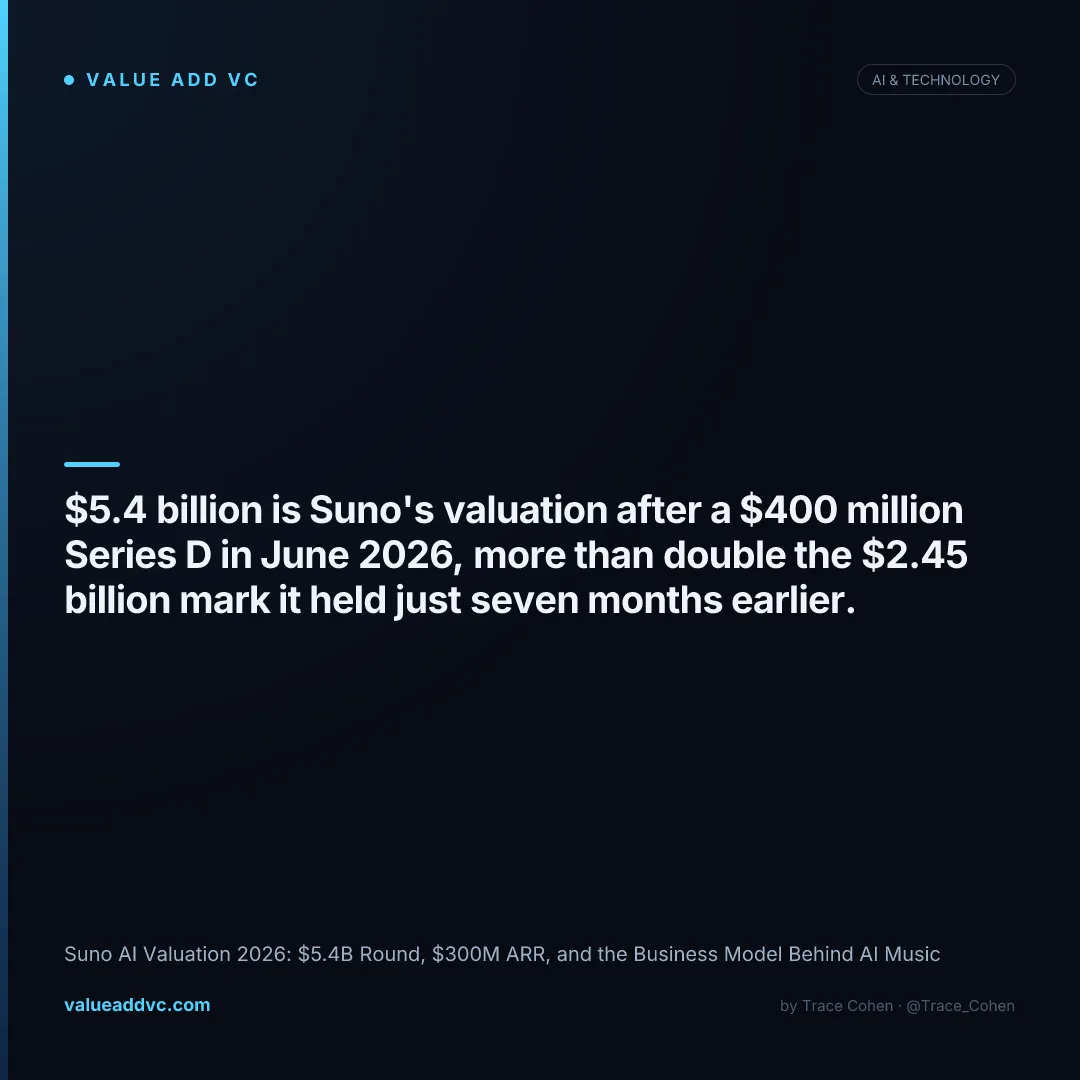
Suno is worth $5.4 billion after a $400 million Series D in June 2026 — more than double the $2.45 billion it was worth seven months earlier. Behind that markup: Suno is one of only two AI music generators with real, licensed revenue at scale, and the other one, Udio, isn't close.
On June 3, 2026, Suno announced a $400 million Series D led by Bond Capital, with IVP, Forerunner, Union Square Ventures, Alkeon Capital Management, and Quiet joining the round. The raise values the AI music startup at $5.4 billion, up from $2.45 billion at its November 2025 Series C and $500 million at its May 2024 Series B. Suno has now raised roughly $775 million in just over two years, and it did so while fighting — and partially settling — copyright lawsuits from every major record label.
What Is Suno AI's Valuation in 2026?
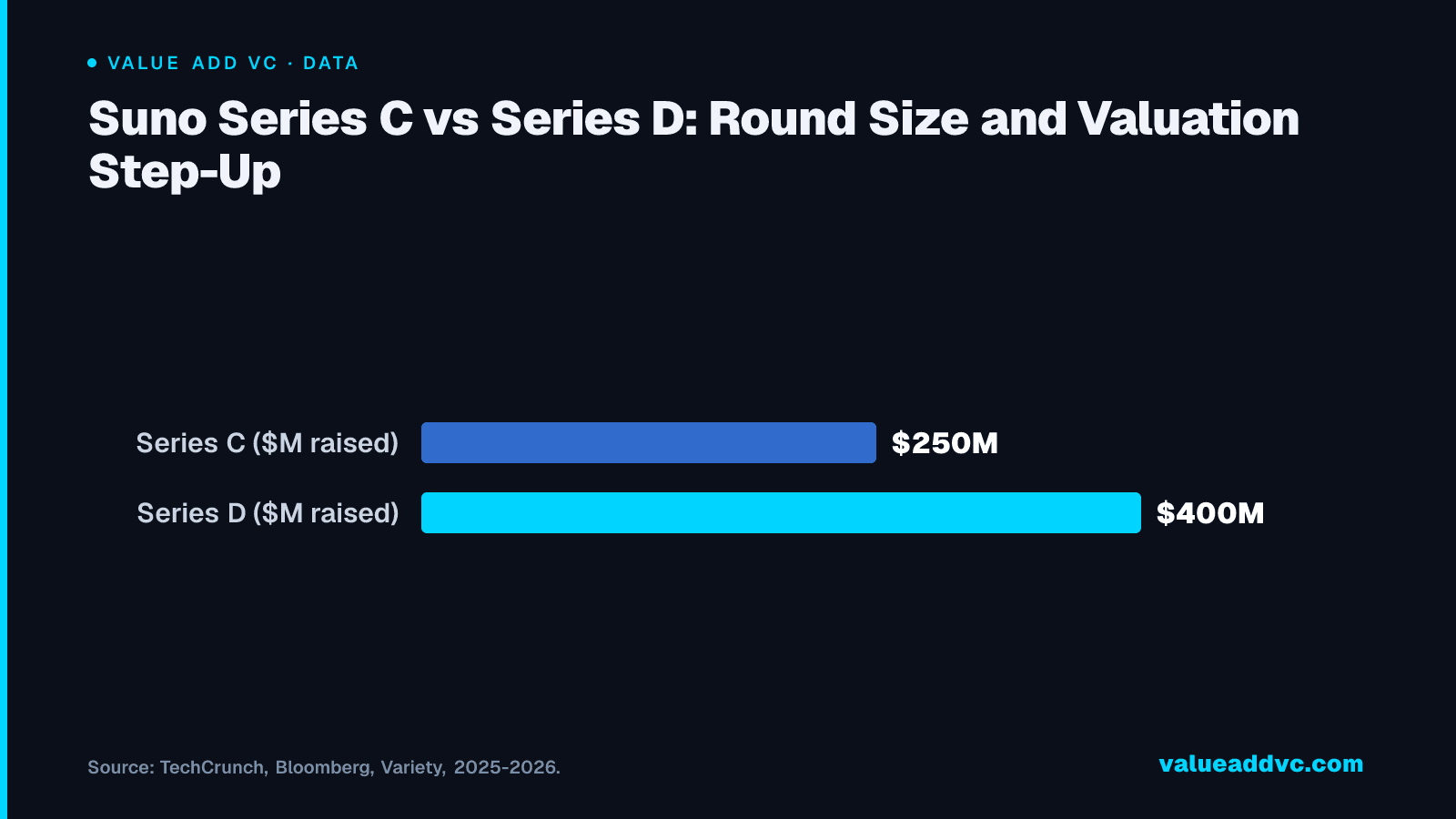
Suno's valuation is $5.4 billion as of its June 2026 Series D, a $400 million round led by Bond Capital. That is 2.2x its $2.45 billion valuation from the $250 million Series C it closed just seven months earlier, in November 2025, and roughly 10.8x its $500 million valuation from the May 2024 Series B. The company was estimated at sub-$1 million in ARR when it emerged in 2023; by February 2026, Sacra pegged its annualized revenue at roughly $300 million.
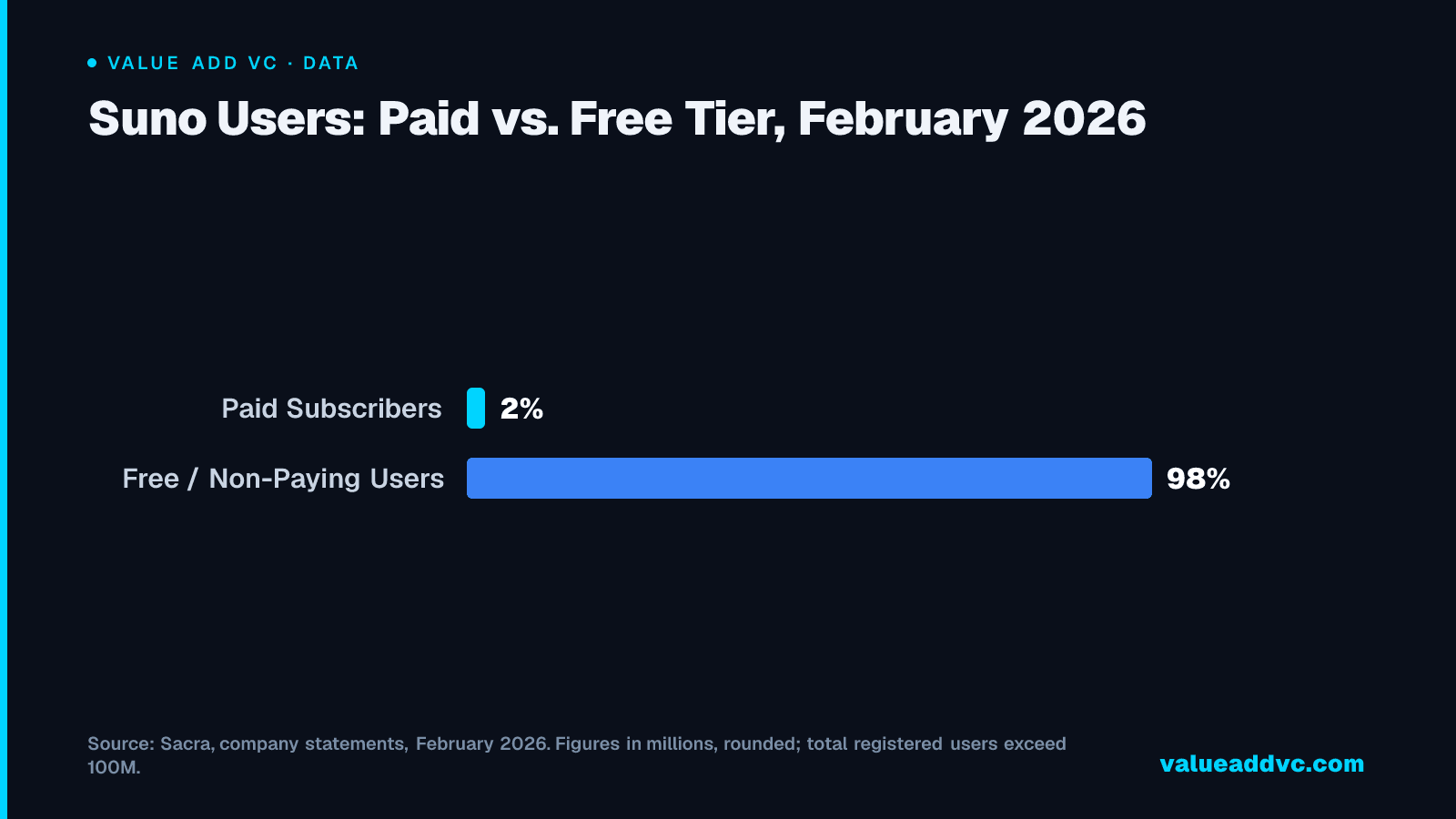
That trajectory places Suno inside the same AI valuation environment that has repriced dozens of AI-native companies in 2026 — investors underwriting the growth curve rather than trailing revenue. Unlike many pure software wrappers, Suno's valuation run has coincided with genuine subscriber and revenue growth, not just hype: paid subscribers crossed 2 million by February 2026, out of more than 100 million total registered users.
Suno's Revenue Growth: From $45M to $300M ARR in 21 Months
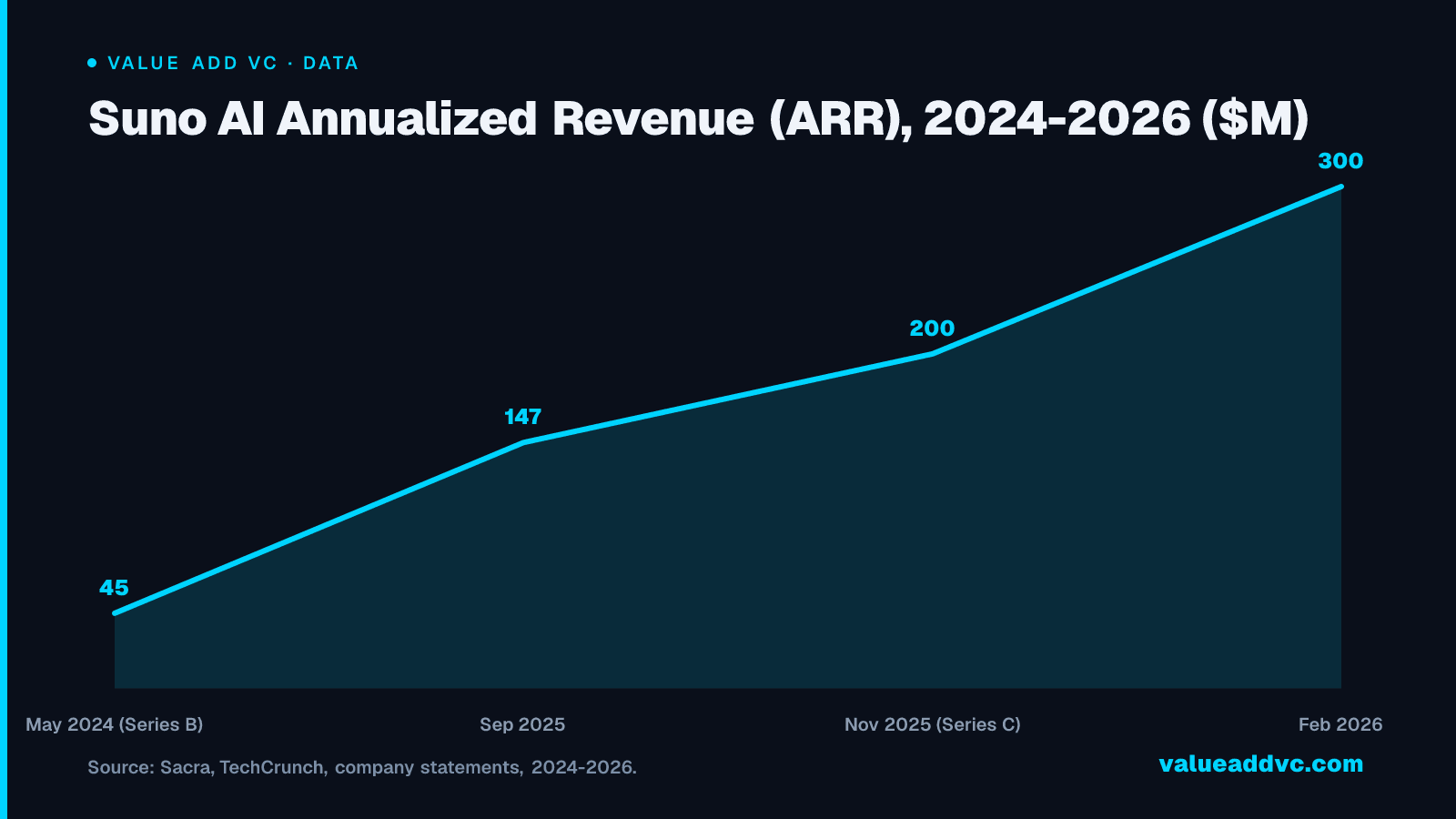
What separates Suno from most AI valuation stories in 2026 is that its markups have tracked real revenue growth, not just usage metrics or narrative. Sacra's estimates show Suno's annualized revenue compounding steadily through five reported checkpoints: $45 million at its Series B in May 2024, $147 million by September 2025, $200 million at its Series C in November 2025, and roughly $300 million by February 2026 — a more than 6.5x increase in under two years.
Suno AI Annualized Revenue (ARR), 2024-2026 ($M)
Sacra, TechCrunch, company statements, 2024-2026.
Data
| Item | ARR ($M) |
|---|---|
| May 2024 (Series B) | 45 |
| Sep 2025 | 147 |
| Nov 2025 (Series C) | 200 |
| Feb 2026 | 300 |
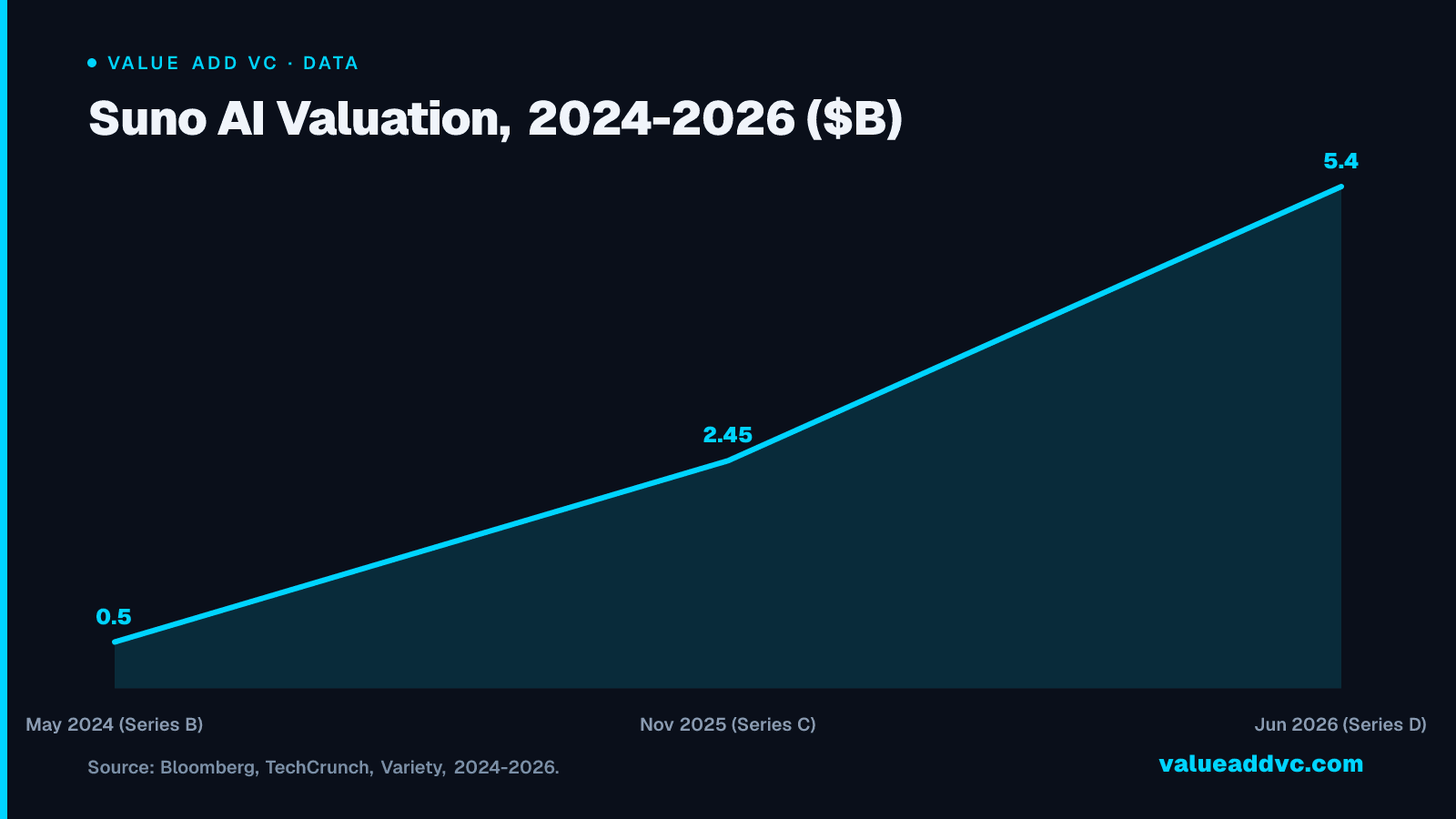
The valuation has moved even faster than revenue — Suno's implied revenue multiple went from roughly 11x ARR at the Series B to about 12x at the Series C to around 18x at the Series D, suggesting investors are now pricing in the licensing deals and legal clarity Suno secured in late 2025, not just the growth rate.
Suno AI Valuation, 2024-2026 ($B)
Bloomberg, TechCrunch, Variety, 2024-2026.
Data
| Item | Valuation ($B) |
|---|---|
| May 2024 (Series B) | 0.5 |
| Nov 2025 (Series C) | 2.45 |
| Jun 2026 (Series D) | 5.4 |
How Does Suno AI Make Money?
Suno operates a freemium subscription model layered on top of its music-generation engine. The free tier caps users at roughly 10 song generations per day and explicitly bars any commercial use of the output — a restriction Suno tightened as part of its Warner Music settlement. The paid tiers are where the ARR comes from: a Basic/Pro plan around $10 a month for roughly 500 song generations, and a Premier plan around $30 a month for about 2,000 generations plus commercial licensing rights. Users generate more than 7 million tracks per day across the platform.
The conversion funnel is aggressive by design: nearly half of first-time users hit the free-tier generation cap, which is the primary lever pushing Suno's 2 million paid subscribers against its 100 million-plus total user base — a roughly 2% paid-conversion rate, low by SaaS standards but generating meaningful ARR because of scale.
Suno Users: Paid vs. Free Tier, February 2026
Sacra, company statements, February 2026. Figures in millions, rounded; total registered users exceed 100M.
Data
| Item | Value |
|---|---|
| Paid Subscribers | 2% |
| Free / Non-Paying Users | 98% |
Suno vs Udio vs ElevenLabs Music: How the AI Music Startups Compare
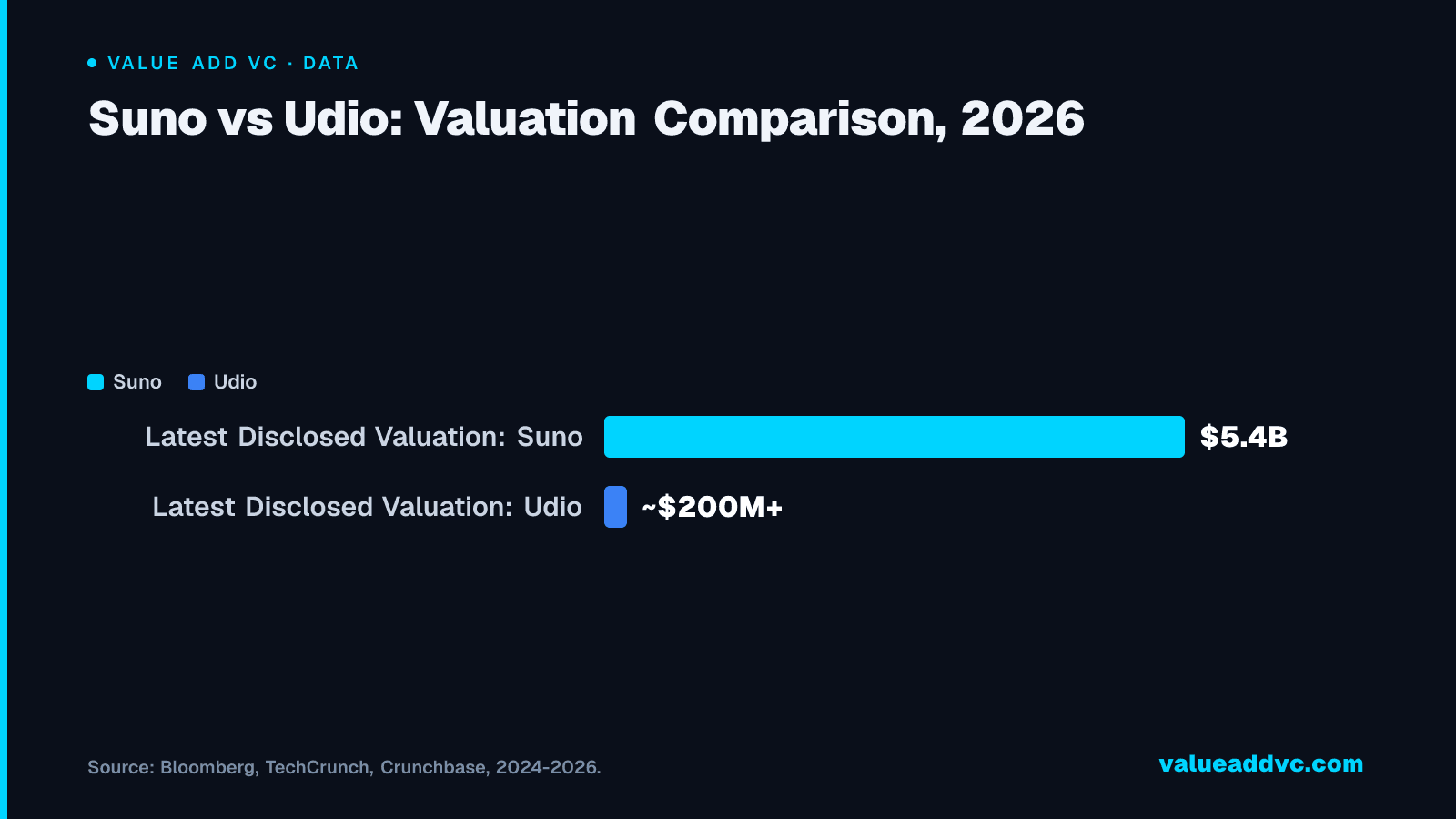
Suno isn't the only AI music generator that emerged from the 2023 wave of generative-audio startups, but it is by far the largest by valuation and revenue. Udio, its closest direct competitor, has not disclosed a funding round since a 2024 Series A, while ElevenLabs — primarily a voice-AI company — entered music later but with licensing deals already in place, avoiding the litigation that defined Suno and Udio's first two years.
| Metric | Suno | Udio | ElevenLabs (Eleven Music) |
|---|---|---|---|
| Latest company valuation | $5.4B (Jun 2026) | ~$200M+ (2024, last known) | $11B (Feb 2026, whole company) |
| Latest funding round | $400M Series D | $60M Series A (2024) | $500M Series D |
| Reported ARR / revenue | ~$300M (Feb 2026) | Undisclosed | $500M+ (whole company, Jun 2026) |
| Paid subscribers | 2M+ | Undisclosed | Undisclosed for music product |
| Major-label licensing status | Settled with Warner; litigating with UMG/Sony | Settled with UMG, Warner, Merlin, Kobalt | Launched with Merlin, Kobalt, Believe deals in place |
| Product launched | 2023 | 2023 | Aug 2025 (Eleven Music) |
| Core business model | Freemium, $10-$30/mo tiers | Freemium subscription | Subscription + API + Music Marketplace |
Figures are 2026 estimates blended from Bloomberg, TechCrunch, Variety, Music Business Worldwide, and Sacra. ElevenLabs figures reflect the parent company, not the Eleven Music product in isolation, since ElevenLabs does not break out music-specific ARR. Udio has not disclosed a funding round or valuation update since 2024.
Suno vs Udio: Valuation Comparison, 2026
Bloomberg, TechCrunch, Crunchbase, 2024-2026.
Data
Suno's Funding Round History Since 2023
Suno's five-round funding history shows a company whose check sizes and valuation step-ups accelerated sharply once it began signing label licensing deals in late 2025 — a signal that legal clarity, not just user growth, is what unlocked its largest rounds.
| Round | Date | Amount Raised | Post-Money Valuation | Reported ARR at Time |
|---|---|---|---|---|
| Seed | 2023 | Undisclosed | Undisclosed | Pre-launch |
| Series A | 2023 | $11M+ (led by Matrix) | Undisclosed | Sub-$1M |
| Series B | May 2024 | Undisclosed | $500M | $45M |
| Interim growth | Sep 2025 | — | N/A | $147M |
| Series C | Nov 2025 | $250M | $2.45B | $200M |
| Interim growth | Feb 2026 | — | N/A | ~$300M |
| Series D | Jun 2026 | $400M (led by Bond Capital) | $5.4B | ~$300M+ |
Figures are 2026 estimates blended from Crunchbase, Bloomberg, TechCrunch, and Sacra. Total disclosed funding across all rounds is approximately $775M. Interim ARR checkpoints (Sep 2025, Feb 2026) are Sacra estimates, not formal funding events.
Suno Series C vs Series D: Round Size and Valuation Step-Up
TechCrunch, Bloomberg, Variety, 2025-2026.
Data
| Item | Value |
|---|---|
| Series C ($M raised) | $250M |
| Series D ($M raised) | $400M |
How Big Is the AI Music Market in 2026?
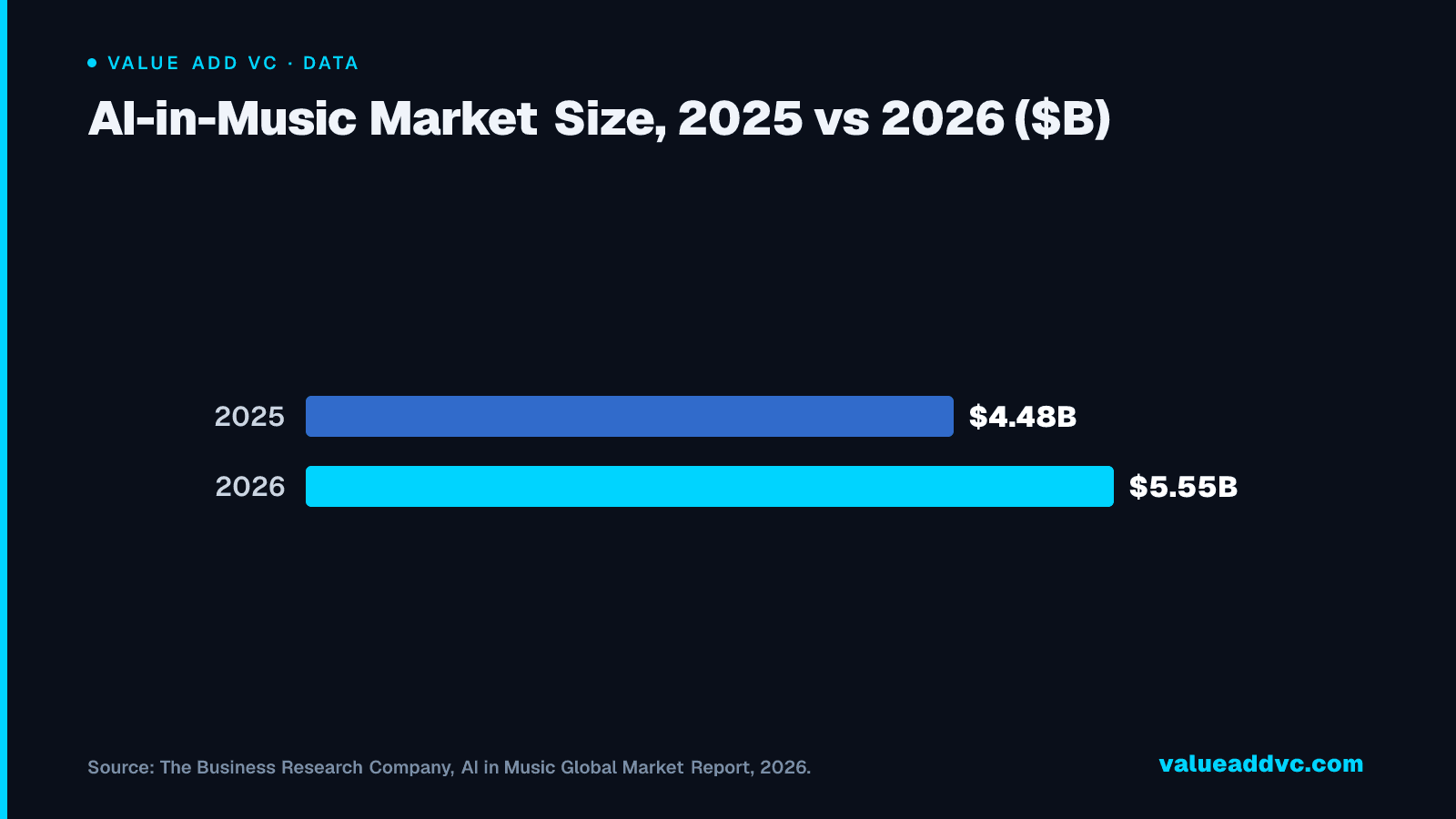
The AI-in-music market is estimated at roughly $5.55 billion in 2026, up from $4.48 billion in 2025, according to The Business Research Company — a 23.7% year-over-year growth rate that's outpacing most other consumer AI categories outside chat and coding. That gives Suno, at $300 million in ARR, roughly 5-6% of the entire addressable category, which helps explain why growth-stage investors like Bond Capital and IVP are willing to pay an 18x revenue multiple for a company still fighting a multibillion-dollar lawsuit.
The market is also getting more crowded at the infrastructure layer. Google's Lyria model, Meta's MusicGen research, and a wave of smaller startups are all competing for the same generative-audio real estate, but none has disclosed revenue or valuation figures anywhere close to Suno's. For now, Suno and Udio remain the two consumer-facing brands with the largest user bases, and ElevenLabs is the best-funded entrant coming at the category from the enterprise-voice side rather than the consumer side — though even ElevenLabs isn't unchallenged there, with open-source voice AI upstart Fish Audio undercutting it on price with 8 million users of its own.
AI-in-Music Market Size, 2025 vs 2026 ($B)
The Business Research Company, AI in Music Global Market Report, 2026.
Data
| Item | Value |
|---|---|
| 2025 | $4.48B |
| 2026 | $5.55B |
The Label Lawsuits: What's Settled and What Isn't
Suno's valuation story cannot be separated from its legal one. The original RIAA-led lawsuit, filed in 2024, accused Suno of training its models on copyrighted recordings without a license. On November 25, 2025, Warner Music Group and Suno announced a first-of-its-kind settlement: Suno agreed to deprecate every model trained on unlicensed music, restrict song downloads to paid accounts with monthly caps, and bar free-tier songs from any commercial use — concessions that directly shaped the freemium tiers described above. In exchange, Suno committed to launching fully licensed models through 2026.
Universal Music Group and Sony Music have not settled. Their original Boston case is still pending, and the May 2026 motion to expand it to 61,026 disputed recordings was denied without prejudice on August 18, 2026 — mainly to avoid disrupting the case schedule, not because the claims lacked merit. A month later, on September 18, 2026, Universal and Sony filed a second, separate lawsuit against Suno covering 60,202 recordings, this time targeting Suno's newer V6 model on a “model laundering” theory — that training a new model on an earlier, allegedly infringing model's outputs doesn't erase the infringement, according to Variety. Suno responded on September 22 that V6 was trained on licensed content from Warner, BMG, and Believe, per Music Business Worldwide. Combined statutory damages exposure across both cases still tops $9 billion in theoretical maximum penalties. Udio, notably, settled with Universal in October 2025 and later with Warner, Merlin, and Kobalt — giving it a cleaner legal position even as it trails Suno badly on revenue and valuation.
Legal clarity is now a valuation input, not just a risk factor — Suno's Series D priced in the Warner settlement and its move toward fully licensed models, not just its ARR growth.
The remaining UMG/Sony litigation is the single largest overhang on Suno's valuation — a $9B+ statutory damages exposure dwarfs the $775M Suno has raised to date.
Udio's cleaner licensing position (settled with all major labels) hasn't translated into comparable fundraising or revenue traction, suggesting product and distribution matter more than legal risk alone in this category.
ElevenLabs' 'license first, launch second' approach with Eleven Music is a direct rebuttal to the Suno/Udio playbook, and its $11B parent valuation suggests investors are rewarding that sequencing.
The Bottom Line
Suno's $5.4 billion valuation is backed by real, compounding revenue — $45M to $300M ARR in under two years — and by a legal settlement that turned its biggest risk into a licensing moat. That combination is rare in AI-native consumer products in 2026, where most valuation headlines are still ahead of monetization. The unresolved UMG and Sony litigation, with more than $9 billion in potential statutory damages on the table, remains the single biggest variable in whether Suno's next markup looks like this one or looks a lot smaller. Watch the label settlements, not just the ARR chart, to know where this one goes next.
Track how AI-native consumer and creative companies are being valued across the market on the AI Valuations dashboard, and see the full list of newly minted AI unicorns on the Unicorn Tracker at Value Add VC.
Latest from the Pulse
Get VC data most people never see
— free to subscribe
Trace's notes on venture, AI and startups, a few times a week. Join 5,000+ subscribers. No spam.
No spam, unsubscribe anytime. Sent via Substack · Privacy · or subscribe on Substack ↗