ElevenLabs passed $600 million in annualized revenue in September 2026 and is now valued at $22 billion after a $300 million employee tender, double the $11 billion price of its February Series D — a business built on consumer subscriptions, per-character API pricing, and enterprise voice agent contracts worth up to $2 million each. That's the short answer. The longer answer is how a text-to-speech tool became the infrastructure layer for AI-generated voice across customer support, media, and dubbing in under three years.
The business model matters beyond curiosity because ElevenLabs' valuation more than tripled in the twelve months between its January 2025 Series C and its February 2026 Series D — and every dollar of that jump is priced against how durable its three revenue streams actually are as competition from Deepgram, Cartesia, and the model labs themselves intensifies. Here's the full breakdown.
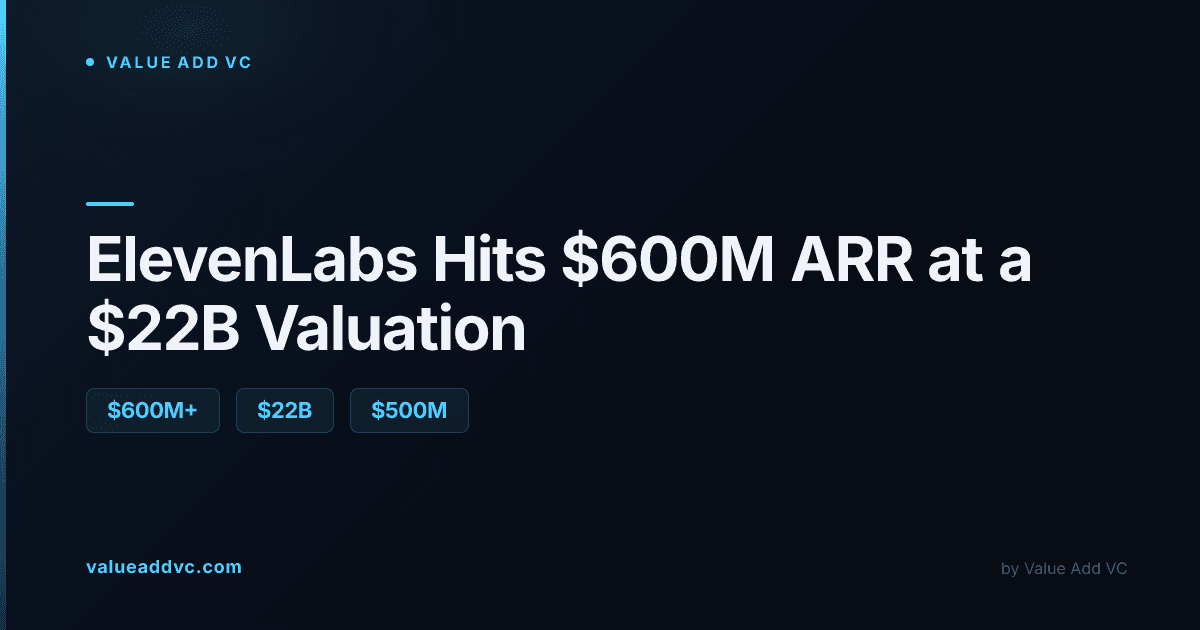
ARR and valuation per TechCrunch (Sep 24, Sep 28 and Sep 30, 2026) and ElevenLabs' Series D announcement (Feb 2026). Fortune 500 penetration per Sacra research, 2026.
ElevenLabs revenue in late 2026: $600M ARR and a $22B tender
ElevenLabs' annualized revenue run rate climbed from roughly $330 million at the start of 2026 to more than $600 million, TechCrunch reported on September 28, 2026, with more than 55% of the business coming from large companies and headcount above 800. Co-founder and CEO Mati Staniszewski put it plainly in a September 24 TechCrunch interview: "We are now $600 million in ARR." He declined to give gross margins and said the company would pass model-cost savings to customers even if margins fall.
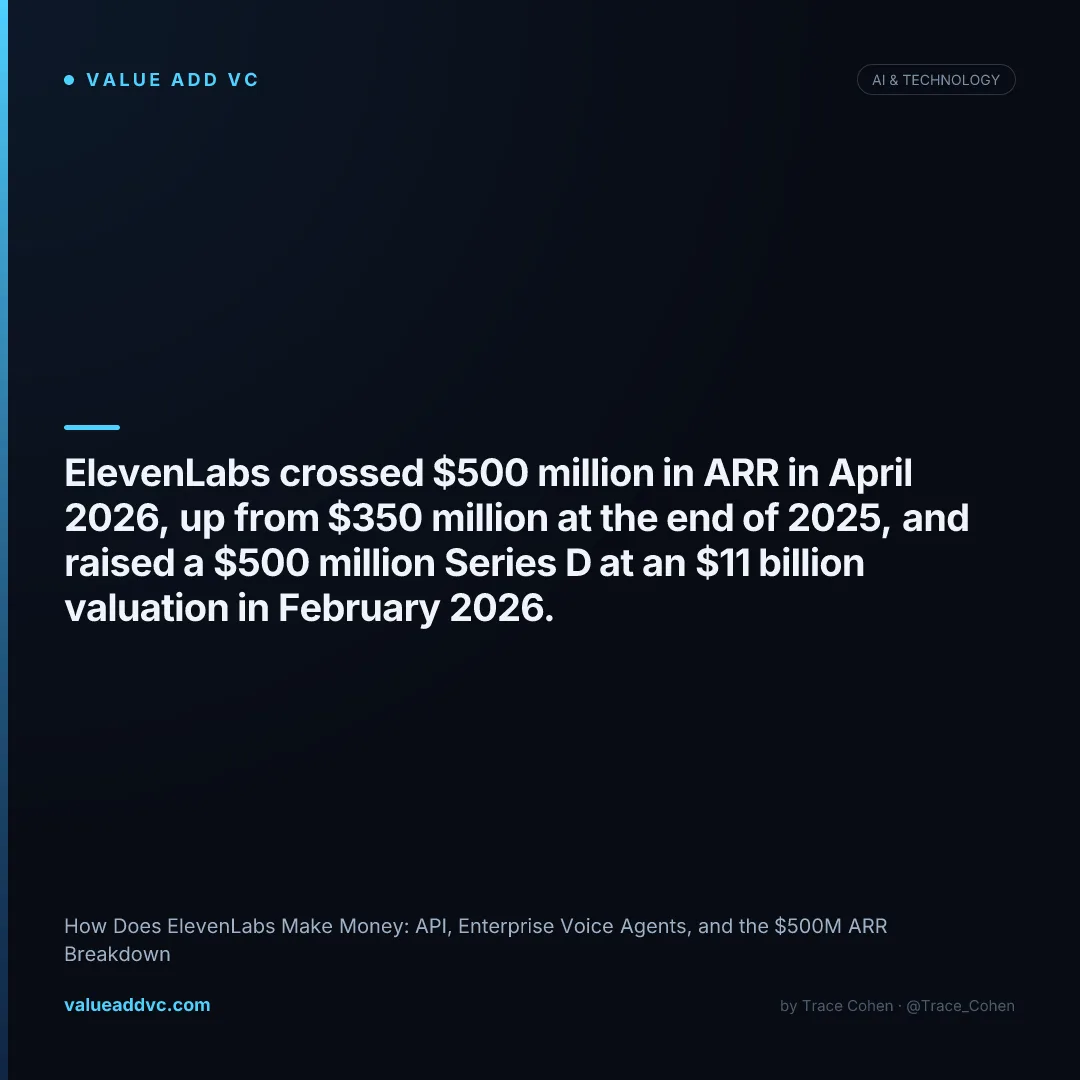
On September 30, 2026, ElevenLabs let employees sell $300 million of vested shares at a $22 billion valuation in a tender co-led by Wellington and T. Rowe Price, TechCrunch reported. That doubles the $11 billion Series D price from February and follows a $100 million tender at $6.6 billion in September 2025. On Value Add VC's arithmetic, $22 billion is about 37x the $600 million run rate, against about 22x for the $11 billion price on the $500 million ARR reached in April.
The product push behind the growth is voice agents: the v4 and v4 Turbo models launched September 28 support more than 90 languages, clone a voice from 10 seconds of audio, and start speaking as soon as the underlying LLM starts answering. ElevenLabs ranks sixth in our ranking of private AI companies by revenue.
How does ElevenLabs make money?
ElevenLabs makes money from three main revenue streams: consumer and creator subscriptions that range from a free tier (10,000 characters/month) up to a $299/month Scale plan and a $990/month Business plan (per ElevenLabs' pricing page, October 2026), usage-based API pricing for developers running $0.06-$0.12 per 1,000 characters generated, and enterprise contracts for voice agents, dubbing, and licensed voices that can reach $2 million annually per customer. Enterprise voice agents — used for customer support, sales, hiring, and marketing automation — have become the company's primary growth driver in 2026, not the consumer text-to-speech product that built the brand.
That mix shift shows up directly in the ARR numbers: ElevenLabs added $100 million in net new ARR in the first quarter of 2026 alone, ending the quarter near $450 million before crossing $500 million in April. The company has also disclosed increasing revenue per API call by roughly 20%, evidence that existing customers are being pushed toward higher-usage voice agent products rather than one-off audio generation.
Consumer and Creator Subscriptions: Where ElevenLabs Started
ElevenLabs' original product was a freemium text-to-speech tool: a free tier offering 10,000 characters per month, with paid creator plans starting around $22/month and scaling up to a $299/month Scale plan for high-volume users like podcasters, audiobook producers, and indie game studios — the same AI voice tooling that's increasingly showing up in audio content workflows well beyond its original creator base. This tier still drives meaningful volume and remains the funnel that introduces most new users — including many enterprise buyers — to the product before they move to the API or a custom contract.
The company has layered consumer products on top of the core subscription, including ElevenReader (an AI narration app) and GenFM (AI-generated podcast-style audio), both aimed at keeping consumer engagement high even as the company's growth story has shifted toward enterprise. It's a similar funnel dynamic to how Figma converts free users into paid seats — the free and low-cost tiers exist to build the top of the enterprise pipeline, not to be the primary profit center.
The API and Developer Platform
Developers who integrate ElevenLabs' voice models directly pay on a per-character usage basis, with rates running $0.06-$0.12 per 1,000 characters depending on the model and voice quality selected. This is the layer most exposed to competitive pricing pressure — Deepgram, Cartesia, and native voice APIs from OpenAI and Google all compete on similar usage-based economics, which is exactly why ElevenLabs has pushed so hard into enterprise voice agents rather than relying on raw API volume alone.
Scale still matters even on a usage-based model: with 41% of Fortune 500 companies using ElevenLabs in some capacity across media, gaming, and publishing, a small percentage increase in usage per customer compounds into meaningful ARR growth without requiring new logo acquisition — the same dynamic that let the company add $100 million in ARR in a single quarter.
Pricing on the API side has also drifted upward as ElevenLabs has shipped higher-fidelity models with lower latency, which lets the company charge more per character for premium voice quality tiers rather than competing purely on the cheapest generation cost. That's a deliberate move away from the race-to-the-bottom dynamic that usage-based infrastructure pricing usually creates, and it's part of why the API line has held its share of total revenue even as enterprise contracts have grown faster in absolute dollar terms.
Enterprise Voice Agents: The New Growth Engine
ElevenLabs' main growth driver is enterprise voice agents — AI-powered voice systems deployed for customer support, sales outreach, hiring screens, and marketing, sold as custom contracts that have reached $2 million annually for the largest accounts. Unlike the API's per-character pricing, these deals are typically priced on usage volume, seat count, or a hybrid platform fee, giving ElevenLabs materially better unit economics and stickier renewal dynamics than pure text-to-speech ever offered.
The company has also built out an "Iconic Voices" licensing program — striking deals with celebrities and rights holders to license their voices for commercial use — plus dubbing and localization tools that let media companies translate content into dozens of languages while preserving the original speaker's voice characteristics. Both are smaller revenue lines today but reinforce the same strategy: move up the value chain from raw audio generation toward end-to-end voice infrastructure that's harder for a customer to replace with a cheaper API call.
This is the same trajectory most infrastructure-layer AI companies are chasing in 2026 — start as a developer tool, then move into enterprise workflows where pricing power and retention are both structurally higher.
ElevenLabs' Revenue Streams Compared
The table below breaks out each of ElevenLabs' disclosed and estimated revenue lines, how each is priced, and roughly how much of total revenue it represents in 2026.
| Product Line | How It's Priced | Typical Rate | Est. % of Revenue |
|---|---|---|---|
| Enterprise voice agents | Custom contract, usage/seat-based | Up to $2M/year | ~32% |
| API / developer platform | Per-character usage | $0.06-$0.12/1,000 chars | ~26% |
| Consumer & creator subscriptions | Monthly plan fee | Free-$990/month | ~20% |
| Dubbing & localization | Per-project/usage | Custom enterprise rate | ~12% |
| Iconic Voices licensing | Revenue share with rights holders | Custom | ~6% |
| GenFM & other consumer apps | Freemium/subscription | Free-$22/month | ~4% |
Revenue-share estimates blended from Sacra and Contrary Research product-mix analysis; ElevenLabs does not publicly disclose an exact product-level revenue breakdown, so figures are directional estimates, 2026.
How ElevenLabs' Business Model Compares to Deepgram
Deepgram, ElevenLabs' closest funded competitor, raised a $130 million Series C at a $1.3 billion valuation in January 2026 to scale its speech-to-text and voice agent infrastructure — roughly a ninth of ElevenLabs' $11 billion valuation on a fraction of the ARR. Further up the input-side of the stack, Wispr Flow's dictation product raised a Series B at a $2B valuation, a sign investors see standalone value in voice-to-text as its own category, not just an ElevenLabs feature. The gap reflects a real product difference: Deepgram is positioned deeper in the infrastructure stack (speech recognition for developers building voice pipelines), while ElevenLabs has pushed further up the stack into branded consumer products and full enterprise voice-agent deployments, both of which carry higher price points per customer.
That positioning gap is also why ElevenLabs' $500 million ARR dwarfs what's been disclosed by Deepgram, Cartesia, or Play.ht — none of which has reported ARR anywhere close to ElevenLabs' run rate. It mirrors a pattern seen across infrastructure-versus-application layer investing more broadly: companies that own the end customer relationship and the full workflow tend to out-earn the companies selling picks and shovels underneath them, even when the underlying technology is comparable.
Does ElevenLabs' Business Model Justify an $11 Billion Valuation?
At $11 billion, ElevenLabs is priced at roughly 22x its $500 million ARR — a multiple that only holds up if the company keeps compounding ARR at the pace it showed in Q1 2026 ($100 million in net new ARR in a single quarter). The bull case is that voice agents represent a genuinely new category of enterprise software spend, not a reallocation of existing budgets, and that ElevenLabs' first-mover brand and Fortune 500 penetration (41%) give it durable pricing power as usage-based API commoditization pressures margins elsewhere in the stack.
The risk is the same one facing every infrastructure-layer AI company in 2026: model labs like OpenAI and Google are shipping increasingly capable native voice APIs, and if voice generation becomes a commodity feature bundled into every foundation model, ElevenLabs' defensibility has to come entirely from the enterprise workflow layer — voice agents, dubbing pipelines, licensing relationships — rather than the underlying audio quality that differentiated it in 2023 and 2024.
Bottom line: ElevenLabs makes most of its money from a three-way split between consumer subscriptions, usage-based API pricing, and enterprise voice agent contracts worth up to $2 million each, and that mix has shifted decisively toward enterprise as ARR grew from $350 million to $500 million in just four months. The company's $11 billion valuation — 22x ARR — bets that voice agents keep growing as a distinct enterprise software category rather than getting absorbed as a free feature inside GPT-5, Gemini, and whatever comes next from the foundation-model labs.
Track more AI company valuations on the AI Valuations dashboard at Value Add VC. Originally published in the Trace Cohen newsletter.
Latest from the Pulse
Get VC data most people never see
— free to subscribe
Trace's notes on venture, AI and startups, a few times a week. Join 5,000+ subscribers. No spam.
No spam, unsubscribe anytime. Sent via Substack · Privacy · or subscribe on Substack ↗