
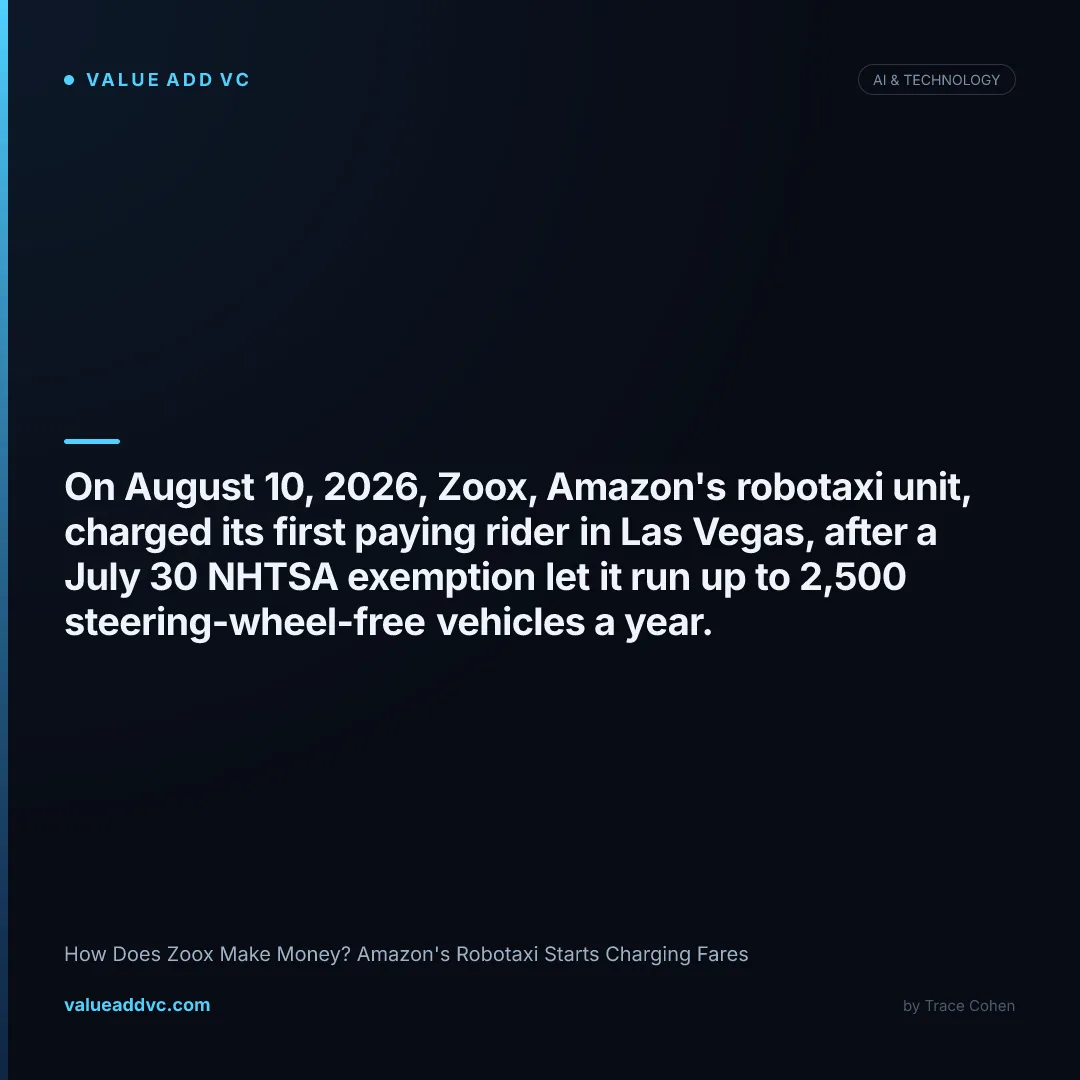
On August 10, 2026, Zoox — Amazon's robotaxi unit — charged a paying rider for the first time in its twelve-year history, per Casino.org, moving its entire 65-vehicle Las Vegas fleet from free rides to fares. That single date is the real answer to "how does Zoox make money": before it, the business model didn't exist yet.
Zoox has been building a steering-wheel-free, purpose-built robotaxi since 2014 and has been giving rides in Las Vegas since around September 10, 2025, but every one of those rides was free, per New Mobility News. Amazon bought the company for a reported $1.2 billion in 2020 and has absorbed years of losses without ever disclosing them. The gap between "has a product people use" and "has a business model" just closed.
What changed is regulatory, not technical: a federal safety exemption that finally lets Zoox legally charge for a ride in a car with no steering wheel or pedals.
Sources: CNBC, June 26, 2020; Electrive.com, July 31, 2026; Casino.org, August 11, 2026.
How Does Zoox Make Money?
Zoox makes money the way any robotaxi does: it charges a fare for a ride, booked through its own app, with no human driver. As of its August 10, 2026 Las Vegas launch, that fare is a "comfort-tier" structure — a base rate plus charges for time and distance, with surcharges for airport trips and select drop-offs such as the Sphere, per Casino.org. Neither Zoox nor Amazon has published an actual rate card or base price. Electrive.com reported on July 31, 2026 that pricing was expected to land "comparable to Uber or Lyft," and on launch day CEO Aicha Evans told Casino.org only that "whatever we quote you is what we are going to charge you" — a promise about transparency, not a disclosed number.
That makes Zoox, right now, a single-revenue-line business: per-ride fares, in one city, from roughly 65 vehicles. There is no advertising layer, no delivery contract, and no disclosed data-licensing deal. Everything else — the Fremont-adjacent Hayward, California manufacturing plant Zoox says can eventually build up to 10,000 vehicles a year, the Uber partnership announced in March 2026, the expansion into new cities — exists to grow that one line, not to add a second.
Zoox vs. Waymo: Two Robotaxis, Two Big-Tech Parents
Zoox isn't alone in having a trillion-dollar tech company behind it. Here's how it compares to Alphabet's Waymo, the market leader by scale.
| Attribute | Zoox (Amazon) | Waymo (Alphabet) |
|---|---|---|
| Vehicle design | Purpose-built, no steering wheel or pedals | Retrofitted Jaguar I-PACE / Hyundai Ioniq 5 |
| Parent's stated/reported stake | $1.2B+ acquisition (2020), reported by FT | $126B valuation after a $16B round (Feb. 2026), per CNBC |
| First paid fare | August 10, 2026 (Las Vegas) | 2020 (Phoenix, pre-dates this comparison window) |
| Federal approval needed to charge | NHTSA exemption granted July 30, 2026 | Standard vehicle, no equivalent exemption required |
| Fleet cap / scale | 2,500 vehicles/year under the exemption | 4,000+ robotaxis across 15 US cities as of Sept. 2026 |
| Revenue disclosure | Not broken out by Amazon | Run rate reported at $355M on 500,000 weekly rides |
How we counted: both companies' own disclosures and reported figures, as of their most recent public update; as of October 31, 2026. Sources: Electrive.com, Casino.org, and Value Add VC's Waymo valuation coverage.
Zoox: Key Dollar and Vehicle Figures, 2018-2026
Amazon bought Zoox for roughly a third of its 2018 private valuation, then needed six more years before the car was legally allowed to charge anyone for a ride.
CNBC (June 26, 2020); Electrive.com (July 31, 2026); Casino.org (August 11, 2026)
Data
| Item | Value |
|---|---|
| 2018 valuation | $3.2B |
| 2020 Amazon deal | $1.2B+ |
| 2026 LV fleet (paid) | 65 vehicles |
| NHTSA annual cap | 2,500/yr |
Why It Took Amazon Six Years to Charge a Fare
Zoox's robotaxi was designed from the start without a steering wheel or pedals — a genuine engineering bet, and also a regulatory problem. US vehicle safety standards were written assuming a human driver, so a car built without the controls to let one drive it couldn't legally carry a paying passenger. Zoox ran free demonstration rides in Las Vegas from around September 10, 2025 while explicitly "awaiting regulatory approval before introducing fares," per New Mobility News.
That approval arrived when the National Highway Traffic Safety Administration published a grant, effective July 31, 2026 through July 31, 2028, exempting Zoox's sedan from portions of eight federal motor vehicle safety standards — covering windshield defrosting and wiping, lamps, rear visibility, braking, interior-impact and glazing protection, and crash protection. Press reports the day the grant was announced, including Electrive.com, described it as the first such commercial exemption for a "purpose-built robotaxi" and reported it caps the fleet at up to 2,500 vehicles a year. Within two weeks, Zoox moved its entire ~65-vehicle Las Vegas fleet to paid service, ending free rides across the Strip and downtown, per Casino.org.
What Does Amazon Actually Own?
Amazon announced the Zoox acquisition on June 26, 2020. It never disclosed the price, but the Financial Times reported it at more than $1.2 billion — down sharply from the $3.2 billion valuation Zoox had set in a funding round two years earlier, per CNBC's report that day. Founded in 2014, Zoox had raised roughly $1 billion from investors before the deal. Amazon kept it as a standalone unit under CEO Aicha Evans and co-founder/CTO Jesse Levinson, rather than folding it into an existing Amazon division.
Six years later, Zoox is still not a reportable segment in Amazon's SEC filings. Amazon discloses results for North America, International, and AWS; Zoox's standalone revenue, operating costs, or losses don't appear as their own line anywhere in Amazon's 10-K or 10-Q filings. Until August 10, 2026, that revenue figure was $0 by definition — every Zoox ride given was free. What Amazon has disclosed is scale of a different kind: a manufacturing plant in Hayward, California that the company says can eventually build up to 10,000 vehicles a year, per New Mobility News — capacity, not current output.
Zoox is also no longer going it alone on distribution. On March 11, 2026, Uber and Zoox announced a multiyear partnership letting Uber riders match with a Zoox robotaxi on eligible trips, starting in Las Vegas and extending to Los Angeles in 2027 — Zoox's first third-party integration, per Transport Topics. Neither company disclosed revenue-sharing terms. By late March 2026, Zoox said it had logged nearly 2 million autonomous miles and collected more than 500,000 waitlist sign-ups, while beginning limited, employees-and-friends-only service in Austin and Miami, per Electrek.
What the launch headline misses
"Zoox starts charging fares" reads like a business model switching on. It's really a regulatory switch flipping on a single city, for one fleet of roughly 65 vehicles, at an undisclosed price. Amazon still hasn't said whether a Zoox ride will cost more or less than an Uber once the novelty wears off, hasn't said when the NHTSA exemption's 2,500-vehicle cap will actually bind, and hasn't said a word about whether fares in Las Vegas come close to covering what the car, the sensors, and the Hayward factory cost to build. A single market charging fares is the opening data point, not proof the unit economics work — the same caveat that applies to every robotaxi operator, Waymo included, before it scales past a handful of cities.
Track AI and robotics company valuations on the AI Valuations Dashboard at Value Add VC. Originally published in the Trace Cohen newsletter.
Latest from the Pulse
Get VC data most people never see
— free to subscribe
Trace's notes on venture, AI and startups, a few times a week. Join 5,000+ subscribers. No spam.
No spam, unsubscribe anytime. Sent via Substack · Privacy · or subscribe on Substack ↗