
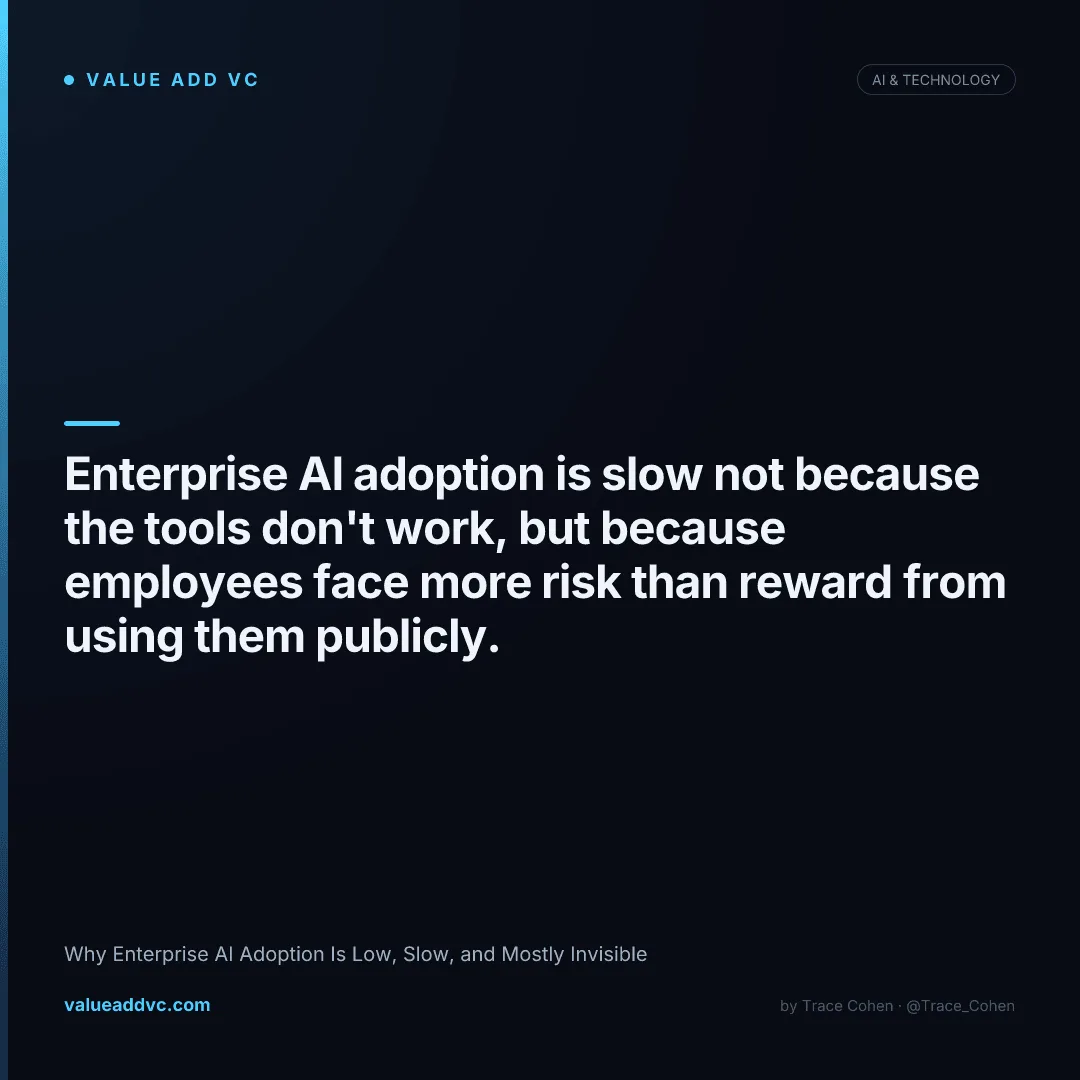
Enterprise AI adoption isn't a technology problem. It's an incentives problem.
At the top of the organization, AI is all anyone talks about. Executives discuss it constantly — board decks, strategy offsites, earnings calls. It's framed as inevitable, transformational, existential. Something the company must do or risk falling behind.
Three Layers, Three Realities
The Executive Layer
AI is all anyone talks about. Framed as inevitable, transformational, existential. They want transformation.
The VP / Middle Management Layer
Their job is to translate executive urgency into something operational. Meetings multiply. Committees form. Roadmaps get drafted. Everyone talks about 'use cases' and 'enablement.' Progress is measured in conversations, not outcomes.
The Individual Contributor Layer
For the people actually doing the work, AI doesn't feel inevitable or empowering. It feels risky. No one has shown them how in a way that maps to their actual job. The systems they work in weren't designed for it.
Why Employees Hesitate
People hesitate not because they're anti-technology, but because they understand the game they're in:
Using AI puts a spotlight on their work — it digitizes, measures, and makes it legible in ways it wasn't before
It can expose gaps in skills, judgment, or output
It can signal that their role is easier to automate than previously assumed
It asks them to help train a system that may eventually reduce the need for their role
Efficiency doesn't come with higher pay — speed doesn't come with more security
The Rational Response
If using AI means more risk for less reward, quiet adoption is the rational choice.
Use it privately. Don't surface it. Don't volunteer to redesign the system around you. This is why enterprise AI feels stalled — not because the tools don't work, but because the incentives don't.
The executives want transformation. The middle layers want alignment.
Until incentives change, enterprise AI will stay uneven and mostly invisible.
Track AI adoption trends on the AI Landscape Dashboard at Value Add VC. Originally published in the Trace Cohen newsletter.
Latest from the Pulse
Get VC data most people never see
— free to subscribe
Trace's notes on venture, AI and startups, a few times a week. Join 5,000+ subscribers. No spam.
No spam, unsubscribe anytime. Sent via Substack · Privacy · or subscribe on Substack ↗