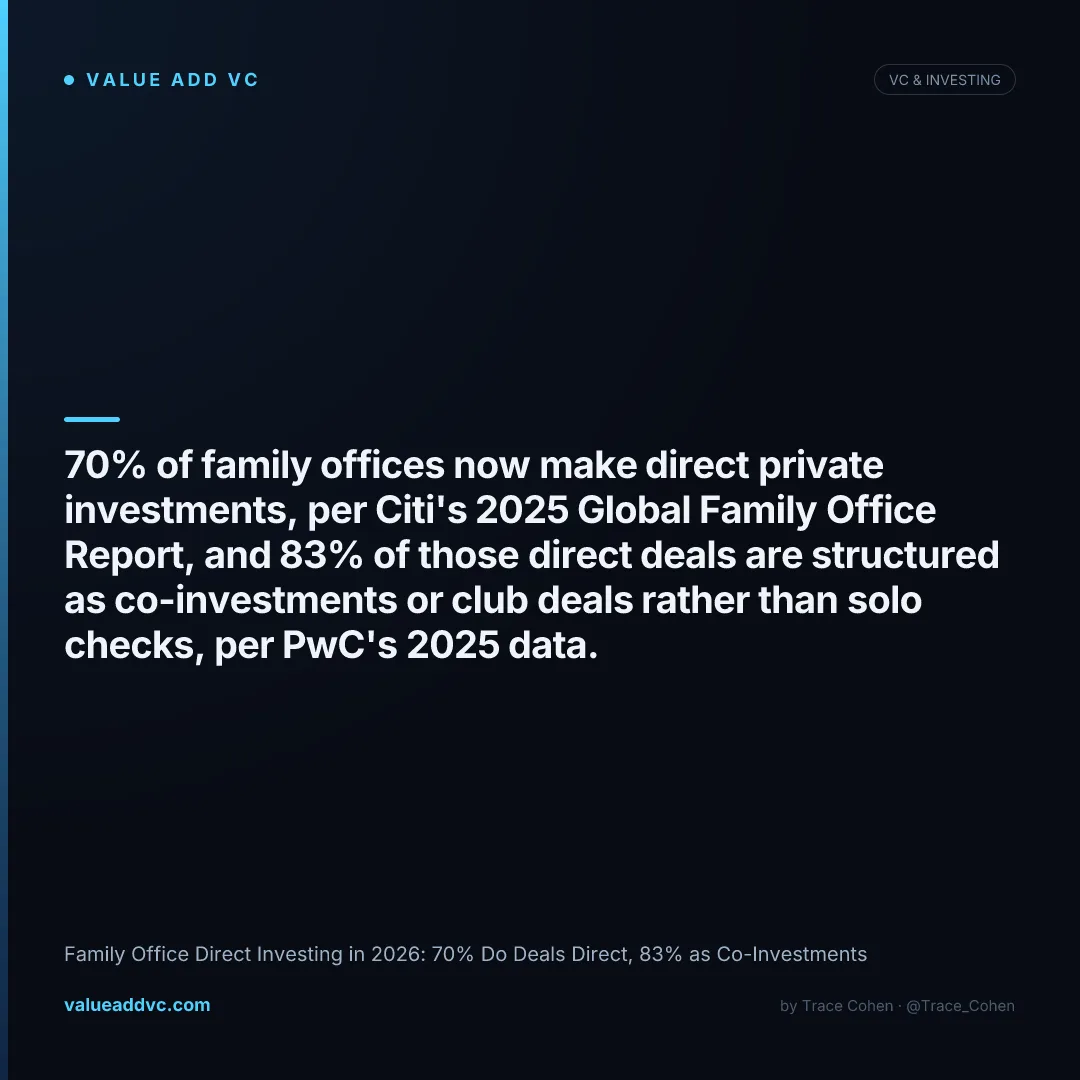
70% of family offices now make at least one direct private investment a year, per Citi Private Bank's 2025 Global Family Office Report, and 83% of those deals are structured as co-investments rather than solo checks, per PwC's 2025 analysis. That's the short answer. The longer answer is more interesting.
"Going direct" sounds simple: skip the fund, skip the 2-and-20, write the check yourself. In practice almost none of the family offices doing this are actually going it alone. The 2026 data shows something closer to a hybrid model — family offices piling into club deals and co-investments so they can get direct-deal economics with fund-level diligence, while pulling back slightly from pure solo direct investing compared to the 2021 peak. Here's what the numbers actually show, and where family offices are moving next.
Figures are 2025-2026 estimates blended from Citi Private Bank, PwC, UBS, BNY Mellon, and Dentons family office survey data.
What Family Office Direct Investing Actually Looks Like in 2026
Family office direct investing is when a family office puts capital directly into an operating company — buying equity in a startup, a real estate deal, or a private business — instead of committing capital to a third-party VC or PE fund that then picks the companies. 70% of family offices reported making at least one direct deal in the past year, per Citi's 2025 Global Family Office Report, and 64% expect to make six or more direct investments over the next twelve months, per Dentons' 2025 family office direct investing survey. But the mechanics of how those deals get done have shifted hard toward shared structures rather than solo sourcing.
Family offices collectively now represent roughly 31% of all startup funding activity worldwide, a scale that would have been unthinkable a decade ago when most single-family offices were still passive LPs in a handful of blue-chip funds. That growth is exactly why the "direct vs. fund" framing understates what's really happening — most of this capital is flowing through club deals, not lone-wolf checks.
Direct Investing vs. Fund Investing: The Real Tradeoffs
| Factor | Direct Investing | Fund Investing |
|---|---|---|
| Typical fee load | 0% mgmt fee, no carry on solo deals | 2% management fee + 20% carry |
| Deal control | Full say on which companies get funded | Delegated entirely to the GP |
| 2026 participation rate | 70% of family offices do at least one deal/yr | ~90%+ still hold at least one fund commitment |
| Typical deal structure | 83% done as co-investments/club deals | 100% pooled, blind or semi-blind at commitment |
| Diversification | Concentrated — 6+ deals/yr for 64% of offices | Broad — 20-30+ portfolio companies per fund |
| Sourcing effort required | High — needs deal team or GP relationships | Low — GP sources, screens, and closes |
| Typical check size | $2M-$25M+ per deal | $5M-$50M+ fund commitment |
| Share of alternatives allocation | Roughly half of the 48% alternatives bucket | Roughly half of the 48% alternatives bucket |
Figures are 2025-2026 estimates blended from Citi Private Bank, PwC, Dentons, and BNY Mellon family office survey data. Fee and check-size figures reflect typical market ranges, not a single source.
The 2021 Peak, and Why Direct Allocations Have Flattened Since
Direct investing didn't just arrive in 2026 — it peaked in relative terms back in 2021, when family offices allocated 13% of assets to direct deals versus 8% to funds, per UBS's tracking. Since then, according to UBS's 2026 Global Family Office Report (a survey of 307 family offices across more than 30 markets, averaging $2.7 billion in net worth, fielded January-March 2026), that gap has closed to roughly even — family offices now split new capital about evenly between direct deals and fund commitments, or tilt slightly toward funds again.
The pullback isn't a retreat from direct investing altogether — it's a shift in how direct deals get sourced. Rather than building the deal-team infrastructure to originate and diligence opportunities solo, more family offices are riding alongside institutional VC and PE funds as co-investors, capturing direct-deal economics without carrying the full sourcing burden. 50% of family offices plan to route direct deals through independent sponsors over the next two years, per Dentons, which is itself a hybrid structure between pure direct and pure fund investing.
Why Co-Investment Now Dominates Family Office Direct Investing
The single biggest structural change in family office direct investing is the near-total shift to shared deal structures. PwC's 2025 data puts co-investments and club deals at 83% of all family office direct deal volume, up from a market where solo direct checks were far more common a decade ago. Citi's 2025 report separately found club deals represent 69% of family office direct investment activity, a close corroborating figure using a different survey methodology.
The logic is straightforward: a $500 million single-family office rarely has the six-to-ten-person deal team a $2 billion VC fund uses to source and diligence 300 opportunities a year to find 20 investments. Building that in-house capability also means competing for talent — see what those investment teams actually get paid in 2026. Co-investing alongside a lead fund — or alongside two or three peer family offices in a club deal — lets a smaller office access that same diligence infrastructure while still writing a direct check with lower fees and more control over which specific deal to say yes to. Track how VC funds are performing before co-investing alongside them on our VC performance dashboard.
What Family Offices Are Actually Buying Direct
Private markets now make up roughly 29% of the average family office portfolio, the single largest allocation category ahead of public equities at 26-30%, fixed income at 18-19%, real estate at 10-11%, and cash at roughly 8%, per the blended 2025-2026 survey data. Within that private-markets sleeve, direct deals skew heavily toward late-stage venture and growth equity, where a family office's larger check size ($2 million to $25 million-plus per deal) can actually move the needle on ownership percentage, versus early-stage seed rounds where a $250,000 check gets diluted into irrelevance by Series C.
That check-size dynamic is also why co-investing has become the default entry point rather than solo sourcing. A family office writing a $10 million check into a Series C round alongside a lead fund gets pro-rata information rights and board observer access it would never negotiate alone at that size, while a family office trying to source and diligence a $10 million direct deal from scratch is competing against institutional VCs with dedicated platform teams. The economics only favor going fully solo once an office has built genuine sector expertise — the family offices doing the most solo direct deals tend to be run by former operators or founders investing back into industries they built companies in themselves.
Entrepreneur-led family offices are also the fastest-growing segment of the direct-investing pool. FINTRX's Q1 2026 family office report found entrepreneur-founded offices are disproportionately favoring direct, private equity, and venture capital deals over traditional fund-of-funds structures, reflecting the same operator instinct that built their original wealth — a preference for concentrated bets they understand deeply over diversified exposure they don't control. Nowhere is that direct-deal appetite more concentrated right now than how family offices are deploying capital into artificial intelligence, where check sizes and time horizons matter more than committee approval.
Should Your Family Office Go Direct?
Family offices allocate roughly 6-10% of total portfolio value to venture capital specifically, whether through funds, direct deals, or a blend of both, within a broader 48% alternatives allocation that also covers private equity, hedge funds, and real estate, per BNY Mellon's 2025 study. For offices under roughly $500 million in net worth, pure solo direct investing rarely pencils out — the deal-sourcing infrastructure costs more than the fees it saves. For offices above that threshold, or offices willing to build co-investment relationships with two or three trusted funds, the 83% co-investment model captures most of the fee savings and control benefits of going direct without requiring a full in-house venture team.
The honest framing for 2026 isn't "direct investing vs. funds" — it's "which mix of direct, co-invest, and fund commitments fits your office's deal flow, team size, and risk tolerance." 70% of family offices have already answered that question by adding at least one direct deal to a portfolio that still includes fund commitments, not by abandoning funds entirely.
Bottom line: 70% of family offices now do direct private investing, but the 2026 data shows that growth has come almost entirely through co-investments and club deals — 83% of direct deal volume, per PwC — rather than solo sourcing. UBS's 2026 survey found the 2021 peak, when direct deals outpaced fund commitments 13% to 8%, has flattened to roughly even as family offices lean on lead funds and independent sponsors to share the diligence load. Going direct in 2026 means fewer solo checks and a lot more strategic co-investing alongside the fund managers family offices used to just write blind checks to.
Latest from the Pulse
Get VC data most people never see
— free to subscribe
Trace's notes on venture, AI and startups, a few times a week. Join 5,000+ subscribers. No spam.
No spam, unsubscribe anytime. Sent via Substack · Privacy · or subscribe on Substack ↗