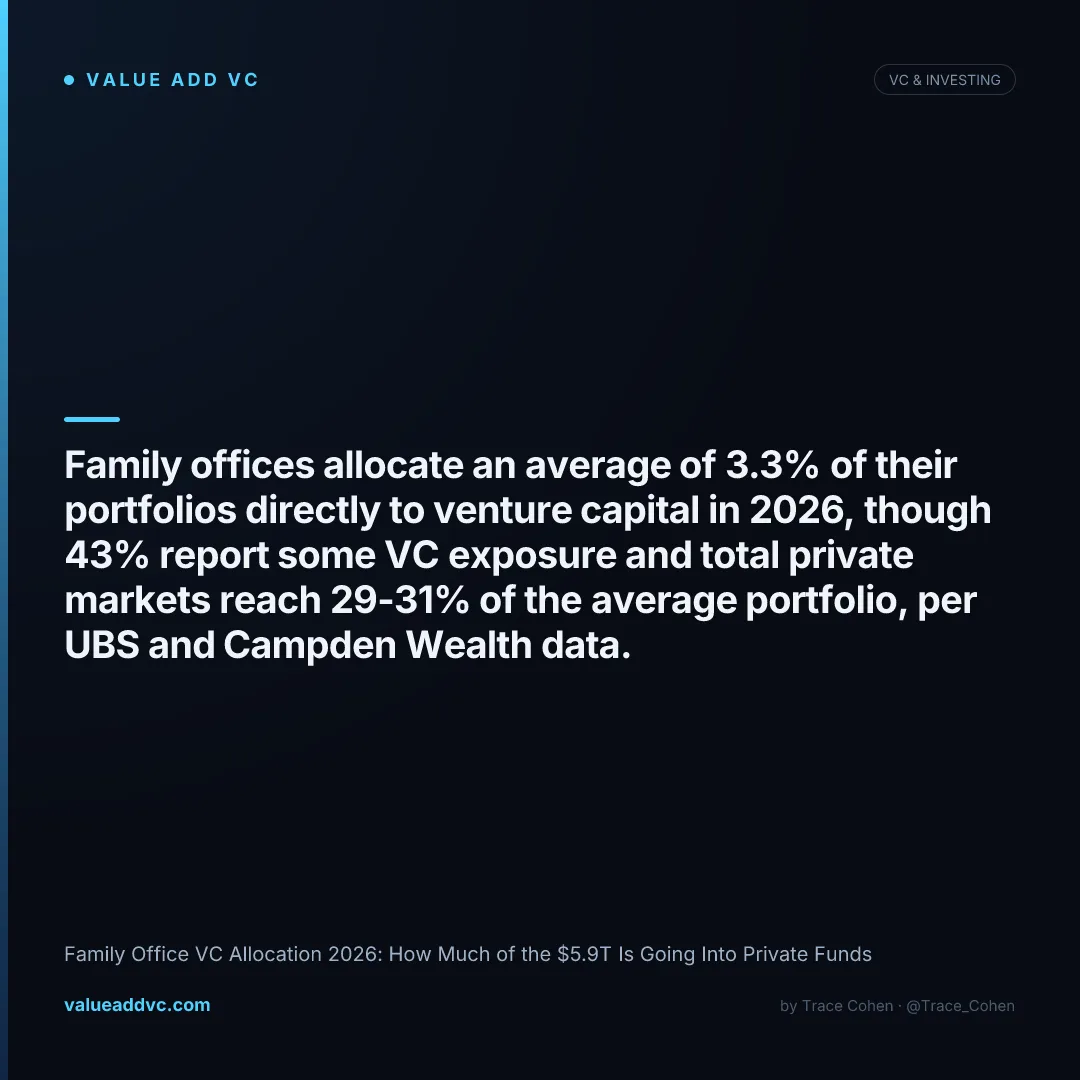
Family offices allocate an average of just 3.3% of their portfolios directly to venture capital, even though 43% report some VC exposure and 35-40% of the roughly 10,000 family offices worldwide now write direct startup checks instead of committing to funds. That's the short answer. The longer answer is that the number that matters isn't the allocation percentage — it's who's getting cut out of the deal.
Family offices collectively manage an estimated $5.9 trillion in assets in 2026, and the UBS Global Family Office Report puts total alternatives exposure at 42% of the average portfolio — the highest on record. But venture capital specifically is a small, contested slice of that pie, and the fight over it is increasingly between VC funds and the family offices themselves, who'd rather skip the 2-and-20 and write the check directly. We track where private capital is flowing more broadly on our funds dashboard.
How Much Is Going Into Private Funds? Family Office VC Allocation in 2026
Family offices allocate an average of 3.3% of total assets directly to venture capital and growth equity as of 2026, according to industry survey data, with 43% of family offices reporting any venture exposure whatsoever. Zoom out to combined private markets — private equity, venture capital, and private credit together — and that figure climbs to 29-31% of the average family office portfolio, per Campden Wealth's 2025 research with RBC Wealth Management and JPMorgan Private Bank's 2026 Global Family Office Report.
The gap between "3.3% pure VC" and "30% private markets" is the story: family offices are heavily allocated to private capital overall, but venture is a minority sport inside that bucket compared to buyout private equity, private credit, and now secondaries. That's changing, but slowly, and mostly through direct deals rather than new fund commitments.
Figures are 2025-2026 estimates blended from UBS Global Family Office Report 2026, Campden Wealth/RBC Wealth Management 2025 research, JPMorgan Private Bank's 2026 Global Family Office Report, and FINTRX Q1 2026 Family Office Report.
Family Office Portfolio Mix: Where the Rest of the Money Sits
Alternatives now make up 42% of the average family office portfolio, per UBS's 2026 report, with the remaining 58% split across public equities, fixed income, and cash. Inside that 42% alternatives bucket, private markets (PE, VC, and private credit combined) account for roughly 30 percentage points, with the rest spread across hedge funds, real estate, and commodities.
The composition inside private markets is shifting fast. Traditional buyout private equity fund allocations are falling — from 22% of portfolios in 2023 to 21% in 2024 and a projected 17% in 2026 — while private credit and secondaries pick up the difference. Venture capital's share hasn't grown proportionally; it's mostly moving from "committed to a VC fund" to "invested directly in a startup."
Why Family Offices Are Skipping VC Funds for Direct Deals
Direct private investment rose from 19% of family office private allocations in 2023 to 26% in 2025 — the single fastest-moving trend in family office venture behavior. The math is straightforward: a VC fund charges roughly 2% in annual management fees and 20% carried interest on profits, plus locks up capital for 10-plus years with no say over individual portfolio decisions. A direct check skips all of that.
The typical direct check size runs $500,000 to $5 million per company, with family offices allocating 10-18% of total assets to combined private equity and venture positions when they go this route, per 2026 FINTRX survey data. Larger single-family offices operate at a completely different scale — Jeff Bezos's family office made five direct AI startup investments in June 2026 alone, including participation in Prometheus's $12 billion Series B, accounting for roughly 10% of all family office direct deals that month.
In February 2026, family offices made 41 direct investments into companies, and nearly all of them were AI-related. That concentration is the real driver: family offices don't want diversified AI exposure through a fund's 20-30 company portfolio, they want concentrated bets on the two or three names they believe in, sized the way a fund manager never would.
Direct Deals vs. Fund Commitments: Where Family Office Private Capital Actually Goes
Every row below compares the direct-investing wave against the traditional fund-commitment model that still carries most family office private capital in 2026 — the split is closer than the AI-startup headlines suggest.
| Metric | Fund Commitments | Direct Deals |
|---|---|---|
| Share of family office private allocations, 2025 | 74% | 26% |
| Share of private allocations, 2023 | 81% | 19% |
| Typical check size | $1M-$25M+ per fund | $500K-$5M per company |
| Fee load | ~2% mgmt + 20% carry | None (direct ownership) |
| Lock-up period | 10+ years typical | Company-dependent, often shorter |
| Diversification per commitment | 20-30 portfolio companies | 1 company, concentrated |
| Operational support provided | Yes — GP network, follow-on capital | Rare — family office typically passive post-check |
| % of family offices participating | ~100% of allocators | 35-40% of family offices |
Figures are 2025-2026 estimates blended from Campden Wealth/RBC Wealth Management research, FINTRX Q1 2026 Family Office Report, and reported deal data via CNBC and TechCrunch on family office direct AI investments.
What This Means for VC Funds Competing for Family Office LP Capital
If you're raising a fund and family offices are on your target LP list, the 2026 data tells you two things. First, the pool is real and growing — 42% of a $5.9 trillion AUM base flowing into alternatives is a bigger number than most GPs act like it is. Second, you're not just competing against other funds anymore; you're competing against the family office's own deal team, which can now write a $2 million check into the same startup with none of your fees and none of your governance rights. We track fund sizes and how GPs are actually closing in the current market on our VC fundraising tracker.
The funds winning family office capital in 2026 aren't the ones pitching diversification — family offices can build that themselves through direct deals now. They're the ones offering co-investment rights, deal flow the family office couldn't source on its own, and genuine value-add beyond capital. That's a harder pitch than "trust our track record," but it's the one that still works.
The AI concentration matters here too. Family offices making 41 direct AI deals in a single month aren't diversifying risk, they're betting on a handful of theses with size. If you're a fund manager, the family offices still worth chasing are the ones who've decided they want a diversified sleeve alongside their direct book — not the ones trying to replace you entirely.
Which Family Offices Allocate the Most: Size, Generation, and Geography
Allocation size scales with structure. Single-family offices run venture and private equity allocations of 10-25% of total assets, while multi-family offices — which have to satisfy multiple client mandates at once — sit lower, at 5-20%, per 2025 industry surveys. Among the 50 largest family offices globally, venture capital averages 12% of the portfolio, well above the 3.3% figure for the broader family office universe, which tells you the biggest, most sophisticated allocators are the ones actually leaning into the category.
Generational control is the bigger swing factor. Next-generation principals — the sons, daughters, and grandchildren now taking over decision-making at roughly 60% of family offices within the next decade — allocate two to three times more capital into AI infrastructure, reasoning systems, and automation software than the generation before them. They're also far more willing to back first-time and emerging fund managers if the thesis is sharp, breaking from the established-manager bias that's dominated family office LP behavior for decades. If you're a first-time GP raising a fund, the next-gen principal is a better target than the legacy CIO.
Geography still tilts heavily toward the US. Roughly 60% of family office venture dollars land in US markets, with Europe and Asia splitting the remaining 40% at 15-20% each — though Asian family offices, concentrated in Singapore and Hong Kong hubs, are the fastest-growing allocators and increasingly deploy capital into US and European deals rather than staying local. On direct investments specifically, the US and Canada captured $6.5 billion of deal value in 2025 (50.4% of the global total), Europe took $5.3 billion, and Asia-Pacific recorded $1 billion — a gap that's more about where the AI deal flow originates than where the capital sits.
Bottom line: family offices allocate an average of 3.3% directly to venture capital, but total private markets exposure reaches 29-31% of the average $5.9 trillion global family office asset base in 2026. The real shift isn't the allocation percentage — it's the mix inside it, with direct deals rising from 19% to 26% of private allocations in two years as family offices bypass funds to write concentrated checks, mostly into AI. For VC funds, that means the pitch to family office LPs now has to be deal flow and access, not just diversification, because family offices increasingly believe they can build that part themselves.
Get VC data most people never see
— free to subscribe
Trace's notes on venture, AI and startups, a few times a week. Join 5,000+ subscribers. No spam.