
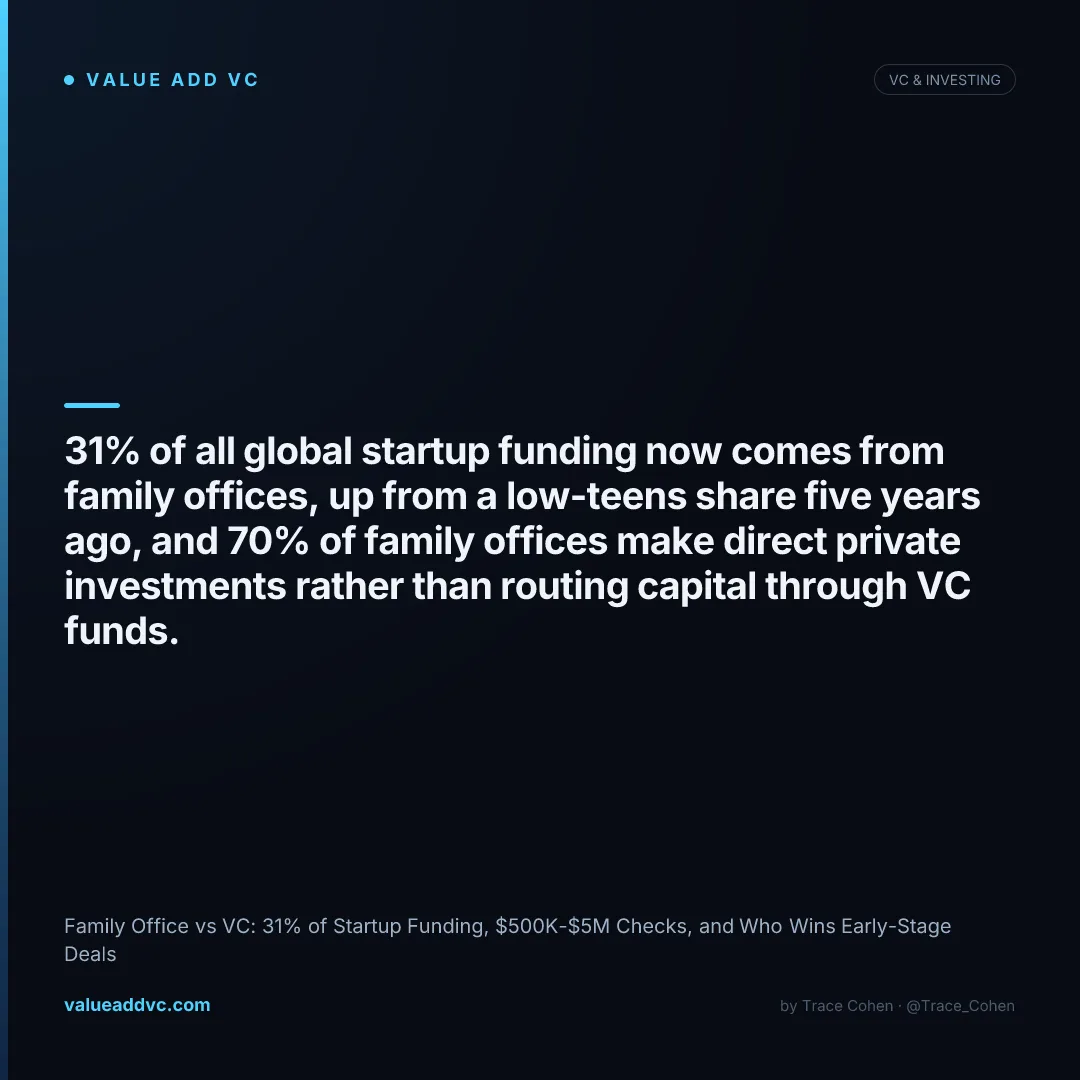
31% of all global startup funding now comes from family offices, not VC funds — up from a low-teens share five years ago. The driver: 70% of family offices now make direct private investments, writing $500K to $5M checks with no LP votes, no investment committee memo, and none of the fee drag that comes with a traditional 2-and-20 VC fund structure.
Founders increasingly have a real choice at the term sheet stage: take a check from a VC fund with a 10-year mandate and a partner who needs sign-off from the rest of the firm, or take a check from a family office principal who can decide alone. Here's how the two actually compare, where each one wins, and why the gap between them is widening in 2026.
Figures compiled from Citi, PwC, PitchBook, Dentons, and BNY Mellon family office and venture capital research, 2025-2026.
Family office vs VC: the side-by-side comparison
A family office is the private investment arm of a single ultra-high-net-worth family (or a handful of families in a multi-family office), deploying its own permanent capital with no outside LPs to answer to. A VC fund pools capital from limited partners — pensions, endowments, fund-of-funds — into a fixed-life vehicle, typically 10 years, with a 2% annual management fee and 20% carried interest on profits. That structural difference drives almost every other gap between them.
| Attribute | Family Office | Traditional VC Fund |
|---|---|---|
| Capital source | Single family's permanent wealth | Pooled outside LP capital |
| Typical check size | $500K-$5M | $1M-$15M+ depending on stage |
| Decision process | Principal or small IC, weeks | Partner vote + IC memo, weeks to months |
| Fee structure | None on direct deals | 2% management fee, 20% carry |
| Fund life / patience | Indefinite, generational capital | 10-year fund life, exit pressure by year 7-8 |
| Deal structure preference | 83% as co-investments alongside a lead | Leads and prices its own rounds |
| Growth-round share (2022 → Q1 2026) | 18% → 29% of Series B-preIPO rounds | Remaining 71%, down from 82% |
| Post-investment involvement | Passive to light-touch, no board seat push | Active, board seats, follow-on reserves |
Figures blended from Citi/PwC 2025-2026 family office surveys, PitchBook growth-round participation data, Dentons' 2025 direct investing survey, and BNY Mellon's 2025 family office allocation study.
Global Startup Funding: Family Offices vs Traditional VC Funds
Citi and PwC 2025-2026 family office wealth reports; PitchBook global VC funding data.
Family offices now account for roughly 31% of global startup funding, a share that's roughly tripled from the low-teens over the past five years.
Family office vs VC at growth stage: who's actually winning early-stage deals
Family offices captured 29% of Series B through pre-IPO rounds in Q1 2026, up from 18% in 2022, per PitchBook — nearly doubling their share of growth-stage capital in under four years. That shift tracks almost exactly with VC dry powder trends: global venture dry powder peaked at $743.9 billion at year-end 2023 and has since fallen 19% to $600.9 billion, meaning VC funds have less uncommitted capital to deploy at exactly the moment family offices are deploying more.
At true early-stage — pre-seed and seed — VCs still dominate deal volume, since most family offices lack the deal-sourcing infrastructure to see hundreds of pre-product pitches a year. But within a family office's own direct-investment sleeve, early-stage VC allocation actually shrank from 8% to 6% while growth equity jumped from 19% to 31%, per BNY Mellon's 2025 study — family offices are chasing later, de-risked rounds, not competing head-on with seed funds. See our VC performance dashboard for how fund-level returns compare by stage.
Why family offices are winning speed, and VCs are winning follow-on capital
The single biggest structural edge a family office has over a VC fund is speed: a $2M check from a family office principal can clear diligence and wire in a matter of weeks because there's no partner vote, no LP advisory committee, and no fund-level conflict check to run. A VC fund, by contrast, typically needs a partner to champion the deal internally, walk it through an investment committee memo, and get sign-off from the rest of the partnership — a process that routinely takes weeks to months even at funds known for moving fast.
Where VC funds still win is follow-on capital and reserves. A typical VC fund reserves 50-60% of committed capital specifically for follow-on rounds in its winners, with a dedicated partner tracking the company toward the next raise. Family offices, especially single-family offices without a dedicated venture team, are far more likely to write one check and step back — 64% expect to make six or more direct investments over the next twelve months per Dentons, but that's spread across new deals, not concentrated follow-on support for existing portfolio companies. For founders raising a Series A or B, that makes the choice less "which is better" and more "which do I need right now" — see our fund benchmarking dashboard for how reserve ratios vary by fund size and stage focus.
What this means for founders choosing between a family office and a VC fund
If you're raising a seed round and need a fast, low-friction check with no board seat demands, a family office co-investment can be the cleaner option — 83% of family office direct deals are structured as co-investments alongside a lead, so they're rarely the ones setting your valuation or your terms. If you're raising a Series A or B and need a partner who will actively help you hire, make intros, and reserve capital for your next round, a traditional VC fund's structural incentive to protect its ownership stake still makes it the stronger long-term partner, even if the check takes longer to clear.
The two aren't purely substitutes — 92% of institutional LPs say fund reporting quality influences their re-up decisions, which is a discipline family offices investing their own capital simply don't have to maintain, and it's part of why VC funds still dominate true seed-stage deal volume even as family offices eat into growth-stage share. The most sophisticated cap tables in 2026 increasingly have both: a VC lead setting terms and a family office riding alongside on the same round.
How to vet a family office the same way you'd vet a VC
The diligence questions are different, but they're not optional just because a family office isn't raising outside LP capital. Ask how many direct deals the family office has actually closed in the past 24 months — 64% expect six or more in the next twelve, so a principal who's done zero to date is a signal they're still building the muscle, not a red flag by itself, but worth knowing before you sign a term sheet around their timeline. Ask whether they're leading or following: 83% of family office deals are co-investments, so if a family office is offering to lead and price your round, that's the less common case and worth extra scrutiny on how they'll behave if the company needs a bridge later.
On the VC side, the equivalent diligence is checking reserve behavior and reporting discipline, since 92% of institutional LPs say reporting quality drives their own re-up decisions with the fund — a proxy for whether the partner leading your round has the internal credibility to fight for follow-on capital when your company needs it two years from now. A fund sitting on dry powder that's shrunk 19% industry-wide from $743.9 billion to $600.9 billion since 2023 may simply have less room to defend its pro-rata than it did at your last raise, regardless of how enthusiastic the individual partner sounds in the room.
Neither capital source is automatically the better partner — the right read is stage-dependent. A pre-seed or seed round benefits from a VC's deal-sourcing muscle and willingness to lead a priced round with real terms; a growth round benefits from a family office's speed and its total lack of a 10-year fund-life clock forcing an exit conversation you're not ready to have. Track how the two sources are actually splitting rounds by stage on our SPV dashboard, and compare fund-level reserve ratios on our benchmarking dashboard before you decide who leads your next round.
Bottom line: Family offices now account for 31% of global startup funding and 29% of growth-stage rounds, up from 18% in 2022, driven by faster decisions, no fee drag, and permanent capital that doesn't answer to outside LPs. VC funds still win on follow-on reserves, active portfolio support, and true seed-stage deal volume — the honest answer to "family office vs VC" isn't which one wins, it's that the smartest founders are increasingly stacking both on the same cap table.
Latest from the Pulse
Get VC data most people never see
— free to subscribe
Trace's notes on venture, AI and startups, a few times a week. Join 5,000+ subscribers. No spam.
No spam, unsubscribe anytime. Sent via Substack · Privacy · or subscribe on Substack ↗