Correction — September 30, 2026
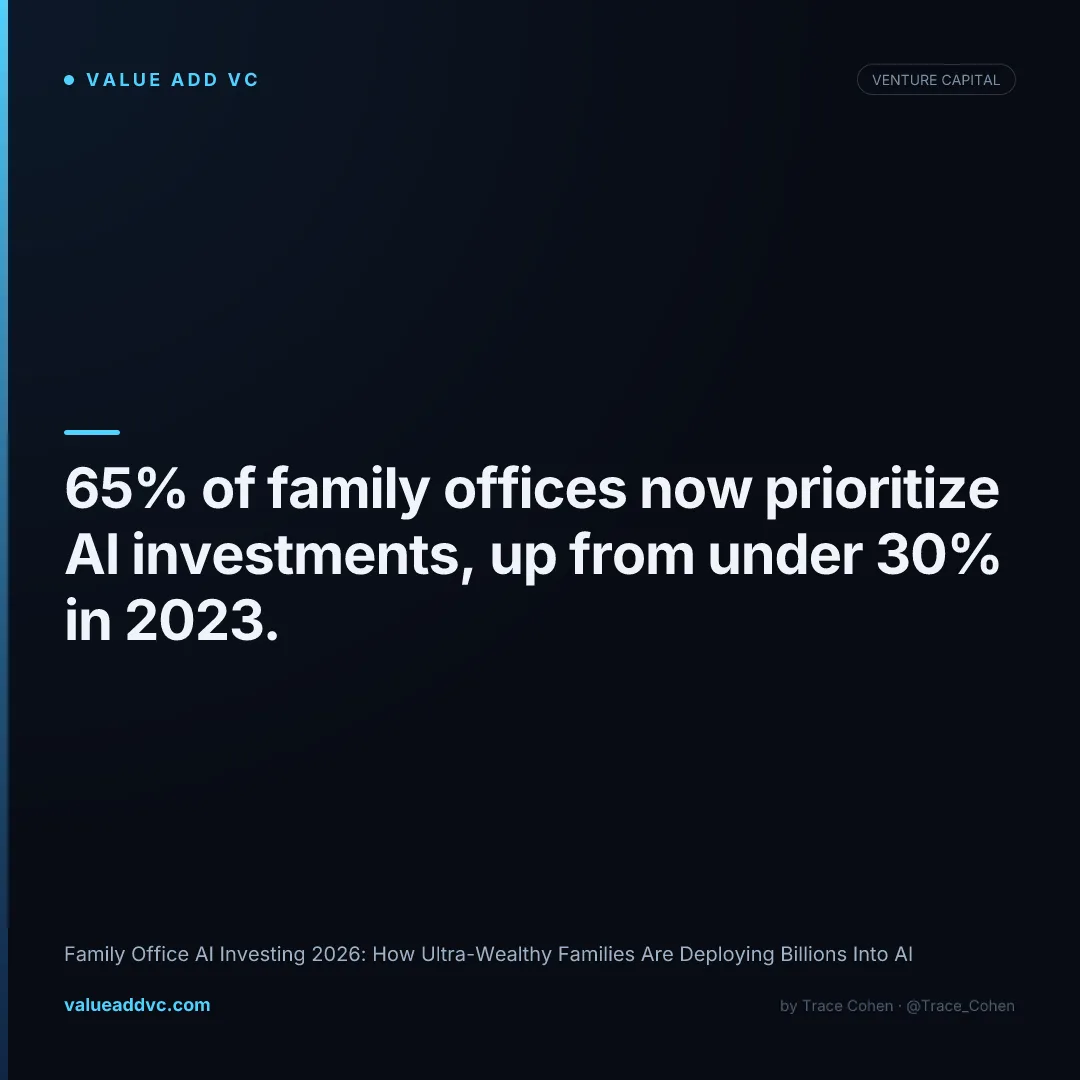
An earlier version said 65% of family offices "prioritize" AI investments, up from under 30% in 2023. UBS's Global Family Office Report 2026 says AI is the leading investment theme, with 65% of family offices already invested across the value chain; we could not source the 2023 comparison.
65% of family offices are already invested in AI. But the headline number understates the concentration: among single-family offices with $1 billion or more in AUM, the figure is closer to 80%. AI has displaced fintech as the number-one technology investment theme for family offices globally.
What makes family offices different from traditional VCs in AI isn't just check size — it's time horizon. A venture fund has a 10-year lifecycle with pressure to return capital by year 7-8. A family office can hold a position for 20 years. When you're backing a company that's spending $10 billion to train a frontier model with no clear revenue model for 3-5 years, that patience is a structural advantage.
Data from UBS Global Family Office Report 2026, KKR/Campden family office surveys, and public deal disclosures. AI allocation percentages are estimates based on disclosed investments and survey responses.
The five family offices reshaping AI
Five family offices have deployed more capital into AI than most venture funds will raise in their lifetimes. Each represents a different thesis — and a different structural advantage.
1. Bezos Expeditions — The infrastructure thesis ($12B+)
Jeff Bezos's family office has made the single largest family office AI bet in history: an estimated $12 billion into Prometheus, an AI venture linked to Amazon's broader AI infrastructure strategy. Bezos Expeditions has also backed at least 8 AI-related deals in 2025-2026, making it the most active family office investor in startups by deal count. The thesis is vertical integration: AI models need compute infrastructure (AWS), and compute infrastructure needs AI demand. Bezos is betting on both sides of the flywheel.
2. ICONIQ Capital — The multi-family AI syndicate ($80B AUM)
ICONIQ manages approximately $80 billion for tech billionaire families including Mark Zuckerberg, Sheryl Sandberg, and Jack Dorsey. Its AI strategy is distinctive: ICONIQ co-led or participated in Anthropic's $13 billion+ Series F, making it one of the largest single AI fundraises in history. ICONIQ's structural advantage is information asymmetry — managing wealth for tech founders gives it real-time intelligence on which AI companies are gaining enterprise traction. Its AI portfolio extends beyond Anthropic into data infrastructure, MLOps tooling, and vertical AI applications.
3. Emerson Collective — The mission-driven AI thesis ($1B+)
Laurene Powell Jobs's Emerson Collective has deployed over $1 billion into AI, with a distinctive focus on AI safety, alignment, and beneficial AI applications. Unlike purely return-driven offices, Emerson invests in AI companies working on interpretability, bias reduction, and safety infrastructure — areas that traditional VCs often avoid because the monetization timeline is uncertain. Emerson's $26 billion AUM and indefinite time horizon let it back these longer-duration bets without the pressure to show near-term returns.
4. Breakthrough Energy Ventures — Climate AI ($2B fund)
Bill Gates's Breakthrough Energy Ventures operates a $2 billion fund focused on climate and energy innovation, increasingly incorporating AI. The thesis is AI as an accelerant for climate technology — using machine learning for grid optimization, materials discovery, carbon capture, and energy efficiency. This represents the fastest-growing AI sub-thesis among family offices: AI not as a product category but as an enabler for the principal's primary philanthropic or strategic mission.
5. Thiel Capital — Defense AI ($800M+)
Peter Thiel's family office has deployed over $800 million into defense and government AI through Palantir (which Thiel co-founded and which trades at a $100B+ market cap), Anduril, and related defense-tech ventures. Thiel Capital's thesis is that the most valuable AI applications will be in national security and defense — domains where the government is the customer, switching costs are effectively infinite, and the competitive moat is security clearance infrastructure rather than model performance. With Palantir expanding in South Florida, this thesis is also driving AI talent to Miami's Wynwood district.
Why family offices have structural advantages in AI
Traditional venture capital has a fundamental mismatch with AI investing: VC funds typically have 10-year lifecycles and need to show returns by year 7-8. Frontier AI companies — the ones training foundation models, building inference infrastructure, or working on safety — often need 5-7 years before generating meaningful revenue. That creates a 2-3 year gap where VCs are pressured to push for premature monetization or exit.
| Factor | Family Office | Traditional VC |
|---|---|---|
| Time horizon | 10-20+ years, no fund lifecycle | 7-10 years, LP pressure by year 7 |
| Check size | $50M-$500M, single decision-maker | $10M-$100M, IC approval required |
| Follow-on capacity | Unlimited from balance sheet | Constrained by fund reserves |
| Board dynamics | Supportive, non-activist | Active governance, exit pressure |
| Strategic value | Principal's network + industry access | Portfolio network + recruiting help |
The structural advantages explain why the largest AI rounds increasingly include family office capital. When Anthropic raised its $13 billion+ Series F, it needed investors who could commit hundreds of millions without LP approval processes that take 6-8 weeks. Family offices can move in days. For founders navigating AI fundraising, see our complete playbook on raising from family offices.
What's next: the second wave
The first wave of family office AI investing (2023-2025) was concentrated in foundation model companies — Anthropic, OpenAI, Mistral, Cohere. The second wave (2026+) is shifting toward three areas:
Vertical AI applications: Family offices with domain expertise (healthcare, real estate, energy, financial services) are backing AI companies that apply foundation models to their specific industries. A real estate family office backing AI property valuation tools, or a healthcare family office investing in diagnostic AI, can offer both capital and customer access.
AI infrastructure picks-and-shovels: GPU cloud providers, data labeling companies, inference optimization startups, and AI observability platforms. These are lower-risk bets that profit regardless of which foundation model wins.
AI-native financial products: Family offices are beginning to back AI-powered investment management tools, AI-driven tax optimization, and autonomous portfolio construction — products they themselves would use. This creates a feedback loop where the family office is simultaneously investor, beta tester, and first customer.
Bottom line: Family offices have gone from peripheral AI investors to central players in less than three years. Their structural advantages — patient capital, large checks, no LP pressure — make them ideal backers for capital-intensive AI companies. The 65% share already invested will likely reach 80%+ by 2027 as AI becomes the default technology investment thesis. For founders building in AI, family offices aren't just an alternative funding source — for capital-intensive, long-duration AI bets, they may be the optimal funding source. Track the biggest family office investors on our Family Office Tracker.
Latest from the Pulse
Get VC data most people never see
— free to subscribe
Trace's notes on venture, AI and startups, a few times a week. Join 5,000+ subscribers. No spam.