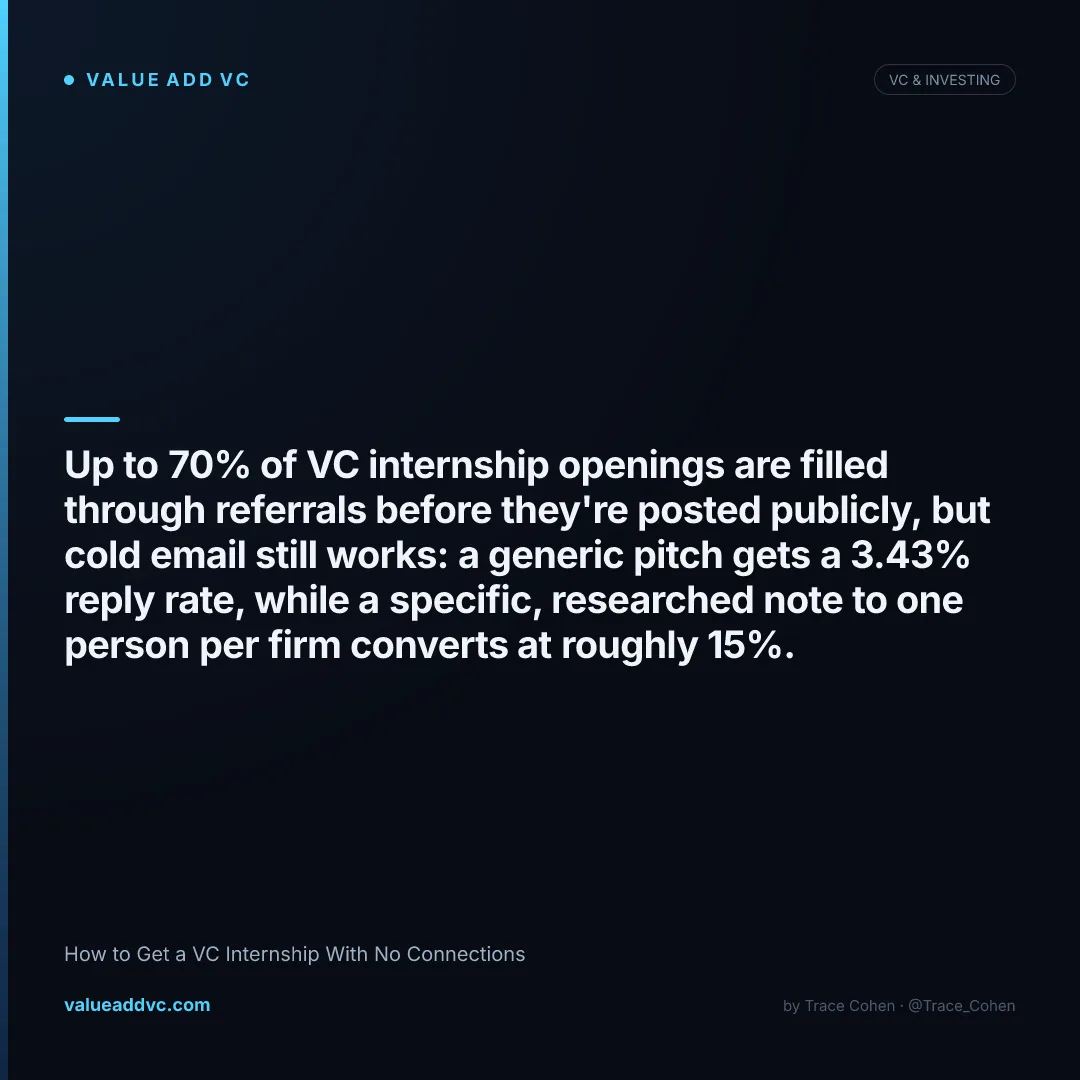
Up to 70% of VC internship openings are filled through warm referrals before they ever reach a job board — but cold outreach still works if you treat it like a numbers game: a generic application gets roughly a 3.43% reply rate, while a specific, researched note to one named person converts closer to 15%.
Venture capital hires more like a private club than a structured pipeline, and no amount of wishing changes that. What does change the outcome is volume and precision: enough well-targeted emails, sent to the right person, saying something only you could say about that firm. This is the playbook for doing that without a single warm introduction.
How to Get a VC Internship With No Connections: The Real Numbers
Most VC internships never get posted publicly — an internal referral or a call from a portfolio-company founder fills the slot first. That's the uncomfortable starting point for anyone without a network, but it's not disqualifying: it just means the strategy has to be volume-based outreach rather than waiting on job boards, and it means accepting a lower hit rate than someone with a warm intro gets.
The reply-rate gap between a generic template and a genuinely researched note is the whole game. At the average 3.43% reply rate, 50 emails produce one or two conversations; at a personalized 15% rate, the same 50 emails produce 7-8, according to outreach benchmarks compiled by Mergers & Inquisitions. That's roughly a 4-5x difference in outcomes for the same number of emails sent — which means the highest-leverage thing you control isn't connections, it's how specific each individual email is.
The Outreach Playbook: List, Email, Follow Up
Build a target list of 60-100 funds that actually fit — stage, sector, and geography, not every fund with a website. Then email one specific, named person per firm rather than a general inbox; a partner or associate whose public work (a blog post, a portfolio investment, a talk) gives you something real to reference. Keep the email under 125 words. Do three things in that space: name the exact reason you're reaching out to that person specifically, prove you've done work relevant to venture — a one-page memo on a company, a thesis on a sector, coursework, or a prior internship — and make a small ask that's easy to say yes to, like a 15-minute call, not a job.
Skip "Dear Sir/Madam" and any opener that could be sent to ten other firms unedited — it signals you didn't bother, and it shows in the reply rate. Follow up once after a week if you don't hear back; a single polite follow-up is normal, not pushy. If a firm's jobs page exists, check it — a16z and other larger funds do post openings there occasionally — but don't wait on it, since most of what fills is never listed.
What you send matters as much as who you send it to. A one-page investment memo on a real company — why you'd invest, what you'd want to see diligence-wise, what would make you pass — does more to prove you can do the job than a finance-heavy resume. Most junior VC work is sourcing and evaluating, not modeling, so a demonstrated point of view on a sector or company is exactly the skill a fund is trying to assess.
What VC Internships Actually Pay
Compensation varies more by fund size than almost any other entry-level finance role. Formal MBA-track programs at large multi-stage funds pay $6,000-$12,000 a month, and Thrive Capital's underclassman fellowship pays a $100,000 annualized rate plus a separate $40,000 education grant — figures we cover in detail in the ranked list of VC internship programs. But those structured, well-paid programs are a small slice of the market, concentrated at a handful of brand-name funds with fewer than a dozen intern slots total. Broader survey data from ZipRecruiter, as of September 7, 2026, puts the average VC internship salary around $36,000 a year, with most reported roles falling between $30,000 and $40,000 — a more realistic baseline for the far larger number of internships at smaller and emerging-manager funds, some of which pay a stipend only or nothing at all.
The gap between those numbers isn't a data error; it's a real bifurcation. Fewer than 5% of applicants get offers at the top-tier structured programs, so most people who successfully cold-email their way into venture land at smaller funds, at lower pay, with far more responsibility per person — which, for someone building a track record with no connections, is often the better trade anyway.
Where I Could Be Wrong
None of this closes the gap with a warm introduction — it narrows it. Someone with a portfolio-founder referral or an alumni connection at the fund is still starting from a materially better position, and volume cold outreach is a real time cost that competes with classes, a job, or other applications. It also skews toward funds small enough to notice an unsolicited email at all; a mega-fund with a brand-name reputation gets enough inbound that even a well-personalized note can go unanswered simply on volume. Treat this as the strategy for building your own opportunity where none exists, not a guarantee it replaces one.
Explore Related Dashboards
Interactive tools with live data on this topic
Track fund performance and career benchmarks on the VC Performance Dashboard at Value Add VC.
Latest from the Pulse
Get VC data most people never see
— 100% free
Weekly benchmarks, valuations, and fund data. Join 5,000+ investors. No spam.