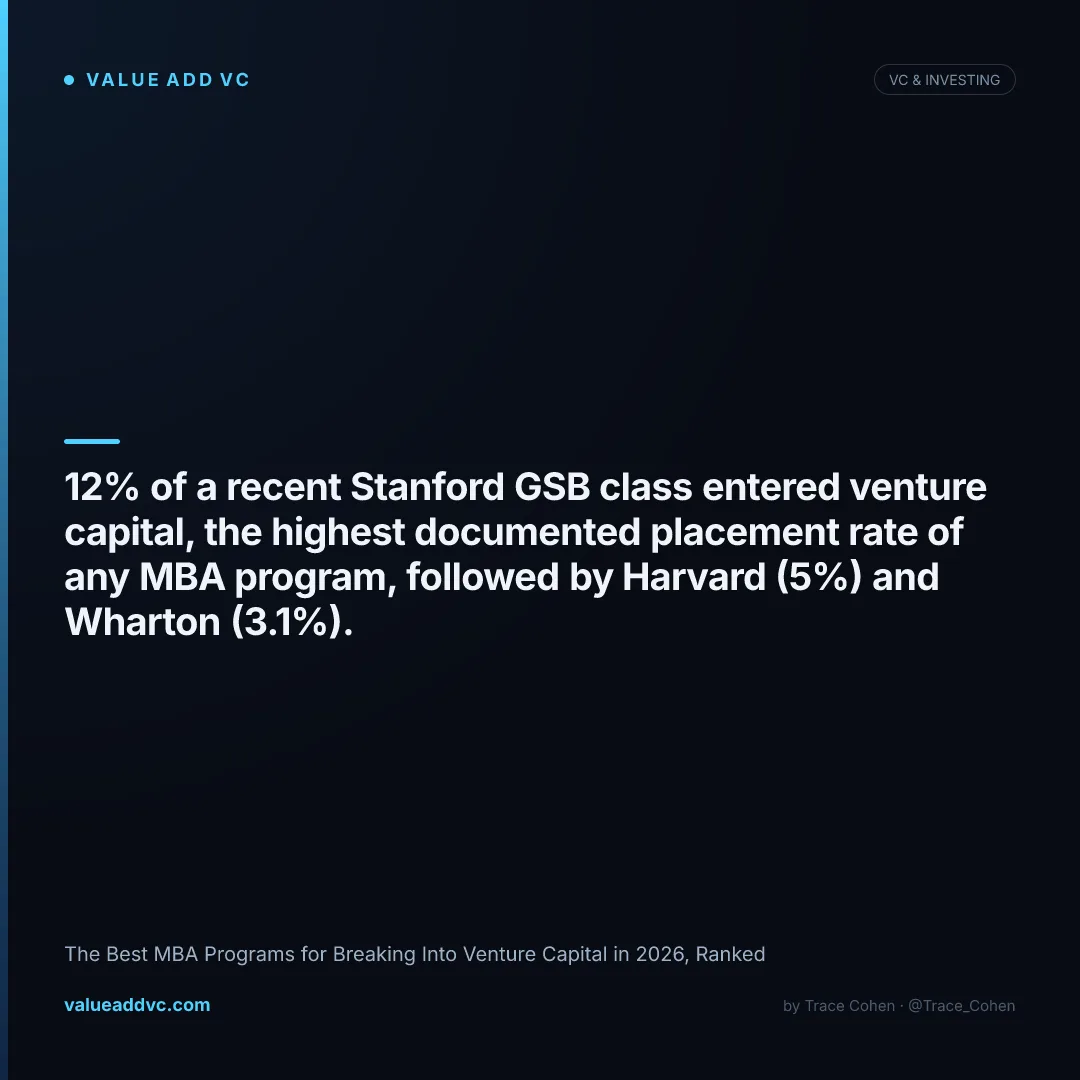
Roughly 12% of a recent Stanford GSB class went into venture capital — the highest documented placement rate of any MBA program — while Chicago Booth's sits at 1.6%.
An MBA is not a requirement to work in venture capital — most seed and early-stage hires still come through operating backgrounds or warm referrals, as we cover in our guide to breaking into VC without a startup background. But for the mid-career associate-to-principal track at larger, multi-stage funds, a small list of MBA programs dominates recruiting, and the gap between them is large and documented, not folklore.
This ranking uses only numbers that are publicly sourced from school employment reports, aggregator compilations of those reports, and a 2025 academic study of VC professionals' educational histories — never an invented "VC score." Where a school does not publish a VC-specific placement percentage, we say so and rank it on the verifiable signals that do exist: a named VC club or curriculum track, proximity to a venture hub, and documented alumni in VC partnerships.
Best MBA Programs for Venture Capital in 2026, Ranked
The best MBA programs for venture capital in 2026 are Stanford GSB, Harvard Business School, and Wharton, based on documented class-wide VC placement percentages, VC-specific curriculum and clubs, and alumni density in active VC partnerships. Columbia, Kellogg, MIT Sloan, Berkeley Haas, and Chicago Booth round out the list, each with a genuine but smaller or less-published VC pipeline.
Haas and some schools report venture capital combined with private equity in a single line item; where a school breaks VC out separately (Stanford, HBS, Wharton, Columbia, Kellogg, Booth), the VC-only figure is used.
Cost, Placement, and Fit: At a Glance
Tuition and VC placement figures compiled from each school's official employment-data pages and Clear Admit's M7 placement-outcomes series. Tuition is the published sticker price for the most recent entering class (2025-26) and excludes scholarships and financial aid, which vary by student.
| Rank | Program | 1-Yr Tuition (2025-26) | VC Placement (most recent) | Best For |
|---|---|---|---|---|
| 1 | Stanford GSB | $85,755 | ~12% (PE+VC: ~26%) | Silicon Valley multi-stage funds |
| 2 | Harvard HBS | $78,700 | 5% (~50 students) | Deep finance alumni network |
| 3 | Wharton (UPenn) | $87,970 | 3.1% | Quant/deal-structuring depth |
| 4 | Columbia CBS | $91,172 | 2.5% | NYC growth equity / fintech VC |
| 5 | Kellogg (Northwestern) | $86,370 | 1.7% | Structured PE/VC curriculum pathway |
| 6 | MIT Sloan | $89,000 | Not separately published | Deep-tech / biotech VC |
| 7 | Berkeley Haas | $76,788 (CA) / $89,033 (non-res.) | 4.6% (PE+VC combined) | Lowest-cost Bay Area access |
| 8 | Chicago Booth | $89,976 | 1.6% (lowest avg. VC salary: $130K) | Flexible curriculum, PE-leaning |
How We Ranked These MBA Programs
Ranking weighs four factors: documented class-wide VC placement rate from the school's own employment report where published (40%); strength of a dedicated VC-specific club, conference, or curriculum track (25%); verifiable alumni density and research backing in active VC partnerships (20%); and cost relative to the other three factors (15%). No school paid for inclusion or position, and placement percentages are never estimated or invented — where a school (MIT Sloan) does not publish a VC-specific breakout, it is ranked on the remaining three factors and that gap is disclosed rather than papered over with a guessed number. Primary sources include each school's own career-statistics office — see HBS's recruiting employment-data page — plus Clear Admit's M7 VC/PE placement-outcomes series and the Poets&Quants coverage of Strebulaev and Jackson's 2025 study of 3,971 senior VC professionals' educational histories.
What the headline misses
A high VC placement percentage is not the same as a high probability any individual student lands a VC seat — these are class-wide averages, and the denominator at a 900-plus-student HBS class is very different from a roughly 420-student Stanford GSB class. The Strebulaev/Jackson study itself measured investment performance of VC professionals who already work in VC, not the odds of getting hired at all, so "graduates of School X perform better as VCs" and "School X is easier to get a VC job from" are two different claims that this ranking is careful not to conflate. One read on this: the placement percentages above also move year to year with the broader PE/VC hiring cycle — Wharton's own combined PE/VC hiring fell from 18.1% to 12.9% in a single class year — so a snapshot from one employment report is directional, not a permanent ranking of the school.
Which Program Fits Your Situation
If you want the single highest odds of landing in VC
Stanford GSB. No other program's own employment report shows a comparable double-digit VC placement percentage, and the Palo Alto location puts you inside the recruiting network before you've applied anywhere.
If you want a deep alumni base and a consulting/banking pivot
Harvard Business School. The class size means HBS places a comparable absolute number of students into VC as higher-percentage schools, and its VC & PE Club conference draws senior industry speakers every year.
If you're coming from a quant finance background
Wharton or Chicago Booth. Both have the deepest formal finance curricula on this list, useful for the deal-structuring and modeling work that growth-stage and PE-adjacent VC roles lean on.
If you want deep tech, biotech, or NYC growth equity specifically
MIT Sloan for deep tech/biotech (Cambridge, Massachusetts proximity), or Columbia for NYC-based growth equity and fintech VC — both are better fits than a Silicon Valley generalist program for those specific sectors.
The MBA Is a Multiplier, Not a Prerequisite
Every figure in this ranking describes a class-wide average at schools that already filter heavily for prior finance, consulting, or startup-operating experience before admission. An MBA from any of these eight programs will not manufacture a VC career on its own — it accelerates and formalizes a recruiting pipeline that candidates with existing operator or investing experience are already positioned to use. Fewer than 200 VC summer internship spots exist across the entire US industry in a given year, per our ranked guide to VC internship programs, and most of them go to candidates these schools' recruiting pipelines already surface.
For candidates without the budget or admit profile for a top program, the honest alternative path — warm introductions, a public investment thesis, and a role at an emerging manager fund — is covered in our honest guide to getting a job in venture capital. The MBA buys you a faster, more structured version of the same outcome — not a different one.
Track VC career benchmarks and fund data at the VC Performance Dashboard and Funds Directory at Value Add VC. Originally published in the Trace Cohen newsletter.
Latest from the Pulse
Get VC data most people never see
— free to subscribe
Trace's notes on venture, AI and startups, a few times a week. Join 5,000+ subscribers. No spam.