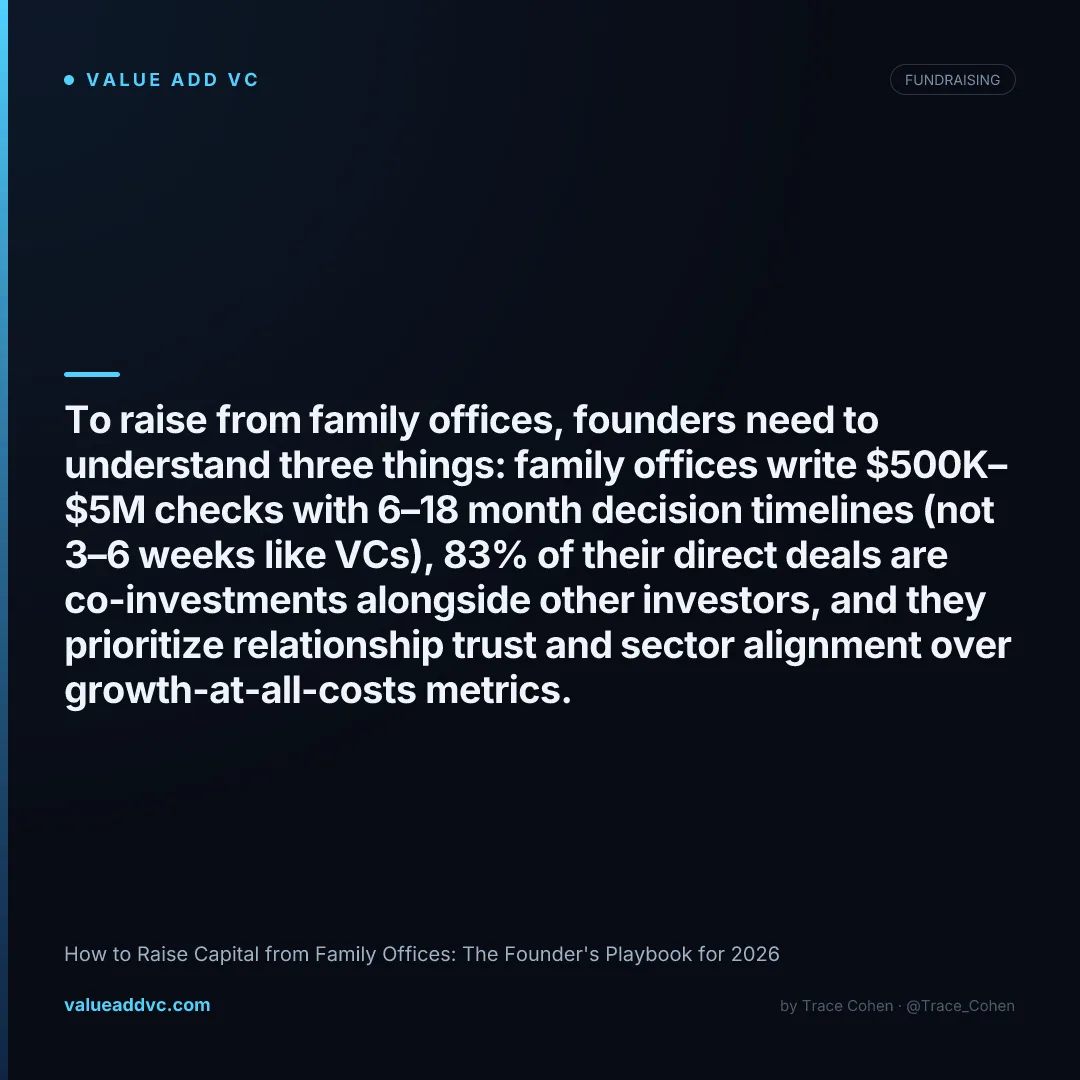
Family offices now account for 31% of global startup funding and 70% make direct investments — but most founders have no idea how to actually access this capital because the process is nothing like raising from VCs. The timelines are 3-4x longer, the decision process is consensus-driven rather than partner-led, and the relationship dynamics that close deals are fundamentally different.
This is the tactical playbook — not theory about how family offices think (we covered that separately), but the specific steps, timelines, and pitfalls for founders who want to raise family office capital in 2026.
Step 1: Source the right family offices
The hardest part of raising from family offices isn't the pitch — it's finding them. Most single-family offices are exempt from SEC registration and have zero public presence. There's no AngelList for family offices. Here's what actually works:
Wealth advisor introductions (45% of deals): Trust companies and wealth managers who serve family offices are the highest-conversion sourcing channel. Bessemer Trust, Wilmington Trust, Fiduciary Trust, and firms like Oxford Financial Group and CV Advisors have direct relationships with the principals. Ask your existing investors which wealth advisors they know who serve family offices — and position the introduction as deal-flow for the advisor's client, not a favor for you.
Family office conferences (25%): The Palm Beach Single Family Office Forum (limited to 50 verified offices), FOX Private Family Capital Summit (The Breakers), iConnections Global Alts (Miami, structured 1:1 meetings), and GFOIS (Miami) are the highest-signal events. eMerge Americas draws family offices too but is broader. These are relationship-building events, not pitch events — don't show up with a deck in hand.
LP referrals (20%): If your existing VC investors have family office LPs in their fund, those LPs already have deal-flow context and a relationship with your investors. Ask your lead VC to introduce you to their family office LPs who invest directly alongside the fund — 83% of direct deals are co-investments, so this is the most natural entry point.
Databases and cold outreach (10%): FINTRX, Dakota, and FamilyOfficeHub sell curated lists. Cold outreach conversion is low (sub-2%) but non-zero — the key is extreme personalization. Reference the family's existing portfolio, sector interests, and a specific reason this deal fits their thesis. Generic "we're raising a round" emails get deleted.
Step 2: Understand the timeline
The single biggest mistake founders make is treating family office fundraising like a VC process. A VC can go from first meeting to term sheet in 3-6 weeks because one partner can champion the deal and push it through a Monday meeting. Family offices don't work that way.
A typical family office decision process involves: the principal (the family member or CIO who takes your meeting), external advisors (often a trusted law firm or wealth manager who vets deals), sometimes a formal investment committee, and in many cases, other family members who have informal veto power. Getting consensus from all parties takes 6-18 months — and that's if everything goes well.
The implication: Start building family office relationships 12-18 months before you need capital. If you're raising a Series A in Q1 2027, you should be meeting family offices now, in Q3 2026. The first meeting plants the seed; the second or third meeting (spread over months) is where real diligence begins. Founders who wait until their round is live to start family office conversations will close zero family office checks.
Step 3: Pitch what they care about
Family offices don't care about the same things VCs care about. A VC is optimizing for fund-level returns within a 10-year fund lifecycle. A family office is optimizing for multi-generational wealth preservation with selective growth. The pitch has to reflect that difference.
Lead with capital efficiency, not growth rate. VCs love 3x YoY growth even with 150% burn multiple. Family offices want to see that every dollar invested generates durable revenue — LTV/CAC ratios, payback periods, and gross margin expansion matter more than top-line growth rate.
Show a clear path to cash flow. Family offices don't need a 100x return — they need confidence the company won't go to zero. A path to profitability within 2-3 years is more compelling than a path to a $10B IPO in 7 years. This doesn't mean you have to be profitable now — it means you need to show you could be if you stopped investing in growth.
Align with the family's interests. Research the family's existing portfolio and sector exposure. A family office built on healthcare wealth is more likely to invest in healthtech. One built on real estate is drawn to proptech. One built on tech is comfortable with SaaS metrics. The best family office pitches feel like a natural extension of what the family already knows, not a leap into the unknown.
Address liquidity honestly. Family offices can hold forever — they don't have a fund lifecycle forcing exits. But that doesn't mean they want to hold forever. Be transparent about liquidity paths: secondary markets, dividend recapitalizations, strategic M&A, or IPO. The worst thing you can say is "we'll figure it out" — family offices have heard that line from hundreds of founders, and it signals that you haven't thought about their exit.
Step 4: Structure the deal
Family offices are more flexible on terms than VCs — and founders should use that to their advantage. Key structural differences:
No board seat required. Most family offices don't want or need a board seat. They'll take board observer rights or informal quarterly updates. This is a real advantage for founders who want patient capital without complex governance — use it as a selling point when balancing your cap table between VC and family office money.
Flexible on instrument. Family offices are comfortable with SAFEs, convertible notes, priced equity, and even revenue-based financing. Some prefer structures with interim cash distributions (like profit-sharing provisions) that VCs would never accept. If your business generates cash, a creative structure can make the deal more attractive to a family office than a standard preferred equity round.
Co-investment is the default. 83% of family office direct deals are co-investments. The easiest structure: your lead VC sets terms, and the family office fills allocation alongside them. This reduces the family office's diligence burden (they lean on the lead's work) and gives the founder a faster close on the FO tranche. Always ask your lead VC if they have family office LPs who want co-invest allocation before going to market.
The 5 mistakes that kill family office deals
1. Treating it like a VC sprint. Sending a deck after the first meeting with "we're closing in 3 weeks" pressure. Family offices don't respond to artificial urgency — and using it signals that you don't understand their process.
2. Leading with growth, not efficiency. "We grew 400% last year" means nothing to a family office if you burned $50M to do it. Lead with unit economics, margin trajectory, and capital efficiency.
3. Not researching the family. Every family office has a unique history, sector expertise, and investment philosophy. Pitching a DTC consumer brand to a family office built on industrial manufacturing shows zero preparation.
4. Asking for too much too fast. Start with a small co-investment alongside your lead VC ($250K–$500K). Build trust. Let them see how you communicate, how the company performs, and how you handle setbacks. The larger check comes on the next round — once you've demonstrated that you're a reliable steward of their capital.
5. No clear liquidity path. Family offices don't need liquidity in 7 years like a VC fund — but they do need to understand how they'll eventually get their capital back. "We'll IPO" isn't a plan. "Our category produces exits at 8-12x revenue via strategic acquisition, and here are 6 comparable exits in the last 3 years" is a plan.
Where to find family offices geographically
New York has the largest concentration of VC-active family offices (52 per FamilyOfficeHub), followed by San Francisco and increasingly South Florida, which now hosts 30+ identifiable family offices across Palm Beach, Miami, and Fort Lauderdale. The South Florida concentration is particularly interesting for founders because the offices are newer, less institutionalized, and often more accessible than their New York counterparts — several principals are themselves entrepreneurs (Lane Bess at Bess Ventures was CEO of Palo Alto Networks, Marc Bell at Marc Bell Capital built and exited Globix).
For the full ranked list of the top 20 family offices by AUM and deal activity, the structural comparison between family office and VC capital, and a real-time view of the family office investment landscape, we track this ecosystem continuously.
Bottom line: Raising from family offices is a 12-18 month relationship game, not a 4-week sprint. The founders who succeed start early, lead with capital efficiency over growth vanity metrics, structure deals as co-investments alongside their lead VC, and resist the urge to apply VC-style urgency pressure to a process that runs on trust and consensus. With 31% of startup funding now coming from family offices and growth-stage participation at 29% and rising, this is capital that's worth the patience.
Latest from the Pulse
Get VC data most people never see
— free to subscribe
Trace's notes on venture, AI and startups, a few times a week. Join 5,000+ subscribers. No spam.