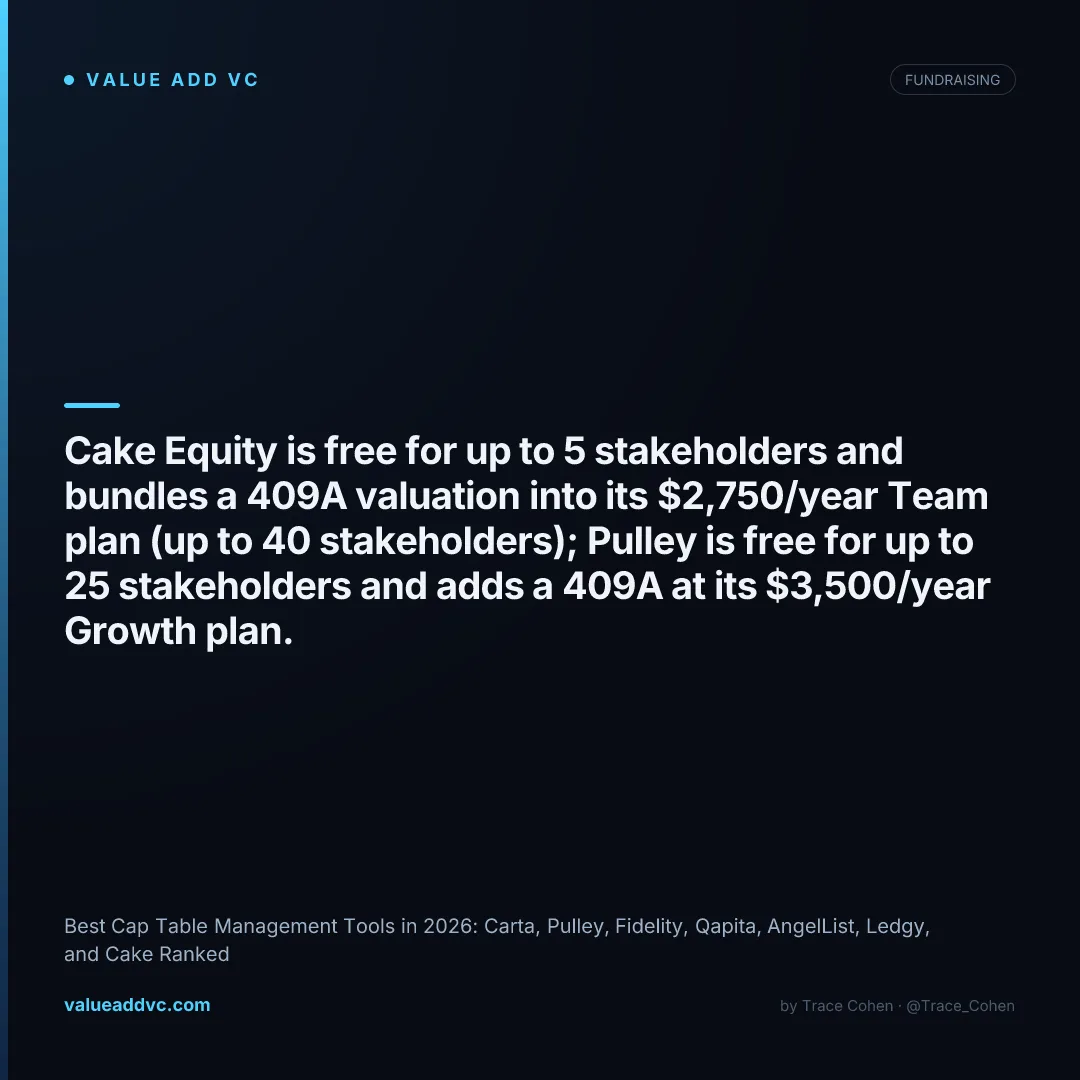
Pulley announced it is shutting down on December 8, 2026 — which settles this comparison for new signups. Cake Equity is the only one of the two still operating, free to 5 stakeholders, with a 409A bundled at $2,750/year.
Cake Equity and Pulley spent 2026 chasing the same customer: a US-based, pre-Series A founder who wants a real cap table without Carta's pricing or complexity. Pulley got there first, backed by Founders Fund since its 2022 Series B, and built its reputation on fast, founder-friendly support. On September 15, 2026, Pulley announced it is winding down, with an exclusive migration partnership sending its customers to Carta. Cake Equity — the newer, leaner challenger that had quietly become the top-rated equity management platform on G2, at 4.8/5 across 135+ reviews — is now the only one of the two founders can actually sign up for. (Cake Equity is a Value Add VC sponsor.) Here's what changed, and what it means if you're already on Pulley.
Pulley is shutting down: what founders need to know
Pulley announced on its own site that it will cease all operations and services on December 8, 2026. The company has entered an exclusive partnership with Carta so Pulley customers can keep access to equity management tools: those who opt into the assisted migration before November 30, 2026 keep their existing Pulley pricing for one year and receive credit for the unused portion of their subscription, according to RuntimeWire. Pulley has said it will not assist migrations to any other provider, and customers retain limited access to their own data through January 31, 2027. Pulley, founded in 2019 by Yin Wu, had raised more than $50 million from Founders Fund, Stripe, General Catalyst, and 8VC, including a $40 million Series B in 2022 at a reported $250 million valuation.
Cake Equity vs Pulley: the side-by-side comparison
| Category | Cake Equity | Pulley |
|---|---|---|
| Operating status | Active | Shutting down Dec 8, 2026; new signups should look elsewhere |
| Free tier | Up to 5 stakeholders | None — retired; paid from $1,200/yr |
| Entry paid tier | $1,000/yr (Build, 25 stakeholders) | $1,200/yr (Startup) |
| 409A-inclusive tier | $2,750/yr (Team, 40 stakeholders) | $3,500/yr (Growth, 40 stakeholders) |
| G2 rating | 4.8/5 (135+ reviews) — #1 in category | Well-reviewed, founder-praised support |
| Market focus | US-based, SAFE through Series A | US-based, pre-seed through Series B |
| Investor default at Series A+ | No — still building brand recognition | Partial — accepted by many, not all, leads |
Sources: published pricing at cakeequity.com and pulley.com, G2 review data, and Pulley's shutdown notice at pulley.com, current as of October 2026.
Annual cost at the 409A-inclusive tier
Cake's 409A-inclusive Team plan runs 21% cheaper than Pulley's comparable Growth tier — now the only one of the two still accepting new customers
Published vendor pricing, verified September 2026; Pulley shutdown notice, October 2026
What Pulley offered before the shutdown: investor familiarity and fundraise modeling
Through most of 2026, Pulley's case rested on ecosystem rather than price — its free Seed plan had already been retired. Pulley had been around longer, was Founders Fund-backed, and was recognised by more Series A leads and their counsel than Cake — not universally, but enough that it was less likely to raise a question in diligence. Its fundraise and dilution modeling was also the stronger of the two for stress-testing a term sheet, and its range extended further up-market, through Series B rather than topping out around Series A. None of that is available to new customers anymore: with Pulley shutting down December 8, 2026, that ecosystem advantage is only relevant to founders already on the platform deciding whether to follow Pulley's Carta migration path or switch to Cake instead.
Where Cake wins now: it's still here, it's cheaper, and it's rated higher
Once you need a 409A — which is most companies within their first year, the moment you grant options or price a round — Cake's $2,750/year Team plan undercuts Pulley's now-discontinued $3,500/year Growth plan by $750, a real number at seed-stage burn rates. Cake also holds the higher aggregate G2 score in the category: 4.8/5 across 135+ reviews, with the #1 ranking in Implementation, Usability, Results, Momentum, and Relationship for Summer 2026. Reviewers consistently cite the clean employee-facing portal and fast support response times as standout strengths — and unlike Pulley, Cake isn't asking anyone to migrate off it.
Cake Equity vs Pulley: the verdict
If you're a founder choosing a cap table platform today, pick Cake Equity — Pulley is no longer accepting the comparison, since it announced it stops operating December 8, 2026. Cake is cheaper at every published tier, the only one of the two with a $0 entry point, and holds G2's top rating in the category (4.8/5, #1 in Implementation and Relationship). If you're already a Pulley customer heading into an institutional priced round in the next 18 months, take the Carta migration offer before November 30, 2026 to lock in matched pricing for a year — that's the path Pulley itself built, and it preserves the fundraise and dilution modeling Series A leads are used to. If you'd rather not end up on Carta and are willing to export and rebuild your cap table yourself, Cake is the alternative. Either way, as with any cap table decision, it's worth a quick check with your lead investor's counsel before you commit if you're heading into a priced round. For the full field of options, see our cap table software ranking, and for the mechanics either platform needs to get right, our cap table playbook.
Latest from the Pulse
Get VC data most people never see
— free to subscribe
Trace's notes on venture, AI and startups, a few times a week. Join 5,000+ subscribers. No spam.
No spam, unsubscribe anytime. Sent via Substack · Privacy · or subscribe on Substack ↗