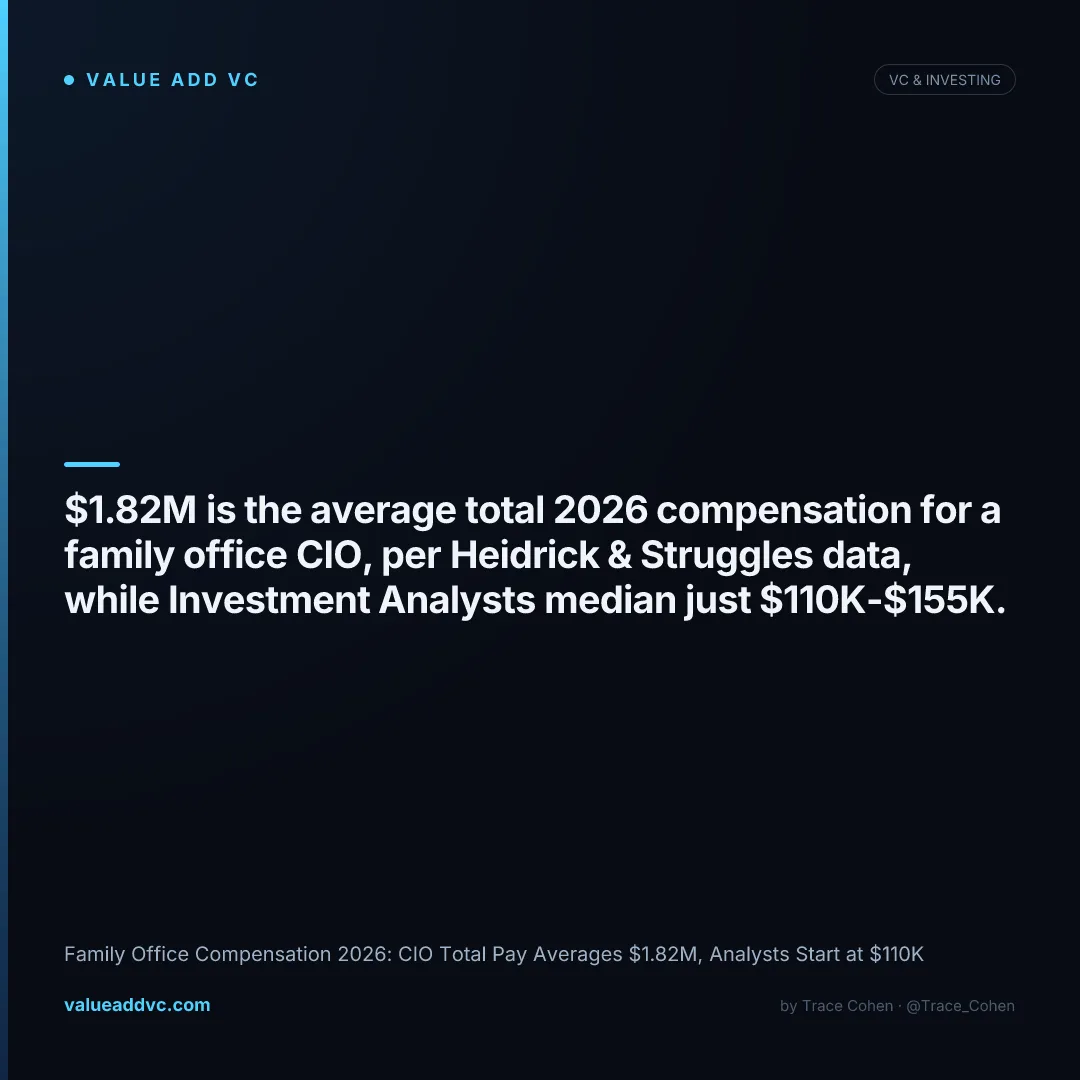
Family office CIOs averaged $1.82M in total 2026 compensation — $864K in base salary plus $958K in bonus — while Investment Analysts at the same firms median just $110K to $155K. That's the short answer. The longer answer is more interesting.
I work with family offices regularly as LPs and co-investors, and the compensation gap inside a single family office is one of the widest in finance. A 25-person single family office can pay its CIO more than $2M while its junior Analyst clears $120K, with almost nothing standardized in between — no public compensation database, no equity research comp surveys, just a handful of private reports that shape how offers actually get made. Here's what those reports show for 2026, role by role.
Family Office Compensation and Salary in 2026: The Numbers by Role
Family office compensation and salary in 2026 range from roughly $110K-$155K in total pay for an Investment Analyst up to $1.82M on average for a Chief Investment Officer, with Chief Executive Officers median around $1.1M. Pay scales sharply with assets under management rather than headcount, since a $2B single family office may run with fewer than ten employees but pay its top two roles more than most 50-person operating companies pay their entire leadership team.
Three surveys anchor most of the market data cited here: Heidrick & Struggles' 2025 Family Offices Compensation Survey, the Morgan Stanley/Botoff Consulting Single Family Office Compensation Report, and the Agreus Group/KPMG Private Enterprise Global Family Office Compensation Benchmark Report, which drew on 605 family office professionals across all levels. All three point to the same trend: comp is rising fastest at the CIO and CEO level, where competition with private equity and hedge funds for talent is most intense.
How Family Office Compensation and Salary Break Down by AUM in 2026
Compensation does not scale linearly with assets under management, but it does rise sharply above certain thresholds. Below $500M in AUM, most family offices pay base plus a discretionary bonus of 25-35% of base, with little to no carried interest. Above $500M, co-investment rights and carried interest become standard, and by $1B+ in AUM, CIO base alone commonly runs $700K to $1.5M with total compensation reaching $2.5M or more once incentive pay is included.
The gap between a small office and a large one is widest at the top of the org chart. A CEO at a $1B+ office earns roughly double the base salary of one at a sub-$250M office, and CIO bonuses at large offices average 75-111% of base, per Heidrick & Struggles data — far above the 10-25% bonus range typical for an Analyst. That widening gap is exactly why the standalone family office population, now estimated above 8,000 and projected toward 11,000 by 2030, is driving such intense recruiting competition for the handful of executives who've run a $1B+ portfolio before.
Family Office Compensation and Salary in 2026: CIO vs CEO vs Analyst
The table below compares base pay, bonus structure, and total compensation across the roles most single family offices actually hire for, from entry-level Analyst up through CIO.
| Role | Base Salary Range | Bonus | Total Comp (Median/Avg) |
|---|---|---|---|
| Investment Analyst | $90K-$130K | 10-25% of base | $110K-$155K |
| Family Office Chief of Staff | $175K-$200K | Varies by AUM/scope | $190K-$300K+ |
| Controller (Financial Reporting) | $260K-$380K | 10-20% of base | $310K-$420K |
| Portfolio Manager / Investment Director | $200K-$425K | 50-125% of base | $300K-$950K |
| Chief Financial Officer | $200K-$700K+ | Varies; higher at $1B+ AUM | $620K median |
| Chief Executive Officer | $700K-$1.5M (at $1B+ AUM) | 25% of total comp typical | $1.1M median |
| Chief Investment Officer | $425K median; $700K-$1.5M at $1B+ AUM | 75-111% of base | $1.82M average |
Figures are 2026 estimates blended from Heidrick & Struggles' 2025 Family Offices Compensation Survey, the Morgan Stanley/Botoff Consulting Single Family Office Compensation Report, GoGravity's Family Office CFO Salary Guide, and Resonance Search's Family Office Chief of Staff Salary Guide. Ranges reflect national medians before location premiums.
Carried Interest, Co-Investment, and Long-Term Incentives
The 2026 comp story isn't just base and bonus — it's how family offices are restructuring long-term incentives to retain senior talent. For the first time since 2015, co-investment opportunity (offered at 57% of firms) overtook deferred incentive compensation (56%) as the most prevalent long-term pay structure, per the Morgan Stanley/Botoff report. Use of incentive compensation broadly remains strong: 90% of firms report employees are eligible for an annual incentive or bonus plan, and 62% now use a formal long-term incentive vehicle.
Carried interest specifically applies to 45-50% of CIOs, mirroring venture and private equity structures more closely than a traditional wealth management pay stub. That shift matters for anyone benchmarking VC fund performance against family office LP behavior — the same professionals negotiating carry inside a family office are often the ones sitting on the other side of the table evaluating GP economics when that office allocates to a fund.
Location Premiums and Signing Bonuses
Geography moves family office comp more than most candidates expect. New York carries a roughly 40% premium over the national baseline, and San Francisco carries about 30%, applying across both Controller and Investment Analyst roles per Botoff's 2025 data. At the executive level, signing bonuses of $100K to $200K occur in roughly 70% of CEO placements, reflecting how competitive the market has become for proven operators.
Why Family Office Pay Structures Look So Different From a Hedge Fund or PE Firm
Anyone moving from a traditional asset manager into a family office needs to reset their expectations on how pay is built, not just how much of it there is. A hedge fund or PE firm pays out of a management fee and carry pool with relatively standardized formulas across the industry. A family office pays out of the principal's balance sheet directly, which means comp committees are effectively one person — the principal or a small family council — deciding case by case what a role is worth. That's part of why the range on almost every role above is so wide: a $2B single family office run by a founder who wants aggressive direct investing will pay its CIO closer to the $2.5M+ ceiling, while a $2B multi-generational office focused on capital preservation may pay the same title closer to $900K with a much smaller bonus swing.
The other structural difference is tenure. Family office roles, especially CIO and CEO, tend to have far longer average tenures than comparable hedge fund or PE seats — often five to ten years versus two to four — because the job is built around a single principal's trust rather than a fund cycle. That longer horizon is part of why co-investment rights and carried interest, not just cash bonus, have become the dominant retention tools: a principal wants their CIO thinking in five-year increments, and equity-like upside does that better than an annual bonus ever could.
What This Means for Anyone Recruiting Into or Out of a Family Office
If you're a founder or fund manager courting family office capital, understanding this pay structure matters — the CIO evaluating your deck is often personally incentivized through co-investment or carry to find deals that outperform, not just to allocate passively. And if you're a candidate weighing a move from private equity or a hedge fund into a family office, the 2026 data says the pay gap that used to exist has largely closed at the CIO and CEO level, even if the brand recognition and exit optionality remain different.
For LPs and allocators tracking how family office capital moves relative to institutional LPs, our Fund Benchmarking dashboard tracks performance data these same CIOs use to underwrite manager selection decisions.
How to Negotiate Family Office Compensation in 2026
For candidates evaluating an offer, the 2026 data suggests three specific negotiating levers beyond base salary. First, push for a defined bonus formula rather than a purely discretionary one — with CIO bonuses averaging 75-111% of base at large offices, a vague "we'll take care of you" promise can cost hundreds of thousands of dollars a year if the office underperforms its own informal expectations. Second, ask directly whether co-investment rights are available below the CIO level; the Botoff data shows 57% of offices now offer co-investment, but availability skews heavily toward senior roles unless a candidate asks. Third, treat the AUM threshold as real: comp negotiated below $500M in assets rarely includes carry, so a candidate joining a growing office should negotiate a contractual step-up clause tied to AUM growth rather than relying on a future renegotiation.
For principals building out a team, the practical takeaway is the opposite: budgeting a flat percentage of AUM for total compensation, the way many funds model management fees, breaks down once an office holds significant direct investments or operating businesses, since those roles require compensation benchmarked against operating companies and PE portfolio roles, not against a passive investment mandate.
$1.82M average CIO total comp. $1.1M median CEO pay. $110K-$155K for the Analyst three desks over.
Family office compensation in 2026 is a barbell, and the barbell is getting heavier at both ends.
With more than 8,000 standalone family offices now competing for a small pool of proven CIOs and CEOs, expect senior compensation to keep climbing faster than junior comp through 2026 and into 2027 — and expect co-investment and carry, not base salary, to be where the real negotiating happens.
Track fund and LP performance data on the VC Performance Dashboard and Fund Benchmarking tool at Value Add VC. Originally published in the Trace Cohen newsletter.
Latest from the Pulse
Get VC data most people never see
— free to subscribe
Trace's notes on venture, AI and startups, a few times a week. Join 5,000+ subscribers. No spam.