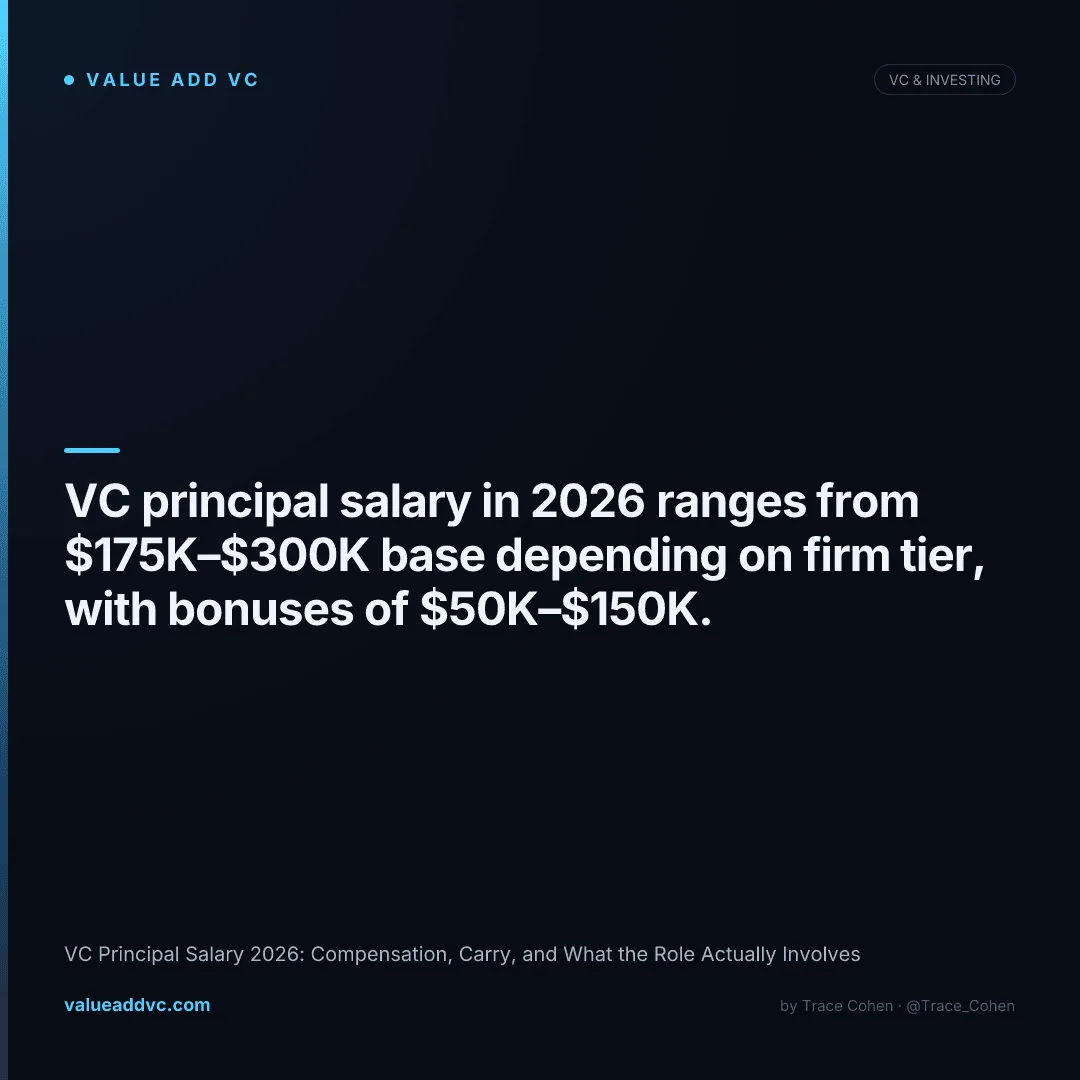
VC principal salary in 2026 starts at $130K at emerging managers and reaches $300K+ at the largest funds — but the real economics of the role are about carry, not base pay.
The principal role is the most misunderstood level in venture capital. It sits above associate and below partner, carries real deal ownership, and often comes with the expectation of generating a sourcing track record. The comp structure reflects that burden: competitive enough to attract operators and former founders, but deliberately loaded toward long-vesting carry to keep principals aligned with fund performance for a decade.
VC Principal Salary by Firm Tier (2026)
Compensation varies significantly by fund size and AUM. The tiers below reflect observable market data from recruiter surveys, Levels.fyi compensation data, and operator-to-VC transition packages disclosed in community forums.
| Firm Tier | AUM Range | Base Salary | Annual Bonus | Carry Points |
|---|---|---|---|---|
| Tier 1 (a16z, Sequoia, GC, Accel) | $5B+ | $250K–$300K | $75K–$150K | 0.5–1.0 pts |
| Tier 2 (Bessemer, IVP, NEA, Insight) | $1B–$5B | $200K–$250K | $50K–$100K | 0.35–0.75 pts |
| Mid-Market | $300M–$1B | $175K–$220K | $40K–$75K | 0.25–0.5 pts |
| Emerging Manager | $50M–$300M | $130K–$175K | $15K–$40K | 0.25–0.75 pts |
Note: Emerging manager carry points are higher as a percentage because the total carried interest pool is smaller. A 0.5-point allocation on a $100M fund with 20% carry yields a theoretical max of $100K on a 2x fund — a fraction of a Tier 1 allocation on the same points.
The Real Economics: How Carry Works for Principals
Carry at the principal level is real but requires patience. Here is a concrete example of what 0.5 carry points looks like across different fund scenarios, assuming a standard 20% carry structure with an 8% preferred return hurdle.
The math only works if you stay. Most LPAs include clawback provisions and 10-year vesting schedules tied to fund lifecycle, not employment date. A principal who leaves after year 4 forfeits the majority of their carry allocation. This structure is intentional — it aligns long-term interests but creates golden handcuffs that make it expensive to leave a fund that is performing poorly.
At funds over $1B with a genuine shot at 3x+ returns, the carry math starts to rival what senior operators earn at late-stage startups. Below $500M AUM at modest multiples, the carry economics rarely justify the base salary discount versus an operator role.
What the VC Principal Role Actually Involves
The principal title means different things at different funds. At some firms it is a senior associate with more autonomy; at others it is a quasi-partner with full deal ownership. These distinctions matter enormously for both comp and career trajectory.
Deal Sourcing
Expected to generate proprietary deal flow, not just process inbound. Track record here is the primary evaluation criterion for the partner track.
Diligence Ownership
Leads investment memos, manages reference calls, coordinates with legal and finance. Partners review and approve but principals run the process.
Portfolio Engagement
Joins boards as observer or director, works with portfolio companies on hiring, fundraising, and strategy. Time allocation varies by firm.
LP Interaction
At most firms, principals participate in LP meetings and annual reviews by year 2–3. This is the proving ground for the partner promotion case.
Fund Strategy
Senior principals contribute to thesis development, sector coverage, and fund strategy work — the activities that build the internal case for partnership.
Internal Mentorship
Manages analysts and associates, owns onboarding for junior team members, and represents the middle layer of institutional knowledge.
Principal vs. Partner: Where the Comp Gap Opens Up
The gap between principal and partner compensation is larger than most people outside the industry understand. At a Tier 1 fund, a newly promoted partner typically earns 2–3x more in total economics than a senior principal — primarily driven by carry allocation jumping from ~0.5 to 2–5 points per fund.
| Level | Base (Tier 1) | Carry Points | Expected Carry ($1B Fund, 2.5x) |
|---|---|---|---|
| Analyst | $130K–$160K | 0–0.1 pts | ~$0–$50K |
| Associate | $150K–$200K | 0.1–0.2 pts | ~$75K–$150K |
| Principal | $250K–$300K | 0.5–1.0 pts | ~$375K–$750K |
| Partner | $300K–$500K | 2.0–5.0 pts | ~$1.5M–$3.75M |
| General Partner | $400K–$1M+ | 5.0–15.0+ pts | ~$3.75M–$11M+ |
Expected carry assumes $1B fund at 2.5x net return, 20% carry rate, 8% preferred return cleared. Carry is split across all fund vintages a person has participated in, so actual distributions depend on when they joined.
The Path From Principal to Partner
Most VC principals do not become partners at the same firm. The bottleneck is structural — the number of partner slots is finite and existing partners stay for decades. The realistic outcomes for principals, ranked by frequency:
- Exit to Operating Role: 40–50% of principals leave for VP/C-suite roles at portfolio companies or adjacent startups. The network built as a principal often opens these doors.
- Launch Own Fund: 25–30% eventually raise their own fund — typically a $15M–$75M emerging manager vehicle using the track record built at the host firm.
- Promoted to Partner: 15–25% are promoted internally, typically after 4–6 years and at least one notable portfolio win that validates their sourcing judgment.
- Lateral to Another Fund: 10–15% move to a different fund at the principal or partner level, sometimes leveraging a hot deal or sector expertise to negotiate a better carry package.
Should You Take a Principal Role?
The right candidate for a VC principal role is someone who has a credible sourcing angle — a sector thesis, a founder network, or a technical edge — and who genuinely wants to invest for a decade, not just use VC as a credential to go back to operating. The comp is competitive but not exceptional at most fund sizes. The real asymmetry is carry at large, top-performing funds.
Take the Role If...
- ✓ Fund AUM is $500M+ with a track record of returning capital
- ✓ You have a genuine sourcing advantage (network, sector, geography)
- ✓ Partner track is explicitly on the table within 4 years
- ✓ Carry terms include a meaningful allocation with fair vesting
Think Twice If...
- ✕ AUM is under $100M and carry economics don't pencil
- ✕ The fund is on Fund I or Fund II with no DPI
- ✕ Partner track is vague or existing partners are all 40s
- ✕ You're taking a $50K+ base salary cut vs. your operator role
The VC principal title is not a destination.
It is a 4–6 year bet that your sourcing judgment is worth a partnership — and that this specific fund will return capital before you need liquidity.
Explore fund performance benchmarks and manager data on the VC Performance Dashboard and Fund Tracker at Value Add VC. Originally published in the Trace Cohen newsletter.
Latest from the Pulse
Get VC data most people never see
— free to subscribe
Trace's notes on venture, AI and startups, a few times a week. Join 5,000+ subscribers. No spam.