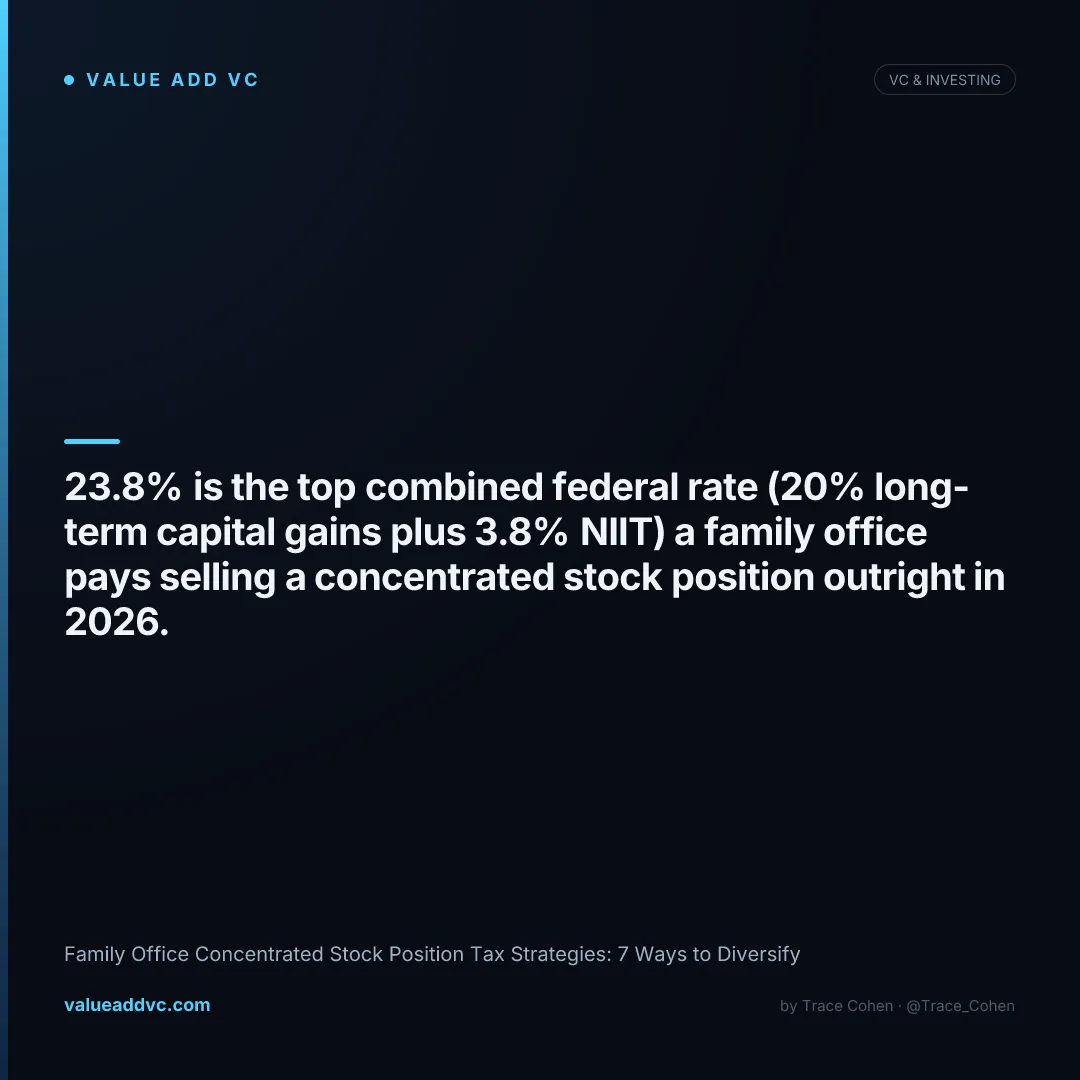
23.8% is the top combined federal rate a family office pays selling a concentrated stock position outright in 2026 — 20% long-term capital gains plus the 3.8% Net Investment Income Tax. In practice, almost no family office holding a $10M+ single-stock position actually sells it that way.
Founders and early operators often sit on huge embedded gains for years after a liquidity event, frozen by the math: sell everything and hand nearly a quarter of it to the IRS in one year, or keep riding a position that's now 50-70% of their net worth. Most single-family offices solve this with a toolkit that's more sophisticated than "sell some each year" — exchange funds, options collars, charitable trusts, and direct indexing — each trading off tax deferral, cost, and how much control the family keeps.
Figures are 2026 estimates blended from the IRS, Kiplinger, Cresset Capital, Kitces, and Fidelity's 2026 concentrated-stock guidance. Combined rate excludes state income tax, which adds materially in non-zero-tax states.
How Family Offices Manage Concentrated Stock Positions Without Triggering a Tax Bill
Family offices manage concentrated stock primarily through Section 721 exchange funds, which let an investor contribute shares into a pooled diversified vehicle with no capital gains recognized at the time of contribution. Other core tools include zero-cost collars for downside protection without a sale, charitable remainder trusts that convert a gain into a lifetime income stream while donating the eventual remainder, and 10b5-1 systematic selling plans that spread realized gains — and the resulting tax bill — across multiple tax years instead of one.
None of these fully eliminates the tax; exchange funds and installment sales defer it, collars and direct indexing manage risk around it, and only outright gifting or a step-up in basis at death removes it entirely. The right mix depends on the position's size, the family's liquidity needs, and how many more years the family wants exposure to the single name at all.
7 Concentrated Stock Position Strategies Family Offices Actually Use
Here's the toolkit in the order most single-family offices reach for it, from lowest-friction to most structurally complex.
| Strategy | Tax Effect | Typical Cost / Lock-Up |
|---|---|---|
| 10b5-1 systematic sale plan | Spreads gains across tax years, no deferral | Brokerage fees only, no lock-up |
| Zero-cost collar | No tax effect, hedges price risk only | ~0% net premium, 1-3 year terms |
| Exchange fund (Section 721) | Fully defers gain until redemption | 7-year lock-up, 1%+ annual fee, $1M-$2M minimum per position |
| Charitable remainder trust (CRT) | No capital gains on contribution, income stream taxed as received | Irrevocable, remainder goes to charity |
| Direct indexing / tax-loss harvesting SMA | Harvested losses offset gains from partial sales | 0.10%-0.35% annual fee, no lock-up |
| Variable prepaid forward contract | Defers gain recognition, monetizes ~75-90% of value now | 2-4 year terms, dealer markup embedded |
| QSBS exclusion (if eligible) | Excludes up to $10M or 10x basis, per Section 1202 | 5-year hold, C-corp original issuance only |
Figures are 2026 estimates blended from Kitces, Cresset Capital, Fidelity, and Darrow Wealth Management's concentrated stock guidance. Fee ranges and lock-up terms vary by provider and position size.
What a Concentrated Position Actually Costs If You Just Sell It
For 2026, the IRS taxes long-term capital gains at 0% up to $48,350 in taxable income for single filers ($96,700 married filing jointly), 15% from there up to $533,400 single ($600,050 MFJ), and 20% above those thresholds. The 3.8% Net Investment Income Tax stacks on top once modified adjusted gross income clears $200,000 single or $250,000 married — thresholds that, unlike the capital gains brackets, are not indexed for inflation, so more concentrated-stock sellers cross them every year by default.
Run the math on a real position: a family office selling $10M of a single stock with a near-zero cost basis owes roughly $2M in federal capital gains tax plus $380,000 in NIIT — $2.38M gone in the year of sale, before any state tax. That single-year hit is exactly what pushes families toward exchange funds and collars instead of a lump-sum liquidation.
How Exchange Funds Work for a Family Office With Concentrated Stock
An exchange fund pools concentrated stock from many contributors — often dozens of families each bringing a different single-name position — into one vehicle structured under IRC Section 721, the same partnership-contribution provision that lets real estate investors defer gains into an operating partnership. Because no shares change hands for cash, no gain is recognized at contribution, and the family's basis simply carries over into their new fund units.
The catch is the IRS-mandated 7-year holding period: redeem before then and the family loses the tax-deferral benefit and may face redemption fees, while redeeming after year seven delivers a diversified basket of securities at the original carryover basis — deferred, not eliminated, since selling the new basket still triggers the original gain. Minimums typically run $1M-$2M per contributed position, funds are open only to Qualified Purchasers with $5M+ in investable assets, and annual management fees commonly exceed 1%, which is real drag against a public-market index alternative.
Zero-Cost Collars and Prepaid Forwards: Hedging Without Selling
A zero-cost collar buys a protective put — the right to sell at a floor price — and funds it by simultaneously selling a call option that caps the family's upside above a ceiling price, so the two premiums roughly offset and the hedge costs close to nothing upfront. It changes nothing about the tax bill since the shares are never sold, but it locks in a trading range while the family executes a longer diversification plan through a 10b5-1 schedule or an exchange fund contribution.
Variable prepaid forward contracts go a step further, letting a family monetize roughly 75-90% of a position's current value in cash today while deferring gain recognition until physical delivery of shares at contract maturity, typically 2-4 years out. Wall Street desks at firms like Goldman Sachs and Morgan Stanley run these for family offices holding $25M+ positions, and the embedded dealer markup is the price of getting liquidity now without a taxable event today.
When Family Offices Use Charitable Structures Instead
For families with philanthropic intent, a charitable remainder trust (CRT) accepts a gift of concentrated stock, sells it inside the trust without triggering capital gains tax at the trust level, and pays the family an income stream — often 5-7% annually — for a term of years or the family's lifetime, with the remainder passing to a designated charity. It's irrevocable and the assets ultimately leave the family, which makes it a fit only when philanthropy is already part of the plan, not a pure tax-deferral play.
A donor-advised fund (DAF) works similarly for a partial, one-time contribution — the family gets an immediate charitable deduction at fair market value and avoids capital gains on the donated shares, while retaining advisory input on which charities eventually receive the funds. Many single-family offices layer a DAF contribution in the same tax year as a large 10b5-1 sale specifically to offset the ordinary and capital gains impact of that year's liquidity event.
Concentrated Stock Strategy: How to Choose the Right Structure
Position size and time horizon drive the decision more than anything else. Under $5M, most families are better off with a straightforward 10b5-1 systematic sale plus tax-loss harvesting elsewhere in the portfolio, because exchange fund minimums and CRT setup costs eat too much of the benefit at that scale. From $5M to $25M, exchange funds and collars start to pencil out, and above $25M, family offices typically run a blended strategy — a collar for near-term protection, a partial exchange fund contribution for core diversification, and a CRT or DAF slice for the philanthropically inclined portion of the family.
Founders and executives sitting on concentrated stock from a startup exit should also check QSBS eligibility before assuming they need any of these hedging structures at all — a qualifying Section 1202 position can exclude up to $10M or 10x basis from federal tax entirely, which changes the math on everything above it. Track fund-level performance benchmarks that inform diversification targets on our VC Performance dashboard.
A $10M outright sale owes $2.38M in federal tax the same year. A 7-year exchange fund contribution owes $0 until redemption.
The families that keep the most wealth aren't avoiding tax — they're choosing which year to pay it.
The Bottom Line
Concentrated stock is the most common wealth-management problem founders and early operators face after an exit, and the mistake is almost always inaction — riding a 50%+ single-name position for years because selling feels like handing 23.8% straight to the IRS. It doesn't have to be that binary. Exchange funds, collars, CRTs, and systematic 10b5-1 plans each solve a different piece of the problem, and most single-family offices run two or three of them at once against the same position.
If you're building the underlying wealth in the first place, see how family offices compare to RIAs and what it takes to set one up, or check whether your original equity qualifies for the QSBS exclusion before you hedge a position that might not need hedging at all.
Follow VC and family office market data on Value Add VC. Reach out at t@nyvp.com or @Trace_Cohen.
Latest from the Pulse
Get VC data most people never see
— free to subscribe
Trace's notes on venture, AI and startups, a few times a week. Join 5,000+ subscribers. No spam.