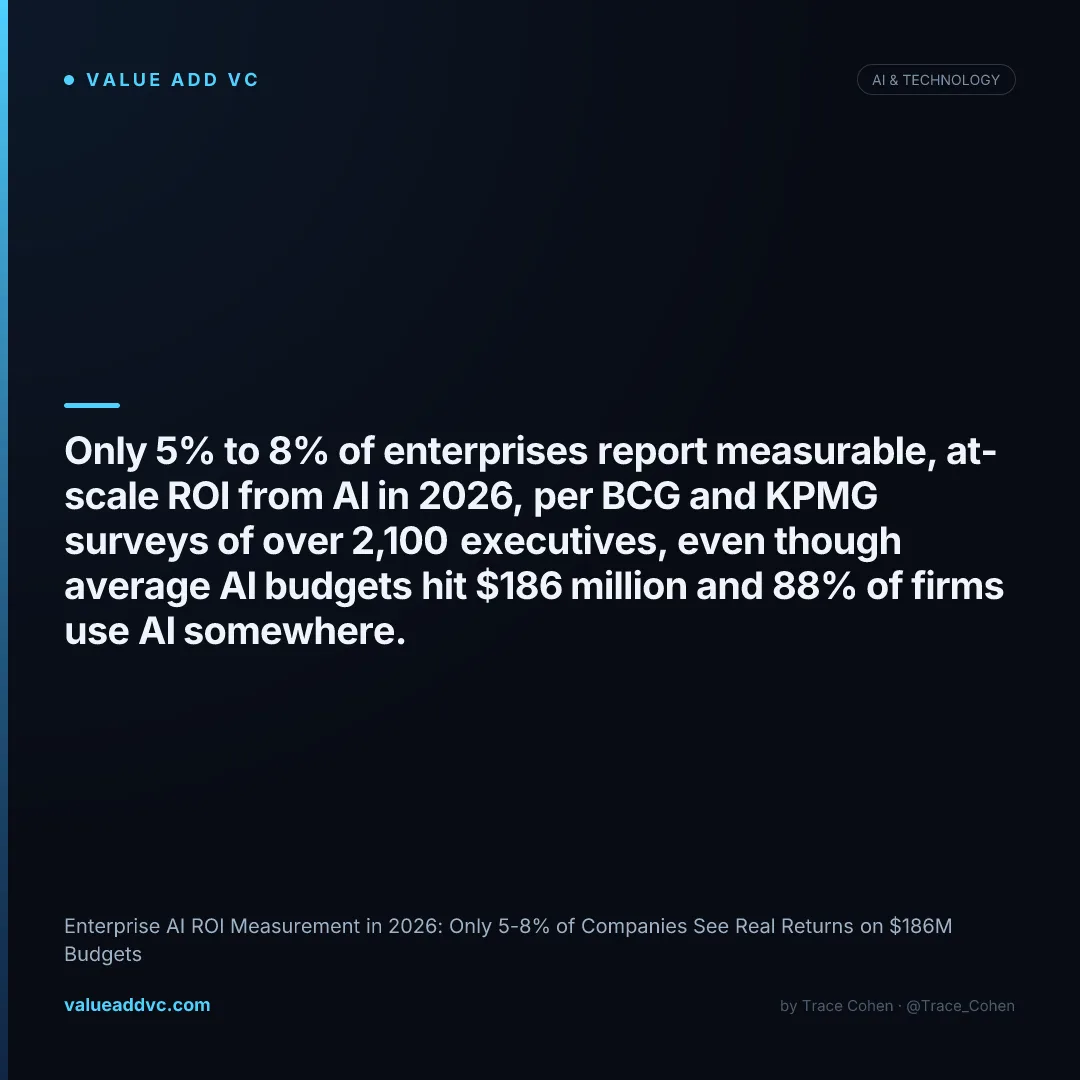
Only 5% to 8% of enterprises report measurable, at-scale ROI from AI in 2026, even though the average company now spends $186 million a year on it. That is the central finding across four independent 2026 surveys, and it is the single most important number for anyone deciding where to put the next AI dollar.
The gap is not subtle. Adoption is nearly universal — 88% of organizations use AI in at least one business function, according to McKinsey — but realized financial return sits in the single digits almost everywhere researchers have measured it independently. That combination, near-total adoption paired with near-total ROI failure, is why "AI ROI measurement" has become the defining CFO conversation of 2026, replacing "AI strategy" as the question boards actually ask.
Figures from BCG's 2026 AI Radar survey, KPMG's Global AI Pulse Q1 2026 survey of 2,110 C-suite leaders across 20 countries, MIT NANDA's "State of AI in Business" research (2025-2026), and McKinsey's 2026 State of AI survey.
Enterprise AI ROI Measurement in 2026: What the Data Actually Shows
Enterprise AI ROI measurement in 2026 shows a consistent pattern across independent surveys: somewhere between 5% and 8% of companies report measurable, at-scale financial return from AI, while 88% of companies report using AI in at least one function. IBM's CEO study puts a broader "delivering expected ROI" figure at 25%, but even there, 56% of CEOs admit zero significant financial benefit has materialized. The spread between adoption and realized value is the largest gap tracked in enterprise technology since the early cloud-migration era.
The most cited data point comes from MIT's NANDA initiative, whose "State of AI in Business" research — built on 300 public AI deployments, 150 leadership interviews, and a 350-person employee survey — found that 95% of generative AI pilots deliver zero measurable P&L impact. MIT also found 42% of companies abandoned most of their AI projects in 2025 outright, rather than continuing to iterate on them.
The 95% Problem: Why Almost No Pilot Moves the P&L
MIT's researchers were explicit that the failure rate is not a model-quality problem. Executives tend to blame regulation or model performance, but the report points to a "learning gap" in enterprise integration: generic tools like ChatGPT are flexible enough to help individuals immediately, but they stall inside companies because they don't learn from or adapt to a specific workflow the way a purpose-built internal tool would. That distinction — a tool that helps one employee versus a system embedded in a process — is the line between the 95% that fail and the 5% that don't.
Budget allocation compounds the problem. MIT found more than 50% of generative AI budgets are devoted to sales and marketing tools, the highest-visibility, easiest-to-approve use case internally. But the same research found the biggest realized ROI sits in back-office automation — eliminating business-process-outsourcing contracts, cutting external agency spend, and streamlining finance and operations workflows that are boring to demo but have a hard dollar baseline to measure against. It's the same labor-arbitrage math reshaping the offshore BPO industry, just running inside a single company's four walls instead of across a vendor contract. Only 7% of leaders in KPMG's survey report having established ROI from AI at all, versus 24% who say they're under active investor pressure to demonstrate it — a gap that is only growing more uncomfortable as 2026 boards start asking harder questions.
Where the Money Actually Shows Up: Klarna, Salesforce, and the Narrow-Use-Case Pattern
The companies in the 5-8% that do report real ROI share a pattern: narrow, high-volume, well-instrumented use cases with a clean before/after cost baseline, almost always in customer service. Klarna's AI customer-service assistant handled 80% of chats and contributed $39 million in savings in 2024 alone, per the company's own disclosures, reaching roughly $60 million in cumulative savings by Q3 2025 while cutting average resolution time from 12 minutes to under 2 and reducing repeat inquiries by 25%.
Salesforce's own internal Agentforce deployment now handles roughly 32,000 customer conversations per week at an 83% resolution rate, with escalations to a human cut in half and only 1% of interactions requiring one. Customers report similar results: OpenTable resolves about 70% of inquiries autonomously, and 1-800Accountant hit a 90% case-deflection rate during peak tax week. Industry-wide, organizations running agentic AI deployments report average returns around 171%, with U.S. enterprises hitting roughly 192% — and 70% of companies using AI agents say they saw measurable value within 60 days, a sharp contrast with the 95% pilot-failure rate for broader, unscoped generative AI rollouts.
The unit economics explain why customer service is where ROI concentrates first: a human agent handling a routine query costs an enterprise roughly $20 to $25 fully loaded, while an AI agent handling the same query costs approximately $0.50 to $0.70 — a 30x to 40x cost gap that's trivial to measure against a baseline. That is a fundamentally different exercise than trying to quantify the ROI of a general-purpose copilot rolled out to 10,000 knowledge workers with no defined success metric, which is exactly the pattern behind most of the 95% that MIT found failing.
Cost to Resolve a Routine Support Query: Human vs AI Agent
Industry cost benchmarks compiled from AI agent deployment case studies (Klarna, Salesforce Agentforce, 1-800Accountant), 2025-2026
Enterprise AI ROI by Function: Where Budget Goes vs Where Returns Actually Land
The mismatch between AI budget allocation and realized ROI is the clearest structural finding in the 2026 data. The table below blends MIT NANDA's function-level findings with McKinsey's State of AI adoption data to show where enterprises are spending versus where the return has actually materialized.
| Function | Share of AI Budget | Adoption Rate | Realized ROI Signal |
|---|---|---|---|
| Sales & marketing | ~50%+ | 50%+ of enterprises | Low — hardest to attribute to revenue |
| Customer service | ~15% | High, concentrated in large enterprises | High — Klarna, Agentforce, 1-800Accountant |
| Finance & corporate strategy | ~10% | Growing steadily | Moderate-high — revenue gains reported by ~70% of adopters |
| Operations & supply chain | ~10% | 45%+ of enterprises | High — best cost-reduction ROI of any function per MIT |
| Back-office / BPO replacement | <10% | Low but rising fast | Highest — MIT's top-ranked ROI category, most underfunded |
| HR & internal knowledge tools | ~5% | Moderate | Low — mostly unscoped copilots, hard to measure |
2026 estimates blended from MIT NANDA's "State of AI in Business" function-level findings, McKinsey's State of AI adoption survey, and BCG's AI Radar. Budget-share and adoption figures are directional; ROI signal reflects qualitative strength of evidence across sources, not a single precise percentage.
A Framework for Getting Into the 5-8%
The pattern across every 2026 study points to the same three-part fix. First, pick a use case with a clean, pre-existing cost baseline — customer service, claims processing, back-office reconciliation — rather than a general productivity copilot with no defined unit economics. Second, measure against that baseline from day one rather than retrofitting an ROI story after a broad rollout; MIT's 42% abandonment rate is largely a function of companies discovering, a year in, that they never had a way to measure success. Third, resource the "boring" categories: back-office automation and operations are where MIT found the strongest ROI signal, yet they receive under 10% combined of most enterprise AI budgets, while sales and marketing tools soak up more than half of spend for comparatively unclear return. The supply chain deployments that have actually won CFO budget approval follow the same clean-baseline logic — they're measured against a known cost line, not a vague productivity promise.
For investors, the 94%-keep-investing-anyway figure from McKinsey is the more important signal than the 5-8% ROI number itself: it means capital allocation toward AI infrastructure and tooling isn't going to slow down even as ROI proof lags, which keeps demand strong for the picks-and-shovels layer of the market. That's also the strongest argument for why 2026 hasn't produced an AI capex pullback despite the ROI data — boards are betting that being late to a working use case is more expensive than funding a few more failed pilots, and only 6% of executives say they'd actually cut spending even if this year's initiatives underdeliver. Track how that capital flow is showing up in valuations on our AI valuations dashboard, and see how it's flowing through the largest AI spenders' balance sheets on our Big Tech Earnings Tracker.
Bottom line: Enterprise AI ROI measurement in 2026 is not an adoption problem — it's a scoping problem. 88% of companies use AI somewhere, average budgets have reached $186 million, and 94% of executives plan to keep spending regardless of near-term returns. But only 5% to 8% can point to measurable, at-scale financial return, and MIT's research suggests that gap is structural: money is flowing to visible, easy-to-approve use cases like sales and marketing copilots, while the actual ROI sits in narrower, less glamorous categories — customer service, back-office automation, and operations — where a cost baseline already exists and a $20 human interaction can be measured directly against a $0.60 AI one. Until budget allocation catches up to where the evidence says returns actually live, the 92% will keep funding pilots that never move the P&L.
Latest from the Pulse
Get VC data most people never see
— free to subscribe
Trace's notes on venture, AI and startups, a few times a week. Join 5,000+ subscribers. No spam.